Hokkaido Couple Campervan Guide: Best Vehicles, Romantic Spots & Costs [2026]
The complete guide to a Hokkaido campervan trip for couples.
Pick a campervan by what matters to you.
Rent at New Chitose Airport
See only the rental bases in Chitose, where the airport is.
Rent in winter (Dec–Mar)
Companies that rent through winter, listed apart from those that close.
Guide price
Moving Inn New Chitose Airport: HIACE van conversion from ¥22,000 per night. 20–30% off when booked 60–90 days ahead (official rate table, checked 15 Oct 2026).
New Chitose Airport map for campervan travellers →
Before you book: with an International Driving Permit if your country is in the Geneva Convention (for example the US, Australia, Singapore); Taiwan, Switzerland, Germany, France, Belgium and Monaco need your licence plus a Japanese translation (Tokyo Metropolitan Police). Questions in English: Moving Inn on WhatsApp. Every roadside station (michi-no-eki) must have free 24-hour toilets, and Hokkaido has 128 of them (MLIT).
Last updated: June 25, 2026
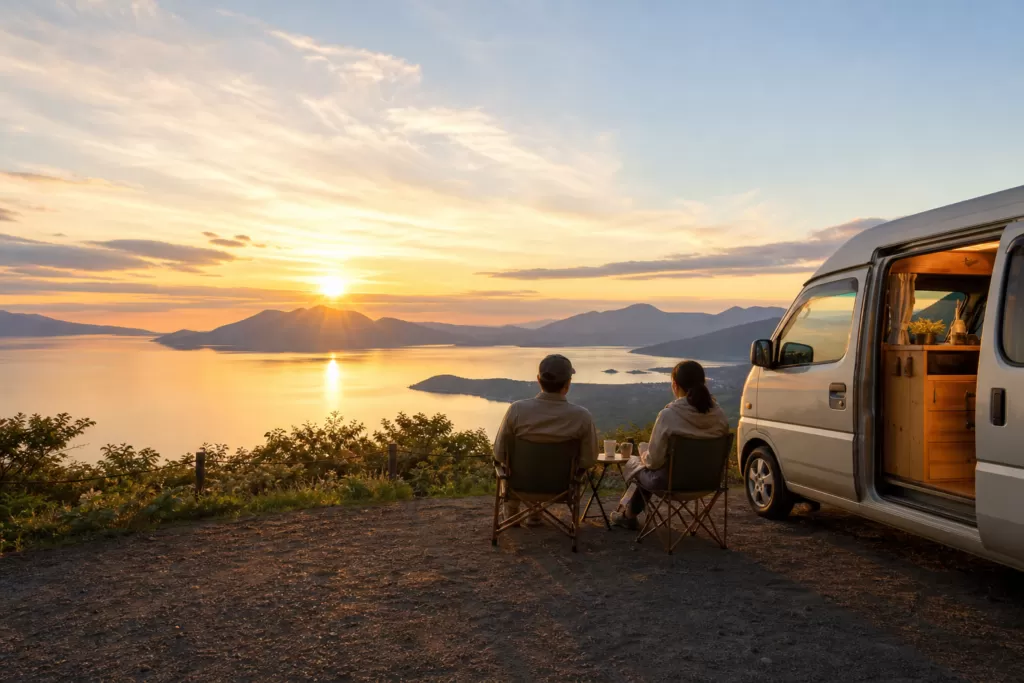
For couples who want privacy and freedom — away from hotel lobbies and crowded check-in desks — a campervan road trip through Hokkaido is an ideal match. If you’ve ever wanted to wake up under a sky full of stars, a rental campervan makes that possible.
For a couple, you don’t need a large vehicle built for families. A compact, easy-to-drive campervan gives you your own private space that travels with you, while keeping fuel costs and rental fees manageable. This guide covers vehicle selection, realistic costs, scenic overnight spots, and how to make the most of a two-person Hokkaido campervan trip.
Why Campervans Work So Well for Couples
Campervans are often associated with families or large groups — but in practice, they’re especially well suited for two people.
Set Your Own Schedule
Hotels lock you into check-in and check-out times. If you want to linger at a beautiful spot in the evening, you’re still tied to “we have to get to tonight’s hotel.” With a campervan, that constraint disappears. Want to wait for the fog to lift over Lake Mashu? Stay until sunset in the lavender fields of Biei? It’s entirely up to the two of you.
Your Private Space Moves With You
Shared spaces in ryokan and hotels mean other guests are always nearby. Inside a campervan, it’s just the two of you. Morning coffee with a view, undisturbed. Evening drinks under the stars. That intimacy is built into the mode of travel itself.
Perfectly Matched to Hokkaido’s Scale
Hokkaido is Japan’s largest prefecture, and major attractions are spread far apart. Driving from Hakodate to Shiretoko means multiple hotel changes along the way. In a campervan, your accommodation moves with you — no unpacking and repacking, no matter how long the route.
Extraordinary Memories Are Easier to Make
Travel memories stick when something unusual happens. “Remember that incredible starry sky?” “A deer was right outside when we woke up in the fog.” Those moments happen more naturally on a campervan trip than in a hotel. Sleeping in special places creates a different kind of travel story.
Even “Failures” Become Good Stories
Campervan trips invite more unexpected moments than hotel stays. Can’t find a parking spot. Rain keeps you inside. Something smoky happens in the kitchen. But those are exactly the scenes that become funny stories later. Solving problems together makes the trip feel like a shared project — and packs more memories into each day.
Cost Breakdown for Two (Per-Night Split)
Campervans have a reputation for being expensive — but split between two people, the per-person cost drops significantly. Here’s what the numbers actually look like.
Rental Price Ranges (2026)
Campervan rental rates in Hokkaido vary by vehicle type. Here’s a reference range for popular categories:
| Vehicle Type | Nightly Rate | Per Person (÷2) |
|---|---|---|
| Vancon (HiAce-based) | ¥15,000–¥25,000 | ¥7,500–¥12,500 |
| Cabcon (compact) | ¥20,000–¥35,000 | ¥10,000–¥17,500 |
| Cabcon (large) | ¥35,000–¥50,000 | ¥17,500–¥25,000 |
In the vancon category, splitting the cost brings the per-person nightly rate close to ¥10,000 — comparable to a budget hotel room in a Hokkaido tourist area. Factor in self-catering some meals, and the overall trip cost can come out lower than a hotel-based itinerary.
Sample Budget: 5 Nights / 6 Days (Vancon, Two People)
Departing and returning to New Chitose Airport, here’s a model cost breakdown:
| Item | Estimated Cost (Two People) |
|---|---|
| Rental (vancon, 5 nights) | ¥90,000–¥120,000 |
| Fuel (approx. 600 km) | ¥12,000–¥15,000 |
| RV parks / parking (5 nights) | ¥5,000–¥10,000 |
| Food (3 restaurant meals + self-catering) | ¥15,000–¥20,000 |
| Sightseeing fees | ¥5,000–¥10,000 |
| Total (two people) | approx. ¥127,000–¥175,000 |
| Per person | approx. ¥63,500–¥87,500 |
Around ¥70,000 per person for 5 nights in Hokkaido is squarely within the normal range for the destination. Compared to hotel-based travel, the freedom of movement and the quality of experiences make the value genuinely competitive.
RV Parks vs. Campsites: Which to Use?
Two main overnight options exist: RV parks (managed sites, usually with electric hookups, ¥2,000–¥4,000/night) and campsites (more natural, ¥1,000–¥3,000/night). A good mix for couples: RV parks early in the trip while you’re still settling in, campsites in the middle stretch when you want more nature. The contrast adds rhythm to the journey.
Compare Hokkaido Campervan Rentals
Base yourself at New Chitose Airport and compare rates, vehicle types, and pickup locations all in one place.
View Rental Options →Best Vehicle Types and Layouts for Two
Vehicle choice directly affects how comfortable and enjoyable your trip will be. Here’s how to think about it from a couple’s perspective.
Vancon (HiAce-Based): The Couple’s Default
The most popular choice for couples is the vancon — a Toyota HiAce or similar van converted for camping. It looks like a regular van from the outside, which means easy parking in city lots and no stress on narrow tourist roads. Convenience store parking is no problem, and it handles tighter roads far better than a large cabcon.
Most offer either a side-by-side double bed or two single bunks. Couples typically prefer the double. The kitchen is compact but functional for simple meals, and while you can’t fully stand up, changing clothes and eating inside is perfectly manageable.
Fuel efficiency is another advantage. Compared to large cabcons, vans use less fuel across Hokkaido’s long drives. Rental prices are also more accessible — a good starting point for a first campervan trip.
Layout Features to Look For
Three layout considerations that matter most for couples:
- Side-by-side double bed: Both sleeping in the same direction. More intimate, preferred by most couples.
- Dinette with fold-out bed: Facing seats for meals and conversation during the day, converts to a bed at night. Great for the social moments of the trip.
- Fixed rear bed: No setup required each night. After a long day, just get in. Increasingly appreciated as the trip goes on.
When a Cabcon Makes Sense
Some couples do choose a cabcon (truck-based camper). The standing headroom and optional toilet/shower allow for fully self-contained travel even in remote areas. For toilet types, usage, and waste disposal, see the Campervan Toilet Complete Guide. The tradeoff is size — narrow roads and urban parking take more care. If your route focuses on rural Eastern Hokkaido and Shiretoko, a cabcon works well. If you want to explore cities like Hakodate and Otaru too, a vancon is easier to navigate.
Gear Worth Having for Two
These items make a noticeable difference in comfort:
- Portable power station or sub-battery (for phones and lighting overnight)
- FFH heater (Hokkaido mornings and evenings can be cold even in summer)
- Coffee maker or insulated flask (transforms morning routines)
- Folding outdoor chairs and table (essential for relaxing outside)
- Lantern (sets the mood for evening time outside)
- Insect repellent (horseflies are common in some Hokkaido areas in summer)
- Blanket (for stargazing sessions outside at night)
Check what the rental company includes before booking — chairs and tables are sometimes provided. If you’re bringing your own, choose items that fold compact so they don’t consume storage space inside the van.
Romantic Overnight and Scenic Spots
Hokkaido has many locations that become especially memorable for couples. Here are spots chosen for their night sky views, morning fog, sunsets, and that quality of feeling far away from everything.
Lake Mashu (Eastern Hokkaido)
Known as “the lake of fog,” this caldera lake has remarkably clear water — on a clear day, the blue is breathtaking. The moment the early morning fog lifts is one of those views you can only catch by sleeping nearby in a campervan. Light pollution is minimal here, making it one of Hokkaido’s best stargazing locations. Spending two nights near the first observation deck or at a nearby campsite is recommended.
Biei and Furano (Central Hokkaido)
Rolling hills covered in patchwork fields and summer lavender — this is one of Hokkaido’s most photogenic regions. Morning fog drifting over the hills has a cinematic quality. The Blue Pond near Shirogane Onsen is less crowded in early morning, and the color of the water stands out most clearly then. Multiple RV parks with electric hookups are available between Biei and Furano.
Hakodate Night View
Ranked among Japan’s top three night views, Hakodate Mountain is a classic stop for couples. After taking in the view, returning to your own space in the campervan has a different quality than going back to a hotel room. Michino Eki rest stops and RV parks are scattered around Hakodate, making it easy to time your stay for the early morning Hakodate morning market.
Shiretoko and Rausu (Eastern Hokkaido)
Shiretoko Peninsula, a UNESCO World Heritage site, brings you close to brown bears, drift ice, and some of Hokkaido’s most untouched landscapes. From Rausu Port, seasonal morning tours offer chances to see orcas and sperm whales. Camping away from the crowds means falling asleep to the sound of waves, under a canopy of stars.
Horokanai and Lake Shumarinai (Northern Hokkaido)
Northern Hokkaido is home to some of Japan’s darkest night skies. Lake Shumarinai is a prime location — on still nights, stars reflect on the water’s surface. Visitor numbers are low, making it ideal for a quiet night for two.
Rebun and Rishiri Islands (Northern Hokkaido)
These islands require a ferry from Wakkanai — leave the campervan on the mainland and cross as foot passengers. The view of Mount Rishiri rising from the sea is one of Hokkaido’s most iconic sights. A day trip or one overnight stay works well, with the campervan parked near Wakkanai’s ferry terminal.
Notsuke Peninsula (Eastern Hokkaido)
This thin strip of land between the Nemuro Peninsula and Shiretoko features ghost forests of dead standing trees (Todowara, Narawara) against a sea backdrop — a uniquely eerie and beautiful landscape. Best visited in morning fog or at dusk. Few visitors, so you can walk quietly together. No large facilities nearby, so bring food and supplies in the campervan.
Shakotan Peninsula Sunset (Central Hokkaido)
West of Otaru, Shakotan Peninsula is known for the “Shakotan Blue” — unusually clear water — and sunsets over the Sea of Japan. It’s also famous for sea urchin, with restaurants serving fresh uni-don from June through August. Parking the campervan near the coast and watching the sun go down together makes for a memorable evening.
Food and Daily Life on the Road
One of the best parts of campervan travel is the flexibility it gives you over meals. You don’t have to eat out every meal, and you don’t have to cook everything yourself. A mix of eating out and self-catering gives the best balance of experience and cost.
Cook Breakfast, Eat Lunch Out
Making breakfast inside the van — parked somewhere with a view, with coffee and toast or a simple egg dish — is one of the most remembered parts of a campervan trip. For lunch, stop at a local diner or roadside station along your route. Soy sauce ramen in Asahikawa, robatayaki in Kushiro, kaisendon in Hakodate — each region has its own signature dishes best enjoyed locally at midday.
Dinner from Local Supermarkets
For dinner, picking up ingredients at a local supermarket or farm stand and eating outside on folding chairs fits the two-person campervan lifestyle well. Hokkaido supermarkets stock fresh seafood and produce that’s hard to find in Honshu. If the campsite has a BBQ grill, cooking and eating outside is an easy and enjoyable option.
Making the Most of Evening Time
How you spend evenings shapes how the trip feels overall. A few ideas:
- Plan tomorrow’s route together: Looking at maps or apps and asking “where should we go?” makes planning itself part of the trip.
- Review the day’s photos: Looking through photos together at the end of the day fills the evening naturally.
- Local drinks and snacks: Pick up Hokkaido craft beer or sake at a roadside station or liquor shop, and enjoy them slowly in or outside the van.
- Early mornings outside: Morning fog and sunrise are easy to miss from a hotel. In a campervan, you just step outside. Depending on where you’re parked, it can be unforgettable.
Don’t Skip the Hot Springs
Hot springs are everywhere in Hokkaido. Even if your campervan doesn’t have a shower, day-use onsen facilities are easy to find. Many public baths charge under ¥500. Soaking in a hot spring and then drinking a cold beer outside in the night air — that rhythm is what makes campervan travel memorable.
Sample Route: 5 Nights / 6 Days from New Chitose
A commonly traveled couple’s route, for reference. Use it to get a sense of pacing and distance.
- Day 1: Pick up at New Chitose Airport → Otaru sightseeing → Drive toward Shakotan, overnight
- Day 2: Shakotan Peninsula drive → Move to Furano / Biei area → Overnight in Biei
- Day 3: Blue Pond, patchwork hills → Drive via Asahikawa toward Eastern Hokkaido → Overnight at Nukabira or Sounkyo
- Day 4: Lake Mashu, Io-zan → Kushiro Wetlands → Overnight in Kushiro
- Day 5: Lake Akan → Head toward Obihiro (Rokkatei, butadon). The Lake Shikaribetsu and Tokachigawa Onsen area is worth a detour for hot springs and wilderness → Overnight heading back toward Chitose
- Day 6: Lake Shikotsu area → Return van at New Chitose Airport, depart
Total driving distance: approximately 800–1,000 km. Keeping daily distances to 100–200 km leaves time to enjoy the scenery. Build in room for “let’s stay a bit longer” — that flexibility is what a couple’s campervan route needs.
Rainy Day Plan
Hokkaido weather changes quickly. Have indoor backup options: Asahiyama Zoo in Asahikawa, sweets shops in Obihiro, the markets and Kanemori Brick Warehouses in Hakodate. Knowing your rainy-day options keeps the trip from falling apart. “We changed plans because of rain” often becomes one of the better stories.
New Chitose Airport / Tokachi-Obihiro Airport
Rent the Cabcon “Cresson Journey”
Base yourself at New Chitose Airport and travel all across Hokkaido by campervan.
View Details at Moving Inn →FAQ
Q: Do I need a special license to drive a campervan?
Most vancon vehicles can be driven with a standard Japanese driver’s license (including AT-only). Cabcons vary — some require a mid-size or larger vehicle license. Check the license requirement when booking.
Q: What should we prioritize when choosing a vehicle for two?
It depends on where you want to spend your time. If you’re mixing city sightseeing with nature, a vancon’s maneuverability is a real advantage. If you prioritize remote nature and want full facilities (toilet, shower), a cabcon makes sense. For two people, a smaller vehicle means less driving stress and better fuel economy.
Q: How many nights is the right length for Hokkaido?
If you want to combine Eastern Hokkaido (Shiretoko, Mashu, Kushiro), Central (Biei, Furano), and Hakodate, plan for at least 5 nights. 3 nights means too much driving and not enough time to enjoy the scenery. 7–10 nights allows a relaxed pace that matches Hokkaido’s scale.
Q: Is Hokkaido actually cool in summer?
Eastern and Northern Hokkaido typically see highs of 25–28°C in July and August — noticeably cooler than the rest of Japan. That said, inland areas like Asahikawa and Obihiro can exceed 30°C. Make sure the campervan has good ventilation, and check whether it has AC or a fan before booking.
Q: How do we find places to park overnight?
Useful resources include the official RV Park website, the Carnel app (campervan specialist), and Ikutopia (vehicle overnight spot listings). Michino Eki rest stops allow brief overnight rests but long-term stays and outdoor cooking are not appropriate. Use RV parks and campsites as your base.
Q: Is it okay if the woman drives?
A vancon drives much like a regular large van. If you’re comfortable behind the wheel of something HiAce-sized, the adjustment is minor. Take a practice run on a quiet road on Day 1 to build confidence. Sharing the driving between two is one of the advantages of a long-distance trip together.
Q: What’s the best season to go?
June through August is most popular for couples — lavender in Furano peaks in mid-July, and the Blue Pond and flower fields are at their most vivid. September and October are also excellent: fewer crowds, autumn color at Daisetsuzan from mid-September. Winter travel requires care on icy roads, but drift ice and snow scenery attract couples looking for something dramatic.
Book a Campervan in Hokkaido
Moving Inn New Chitose Airport supports English booking and offers airport transfers.
Pick a campervan by what matters to you.
Rent at New Chitose Airport
See only the rental bases in Chitose, where the airport is.
![Campgrounds Near Tokachi-Obihiro Airport: 8 Sites Within 30 km, Compared by Vehicle Access, Power and Price [2026]](https://hokkaido-campingcar.jp/wp-content/uploads/2026/10/photo-obihiro-airport-featured-pl232-768x512.jpg.webp)
![Campgrounds Near Hakodate Airport: 12 Sites Within 30 km, Compared by Vehicle Access, Power and Price [2026]](https://hokkaido-campingcar.jp/wp-content/uploads/2026/10/photo-hakodate-airport-featured-hl4722-768x484.jpg.webp)