What Is an FF Heater? Meaning, How It Works and Fuel Cost in a Camper Van [2026]
An FF (Forced Flue) heater burns a little of the vehicle’s own fuel to heat the cabin with the engine off, venting all fumes outside.
If you’re planning a camper van trip through Hokkaido in winter, an FF heater isn’t a nice-to-have — it’s something you genuinely can’t do without. Sleeping with just an electric blanket when it’s -20°C outside isn’t realistic, and running the engine all night carries a carbon monoxide risk. The FF heater is the only heating solution that safely solves both problems.
This article covers how FF heaters work, their fuel consumption and safety, how to actually use them on a Hokkaido winter trip, and what to check before booking a rental. We also explain why seeing “FF heater included” in a listing isn’t always enough information.
New Chitose Airport / Tokachi-Obihiro Airport
Rent the Cabcon “Cresson Journey”
Base yourself at New Chitose Airport and compare rates, vehicle types, and pickup locations all in one place.
See details at Moving Inn →Tap a dot on the map to see its name here.
Tap a dot to see its name and a link to where it appears in this article. 1 places whose location could not be confirmed are not shown. Dot positions are based on each facility’s address or officially published location. Lakes and expressways are from OpenStreetMap data.
First, Let's Clarify What an FF Heater Actually Does
An FF heater is a forced-flue combustion heater. It draws in outside air, burns fuel, and blows the heated air into the cabin. Because combustion gases are vented outside through a dedicated exhaust pipe, carbon monoxide cannot enter the interior.
"FF" stands for Forced Flue — the same combustion method used in household kerosene FF fan heaters. It runs on the vehicle's own fuel (gasoline or diesel), so no separate fuel tank is needed; it draws directly from the car's tank.
| Item | Details |
|---|---|
| Fuel | Gasoline or diesel (from the vehicle's tank) / some models use LPG |
| Power consumption | 10–30W at startup; 5–10W while running (from sub-battery) |
| Fuel consumption | 0.1–0.27L per hour (diesel: approx. ¥200–300 for 8 hours overnight) |
| Heating capacity | ~15°C interior at -20°C outside; ~20°C interior at -5°C outside |
| With engine off | Fully usable (runs on sub-battery, no engine needed) |
Heating Without Running the Engine — That's the Key Advantage
Even if you choose a vehicle well-suited for winter overnight stays, running the engine for heat is a different matter. If snow piles up and blocks the muffler, exhaust gas can flow back into the cabin. Real accidents have happened in Hokkaido, and many roadside stations in the region permanently post carbon monoxide warnings.
Because the FF heater burns and exhausts separately from the engine, it can run all night with the engine fully off. Most models let you set temperature automatically via thermostat or timer, and they start quietly enough not to disturb sleep.
Run the Engine to Stay Warm, and You're in Danger Within 16 Minutes
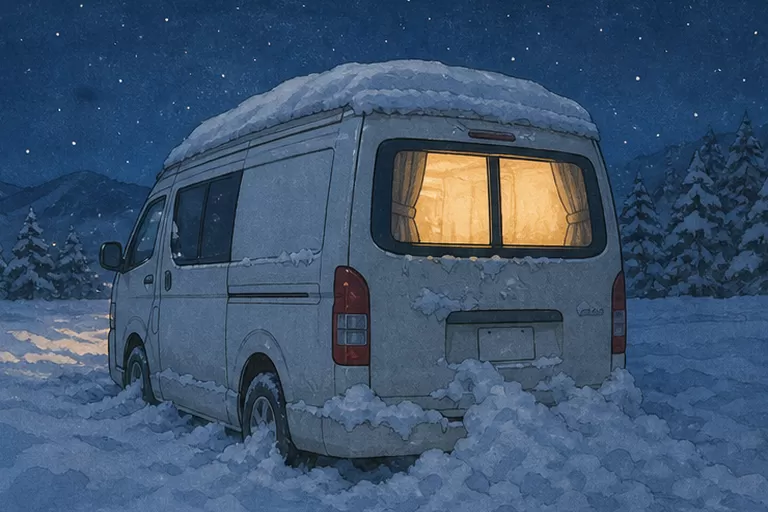
The answer to "is an FF heater really worth having" shows up in this test data. JAF (the Japan Automobile Federation) ran the experiment on February 16, 2015, at Santa Present Park in Asahikawa, Hokkaido. It measured what happens inside a snow-covered vehicle when you keep the engine running.
| Condition | In-cabin carbon monoxide level |
|---|---|
| No action taken | Rose from the start. Reached 400ppm (the short-term exposure limit) after 16 minutes, then hit the measurement ceiling of 1,000ppm just 6 minutes after that |
| Window cracked open 5cm | Reached the 100ppm range within 5 minutes, hit 400ppm at around 40 minutes, then climbed into the 800ppm range shortly after |
| Snow cleared from around the muffler | Almost no CO detected throughout |
Three ways to read this.
First, 16 minutes. That's about how long it takes to doze off without noticing. Carbon monoxide is colorless and odorless, so your judgment degrades before you sense anything is wrong.
Second, cracking a window doesn't save you. It only buys about 40 minutes instead of 16 before you hit 400ppm. "Leave the window open a bit" isn't a real fix.
Third, clearing the snow does work. But you can't keep shoveling snow away from the muffler all night while you're asleep.
JAF itself notes that "results vary depending on conditions around the vehicle, wind direction, and air conditioning settings, so conditions that were safe in this test may be dangerous in other situations." Even clearing snow isn't a guarantee.
The FF heater sidesteps this problem entirely. Because it keeps you warm with the engine off, it doesn't matter if the muffler gets buried in snow. It's less a convenience feature than a way to remove the need to run the engine while you sleep in the first place.
Source: JAF user test, "Does carbon monoxide poisoning occur inside a snow-buried car?" (conducted February 16, 2015)
How FF Heaters Compare to Other Heating Options
| Heating method | Safety | Cost | Usable while sleeping | Practical for Hokkaido winter |
|---|---|---|---|---|
| FF heater | ◎ (separate exhaust) | ~¥200–300/night | ◎ | ◎ Standard solution |
| Electric blanket / electric heater | ◎ | High power draw | ○ (blanket only) | △ Hard to maintain room temp below -15°C |
| Kerosene stove | ✗ (CO risk) | Low | ✗ Not safe while sleeping | ✗ Requires constant ventilation — not practical |
| Engine idling | ✗ (snow blockage risk) | High fuel use | ✗ Dangerous | ✗ Known accidents |
| Hot water bottle + sleeping bag | ◎ | Low | ○ | △ Limited effectiveness below -10°C |
Realistically, camper van overnight stays in Hokkaido in winter are only practical with an FF heater-equipped vehicle or at an RV park with an electric hookup (for electric heaters).
How Much Fuel Does It Actually Use?
Consumption varies by model, but a typical unit at around 2kW output uses 0.1–0.27L per hour.
| Operating condition | Fuel consumption | Estimated cost (diesel at ¥130/L) |
|---|---|---|
| Low setting, 1 hour | approx. 0.1L | approx. ¥13 |
| High setting, 1 hour | approx. 0.27L | approx. ¥35 |
| Overnight, 8 hours (average) | approx. 1.0–1.5L | approx. ¥130–200 |
| Full day, 24 hours (cold winter day) | approx. 2–4L | approx. ¥260–520 |
Fuel type matches the vehicle: diesel for cab conversions (diesel-based), gasoline for HiAce-based van conversions. The FF heater refuels every time you fill the tank — no separate step needed.
How Effective Is It in a Hokkaido Winter?

In inland Hokkaido (around Obihiro and Asahikawa), January lows can reach -15 to -20°C. FF heater output varies with outside temperature.
- Outside -5°C → interior approx. 20°C (comfortable)
- Outside -10°C → interior approx. 18°C (no problem)
- Outside -20°C → interior approx. 15°C (slightly cool — comfortable with a down jacket)
Even on a -20°C night, running the FF heater on low all night maintains a sleepable temperature without a sleeping bag. That said, smaller vehicles (kei campers) lose heat more easily; van conversions and cab conversions maintain more stable interior temperatures.
FF Heater Fuel Types: Kerosene, Diesel, and Gas
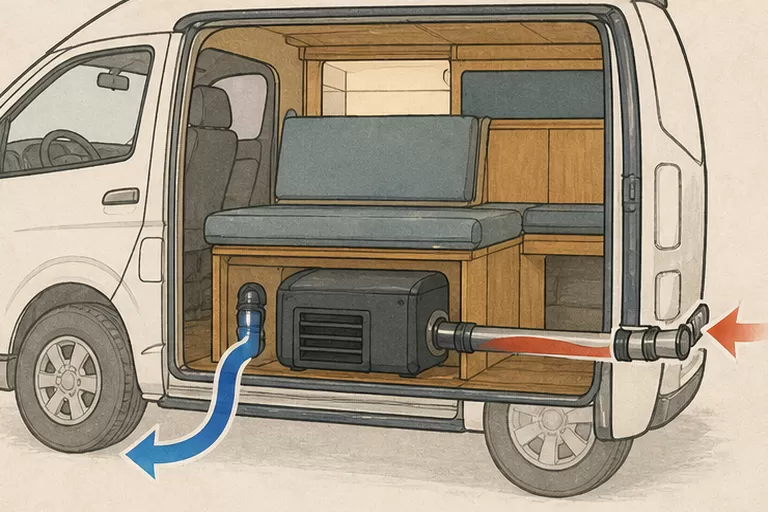
FF heaters fall into three types based on fuel: kerosene, diesel, and gas. Kerosene is the most common in Japanese camper vans, and well-known brands include Eberspächer's Airtronic and Webasto's Air Top series. A kerosene tank typically holds 5–10L, enough for roughly 12–60 hours of heating on a full tank, so on a Hokkaido winter trip you can expect to refill about once every two to three days.
Diesel-fuelled units draw directly from the vehicle's own fuel tank, so there's no separate kerosene tank to manage — this is the standard setup on diesel-engined cab conversions. Gas (LPG) units are more common in European-built camper vans; in Japan, sourcing gas canisters can be harder to arrange. For a Hokkaido trip, a kerosene or diesel FF heater is the easier option for keeping fuel supplied.
| Fuel type | Availability in Hokkaido | Approx. fuel cost | Typically found on |
|---|---|---|---|
| Kerosene | ◎ (nearly every petrol station) | ~¥90–110/L | Most domestic camper vans |
| Diesel | ◎ (shared with the vehicle's own tank) | ~¥130–150/L | Diesel-engined vehicles |
| Gas (LPG) | △ (needs dedicated canisters) | Tends to run higher | European-built camper vans, etc. |
How to Use an FF Heater: Operating Steps and Precautions
Operation is simple — most units have a thermostat-equipped controller. The basic steps are:
- Check the fuel level before departure and before going to sleep
- Turn on the controller and set your target temperature (20–22°C is a good baseline)
- For the first 1–2 minutes you may hear only the fan with no combustion sound — that's normal
- Once combustion starts, output warms up and you'll feel warm air within 2–5 minutes
- Setting the temperature slightly lower at bedtime (around 18°C) saves both battery and fuel
- When you turn it off, wait for the fan to fully stop (1–3 minutes) before doing anything else
With a typical 100Ah-class sub-battery, the FF heater alone can run continuously for 50–100+ hours. Even with lighting and phone charging on top of that, it's rare for the battery to run flat over a single night.
A few things worth keeping in mind while using it:
- Snow blocking the exhaust outlet: heavy snow can block the exhaust pipe and cause incomplete combustion. Check around the outlet after parking and before starting it up.
- Fuel tank freezing: in Hokkaido's deep winter, condensation inside a kerosene tank can freeze. Cold-climate JIS No.1 kerosene helps prevent this.
- Ventilation: exhaust is vented outside by design, but leaving a vent slightly open overnight is good practice regardless.
- A smell on first use: a combustion smell on first startup — whether brand new or the season's first use — is common and usually clears within a few minutes; if it persists, contact the rental company.
- Don't restart immediately after stopping: restarting before the fan has fully stopped shortens the unit's lifespan. Wait 2–3 minutes after shutdown before starting it again.
If You Want an FF Heater Installed in Your Own Vehicle
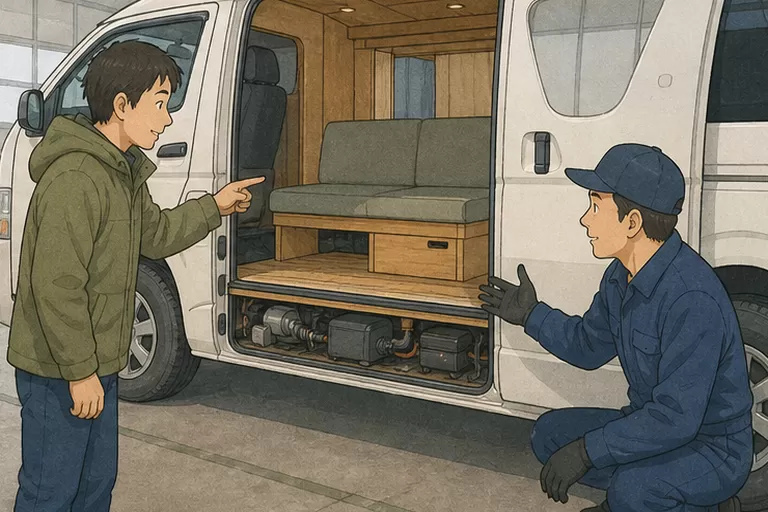
Everything above is about renting. But some readers searching this topic want to install an FF heater in a vehicle they already own. Here's what we could confirm, and what we couldn't.
Two main manufacturer families
Webasto. A German manufacturer with a Japanese-language official site. Its air heaters for vehicles include the Air Top Evo 40 (4kW heating output) and Air Top Evo 55 (5.5kW), and they run on diesel, gasoline, or paraffin-based fuels.
Eberspächer. Also a German manufacturer. In Japan it has merged with Mikuni, which previously made its own FF heaters, and now operates as "Eberspächer Mikuni Climate Control Systems." The distributor White House handles the Airtronic series.
Almost every factory-fitted FF heater in a camper van comes from one of these two families.
Pricing isn't published
We found no published pricing for either the unit itself or installation labor on either manufacturer's official site. As far as we could find, there's no official, publicly posted price list.
Dealer sites do list figures, but they vary by dealer, and installation labor varies by vehicle. We're deliberately not writing a "roughly ¥X" figure here. Get a quote from an authorized dealer or a camper van conversion shop.
What we couldn't confirm about installation and vehicle inspection
Retrofitting involves tapping into the vehicle's fuel tank and routing an exhaust pipe to the outside. Whether this work requires a structural modification filing, we could not confirm from public materials from the Ministry of Land, Infrastructure, Transport and Tourism or regional transport bureaus.
This isn't something to proceed on without knowing. Check with both the installer you're using and your local transport bureau. If an installer tells you it's fine, it's worth asking what that's based on.
On cheaper imported units
Mail-order imported units in the ¥20,000–¥50,000 range are widely available. We found no warnings or incident reports about them from the National Consumer Affairs Center, the Fire and Disaster Management Agency, or NITE.
That said, "we found nothing" doesn't mean "it's been confirmed safe." This is a combustion device used inside a vehicle, and the exhaust routing and fuel handling are what matter most. When you talk to an installer, ask upfront whether they're willing to install that specific product — if they decline, the reason they give is useful information.
When Checking "FF Heater Equipped" in a Rental Listing, Look This Far
A listing that says "FF heater installed" doesn't always tell the full story. Here's what to confirm before booking.
Check ①: Is it fitted in every vehicle?
Even within the same rental shop, FF heater availability can vary by individual vehicle. "This shop has FF heater-equipped vehicles" is not the same as "the specific vehicle you're booking has an FF heater." Confirm by vehicle name or number.
Check ②: Are there usage time restrictions?
Some operators impose conditions like "FF heater for parked use only" or "limited hours." Confirm whether you can run it overnight while sleeping.
Check ③: Is there a pre-departure walkthrough?
The FF heater's startup, temperature settings, and fuel level checks are separate from the engine system. If it's your first time, ask whether the shop gives an operational briefing before departure.
Check ④: Are studded (studless) snow tires also included?
Great heating means nothing if you can't drive on winter roads. Confirm that the vehicle has FF heater + studless tires + winter operation — all three together. Whether studless tires are standard or an add-on varies by operator.
Check ⑤: Fuel tank capacity
Kerosene tank size varies by vehicle — commonly 5L, 8L, or 10L. On longer itineraries, a larger tank means fewer refuelling stops.
Check ⑥: Sub-battery capacity
If you'll be running the FF heater alongside lighting and phone charging, a vehicle with a 100Ah or larger sub-battery gives you more headroom.
Where Can You Rent an FF Heater-Equipped Vehicle in Hokkaido?
Among our site's 42-base rental database, 7 bases list an FF heater as a stated feature: KEGANI CAMP and BICUP Sapporo Main Store in Sapporo; Sunlife Rental Car in Eniwa; Iris Rental Campervan and Camping Rental Service Kogyo (which states all vehicles come with 4WD and an FF heater) in Kitahiroshima; Halcamp Hokkaido in Ebetsu; and Moving Inn Tokachi Obihiro Airport, mentioned above (as of the base data on 2026-09-21). This doesn't mean bases not on this list have no FF heater-equipped vehicles. Many companies simply don't note it in their feature list, so the reliable way to check is to look at each vehicle's own page for "FF heater."
A table ranking all 13 Sapporo-city bases by price is in 13 Bases You Can Rent From in Sapporo, and a comparison against renting from New Chitose Airport is in Sapporo vs. New Chitose Airport Comparison. For what to check to sleep warm in your vehicle in winter, see What to Check for Sleeping Warm in a Winter Campervan, and for winter-only activities, see 43 Things You Can Only Do in Hokkaido in Winter.
FF Heater-Equipped Vehicles Available from Obihiro Airport
Moving Inn Tokachi serves the Obihiro/Tokachi area with a winter-ready vehicle lineup.
- FF heater standard on every HIACE
- Studless tires (winter season) and 4WD on every vehicle (interview with Moving Inn, October 6, 2026)
- Free transfer between Obihiro Airport and the shop
- Pre-departure operational walkthrough included
- Rates: from ¥15,400 (off-season) / from ¥36,850 (peak season)
Moving Inn Tokachi Obihiro Airport — Details & Availability
Situations Where the FF Heater Matters Most
Roadside station overnight (no electric hookup)
If you're staying overnight at Hokkaido roadside stations, the FF heater is your only heat source. Electric heaters aren't an option there.
Multi-night or extended stays
One cold night might be manageable, but four or five nights will wear you down. Whether the cabin is warm during morning dressing and meal prep makes a significant difference to your overall experience.
Family trips with children
Children regulate body temperature less effectively than adults. Even in a family-sized cab conversion (sleeping 4–6), a winter Hokkaido trip without an FF heater is genuinely difficult. Always check when travelling with family.
Early morning sightseeing
Some of Hokkaido's best views — Cape Nosappu sunrise, early morning wildlife on the Notsuke Peninsula, autumn foliage at Mikuni Pass — are most spectacular at dawn. Camper van travel lets you park near these spots the night before and be moving before sunrise. That requires reliable overnight heating.
Monthly Temperatures in Hokkaido and When the FF Heater Becomes Necessary
Temperatures in Hokkaido vary widely by region and month. Here's a month-by-month guide to whether the FF heater is "nice to have" or "can't go without."
| Period | Approximate low (inland) | FF heater necessity | Notes |
|---|---|---|---|
| Late April–May | 0–5°C | △ Helpful | Chilly mornings and evenings; high-quality sleeping bag may suffice |
| June–August | 10–15°C | Not needed | Summer: heat management is the main concern; FF heater unused |
| September | 5–10°C | △ Reassuring | Late September mornings and evenings get quite cold |
| October | 0–5°C | ○ Needed | Inland areas begin to see below-freezing nights |
| November–March | -10 to -20°C | ◎ Essential | Overnight stays without FF heater carry real health risks |
When renting a camper van in Hokkaido, the FF heater is practically necessary for roughly 7 months — from October through early May. It's largely unneeded in summer (June–August), but if you're booking in September or October, choosing a vehicle with one fitted is a decision that directly affects your comfort.
New Chitose Airport / Tokachi-Obihiro Airport
Rent the Cabcon "Cresson Journey"
Base yourself at New Chitose Airport and compare rates, vehicle types, and pickup locations all in one place.
See details at Moving Inn →Two Things People Often Confuse About FF Heaters
"FF heater" and "ceramic/electric heater" are different things
If a rental listing says "heater equipped," confirm whether it's an FF heater (combustion) or an electric heater. Electric heaters require an AC hookup (at a campsite with electric power). They can't be used at roadside stations, so for winter Hokkaido they should be treated as a separate category from FF heaters.
"Studless tires" and "FF heater" need to be confirmed together
Studless tires let you drive on winter roads. An FF heater keeps you warm at night. Neither one alone makes a winter Hokkaido trip safe and comfortable. A vehicle with studless tires but no FF heater is not suited for winter overnight stays. Always confirm both at the same time when booking.
Frequently Asked Questions (FAQ)
Q. Can I get carbon monoxide poisoning from an FF heater?
A properly functioning FF heater has a fully sealed separation between the combustion chamber and the interior, so carbon monoxide cannot enter the cabin. However, if the exhaust pipe becomes blocked by snow, a safety sensor will automatically shut the unit down. Before use, clear any snow from around the exhaust outlet. Keeping a CO alarm inside the vehicle adds another layer of safety.
Q. Does the FF heater require the engine to be running?
No. The FF heater draws power from the sub-battery, so it operates with the engine fully off. As long as the sub-battery has sufficient capacity, running it overnight is fine. Rental vehicles are designed with overnight use in mind.
Q. Is the FF heater fuel included in the rental fee?
In most cases it's not separately charged — the fuel it consumes simply comes out of the vehicle's tank and is accounted for in fuel costs. Operators who charge a separate FF heater usage fee are rare, but it's worth confirming at booking.
Q. Which heats more efficiently — a van conversion or a cab conversion?
Smaller interiors warm up faster, so for the same FF heater output, efficiency runs kei camper > van conversion > cab conversion. That said, cab conversions have thicker insulation and greater exterior wall area, so once warmed up they retain heat better. For 2–4 people, a van conversion is the practical choice; for 4–6, a cab conversion.
Q. Is it okay to go to Hokkaido in winter without an FF heater?
In late April–May and September, inland lows are around 5–10°C, and a quality sleeping bag with a down jacket can be enough on many nights. However, from December through March — especially in inland and eastern Hokkaido — temperatures reach -10 to -20°C, and overnight stays without an FF heater carry real health risks. For winter travel, choosing an FF heater-equipped vehicle is strongly recommended.
Q. What should I do if the FF heater breaks down during my rental?
Contact the rental operator immediately. If it happens at night, have the emergency contact number saved in advance. As an emergency measure, relocating to a nearby RV park with electric hookup and switching to an electric heater is the most practical option. Building some flexibility into your itinerary makes it easier to handle situations like this.
Q. Where can I buy kerosene in Hokkaido?
Kerosene is sold at nearly every petrol station in Hokkaido. Winter heating demand keeps supply steady, and even small towns in the east and north generally stock it. Refuelling is usually done by carrying a portable jerry can to the pump — a 10L can is a convenient size to bring along. Choosing cold-climate JIS No.1 kerosene gives more stable combustion in low temperatures.
Q. Do I need any special qualification to operate an FF heater?
No special qualification is needed. Starting, stopping, and adjusting the temperature is just a matter of using the controller switch, and the rental company's pre-departure walkthrough covers everything a first-time user needs. If you notice a malfunction, an unusual smell, or abnormal smoke, turn it off right away and contact the rental company.
Book a Campervan in Hokkaido
Moving Inn New Chitose Airport supports English booking and offers airport transfers.

![When and Where Can You See Harbor Seals at Cape Erimo? Kaze no Yakata Official Information, Viewing Season, and Windy-Day Notes [2026-27]](https://hokkaido-campingcar.jp/wp-content/uploads/2026/10/erimo-cape-lighthouse-768x511.jpg.webp)
![Where and Under What Conditions Can You See Diamond Dust in Hokkaido? How Cold a Morning It Takes, and Where It Appears [2026-27]](https://hokkaido-campingcar.jp/wp-content/uploads/2026/10/hokkaido-diamond-dust-nayoro-768x512.jpg.webp)
![Can You Drive to Hokkaido Jingu for Hatsumode? Parking, Crowds, and Where to Park and Walk [2027]](https://hokkaido-campingcar.jp/wp-content/uploads/2026/10/hokkaido-jingu-winter-torii-768x504.jpg.webp)
![Hokkaido Roads Over New Year [2026-27] | Expressway Sections Prone to Blizzard Closures, Forecast Congestion Days, No Holiday Discount, and New Chitose Airport Parking](https://hokkaido-campingcar.jp/wp-content/uploads/2026/10/hokkaido-winter-rural-road-edge-markers-768x432.jpg.webp)
![Where to See Sea Smoke (Kearashi) in Hokkaido: Rumoi’s Ogon-misaki and the Morning Conditions [2026-27]](https://hokkaido-campingcar.jp/wp-content/uploads/2026/10/rumoi-kearashi-sea-smoke-768x511.jpg.webp)
![Geminid Meteor Shower 2026 in Hokkaido: Peak Around 23:00 on December 14, Sapporo Moonset 20:40, and Staying Warm in a Winter Campervan [2026]](https://hokkaido-campingcar.jp/wp-content/uploads/2026/10/geminids-2026-hokkaido-768x575.jpg.webp)