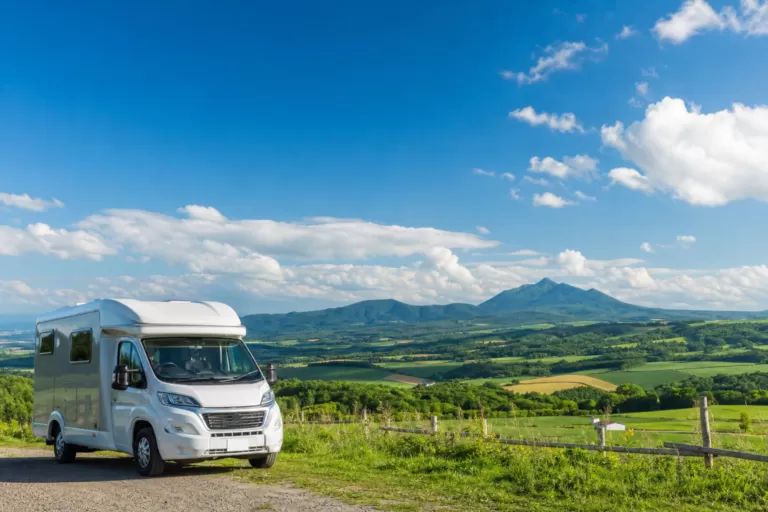
Kei Camper Rental in Hokkaido: Prices & How to Choose Between Sapporo, New Chitose Airport, and Hakodate
Compare kei camper rental bases in Hokkaido by departure point. Covers prices, airport access, pet policies, tips for two adults, and when to upgrade to a van-conversion.
Pick a campervan by what matters to you.
Guide price
Moving Inn New Chitose Airport: HIACE van conversion from ¥22,000 per night. 20–30% off when booked 60–90 days ahead (official rate table, checked 15 Oct 2026).
Rent at New Chitose Airport
See only the rental bases in Chitose, where the airport is.
Rent in winter (Dec–Mar)
Companies that rent through winter, listed apart from those that close.
Before you book: with an International Driving Permit if your country is in the Geneva Convention (for example the US, Australia, Singapore); Taiwan, Switzerland, Germany, France, Belgium and Monaco need your licence plus a Japanese translation (Tokyo Metropolitan Police). Questions in English: Moving Inn on WhatsApp. Every roadside station (michi-no-eki) must have free 24-hour toilets, and Hokkaido has 128 of them (MLIT).
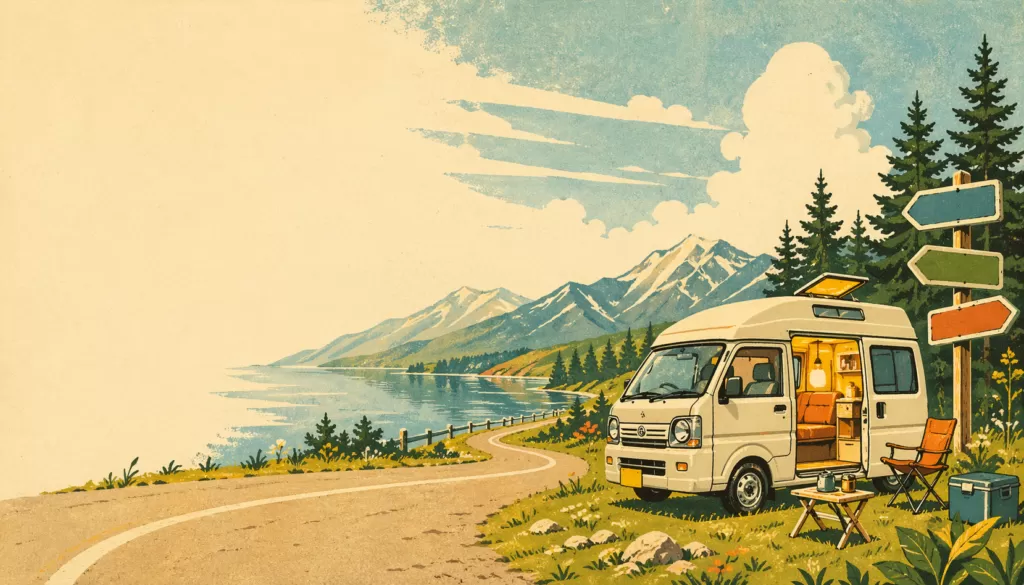
If you want to rent a camper in Hokkaido but feel anxious about driving a large vehicle, or simply want to try it out at low cost, a kei camper is worth considering. Based on a kei (mini) car, it handles much like a regular passenger car, making it a good fit for solo trips, couples, and short overnight stays in the vehicle.
Keep in mind that distances in Hokkaido are long. Kei campers are affordable and easy to handle, but they have limits in cargo space, sleeping room, and comfort on long drives. This article organizes kei camper rental options in Hokkaido by departure point — Sapporo, New Chitose Airport, and Hakodate — and helps you decide when a kei camper is enough and when you should consider a van-conversion instead.
Compare Kei Camper Rentals in Hokkaido
Browse rental bases by vehicle type if you want to focus on kei campers.
View Kei Camper Rental Bases →Conclusion: Sapporo for Price, New Chitose Airport for Efficiency
When renting a kei camper in Hokkaido, the first decision is where to pick it up. For the lowest rates, Sapporo-based kei campers are the strongest option, with choices starting from ¥4,800–¥7,800 per day. If you’re flying into Hokkaido, bases near New Chitose Airport or those offering airport transfers will save you time on day one.
For budget-first renters, Sapporo options like SALMON RENTALCAR, QUUM, and CAMPINGLABO are top candidates. If you want to drive right after landing, GOODLUCK Camping Car Rental and Tabi-suru Kuruma New Chitose Airport BASE are convenient. For southern Hokkaido (Donan), Ado VAN’S in Hakodate is a separate option worth considering.
Kei Camper Rental Comparison Table
Compare Hokkaido Camping Car Rentals
Base yourself at New Chitose Airport and compare rates, vehicle types, and pickup locations all in one place.
Compare Rental Companies & Prices →Prices vary by season, day of week, vehicle type, and options. The table below is a starting reference based on comparison data from this site.
| Base | Area | Kei Camper Rate (approx.) | Airport Access | Pets | Best For |
|---|---|---|---|---|---|
| SALMON RENTALCAR | Sapporo | From ¥4,800 | New Chitose delivery available | OK | Trying a kei camper at the lowest cost |
| QUUM | Sapporo | From ¥6,600 | Confirm on booking | No | Budget-first Sapporo departures |
| CAMPINGLABO | Sapporo | From ¥7,800 | New Chitose delivery ¥5,000 | No | Comparing kei, van, and cab-over types |
| Chikichiki Camping Car Rental | Eniwa | From ¥11,000 | JR Eniwa Station transfer | Some OK | Train from airport to rental base |
| GOODLUCK Camping Car Rental | Chitose | From ¥14,300 | Free shuttle from New Chitose | No | Smooth airport pick-up and departure |
| Ado VAN’S | Hakodate | From ¥14,300 | Confirm on booking | No | Touring Hakodate and southern Hokkaido |
| BicUp | Sapporo | From ¥17,300 | Confirm on booking | No | Comparing kei campers with cab-overs |
| Tabi-suru Kuruma New Chitose Airport BASE | Chitose | From ¥19,800 | 5 min from airport, free individual shuttle | OK | Airport proximity, pets, equipment focus |
If lowest price is your only criterion, Sapporo wins. However, flying in and then traveling to Sapporo for pick-up eats into your first day. For 1–2 night trips, choosing a base near New Chitose Airport — even at a slightly higher rate — makes itinerary planning easier.
Sapporo Departures: Best for Keeping Costs Down
The budget advantage of kei campers is most apparent with Sapporo-based rentals. SALMON RENTALCAR starts at ¥4,800, QUUM at ¥6,600, and CAMPINGLABO at ¥7,800. These suit travelers who want to keep accommodation costs low, try one overnight, or experience Hokkaido car camping in a familiar-sized vehicle.
Sapporo departures also make it easy to stock up on day one. Supermarkets, home centers, hot springs, and coin laundries are all within reach, letting even first-timers prepare before heading out. Routes toward Otaru, Shikotsu Lake, Toya Lake, and Niseko are all manageable from Sapporo.
One downside: if you’re flying in, you’ll need to travel from New Chitose Airport to Sapporo first. If arrival is in the afternoon, plan to spend day one shopping and scouting a place to sleep, then start driving in earnest the next morning.
New Chitose Airport Departures: Drive Right After Landing
The New Chitose Airport rental guide covers bases that offer free airport transfers — always confirm return time conditions when requesting a transfer. Tabi-suru Kuruma New Chitose Airport BASE is close to the airport and offers free individual pickups, making airport arrivals and departures straightforward.
From New Chitose Airport, you can head easily to Shikotsu Lake, Tomakomai, Toya Lake, Furano, and Biei. A realistic 2-night, 3-day itinerary might look like: day 1 to Shikotsu Lake or Tomakomai, day 2 to Toya Lake or Niseko, day 3 back to the airport.
Rates tend to be higher than Sapporo’s budget kei campers, but the time saved on transfers is significant — especially for families with children, pet owners, or anyone traveling with lots of luggage.
Hakodate Departures: An Option for Southern Hokkaido
If your plan centers on Hakodate, Onuma, Matsumae, and Esashi, a Hakodate-based kei camper rental is worth considering. Ado VAN’S handles the kei camper Happy1 in Hakodate, with rates starting around ¥14,300. Confirm transport from Hakodate Airport or Shin-Hakodate-Hokuto Station in advance, but if you’re only touring Donan, you’ll cover far less distance than departing from New Chitose.
Southern Hokkaido’s sights are relatively easy to read in terms of distance, making it a good match for a kei camper. Hakodate city sightseeing, Onuma Park, Shikabe, Esashi, and Matsumae are all doable in 2–3 days. See also the Hakodate Camping Car Rental Complete Comparison for a full base breakdown.
When a Kei Camper Is Enough for Hokkaido
Kei campers are best suited to solo travelers, couples, light packers, and short trips — specifically 1–3 nights touring Sapporo suburbs, central Hokkaido, or southern Hokkaido at a relaxed pace. Even drivers who feel nervous about large vehicles find kei cars easy to park and maneuver on narrow roads, with convenient access to tourist spots and hot springs.
Rather than cooking all meals inside, kei camper trips work best when you rely on local restaurants, roadside stations (Michi-no-Eki), and convenience stores like Seico Mart for food, using the vehicle mainly as a place to sleep. The limited interior space gets cramped fast if you add too many cooking tools or bulky bedding.
Here are the conditions under which a kei camper trip is least likely to go wrong:
- Solo or up to two adults
- Luggage limited to carry-on size
- Daily driving distance roughly 150 km or less
- Combining hot springs and restaurant meals
- Short-loop trips rather than extended multi-night stays
- Not forcing yourself to stay in the vehicle all day in bad weather
Hokkaido’s scale is different from Honshu. A kei camper can handle it, but if your itinerary requires more than 300 km of driving per day, fatigue builds quickly. Focus on fewer destinations rather than trying to cover everything.
Sample Kei Camper Routes in Hokkaido
Satisfaction on a kei camper trip depends less on the vehicle size and more on how you structure the distances. Going deep in one area near your departure point beats trying to cover all of Hokkaido at once. Here are three beginner-friendly route ideas.
Sapporo Departure, 1 Night 2 Days: Otaru – Yoichi – Niseko
For your first kei camper trip from Sapporo, the Otaru–Yoichi–Niseko direction is manageable. Day 1: pick up supplies in Sapporo, sightsee in Otaru or Yoichi, then combine a hot spring or roadside station for the night. Day 2: loop through Niseko or Shikotsu Lake before returning to Sapporo by evening.
This route doesn’t push driving distances too far and minimizes the stress of a cramped kei camper interior. Rely on restaurants and takeout for meals; use the vehicle just for sleeping and resting.
New Chitose Airport Departure, 2 Nights 3 Days: Shikotsu Lake – Toya Lake – Tomakomai
Flying into Hokkaido? A 2-night, 3-day loop covering Shikotsu Lake, Toya Lake, and Tomakomai from near New Chitose Airport is realistic. Day 1: pick up the vehicle after landing and head toward Shikotsu Lake. Day 2: move toward Toya Lake or Noboribetsu. Day 3: return with time to spare via Tomakomai or Chitose.
The key advantage of departing from New Chitose is minimal dead time on arrival and return days. Kei camper rates look higher than Sapporo’s budget options, but when you factor in travel time to Sapporo, delivery fees, and the buffer needed on the return, it often works out as the smarter choice for short trips.
Hakodate Departure, 2 Nights 3 Days: Onuma – Shikabe – Esashi – Matsumae
For a Donan-only tour, Hakodate-based kei campers are a natural fit. Starting from Hakodate city, combining Onuma Park, Shikabe, Esashi, and Matsumae gives you a relaxed route along the coast and through historic towns.
Driving all the way from New Chitose to Donan eats up a lot of travel time; starting from Hakodate lets you begin sightseeing from day one. If you’re using Hakodate Airport or Shin-Hakodate-Hokuto Station, confirm pick-up location and transfer conditions in advance.
Understanding Kei Camper Rental Costs
The rental rate alone looks cheap, but total trip cost includes vehicle hire, insurance/liability waiver, fuel, hot springs, meals, and campsite fees — the vehicle cost itself is significantly lower than other camper types. Watch out for bedding and cooking gear that may be charged separately.
| Item | Approx. (1 night 2 days) | Easy to Overlook |
|---|---|---|
| Vehicle rental | ¥10,000s–¥30,000s | Varies by day of week and season |
| Insurance / liability waiver | A few thousand yen | Check if optional or mandatory |
| Fuel | ¥3,000–¥8,000 approx. | Varies significantly with distance |
| Overnight / campsite | Free–a few thousand yen | RV parks and powered sites are paid |
| Food / hot springs | Depends on traveler | Big difference between eating out vs. self-catering |
To keep the total down, look beyond the rental rate and check transport from airport to base, delivery fees, equipment rental, and return time. For trips departing and returning via New Chitose Airport, choosing a nearby base can cut both cost and travel time.
Kei Camper Purchase Price and Running Costs
If you’re also weighing whether to buy rather than only rent, it helps to know typical vehicle prices and running costs. Prices reflect 2026 market ranges confirmed across multiple sources; actual figures vary by model, grade, and builder, so always confirm with a dealer before purchasing.
| Category | Price range | Notes |
|---|---|---|
| New (entry model) | ¥2.0M–¥2.8M | Basic equipment: bed and ventilation fan |
| New (standard model) | ¥2.8M–¥3.5M | Often includes a sub-battery, sink, and FF heater |
| New (premium model) | ¥3.5M+ | Increasingly ships with a lithium-ion battery and air conditioning |
| Used | ¥1.0M–¥2.5M | Low-mileage units in good condition are available; check model year and build quality |
Running costs are cheap because taxes, insurance, and highway tolls are all calculated at kei-car rates, landing around ¥200,000–¥300,000 a year.
| Item | Kei camper (approx.) | Reference: standard van-conversion |
|---|---|---|
| Vehicle tax | ~¥10,800/year | ~¥29,500–¥40,500/year (varies by engine size) |
| Highway tolls | 80% of standard rate (kei discount) | Standard rate |
| Optional insurance | ~¥40,000–¥80,000/year | ~¥60,000–¥120,000/year |
| Inspection | Every 2 years (same for 8-number) | Every 2 years |
| Fuel (assuming 5,000 km/year) | ~¥40,000–¥60,000 (14–18 km/L) | ~¥60,000–¥100,000 (8–12 km/L) |
If you’re torn between buying and renting each time, here’s a rough break-even comparison (assuming a ¥3M new vehicle and ¥13,000/night rental).
| Item | Buy (¥3M new vehicle) | Rent (¥13,000/night) |
|---|---|---|
| Upfront cost | ~¥3M + fees (registration, insurance, etc.) | ¥0 |
| Annual fixed cost | ~¥200,000–¥300,000 upkeep | ¥0 |
| One 2-night trip | Fuel and tolls only | ~¥26,000 + fuel and tolls |
| 3 trips/year over 5 years | ~¥4.5M total (partly recovered at resale) | ~¥390,000 (rental only) |
| 12 trips/year over 5 years | ~¥4.5M total (partly recovered at resale) | ~¥1.56M |
Under the conditions in the table (a ¥3M new vehicle, ¥13,000 per rental night, over 5 years), renting is cheaper whether you travel 3 times a year or every month. Even renting for 2 nights every month comes to about ¥1.56M over 5 years, roughly a third of the ~¥4.5M cost of buying. Buying only becomes cheaper once you use the vehicle for more than about 346 nights in 5 years (~¥4.5M ÷ ¥13,000 per night) — that is, more than about 70 nights a year, or roughly 35 two-night trips a year. Resale value isn’t included in the table, so a good resale price would lower that threshold somewhat. If you’re not sure yet, rent a few times first to find your actual usage rate — that’s the safest order of decisions.
Popular Kei Camper Base Vehicles
Base vehicles vary by rental company. Here’s a quick reference on the main models to help you choose a rental.
Suzuki Every: the van-conversion standard
The Every is the most common base for kei van conversions. Its tall, boxy cargo area gives the best bed-mode livability in its class, and turbocharged grades like the JOIN Turbo take most of the sting out of highway driving. Rental fleets in Hokkaido rely on Every-based sleepers as a staple. One downside: a smaller fuel tank (about 30 L), which can mean planning refueling stops on long Hokkaido drives.
Daihatsu Atrai and Hijet: the widest conversion lineup
The Atrai (van) and Hijet Truck are Daihatsu’s two pillars. The Hijet Truck is the go-to base for kei cab-overs and truck campers, some of which offer enough headroom to stand and change. If you want to spend time in the vehicle rather than just sleep, look at cab-over types.
Honda N-VAN: pillar-less flexibility
The N-VAN’s pillar-less passenger side opens into one huge aperture, giving unmatched freedom for cargo and interior layout. It is popular as a DIY base, and both Honda and converters offer sleeping packages. If daily usability is your top priority, the N-VAN family deserves a look.
Suzuki Carry and Daihatsu Hijet Truck: the cab-over base
If interior headroom matters most, the Carry and Hijet Truck — bases for kei cab-overs — are the ones to look at. Shell conversions can offer 150–180 cm of headroom, letting you stand inside a kei-class vehicle. Pricing tends to run higher than an equivalent van conversion, but the comfort on multi-night trips is in a different league.
Equipment Checklist: 7 Things to Check
A kei camper’s comfort comes down to how well it packs practical equipment into a small footprint. Whether you’re buying or renting, check these seven items to avoid the “the equipment wasn’t enough” letdown.
- Bed size: 180 cm or longer? How many minutes to convert to full-flat?
- FF heater: engine-off heating, effectively mandatory for Hokkaido winters
- Sub-battery / portable power: does it charge while driving, and what capacity? This sets your phone, lighting, and electric blanket runtime
- Ventilation fan and screens: summer comfort is decided almost entirely by airflow
- Insulation: ceiling and wall insulation directly affect condensation and winter cold
- Storage layout: is there anywhere to put gear with the bed deployed?
- Turbo: the biggest felt difference in a long-distance region like Hokkaido
Common Regrets and How to Avoid Them
The regrets that show up most often in owner reviews are almost all avoidable if you know about them beforehand. Here are the four most common.
“Two people’s gear wouldn’t fit”
In many models the cargo space disappears once the bed is deployed. Avoid the trap by loading your actual travel gear into a rental before buying — catalog numbers never show you the margin left over when you are living in the vehicle.
“Too hot to sleep in summer”
Weak insulation and ventilation make summer nights exhausting. A ventilation fan, insect screens, and a circulator are the minimum; if you run hot, look at models with built-in air conditioning.
“Couldn’t keep up on highway climbs”
A non-turbo engine hauling a heavy conversion can make the climbing lane your permanent home. If long drives are in your plans, turbo is the only sensible choice — and always test on an actual highway during your rental or test drive.
“We barely use it”
The most common and most expensive regret. If you travel only a few times a year, renting beats owning on pure economics. Use the cost comparison above, rent for a year, count your trips, then decide.
When to Choose a Van-Conversion or Cab-Over Instead
Kei campers are not all-purpose. If you’re traveling as two adults with lots of luggage, taking a long trip, spending extended time inside during rainy days, or driving as far as eastern or northern Hokkaido, compare van-conversions and cab-overs too.
Eastern Hokkaido in particular involves long drives. A trip from New Chitose Airport to Shiretoko, Kushiro, or Lake Akan is doable in a kei camper, but travel time is long and you lose flexibility for cargo and rest stops. For a Doho-centered trip, consider a van-conversion departing from Obihiro Airport or New Chitose Airport. Compare all Hokkaido options in the Hokkaido Camping Car Rental Top 15.
If you’re starting your trip from Obihiro and Tokachi, see the Obihiro Tokachi Camping Car Drive Guide and the Obihiro Tokachi Camping Car Rental Comparison.
For families of three or more, winter Hokkaido travel, or pet owners with growing luggage, a kei camper gets tight. Rather than choosing on price alone, decide based on headcount, luggage volume, driving distance, and expected weather.
What to Confirm Before Booking
Before booking a kei camper, check these items at minimum. Budget-priced bases in particular can see totals change significantly with options and delivery fees.
- What’s included: Confirm whether bedding, cooking gear, insurance, and liability waiver are extra
- Mileage limits: Hokkaido distances add up fast — check limits and overage fees
- Airport access: Shuttle or delivery? Free or paid? Confirm return time conditions
- Sleeping capacity: Verify two adults can actually sleep with luggage on board
- Pet policy: Even “pets OK” may require agreements, cleaning fees, and crate conditions
- Winter equipment: Studded tires, FF heater, bedding, winter operating period
- Cancellation terms: In high season, check when cancellation fees kick in
For packing advice, see the Hokkaido Camping Car Trip Packing Checklist. First-time drivers should also read the Complete Beginner’s Guide.
FAQ
How much does a kei camper rental cost in Hokkaido?
Based on this site’s comparison data, Sapporo-based kei campers start from around ¥4,800, ¥6,600, and ¥7,800 per day. Bases near New Chitose Airport or with transfer service typically range from ¥14,000 to ¥19,000+. Actual rates vary by season, day of week, vehicle type, insurance, and options.
Can two adults sleep in a kei camper?
Yes, depending on the model — but it gets quite tight once luggage is added, so pack light. For longer trips or days when you’ll spend a lot of time inside due to rain, a van-conversion is more comfortable.
Can I rent a kei camper from New Chitose Airport?
There are bases around New Chitose Airport that handle transfers and deliveries. GOODLUCK Camping Car Rental, Tabi-suru Kuruma New Chitose Airport BASE, CAMPINGLABO, and SALMON RENTALCAR are all worth checking for airport access terms. Free shuttle vs. paid delivery differs by base.
Can I bring my pet in a kei camper?
Some bases allow it. SALMON RENTALCAR and Tabi-suru Kuruma New Chitose Airport BASE are both listed as pet-friendly. However, agreements, cleaning fees, crates, and breed restrictions may apply. See the Pet-Friendly Hokkaido Camping Car Travel page for more comparisons.
Can I use a kei camper in Hokkaido in winter?
Winter availability and equipment vary by base. The small interior of a kei camper makes heating, condensation, and driving on snowy roads more challenging in winter. If you plan to use one in winter, always confirm studded tires, an FF heater, and winter operating dates. If uncertain, consider a winter-capable van-conversion or cab-over instead.
How much does a new kei camper cost?
The 2026 market range is ¥2.0M–¥4.0M new. Entry models start in the low ¥2M range, while premium models with a lithium battery and air conditioning run ¥3.5M+. Used units are typically ¥1.0M–¥2.5M.
What are the annual running costs?
Roughly ¥200,000–¥300,000 a year including taxes, insurance, inspection, and consumables. This varies with registration type (8-number vs. 4/5-number) and storage conditions.
Is a kei camper registered as an 8-number vehicle?
It depends on the build and how it’s registered. A kei camper can qualify for 8-number (camping vehicle) registration if it meets the relevant government standards, but some models stay registered as 4-number or 5-number. For kei vehicles, inspections are every two years even with 8-number registration. Confirm with the dealer at purchase.
Are “kei camper” and “kei campervan” the same thing?
Yes, essentially. Both terms refer to the same category of kei-based camping vehicle; naming varies by source, and either term will surface the same vehicles in a search.
How many nights should a pre-purchase rental trial be?
Two nights is recommended. One night mostly shows you the novelty; the inconveniences you notice on the second morning — condensation, storage, sleep quality — are what you’ll live with day to day after buying.
To explore more budget rental options including kei campers, see Budget Camping Car Rentals in Hokkaido.
To compare kei campers side-by-side with other vehicle types, see the 7-Type Camping Car Detailed Comparison.
Summary: Kei Campers Are Made for “Small and Affordable” Hokkaido Trips
When renting a kei camper in Hokkaido, start by narrowing down your departure point. Budget-first: Sapporo. Efficiency-first: New Chitose Airport. Southern Hokkaido only: Hakodate.
Kei campers suit solo or two-person trips with minimal luggage and a focused, short itinerary. For long trips, eastern or northern Hokkaido, family travel, or winter trips, comparing van-conversions and cab-overs will likely improve your satisfaction.
Start by browsing the Kei Camper Rental Base List to find options that match your budget, departure point, and group size. For a broader view beyond kei campers, the Hokkaido Camping Car Rental Comparison covers all types.
Book a Campervan in Hokkaido
Moving Inn New Chitose Airport supports English booking and offers airport transfers.
Pick a campervan by what matters to you.
Guide price
Moving Inn New Chitose Airport: HIACE van conversion from ¥22,000 per night. 20–30% off when booked 60–90 days ahead (official rate table, checked 15 Oct 2026).
![Can You Rent a Campervan in Hokkaido in Winter (Dec–Mar)? Companies With Winter Closures and What to Check Before Booking [2026]](https://hokkaido-campingcar.jp/wp-content/uploads/2026/10/hokkaido-campingcar-rental-winter-open-eyecatch-768x432.webp)