What Is a Cab-over Camper? Features, Pros & Cons, and How It Compares to Cabin Vans
Pick a campervan by what matters to you.
Rent at New Chitose Airport
See only the rental bases in Chitose, where the airport is.
Rent in winter (Dec–Mar)
Companies that rent through winter, listed apart from those that close.
Guide price
Moving Inn New Chitose Airport: HIACE van conversion from ¥22,000 per night. 20–30% off when booked 60–90 days ahead (official rate table, checked 15 Oct 2026).
Before you book: with an International Driving Permit if your country is in the Geneva Convention (for example the US, Australia, Singapore); Taiwan, Switzerland, Germany, France, Belgium and Monaco need your licence plus a Japanese translation (Tokyo Metropolitan Police). Questions in English: Moving Inn on WhatsApp. Every roadside station (michi-no-eki) must have free 24-hour toilets, and Hokkaido has 128 of them (MLIT).

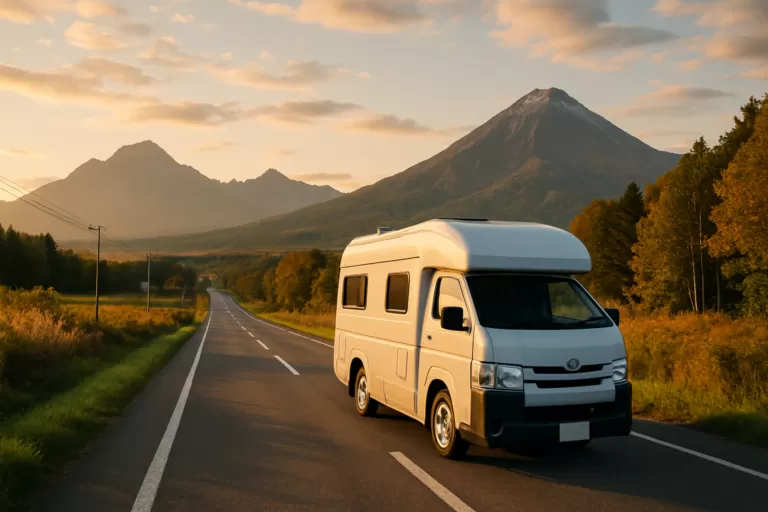
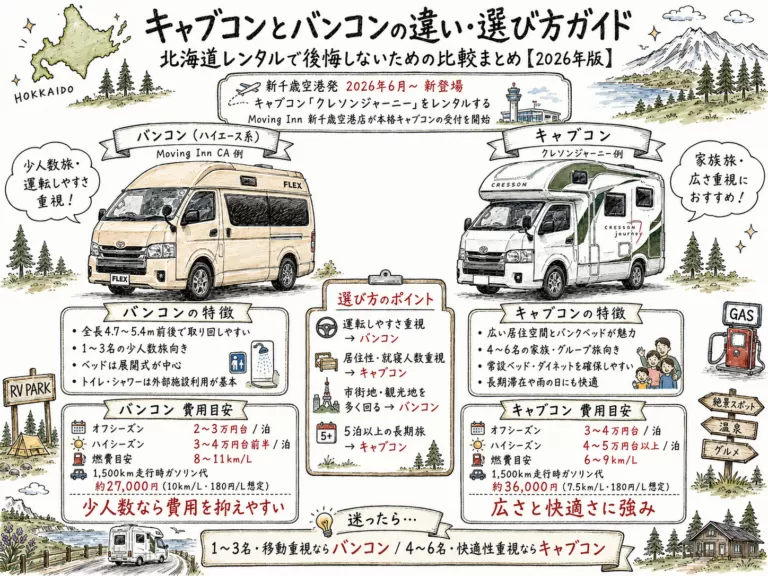
The Cab-over Camper is one of the most popular campervans, known for its superior livability. When most people picture a “campervan,” this is exactly what they have in mind. This article explains what a Cab-over Camper is, how it’s built and laid out, its advantages and disadvantages, how it compares to Cabin Vans and kei campers, its price range, and what to check before renting one—from a neutral, third-party perspective. If you want to try one, you can experience a Cab-over Camper through Moving Inn’s rental service.
What Is a Cab-over Camper? | The Iconic Campervan
The term “Cab-over Camper” is short for “cab-over conversion.” It’s built by retaining the original driver’s cab of a truck and mounting a living shell (a box-shaped living space) over the cargo bed. The Toyota Camroad is the most commonly used base vehicle, making it the dominant platform for domestic Cab-over Campers.
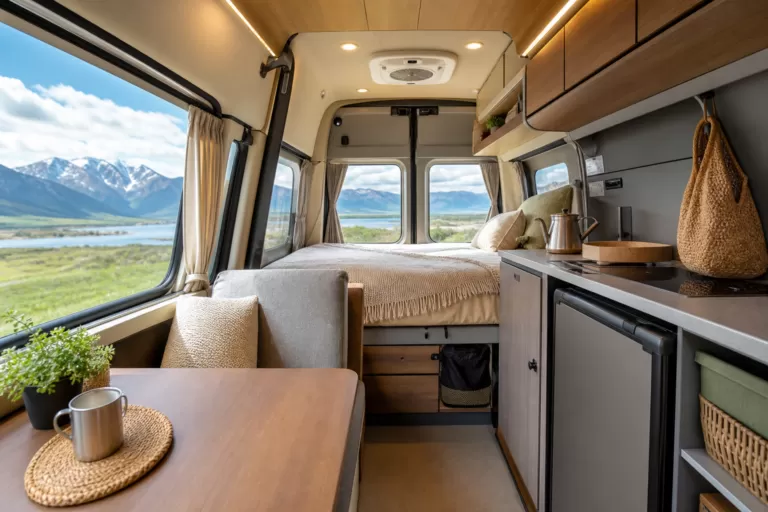
The defining feature is the interior of the shell, which is spacious enough to be called a “room on wheels.” The ceiling is high enough for an adult to stand and walk around, with an independent kitchen, dining area, and sleeping space. Most models include a bunk bed—called a bank bed—above the driver’s cab, making them particularly well-suited for family campervan trips.
How a Cab-over Camper Is Built | Chassis and Shell
The reason a Cab-over Camper can offer a “room on wheels” with real headroom comes down to how it’s built. Unlike a Cabin Van, which is created by raising the roof of an existing van body, a Cab-over Camper reuses only the truck’s cab and chassis, then mounts a purpose-built FRP shell (the boxy living space) over the cargo bed, designed completely from scratch. Because the shell’s height isn’t constrained by an existing body, manufacturers can design in enough headroom for an adult to stand and walk around.
The shell and chassis are built separately
The chassis cab, typically a Toyota Camroad, comes from the truck maker, while the shell itself is produced by a specialist conversion manufacturer. Reusing standard truck components around the driver’s seat while designing the living space independently is what defines the Cab-over Camper’s manufacturing process. This division of labor makes it easier to lay out the kitchen, toilet, and sleeping areas efficiently.
The legal backing behind the tall ceiling
Most Cab-over Campers are registered in Japan as “Category 8” special-purpose vehicles. Japan’s Ministry of Land, Infrastructure, Transport and Tourism (MLIT) structural requirements call for at least 1,600 mm of clear headroom above the floor at the sink and cooking counter (source: MLIT structural requirements for camping vehicles (Appendix Table 2), confirmed August 2026). Because the shell is designed from scratch, Cab-over Campers can comfortably clear this standard, which is why you can stand up and walk around inside. For the full requirements covering sleeping berths, water supply, and cooking equipment needed for Category 8 registration, see What Is a Campervan? A Beginner’s Guide to Types, Costs, and Rentals.
Insulation from the FRP shell
Most shells are built as sandwich panels: layers of FRP (fiber-reinforced plastic) with foam insulation in between. Unlike a Cabin Van’s raised roof, which is bolted onto an existing metal frame, a Cab-over Camper’s entire shell, insulation included, is engineered from the ground up, making it less affected by outside temperatures. In Hokkaido, where summer and winter temperatures swing widely, this insulation performance directly affects how comfortable the interior feels. For heating equipment, see our guide to FF heaters.
5 Advantages of Cab-over Campers
Here are five reasons why Cab-over Campers are chosen by so many campervan enthusiasts.
1. Spacious interior
The shell interior has a ceiling height of around 190 cm, allowing adults to move around without stooping. Even when Cabin Vans require you to duck, a Cab-over Camper lets you move freely. On extended trips, the ability to maintain a “home-like comfort” is its greatest appeal.
2. Large sleeping capacity
Most models feature multiple sleeping spots including a bank bed, a dinette converted bed, and a rear bed. A typical Cab-over Camper sleeps 4–6 people, making it ideal for family use.
3. Well-equipped
Standard or optional equipment typically includes a kitchen (stove, sink, and refrigerator), a multi-room (toilet/shower-ready), air conditioning, and a large sub-battery for long-term stays.
4. High insulation
The FRP (fiber-reinforced plastic) shell offers excellent insulation, making it easier to maintain a comfortable interior temperature during summer heat or in cold regions like winter Hokkaido—ideal for overnight camping.
5. Perfect for families and pet owners
The spacious interior and rich equipment are ideal for trips with children or pet-friendly Hokkaido travel. There’s room for kids to change clothes or play, and even space for a pet crate.
3 Common Cab-over Camper Layouts
Not all Cab-over Campers are laid out the same way, and how the sleeping space is arranged changes the whole experience. Here are the three most common layouts to look for.
Over-cab bunk bed
A sleeping space, called a “bank bed,” juts out above the driver’s cab. Because it uses space that would otherwise go unused during the day, it adds sleeping capacity without eating into floor space. This is the standard layout on most Cab-over Campers.
Dinette conversion bed
The dining table and bench seating fold down into a bed at night. This lets the same space work as a living area by day and a bedroom by night, but you’ll need to fold away the table and set up the bed every evening.
Fixed rear bed
A permanent bed is built into the rear of the vehicle. There’s no setup required and it’s always ready to use, but the bed permanently occupies that floor space, leaving less room than the other layouts. It suits travelers on long trips who value never having to make up a bed.
Layouts vary by vehicle when renting, so check the floor plan for the number and arrangement of sleeping spaces before you book.
4 Disadvantages of Cab-over Campers
Despite its many advantages, there are some drawbacks worth understanding in advance.
1. Tall height limits parking options
Cab-over Campers stand about 2.7–3.0 m tall. They won’t fit in the self-park multi-story car parks common in cities (height limit: 2.1 m). In urban areas or shopping centers, always check height restrictions in advance. This height is partly a byproduct of the structural requirements, the Category 8 registration standards, needed to secure enough living space. For the full structural requirements, see What Is a Campervan?; for route planning that avoids height-restricted roads, see our parking and navigation guide.
2. Susceptible to crosswinds
The box-shaped shell presents a large surface area to the wind, making the vehicle susceptible to crosswinds. Care is needed on expressways and bridges on windy days. Until you get used to it, choose calm-weather days for driving.
3. Fuel economy is somewhat poor
The heavy vehicle weight and large aerodynamic drag put real-world fuel economy at around 6–9 km/L. Diesel models use cheaper light fuel oil than gasoline, but budget generously for fuel on long-distance trips.
4. High new-vehicle price
New Cab-over Campers are priced in the range of ¥6–10 million. Full-option models can exceed ¥10 million. Given the significant investment, it’s smart to try a rental first to assess real-world usability before buying.
Comparison: Cab-over Camper vs. Cabin Van vs. Kei Camper
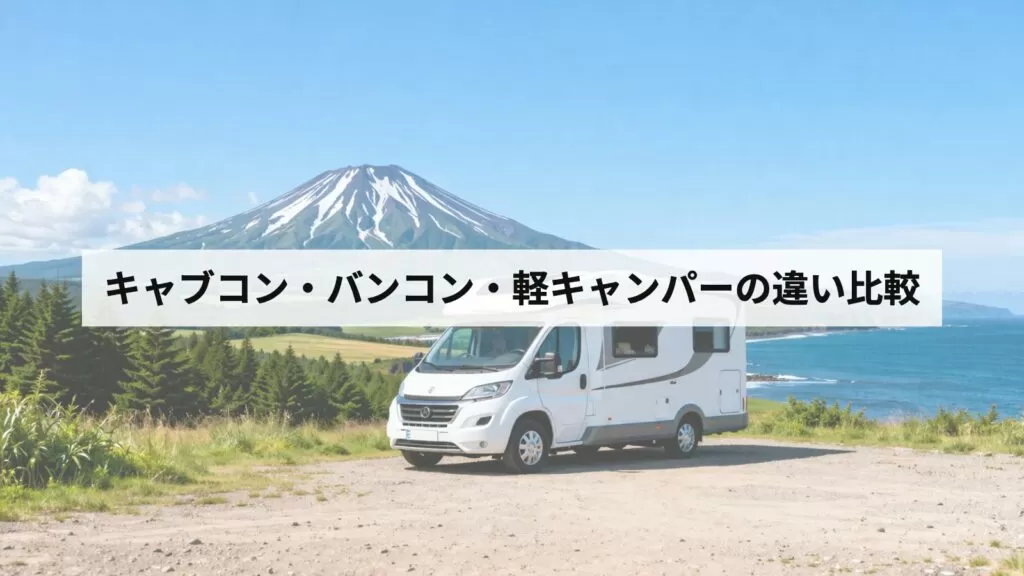
Here is a comparison table of the three main campervan types. Use it to choose the type that best fits your purpose and budget.
| Category | Cab-over Camper | Cabin Van | Kei Camper |
|---|---|---|---|
| Base vehicle | Truck (Camroad, etc.) | Commercial van (HiAce, etc.) | Kei van (Every, etc.) |
| Length | ~5.0–5.5 m | ~4.8–5.4 m | ~3.4 m |
| Height | ~2.7–3.0 m | ~2.1–2.3 m | ~1.8–2.0 m |
| Sleeping capacity | 4–6 | 2–4 | 1–2 |
| Stand upright inside? | Yes | Depends on model | No |
| Equipment | ◎ (Kitchen, toilet, etc.) | ○ (Mainly kitchen) | △ (Minimal) |
| Ease of daily use | △ (Parking restrictions) | ○ (Looks like ordinary car) | ◎ (Kei-class) |
| New vehicle price | ¥6–10M | ¥4–8M | ¥1.5–4M |
| Fuel economy | 6–9 km/L | 8–10 km/L | 10–13 km/L |
| Best for | Family trips, long journeys | Weekend trips, dual-use | Solo/couples, casual travel |
Cabin Vans are easy to use alongside everyday driving since they look like ordinary cars. Kei campers are attractive for their low running costs and maneuverability. For livability and equipment richness, however, the Cab-over Camper is overwhelmingly superior. For a detailed rental price comparison, see the campervan rental price guide.
Cab-over Camper Prices | New and Used
New Cab-over Camper prices vary significantly depending on the base vehicle and conversion. For the mainstream Camroad-based models, entry-class starts at around ¥6 million, popular models run ¥8–10 million, and full-option specs exceed ¥10 million as of 2026.
Used vehicles are available in the ¥2–8 million range, with a wider selection depending on year and mileage. Since the condition of the conversion is critical, buying from a specialist dealer is the safer choice. If you’re unsure about spending that much upfront, renting first to test usability is the smart move.
Cab-over Campers cost more than Cabin Vans or kei campers largely because the shell is designed and built from scratch, separately from the base vehicle. The more densely a model packs in a kitchen, toilet, and sleeping berths, the more materials and labor go into the conversion, and that shows up in the price.
License Requirements for Cab-over Campers
Most Cab-over Campers have a gross vehicle weight under 5 t and seat 10 or fewer passengers, so a standard license is sufficient. However, standard licenses obtained on or after March 12, 2017 are limited to vehicles under 3.5 t gross weight, so some models may require a semi-medium license.
For detailed information on license categories and eligible vehicles, see the campervan license guide. When renting, the rental company will verify your license, so check the vehicle’s gross weight in advance.
Try a Cab-over Camper through rental
Cab-over Campers are expensive vehicles, but rental lets you experience them by the day. Driving one for real gives you a feel for its size, maneuverability, interior space, and how the equipment works.
Hokkaido in particular, with its wide roads and many straight stretches, is a forgiving environment even for Cab-over Camper first-timers. Traveling through Hokkaido’s vast nature while sleeping in a campervan is the ultimate stage for experiencing the full appeal of a Cab-over Camper. Also check out overnight parking spots and rules in Hokkaido.
Moving Inn offers campervans ideal for Hokkaido trips. Check the rental page for equipment details and pricing.
3 Reasons a Cab-over Camper Suits Hokkaido Travel
Among all campervan types, the Cab-over Camper is especially well matched to long-distance travel in Hokkaido. Here are three reasons why.
Reason 1: In a vast region like Hokkaido, a “room on wheels” is the best accommodation
Hokkaido covers 83,424 km²—about 22% of Japan’s total land area. Within the island alone, it’s not unusual to cover a distance comparable to Tokyo–Osaka (roughly 550 km). Rather than booking a hotel every night, staying in a Cab-over Camper at roadside stations or other overnight spots gives you far more flexibility in your itinerary.
Reason 2: An FF heater keeps Hokkaido nights comfortable
Nighttime temperatures in Hokkaido can drop below 10–15°C even in summer, and fall much further in spring, autumn, and winter. Most Cab-over Campers come with an FF heater as standard equipment, which can keep the interior above 20°C even when it’s -20°C outside. Our guide to how FF heaters work and how to choose one covers this in detail.
Reason 3: A fridge and home cooking keep food costs down
Hokkaido’s produce is fresh, affordable, and widely available at roadside stations and farm-direct markets. Cooking in the Cab-over Camper’s kitchen lets you enjoy Hokkaido’s food culture while keeping your travel budget in check.
Who a Cab-over Camper Is (and Isn’t) Right For
| Good fit | Not a good fit |
|---|---|
| Family trips of 4 or more | Solo or couple trips of 1–2 people (a Cabin Van or kei camper suits better) |
| Hokkaido trips of a week or longer | Short 2–3 night trips (the cost is harder to justify) |
| Travelers who want to cut hotel costs | Trips that rely heavily on multi-story car parks in cities |
| Travelers concerned about Hokkaido’s climate (an FF heater helps) | Drivers nervous about handling a large vehicle (try a Cabin Van first) |
| Trips centered on roadside stations or RV parks | Trips built mainly around tent camping |
Checklist: What to Confirm Before Renting a Cab-over Camper
A Cab-over Camper is a high-value vehicle, whether you’re buying or renting. Use this checklist to avoid surprises after you’ve booked.
- [ ] Confirmed the license category required (gross vehicle weight) before booking
- [ ] Confirmed sleeping capacity and how to set up the bank bed or dinette conversion
- [ ] Confirmed the size of the fresh and waste water tanks, and the rules for returning them (for example, full-tank return)
- [ ] Confirmed whether the vehicle has an FF heater, if traveling in winter
- [ ] Confirmed the pet policy and any extra rules for traveling with pets
- [ ] Confirmed mileage limits and insurance deductible amounts
- [ ] Confirmed whether there’s a walkthrough of the water, drainage, and toilet systems before departure
- [ ] Confirmed the vehicle’s height and width, and whether your route avoids height-restricted parking
- [ ] Confirmed pickup/return times and locations, and any extension fees
For FF heater specifics, see our guide to FF heaters; for vehicle size and parking considerations, see our parking and navigation guide.
FAQ
Q. Can I drive a Cab-over Camper with a standard license?
Yes, most Cab-over Campers have a gross vehicle weight under 5 t and can be driven with a standard license obtained on or before March 11, 2017. However, standard licenses issued on or after March 12, 2017 are limited to under 3.5 t, so some models may require a semi-medium license.
Q. Which is better for beginners—a Cab-over Camper or a Cabin Van?
If you want to use it alongside everyday driving, the Cabin Van is the easier choice since it looks like an ordinary car and has fewer parking issues. If interior comfort and equipment are your priority, the Cab-over Camper has a clear advantage in interior space.
Q. What is the fuel economy of a Cab-over Camper?
A typical Camroad-based Cab-over Camper averages around 6–9 km/L in real-world driving. Diesel models use cheaper light fuel oil than gasoline, helping offset the cost. Fuel economy tends to improve when driving at a steady speed on expressways.
Q. How many people can sleep in a Cab-over Camper?
Including the bank bed and dinette conversion, a typical Cab-over Camper sleeps 4–6 people. Most models comfortably accommodate a family of four including children.
Q. Can I rent a Cab-over Camper?
Yes, Cab-over Campers are available at campervan rental companies across Japan. Daily rates vary by model and season, and more people are using rental as a way to try before buying.
Q. Why is the ceiling in a Cab-over Camper so high?
Because the living shell is designed from scratch, independent of the truck’s cab and chassis. Japan’s structural requirements for Category 8 special-purpose vehicle registration also require clear headroom around the sink and cooking counter, which is why you can stand up and move around inside.
Q. What layouts are available in a Cab-over Camper?
The three most common are an over-cab bunk bed, a dinette conversion bed, and a fixed rear bed. Layouts vary by vehicle when renting, so check the floor plan before you book.
Q. What should I confirm before renting a Cab-over Camper?
Check the license category, sleeping capacity and bed setup, water tank capacity, whether an FF heater is fitted, mileage limits, and insurance deductibles before you book. Doing so avoids surprises on the day.
Summary
The Cab-over Camper is the classic campervan, combining a spacious interior, rich equipment, and excellent insulation. Despite drawbacks like parking restrictions and fuel consumption, it delivers unmatched comfort for family trips and extended overnight travel. Compare it against Cabin Vans and kei campers, and choose the type that suits your travel style. When renting, compare the layout types and the checklist above to find the vehicle that best fits your trip.
Why not start by experiencing the appeal of a Cab-over Camper through rental? Reserve a Moving Inn rental here.
※ Article content reflects information as of March 2026. Vehicle specs and prices are subject to change.
Book a Campervan in Hokkaido
Moving Inn New Chitose Airport supports English booking and offers airport transfers.
Pick a campervan by what matters to you.
Rent at New Chitose Airport
See only the rental bases in Chitose, where the airport is.