Campervan Fuel Economy Comparison Guide | Real-World Economy by Vehicle Type & Costs to Know Before Renting
A thorough comparison of campervan fuel economy by vehicle category.
Pick a campervan by what matters to you.
Rent at New Chitose Airport
See only the rental bases in Chitose, where the airport is.
Rent in winter (Dec–Mar)
Companies that rent through winter, listed apart from those that close.
Guide price
Moving Inn New Chitose Airport: HIACE van conversion from ¥22,000 per night. 20–30% off when booked 60–90 days ahead (official rate table, checked 15 Oct 2026).
Before you book: with an International Driving Permit if your country is in the Geneva Convention (for example the US, Australia, Singapore); Taiwan, Switzerland, Germany, France, Belgium and Monaco need your licence plus a Japanese translation (Tokyo Metropolitan Police). Questions in English: Moving Inn on WhatsApp. Every roadside station (michi-no-eki) must have free 24-hour toilets, and Hokkaido has 128 of them (MLIT).

Fuel Economy Matters as Much as Rental Price
When renting a campervan, most people only compare rental rates. But on a Hokkaido trip covering 200–400 km a day, fuel costs can account for 20–40% of what you spend on the rental itself.
For example, driving 1,000 km over 3 nights and 4 days, the difference in diesel costs between a vehicle getting 6 km/L and one getting 10 km/L can reach roughly ¥8,000–¥10,000. Choosing a more fuel-efficient model can actually be cheaper overall than going for a lower rental price.
This article lays out all the decision criteria for choosing the right vehicle type.
Real-World Campervan Fuel Economy | Catalogue vs Reality Differs by 20–30%
Why You Shouldn’t Trust Catalogue Figures
Manufacturer WLTC figures do not reflect real-world conditions: air conditioning, load, hills, crosswinds. For campervans, actual fuel economy is 70–80% of the catalogue value. Roughly speaking:
- Catalogue 10 km/L → real-world 7–8 km/L
- Catalogue 12 km/L → real-world 8–9.5 km/L
- Catalogue 8 km/L → real-world 5.5–6.5 km/L
When reading the spec sheet for a rental vehicle, always multiply the stated figure by 0.75 before planning.
5 Factors That Determine Fuel Economy
- Vehicle weight: Kei campervan ~1 tonne ⇔ cab-over ~3 tonnes — huge difference
- Vehicle height (aerodynamic drag): High-roof and pop-top designs suffer in wind
- Engine type: Petrol vs diesel can vary by 1.5× even at the same weight
- Cruising speed: 10–15% difference between 90 km/h and 110 km/h cruise
- Load and occupants: 4 people + food + water = 200–300 kg extra → 5–10% worse fuel economy
Real-World Fuel Economy Ranking by Vehicle Category (2026)
| Category | Representative model (base) | Fuel | Estimated real-world economy | Comment |
|---|---|---|---|---|
| Kei campervan | Suzuki Every / Daihatsu Atrai | Petrol | 10–13 km/L | No.1 economy. Better for short trips |
| Van conversion (standard vehicle) | Toyota HiAce 2.8L diesel | Diesel | 8–10 km/L | Best all-rounder |
| Van conversion (petrol) | HiAce 2.7L | Petrol | 7–9 km/L | Better for city driving |
| Cab-over (Camroad base) | Vantech ZIL, Nuts RV Crea | Diesel | 7–9 km/L | Living space ◎ / Economy △ |
| Bus conversion | Coaster / Civilian | Diesel | 5–7 km/L | For large groups |
| American motorhome | Ford / Chevrolet chassis | Petrol | 3–5 km/L | Be prepared for fuel costs on long trips |
Sources for these estimates: van conversion — Toyota HiAce Van 2.8L diesel WLTC up to 12.4 km/L (Toyota spec sheet) and owner-reported average 9.75 km/L (Minkara); cab-over — Camroad owner-reported averages of 8.32 km/L diesel / 6.73 km/L petrol (Minkara); kei campervan — base Suzuki Every WLTC 13.1–17.2 km/L adjusted ×0.7–0.8 for conversion weight and luggage (editorial estimate). Checked September 2026. Bus conversion and American motorhome figures are editorial estimates.
The kei campervan ranks No.1 for fuel economy, but it seats a maximum of 4 and has limited living space. See the Kei Campervan Rental Guide for more.
Real-World Simulation | Hokkaido 3-Night 4-Day Trip (1,000 km) — How Much Does Fuel Cost?
Assuming diesel at ¥160/L:
| Vehicle | Real-world economy | Fuel needed (L) | Fuel cost |
|---|---|---|---|
| Kei campervan (petrol at ¥170/L) | 13 km/L | 76.9 L | approx. ¥13,100 |
| Van conversion (HiAce diesel) | 10 km/L | 100 L | approx. ¥16,000 |
| Cab-over (Camroad diesel) | 8 km/L | 125 L | approx. ¥20,000 |
| Bus conversion | 6 km/L | 167 L | approx. ¥26,700 |
The gap between a HiAce diesel and a Camroad cab-over over 3 nights and 4 days is around ¥4,000. For the full cost picture over a week, see the 1-Week Cost Simulation at 1-Week Rental Cost Simulation.
New Chitose Airport / Tokachi-Obihiro Airport
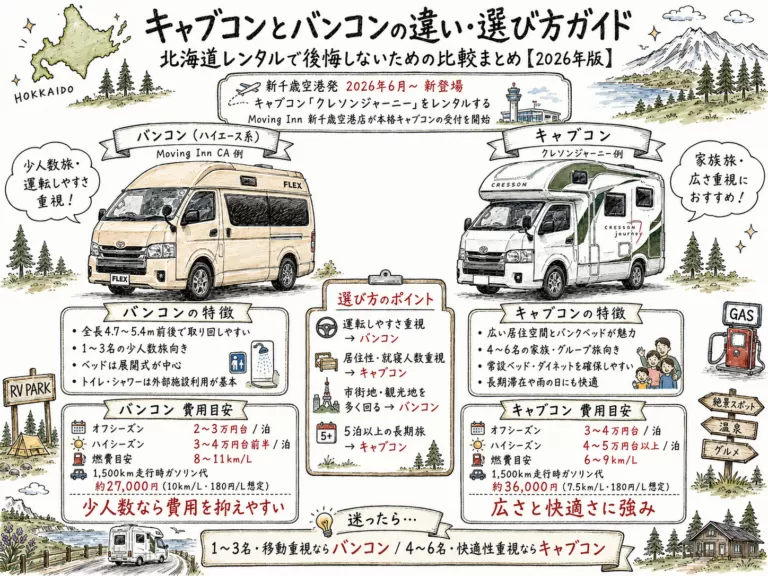
Rent the Cabcon “Cresson Journey”
Base yourself at New Chitose Airport and compare rates, vehicle types, and pickup locations all in one place.
See details at Moving Inn →5 Techniques to Improve Fuel Economy by 10%
① Cruise at 90 km/h
Above 100 km/h, aerodynamic drag spikes and fuel economy drops 10–15%. For long Hokkaido distances, 90 km/h cruise is optimal (also see Campervan Driving Tips).
② Avoid Sudden Acceleration and Hard Braking
A heavy campervan needs more than twice the energy of a passenger car to accelerate. Smooth acceleration is the single biggest fuel economy improvement you can make.
③ Check Tyre Pressure Before Departure
Tyres just 50 kPa below the recommended pressure mean 2.5–4.8% worse fuel economy (Japan Automobile Tyre Manufacturers Association; it varies between city, suburban and expressway driving). Check at a petrol station before a long trip.
④ Don’t Carry Unnecessary Weight or Water
A full fresh water tank adds 100 kg. Half a tank is enough for short trips. Reducing weight by 10% improves fuel economy by about 3–5%.
⑤ Minimise Idling
The FF heater and air conditioning while sleeping don’t affect fuel economy, but idling the engine burns about 1 L of fuel per hour.
Checklist for Choosing a Fuel-Efficient Model
At the time of booking, confirm the following:
- Fuel type (diesel or petrol): Diesel tends to be cheaper per litre and more fuel-efficient
- Engine displacement and torque: High-torque diesel handles hills with less fuel penalty
- Tyre size: Oversized tyres prioritise looks and worsen fuel economy
- Aerodynamic add-ons: Presence of roof vent, solar panel, or roof rack
Frequently Asked Questions (FAQ)
Q1: Which campervan has the best fuel economy?
If you can sacrifice living space, the kei campervan (10–13 km/L). For family trips, a HiAce diesel van conversion (8–10 km/L) is the practical best.
Q2: Petrol or diesel?
For long distances or a cab-over, diesel without question. For mostly city driving, petrol is fine.
Q3: Are there hybrid campervans?
Still very few domestically, and barely available in the rental fleet. As of 2026, diesel is the practical answer.
Q4: How can I use a cab-over without worrying about fuel costs?
Limit daily driving to around 200 km and centre the itinerary on sightseeing and staying put, which reduces the impact of fuel costs.
Driving style also matters for fuel economy. Check Campervan Driving Tips for fuel-saving techniques.
Summary | Calculate Total Cost Using “Real Economy × Planned Distance”
Campervan fuel economy varies by up to 2–3× across vehicle categories. Don’t just compare rental prices — always calculate the total using “real-world economy × planned distance × fuel price per litre” before deciding on a vehicle.
For long-distance Hokkaido trips, a HiAce-based diesel van conversion offers the best balance of fuel economy, living space, and drivability.
Fuel Cost Simulator
New Chitose Airport / Tokachi-Obihiro Airport
Rent the Cabcon “Cresson Journey”
Base yourself at New Chitose Airport and compare rates, vehicle types, and pickup locations all in one place.
See details at Moving Inn →Book a Campervan in Hokkaido
Moving Inn New Chitose Airport supports English booking and offers airport transfers.
Pick a campervan by what matters to you.
Rent at New Chitose Airport
See only the rental bases in Chitose, where the airport is.