Buying a Used Campervan in Hokkaido: 7 Cold-Climate Checks and Where to See One in Person
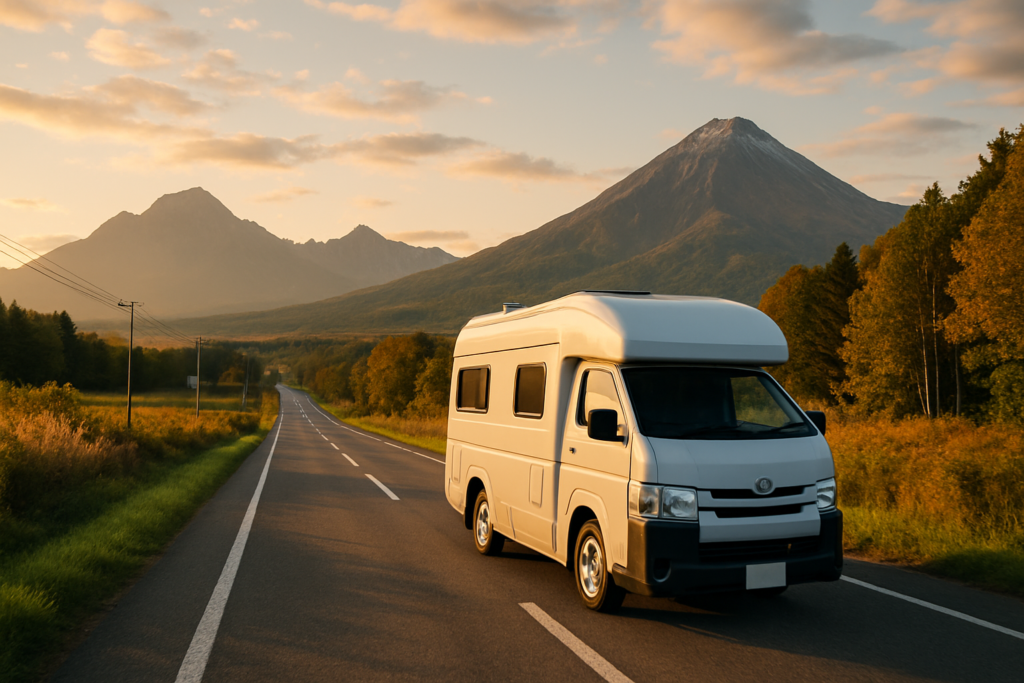
Scrolling through used campervan listings on Carsensor or Goo-net, the one that catches your eye is usually located outside Hokkaido. It may look great in the photos, but you can’t tell from the screen what kind of environment the vehicle has been used in, or whether its equipment can handle a Hokkaido winter.
The basics of choosing a used campervan are the same everywhere in Japan, but driving one in Hokkaido adds 7 cold-climate-specific checks. Does the FF heater actually ignite? Has road de-icing salt corroded the underside? Have the water pipes cracked from freezing? This article covers how to check those 7 points, plus how to choose between the dealers in Hokkaido where you can see the vehicle in person.
This is written for people who live in Hokkaido, or who plan to move there and use the vehicle long-term. If you only want to use one for a 1–2 week trip, renting comes before buying. The dividing line between buying and renting is covered in the second half of this article.
There Are 3 Routes to Buying a Used Campervan in Hokkaido
Broadly speaking, there are 3 ways to search. None is “correct” over the others — the right choice depends on whether you can go see the vehicle in person.
| Route | Strength | Where people get stuck |
|---|---|---|
| Nationwide used car portals (Carsensor, Goo-net, etc.) | The largest number of listings; you get a feel for market prices | If the vehicle is outside Hokkaido, you must choose between traveling to see it or buying unseen |
| Buying from a dealer in Hokkaido | You can inspect the actual vehicle yourself. Staff can answer questions about snow roads and winter equipment | Fewer options than nationwide portals |
| Buying from a dealer outside Hokkaido and shipping it in | Covers cases where the one vehicle you want only exists outside Hokkaido | Land transport plus ferry costs money. Some vehicles won’t have cold-climate specification |
Shipping costs vary by departure point, vehicle size, and season, so if you’re considering buying outside Hokkaido, get a shipping quote first. That lets you judge whether a “cheap vehicle” you see on a portal site is actually cheap once shipping is added.
Whichever route you buy through, the following 7 points apply the same way. They’re listed in order so you can use them directly during an in-person inspection.
Where Cold-Climate Used Vehicles Wear Out: 7 Points to Check
Of the 7 points, the first 3 are “places that get expensive to fix,” and the remaining 4 determine “whether the vehicle actually works in winter.” During an in-person inspection, don’t settle for a verbal explanation — ask the dealer to actually operate each system in front of you.
1. Does the FF Heater Actually Ignite?
For overnight parking in Hokkaido, a vehicle whose FF heater doesn’t work isn’t an option. Have the dealer ignite it during your visit, and check the time it takes to produce warm air, any unusual noise while it’s burning, and the smell of the exhaust. A unit that hasn’t been run for a long time can misfire or produce white smoke, and repairs require disassembling the unit. How the system works and what normal operation looks like is covered in our FF heater guide — reading it before your visit makes the conversation with the dealer more concrete.
2. Sub-Battery Degradation and Replacement History
Sub-batteries lose performance in low temperatures and are a consumable part. Get written confirmation of the battery type installed (lead-acid or lithium), its replacement history, and the year it was replaced. If you take the dealer’s word for “it still works” without documentation, it may not last a single night through your first winter. The basics of the electrical system are covered in our electrical system guide.
3. Rust Underneath: Road De-Icing Salt Eats Metal
Chloride-based de-icing salt is spread on main roads in winter, so vehicles that have driven in Hokkaido or other heavy-snow regions tend to develop rust underneath faster. Ask the dealer to lift the vehicle and show you the frame, muffler, brake lines, and step area. Surface rust and corrosion that has progressed to near-perforation are two very different things. If rust-proofing has been applied, check that record too.
4. Whether It Has Cold-Climate Specification
Vehicles that came from outside Hokkaido sometimes have a base vehicle that isn’t cold-climate specification. What “cold-climate specification” includes varies by model and year, so don’t settle for a yes/no answer to “is this cold-climate spec?” — ask for it in writing, listing exactly what’s included (battery capacity, wiper de-icer, heater upgrade, etc.). If there’s no documentation, treat it as “not stated” and judge based on the physical equipment in front of you.
5. Insulation and Signs of Condensation
The temperature difference between inside and outside the vehicle in winter causes condensation, which lets mold and corrosion progress behind the interior panels. Check the rubber around the window frames, the seams in the wall panels, and the wall surface under the bed for stains or warping. A musty smell the moment you step inside is also a useful clue. Whether the vehicle has double-glazed (acrylic) windows or insulation work makes a big difference to how usable it is in winter.
6. Studless Winter Tires and Storage History
Campervans sometimes use unusual tire sizes, so buying a new set of studless winter tires can be costly. If tires are included, check their manufacture date and tread depth. Ask whether the vehicle itself has been stored indoors or outdoors — one that’s been stored outdoors under snow carries a higher risk of deteriorated seals and leaks.
7. Freeze Protection and Cracks in the Water System
Water supply and drain tanks and pipes crack from freezing if the water isn’t drained before winter. Check the replacement history of the tank, pump, and pipes, and whether the previous owner drained the water system for winter. If possible, have the dealer run water through the system to check for leaks. Repairs here require disassembling part of the vehicle’s interior structure, which is a classic case where a vehicle that looked cheap ends up expensive.
Three Hokkaido Dealers Where You Can See the Vehicle in Person
The 7 points above can only be checked once you’re standing in front of the actual vehicle. Here are the dealers in Hokkaido where you can inspect a used campervan (or a HiAce with campervan lineage) in person, organized by the type of vehicle you’re after. FLEX suits HiAce-based Vancon buyers, Fuji Cars Japan Sapporo suits people who want to see a wide range of campervan-spec vehicle types, and RV Land Hokkaido suits people who want to include large motorhomes and trailers.
| Dealer | Location | Best for | Inventory (checked) |
|---|---|---|---|
| FLEX HiAce Sapporo-Nishi | Sapporo | People looking for a HiAce-based Vancon | Mainly HiAce vans and wagons. Many converted interior Vancon-type vehicles. No cabcons carried (checked 2026-08-14) |
| Fuji Cars Japan Sapporo | Kiyota-ku, Sapporo | People who want to see a wide range of campervan-spec vehicle types | Of 49 vehicles listed on Carsensor, campervan-spec vehicles ranging from kei-truck-based to HiAce vans and imports, across a wide price range (checked 2026-08-14) |
| RV Land Hokkaido | Chitose | People who want to see large motorhomes and trailers too | Calls itself “Japan’s largest outdoor campervan showroom.” Inventory includes imported motorhomes and trailers (checked 2026-08-14) |
FLEX HiAce Sapporo-Nishi specializes only in HiAce-based vehicles. As of 2026-08-14, its listed inventory was around 140 vehicles, priced roughly ¥4,000,000–¥6,450,000, centered on Vancon-type vehicles fitted with bed kits and reconfigured seating. Inventory turns over, so check the store page for the latest count and pricing. It won’t suit anyone looking for a cabcon. Note that a separate FLEX store called “HiAce Sapporo” also exists nearby, so confirm the exact store name before visiting.
[Disclosure] Moving Inn, the campervan rental service compared on this site, is operated by FLEX Co., Ltd. (The former Moving Inn Co., Ltd. was dissolved through a merger in November 2025 and integrated into FLEX Co., Ltd.) The FLEX HiAce Sapporo-Nishi store mentioned above is a store of the same FLEX Co., Ltd.
Fuji Cars Japan Sapporo (2-jo 2-16-1 Kiyota, Kiyota-ku, Sapporo / 011-375-8330) is a specialty dealer carrying a wide range of campervan-spec vehicles. As of 2026-08-14, its Carsensor-listed store page showed 302万円 (approx. ¥3,020,000) base price for a Nissan Vanette Truck (campervan spec), and base prices of approx. ¥2,820,000, ¥5,590,000, and ¥8,180,000 for Toyota HiAce Van (campervan spec) units among 49 vehicles listed — ranging from kei-truck-based vehicles to large HiAce vans at very different price points. Inventory turns over, so check the Carsensor listing page for the latest vehicles and prices. Note that the company’s Chitose store is a rental base, and its official page makes no mention of used vehicle sales (checked 2026-08-14). For a purchase inquiry, go to the Sapporo store.
RV Land Hokkaido (2-chome 17-28 Aoba, Chitose) is a specialty dealer that calls itself “Japan’s largest outdoor campervan showroom,” and its inventory stands out for including large motorhomes and trailers. As of 2026-08-14, its official used-vehicle inventory page showed a White House Compass Doruku P-Cool at approx. ¥8,570,000, a Trigano Emeraude 376VP at approx. ¥2,950,000, and a Knaus (with air conditioning) at approx. ¥2,550,000. Check the official used-vehicle inventory page for the latest vehicles and prices.
Checking the vehicle in Sapporo
See FLEX HiAce Sapporo-Nishi’s inventory
Browse HiAce-based Vancon inventory with photos and prices listed.
See the inventory →How Much Should You Budget for Price and Running Costs?
General price ranges for new and used vehicles by type are covered in our campervan price guide. Vancon and cabcon prices are in completely different ranges, so getting a baseline there before you visit dealers will help you judge whether the vehicle in front of you is expensive or cheap.
What’s easy to overlook is the cost after you buy. Vehicle tax, insurance, inspections, and parking add up every year, separate from the purchase price. The actual annual amount, and how many nights of rental that same amount would cover, is calculated in our running cost article. Set your purchase budget as “vehicle price plus first-year running costs.”
Before You Buy: Try Renting First to Check
Deciding on a multi-million-yen purchase for a vehicle size you’ve never driven is a bad bet. Once you’ve narrowed down your candidates, renting the same type of vehicle for 1–2 nights lets you experience life after purchase before you commit, which cuts down on regrets. The steps are simple.
- Choose the same type as your candidate (a Vancon if you’re eyeing a HiAce Vancon, a cabcon if you’re eyeing a cabcon)
- Rent it for 1–2 nights, ideally when temperatures drop
- Use everything as if you already bought it: sleeping, the FF heater, the water system, driving and parking
- After you return it, re-read the 7-point checklist. What you prioritize should have shifted
Some people sleep one night in a Vancon and realize “a family of 4 needs the space of a cabcon,” while others become convinced that “a Vancon is plenty for everyday use.” If you’re renting in Hokkaido, the Moving Inn vehicle and pricing comparison page lets you compare both Vancons and cabcons.
Buy, Try Renting First, or Is Renting Enough?
Finally, let’s turn everything above into a decision. Which category you fall into determines what to do next.
- You should buy: You’ll use it many times a year, including in winter, and you have somewhere to store it. Take the 7-point checklist to a dealer in Hokkaido. Building a price baseline from the price guide first makes negotiations faster
- Rent first, then decide: You haven’t settled on Vancon vs. cabcon, or you can’t picture living in the vehicle in winter. Rent the same type for 1–2 nights, then come back to this
- Renting is enough for you: You’ll only use it a few long weekends a year. Once you look at the annual running cost, renting usually works out cheaper
If you’re leaning toward buying, read our campervan drawbacks article before signing anything. It covers storage, fuel economy, and everyday-use constraints — regrets that show up after buying, separate from the cold-climate checks above.
Frequently Asked Questions (FAQ)
Q1: Is it OK to buy from a dealer in mainland Japan and bring the vehicle to Hokkaido?
Yes — it opens up far more options. But 3 conditions apply: ① Don’t buy without seeing the actual vehicle (budget for the travel cost of visiting it). ② Get a shipping quote (land transport plus ferry) first. ③ Confirm cold-climate specification in writing. Skip these 3 steps and decide on price alone, and it can end up costing more than buying in Hokkaido.
Q2: Should I avoid taking delivery in winter?
It depends. Taking delivery in winter has the advantage of letting you test the FF heater and insulation in real conditions right away. On the other hand, you’ll be driving an unfamiliar, large vehicle on snowy roads immediately after delivery. If you’re not confident driving in snow, taking delivery in spring through fall and getting used to the vehicle’s size before your first winter is the safer choice. Preparing to drive in winter is covered in our winter driving article.
Q3: Where can I get maintenance and inspections done in Hokkaido?
The base vehicle can be serviced at a regular garage, but the converted parts — the FF heater, sub-battery, and water system — can be difficult for a shop without campervan experience to handle. Before you buy, always ask “can this shop handle inspections and repairs on the converted parts as well?” This matters even more if you’re buying and shipping the vehicle in from outside Hokkaido.
Book a Campervan in Hokkaido
Moving Inn New Chitose Airport supports English booking and offers airport transfers.
![Hokkaido Winter Trip: Shoes & Packing List [2026] – 2,060 Sapporo Fall Transports and a Pre-Departure Checklist](https://hokkaido-campingcar.jp/wp-content/uploads/2026/10/hokkaido-winter-trip-shoes-packing-eyecatch-768x432.webp)
![Things to Do in Sapporo in Winter: Beyond the Snow Festival, Plus Seasonal Highlights and a Campervan Guide [2026-27]](https://hokkaido-campingcar.jp/wp-content/uploads/2026/10/sapporo-hl1841-768x576.jpg)
![Snow Cancels Your New Chitose Airport Flight? Rebooking Rules and Campervan Rental Delays [2026]](https://hokkaido-campingcar.jp/wp-content/uploads/2026/10/new-chitose-airport-snow-cancellation-eyecatch-768x432.webp)
![Monbetsu Drift Ice Festival 2027 [Feb 11–14]: Dates, Ice Sculptures, Garinko-go Icebreaker, Parking and Access by Campervan](https://hokkaido-campingcar.jp/wp-content/uploads/2026/10/monbetsu-hl999-768x576.jpg)
![Hokkaido New Year Weather and What to Wear | Sapporo, Hakodate, Asahikawa, Obihiro Mornings and Evenings, and Heavy-Snow Years [2026-27]](https://hokkaido-campingcar.jp/wp-content/uploads/2026/10/hokkaido-new-year-holiday-weather-eyecatch-768x432.webp)