Campervan Electricity & Power Complete Guide | How to Use Sub-Battery, Solar Panels & External Power [2026]
A complete guide to campervan electricity and power. Explains how to use sub-batteries, solar panels, and external power connections effectively.
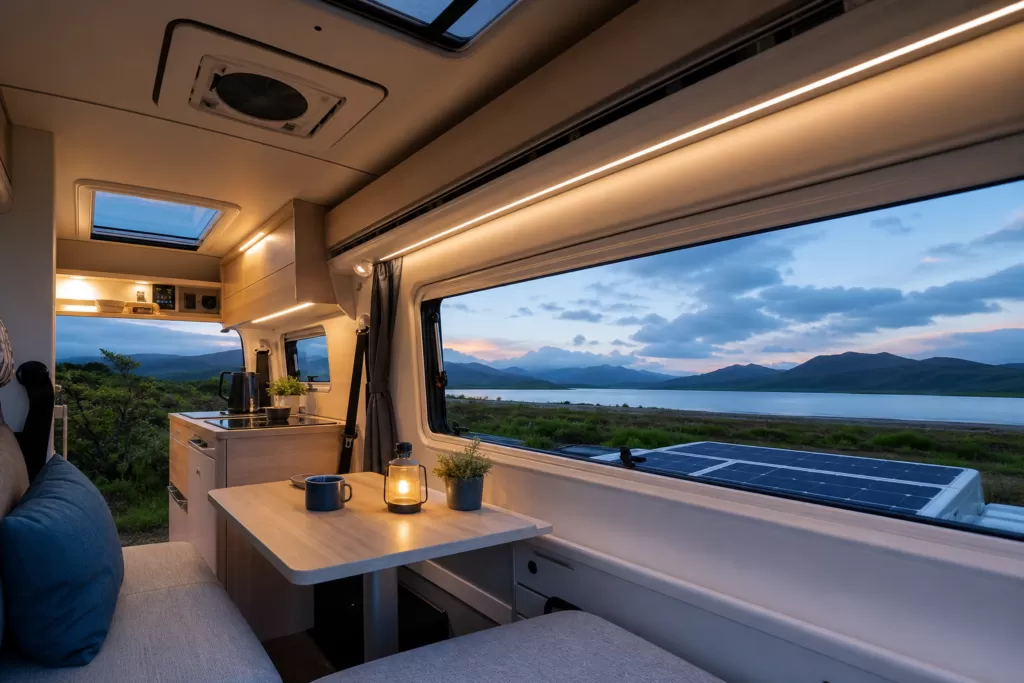
When traveling around Hokkaido in a campervan, how well you understand the electrical system makes a huge difference to your comfort. Complaints like “the battery died and I couldn’t charge my phone” or “the fridge stopped working in the middle of the night” are common. This guide covers everything from the basics of a campervan’s electrical system to solar panels, external power hookups, power-saving techniques, and how to deal with battery trouble — all the practical information you need for your trip.
Especially with rental campervans, many people feel confused by an unfamiliar vehicle’s electrical system on their first time behind the wheel. Questions like “which switch do I press?”, “how much of the battery am I allowed to use?”, and “how do I hook up to external power at an RV park?” are answered here step by step. Since a Hokkaido trip often includes free camping, understanding how solar charging and engine charging work makes it much easier to plan your trip.
The Campervan Electrical System at a Glance (Engine Charging, Sub-Battery, Inverter)
A campervan’s electrical setup is broadly made up of two systems: the “driving battery (main battery)” and the “house battery (sub-battery).” Understanding the role of each helps you avoid trouble on the road.
Main Battery vs. Sub-Battery
The main battery is dedicated to starting the engine. All house power — lighting, the fridge, phone charging — is supplied entirely by the sub-battery. Because the two systems are kept separate, the engine will still start even if you’ve used up all your house power.
Sub-battery capacity varies by vehicle, but a typical campervan (Cabcon type) carries one or two batteries rated at 100–200Ah. As a rough guide, a 100Ah battery (about 1,200Wh at 12V) would run a fridge drawing 50W for just under a day (about 20 hours), while an air conditioner drawing 1,000W would drain it in about 1 hour.
How Engine Charging Works
While the engine is running, the alternator automatically charges the sub-battery. About an hour of driving replenishes roughly 10–20Ah. On routes that involve long-distance driving around Hokkaido, engine charging alone is often enough to keep the battery topped up.
The Role of the Inverter and How to Choose One
The sub-battery supplies DC 12V (12-volt direct current). Since most household appliances run on AC 100V (100-volt alternating current), you need a converter called an “inverter” to bridge the two.
There are two types of inverter: “pure sine wave” and “modified sine wave (quasi sine wave).”
| Type | Characteristics | Best suited for |
|---|---|---|
| Pure sine wave | Same waveform as household outlets. Minimal impact on electronics | Precision equipment, medical devices, AC chargers, motors |
| Modified sine wave | Lower cost. Can cause noise in some appliances | Light bulbs, fans, simple chargers |
If you’re using precision equipment such as a laptop charger, a mirrorless camera charger, or an electric toothbrush, a pure sine wave inverter is the safer choice. Most recent campervans now come standard with a pure sine wave inverter.
For tips on choosing the right inverter capacity — including the starting-wattage trap and appliance-by-appliance power draw — see the Inverter Buying Guide.
Compare Hokkaido campervan rentals
Base yourself at New Chitose Airport and compare rates, vehicle types, and pickup locations all in one place.
Compare rental companies and prices →How Solar Panels Work and Expected Power Output
Solar panels convert sunlight into DC power to charge the sub-battery. Because they can top up power even on days you don’t drive, they’re well suited to multi-night free-site camping or overnight parking. Hokkaido gets long hours of summer sunshine (Sapporo averages 180–200 hours of sunshine a month from June to August), making it a good match for solar power generation.
Expected Power Output
With a 100W solar panel mounted on the roof, you can expect around 400–500Wh of generation per day on a clear summer day in Hokkaido. That’s enough for roughly 30 phone charges (about 15Wh each), or 8–10 hours of fridge operation (at 50W).
However, output varies a great deal depending on the weather, the panel’s orientation, and shading. On cloudy or rainy days, output can drop to as little as 20–30% of a clear day’s output. Hokkaido gets long summer daylight hours, but the weather can still turn unpredictably, so it’s important not to design your power plan around solar alone.
Types of Solar Panel Installation
- Fixed (roof-mounted): Charges even while driving. The angle can’t be adjusted, but maintenance is easy
- Portable (foldable): Can be angled toward the sun for maximum efficiency. Requires storage space
Most rental campervans are fitted with fixed solar panels. Check each rental company’s vehicle specs for details.
What Is an MPPT Charge Controller?
A charge controller is required between the solar panel and the battery. Using an “MPPT (Maximum Power Point Tracking)” controller — more efficient than the older PWM type — can increase your charging yield by 10–30% from the same panel. MPPT is becoming standard in newer campervans.
For a deeper dive into calculating your own solar panel output, regional differences across Hokkaido, and how much panel capacity you actually need, see the Campervan Solar Panel Complete Guide.
Making the Most of RV Parks with External Power (AC 100V)
An RV park is a parking and overnight facility built specifically for campervans. They’re often located next to hot spring facilities or Michi-no-Eki, and most offer an AC 100V external power outlet. With external power, you can run the air conditioner, microwave, or hair dryer without worrying about your battery level.
As of 2026, the number of RV parks in Hokkaido keeps increasing year by year, and you can check the latest information on Kurumatabi, the site run by the Japan Recreational Vehicle Association (JRVA). Facilities are also being developed around popular sightseeing areas such as Furano, Biei, Shiretoko, and Hakodate. With the boom in overnight parking, more RV parks are also appearing next to Michi-no-Eki, making it easier to plan a convenient route where you can sightsee and recharge at the same time.
RV Park Power Specs
A typical RV park provides 100V/15A power — enough for up to 1,500W of simultaneous use. Running an air conditioner (700–1,000W) and a microwave (600–900W) at the same time will exceed that capacity, so you’ll need to use them one at a time or keep an eye on your total power draw.
Steps to Connect to External Power
- Take out the vehicle’s built-in power cable (cord)
- Plug it into the RV park’s outlet box
- Turn on the external power switch inside the vehicle
- The converter starts working, and charging of the sub-battery begins at the same time
Always plug in “vehicle side first, then park side,” and unplug in the reverse order. Avoid handling the connection with wet hands.
Where RV Parks Are Located in Hokkaido
RV parks are scattered across Hokkaido. Popular areas include Asahikawa, the Furano region, Tokachi, and the Hakodate area, each with multiple locations. Most require advance booking, and reservations fill up fast during the summer season (July–August). A night typically costs ¥1,000–¥3,000, and some locations include amenities such as hot spring bathing or laundry machines.
Power-Saving Tips and a Power Consumption Comparison for Fridges, Air Conditioners, and Lighting
To make your battery last, it’s important to know the power draw of each device and prioritize accordingly. Stories like “I used so much power I couldn’t even make coffee the next morning” are common. Build the habit of being mindful of power use to keep your trip comfortable.
Power Consumption of Common Electrical Devices (Approximate)
| Device | Power draw (approx.) | Runtime on a 100Ah battery |
|---|---|---|
| Fridge (campervan type) | 30–60W | Approx. 17–33 hours |
| LED lighting (all interior lights) | 10–30W | Approx. 40–100 hours |
| Smartphone charging (1 unit) | 5–15W | Approx. 70–200 hours |
| Laptop | 30–60W | Approx. 17–33 hours |
| Electric fan | 20–40W | Approx. 25–50 hours |
| Microwave (600W setting) | Approx. 900W | Approx. 1.3 hours |
| Room air conditioner (campervan type) | 600–1,200W | Approx. 1–1.5 hours |
| Hair dryer | 1,000–1,200W | Approx. 1 hour |
Tips for Saving Power
- Don’t set the fridge colder than necessary: Set it within a range that keeps food safe (3–5°C), and avoid leaving the door open for long each time
- Choose LED lighting: LEDs use 1/5 to 1/10 the power of incandescent bulbs. If you’re renting an older vehicle, bringing an LED lantern will help save power
- Use the air conditioner while driving or on external power: Running the AC on battery alone tops out at 1–2 hours, so save heavy AC use for nights at an RV park with external power
- Use the microwave for short bursts: Standby power isn’t zero either, so unplug it when it’s not in use
- Charge your phone while driving: Since engine charging gives you more headroom, charging on the move reduces battery drain at night
How to Check Remaining Battery Level
Many campervans come with a “battery monitor” (voltmeter/charge gauge). Once voltage drops below 12.0V, the battery is considerably drained. Ideally, keep it above 12.4V. If your vehicle doesn’t have a monitor, bringing a Bluetooth-enabled battery monitor that pairs with a smartphone app is a handy option.
New Chitose Airport / Tokachi-Obihiro Airport
Rent the Cabcon “Cresson Journey”
Base yourself at New Chitose Airport and travel all across Hokkaido by campervan.
See details at Moving Inn →Moving Inn’s Cresson Journey supports both a sub-battery and external power (AC 100V), so paired with RV parks you can enjoy your trip without worrying about power. Another plus: the shop is about 10 minutes by car from New Chitose Airport, with a free shuttle.
How to Deal with a Dead Battery and How to Prevent It
If the sub-battery discharges completely, the converter may stop working and you may no longer be able to charge from external power. Repeated deep discharging also shortens battery life significantly — with lead-acid batteries, repeatedly discharging below 50% is said to cut lifespan to a fraction of normal. Manage your battery carefully.
What to Do If the Sub-Battery Dies
- Connect to external power: Move to a powered site at an RV park or campground and charge up. The most reliable method
- Recover through engine charging: Driving for 1–2 hours restores a minimum level of power, though recovering from a full discharge takes longer
- Rent or buy a portable power station: Available at home centers in Hokkaido (Kohnan, DCM, etc.). Useful as an emergency backup
Since the main battery is independent of the sub-battery, the engine will still start even if the sub-battery dies, so you can drive to an RV park or another location with charging facilities.
What to Do If the Main Battery Dies
Leaving headlights or other electronics running for a long time with the engine off can drain the main battery. In that case, the engine won’t start.
- Use a jump starter: Keeping a compact lithium jump starter in the vehicle is a good safeguard — available for around ¥10,000
- Contact JAF or the rental company: For a rental vehicle, always contact the rental company’s emergency line. Connecting another battery on your own judgment could damage the vehicle
Habits That Prevent a Dead Battery
- Check your remaining battery level before bed, and plan for engine charging the next morning if it’s at 12.2V or below
- Make it a habit to turn off all interior and exterior lights after the engine is off
- Choose an RV park with external power for nights you’ll be using the air conditioner
- When staying at free sites for two nights or more in a row, check your solar output every day
- Use your battery monitor’s alarm setting (e.g. notify below 50% remaining)
Upgrading to a Lithium Battery
More campervans are now fitted with lithium-ion batteries (LiFePO4) in place of traditional lead-acid batteries (AGM/gel). For the same capacity, lithium batteries offer more usable discharge (about 80–90% for lithium versus 50% for lead-acid) and charge faster. However, they cost more per unit and require a compatible converter and charge controller. Check each rental company’s vehicle description for the battery type used.
Frequently Asked Questions (FAQ)
Q: Can I use a microwave in a campervan?
Yes, if you have an inverter and a sub-battery with enough capacity. However, running it on battery power alone should be limited to short bursts. If you’re connected to external power at an RV park, you can use the microwave comfortably.
Q: Can I run the air conditioner on battery power alone?
You can, but because it draws a lot of power, a 100Ah battery is only good for 1–2 hours. In Hokkaido summers (July–August), even at free sites the nighttime temperature often drops to around 20°C, so an electric fan is often enough. If you’re worried about a hot, humid night, choosing an RV park with external power is the safer bet.
Q: Can I travel on solar power alone?
If clear weather continues and you keep your power use to the fridge, lighting, and phone charging, a 100W solar panel can sometimes strike a balance. But Hokkaido’s weather is changeable, and cloudy or rainy days can continue for several days in a row. It’s more realistic to combine solar with engine charging and external power.
Q: How do I check the remaining battery level?
You can check it on the in-vehicle battery monitor (voltmeter). As a rough guide, 12.6V or above means fully charged, around 12.4V means 50–70%, and 12.0V or below means considerably drained. If your vehicle doesn’t have a monitor, ask the rental company or bring a Bluetooth-enabled battery monitor.
Q: What’s the difference between an RV park and a campground’s powered site?
An RV park is built specifically for campervans, with a parking-lot style layout equipped with restrooms, water, and power. There are no tent sites, so you spend your time compactly inside the vehicle. A campground’s powered site is a plot where you can also pitch a tent or tarp, with power supplied — giving it more of an outdoor feel. Both offer AC 100V power, but capacity and pricing differ, so check before booking.
Q: Can I use solar power or external power with a rental campervan?
It depends on the vehicle. Many Cabcon-type campervans come standard with a solar panel and an external power outlet. Vancon-type vehicles sometimes have a simpler setup. Before booking, check each rental company’s vehicle spec page for “sub-battery capacity,” “solar equipped,” and “external power support.”
Q: Can I travel around Hokkaido on engine charging alone?
In Hokkaido, where the distance between sightseeing spots is often long, driving 100–300km in a day is not unusual. Since an hour of driving replenishes about 10–20Ah, engine charging alone is often enough to cover the fridge, lighting, and phone charging. That said, if you stay in the same place for several days in a row or use the air conditioner heavily, you should plan to combine it with solar or external power.
Q: What should beginners be especially careful about with a campervan’s electrical system?
First, remember that the sub-battery and main battery are separate systems — the engine will still start even if you use up all your house power. Second, build the habit of checking your battery monitor regularly. And third, turn off all interior and exterior lights before bed. Following just these three points prevents most kinds of trouble. If anything is unclear, don’t hesitate to ask the rental company’s staff — they’re happy to explain in detail.
Book a Campervan in Hokkaido
Moving Inn New Chitose Airport supports English booking and offers airport transfers.

![When and Where Can You See Harbor Seals at Cape Erimo? Kaze no Yakata Official Information, Viewing Season, and Windy-Day Notes [2026-27]](https://hokkaido-campingcar.jp/wp-content/uploads/2026/10/erimo-cape-lighthouse-768x511.jpg.webp)
![Where and Under What Conditions Can You See Diamond Dust in Hokkaido? How Cold a Morning It Takes, and Where It Appears [2026-27]](https://hokkaido-campingcar.jp/wp-content/uploads/2026/10/hokkaido-diamond-dust-nayoro-768x512.jpg.webp)
![Can You Drive to Hokkaido Jingu for Hatsumode? Parking, Crowds, and Where to Park and Walk [2027]](https://hokkaido-campingcar.jp/wp-content/uploads/2026/10/hokkaido-jingu-winter-torii-768x504.jpg.webp)
![Hokkaido Roads Over New Year [2026-27] | Expressway Sections Prone to Blizzard Closures, Forecast Congestion Days, No Holiday Discount, and New Chitose Airport Parking](https://hokkaido-campingcar.jp/wp-content/uploads/2026/10/hokkaido-winter-rural-road-edge-markers-768x432.jpg.webp)
![Where to See Sea Smoke (Kearashi) in Hokkaido: Rumoi’s Ogon-misaki and the Morning Conditions [2026-27]](https://hokkaido-campingcar.jp/wp-content/uploads/2026/10/rumoi-kearashi-sea-smoke-768x511.jpg.webp)
![Geminid Meteor Shower 2026 in Hokkaido: Peak Around 23:00 on December 14, Sapporo Moonset 20:40, and Staying Warm in a Winter Campervan [2026]](https://hokkaido-campingcar.jp/wp-content/uploads/2026/10/geminids-2026-hokkaido-768x575.jpg.webp)