Southern Hokkaido Campervan Tour Route | 5-Night 6-Day Complete Guide to Hakodate, Matsumae, Esashi & Lake Toya [2026]
A 5-night 6-day campervan route through southern Hokkaido starting from New Chitose Airport, covering Hakodate's night view, Matsumae Castle, Esashi's maritime culture, and Lake Toya hot springs.
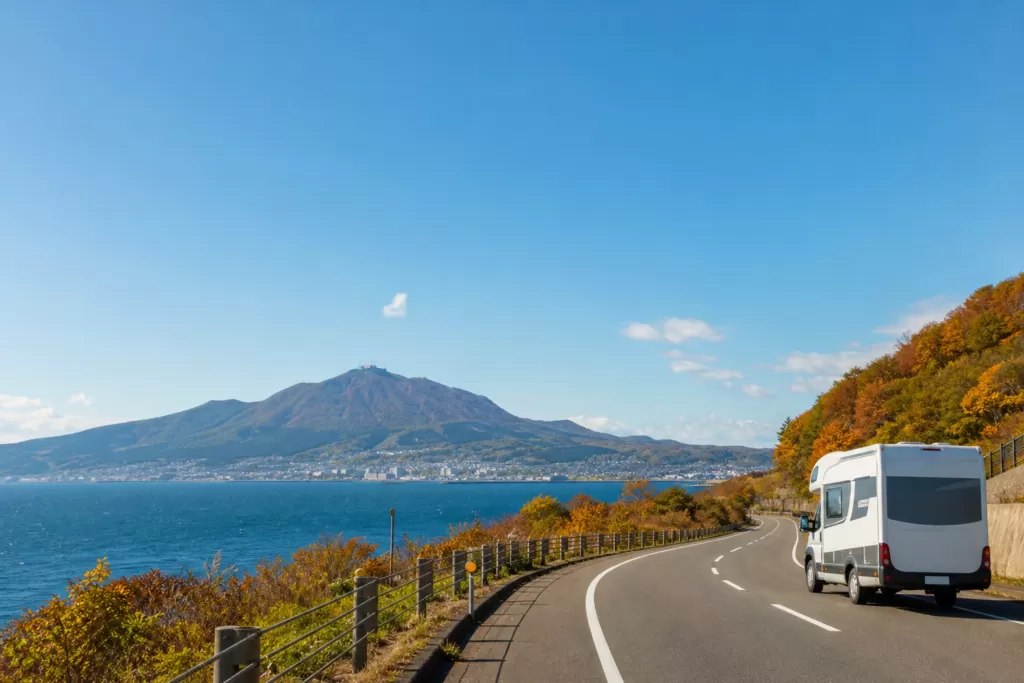
The southern Hokkaido (Donan) region is a stage for campervan travel packed with history, nature, and food — from the night views and morning markets of Hakodate to the cherry blossoms of Matsumae Castle, the Kitamaebune trading culture of Esashi, and the hot springs of Lake Toya. A 5-night, 6-day loop departing from New Chitose Airport keeps daily driving distances to roughly 200 km or less, making it manageable even for those who prefer not to drive long stretches.
This article covers the full model route, sightseeing highlights at each stop, recommended RV parks and campgrounds, and frequently asked questions — everything you need to plan your trip before you go.
Overview of the Southern Hokkaido Loop Route and Access from New Chitose
The route introduced here runs counterclockwise, starting and ending at New Chitose Airport, and is designed to connect the major attractions of the Donan region.
| Day | Itinerary | Estimated Driving Distance |
|---|---|---|
| Day 1 | New Chitose Airport → Lake Toya | approx. 100 km |
| Day 2 | Lake Toya → Hakodate | approx. 110 km |
| Day 3 | Hakodate (sightseeing, 2nd night) | ~30 km or less |
| Day 4 | Hakodate → Matsumae | approx. 95 km |
| Day 5 | Matsumae → Esashi → Oshamanbe | approx. 120 km |
| Day 6 | Oshamanbe → New Chitose Airport | approx. 200 km |
The total driving distance is around 620 km — modest by Hokkaido standards. On most days, you’ll be behind the wheel for three to four hours at most.
Getting There from New Chitose Airport
Pick up your campervan at a rental company near New Chitose Airport. Moving Inn offers airport transfers, and several other rental companies are located in the area. After pickup, head south on the Dō-ō Expressway toward the Lake Toya IC — about 1 hour 20 minutes with the highway.
The Donan region has very few mountain areas without cell coverage, and supermarkets and convenience stores are dotted along the main national highways, so stocking up on food is rarely a problem.
Hakodate (Morning Market, Night View, Goryokaku): Sightseeing and Overnight Options
Hakodate is the heart of any southern Hokkaido trip. It pairs well with campervan travel because large parking lots are plentiful, and Mount Hakodate, Goryokaku, and the morning market are all within easy driving distance of each other. With two nights here, you can explore the city at a relaxed pace.
The main sights in Hakodate are compact — you can drive from Mount Hakodate to the morning market in under 20 minutes. The city also has a tram network, but if you’re carrying luggage in a campervan, driving is more convenient. Coin parking in the city center costs 100–200 yen per 30 minutes, so daytime sightseeing is rarely an issue.
The historic Western-style buildings of the Motomachi district are another must-see. The area is home to Meiji- and Taisho-era landmarks such as the Old Hakodate Ward Public Hall (admission ¥300) and the Former British Consulate (admission ¥300), with views of the Tsugaru Strait stretching out at the foot of the slopes — a scene that feels uniquely Hakodate. Since there is no free parking in Motomachi itself, the standard approach is to use the paid lot near the Mount Hakodate Ropeway station (¥300/hour).
Hakodate Night View
The night view from Mount Hakodate is considered one of Japan’s three great night views, alongside those of Nagasaki and Kobe. The summit can be reached by ropeway (round-trip adult ¥1,500) or by private vehicle — though during the private-car restriction period (late April to early November, 5:00–10:00 PM), the ropeway is the only option. Since campervans cannot enter multi-story parking garages with height restrictions, use the flat parking lot at the base of the mountain (free).
The best time to view the lights is 30–40 minutes after sunset, when the city’s glow is sharply reflected along the waterfront. In summer, sunset falls around 9:00 PM; in winter, around 5:00 PM. The summit can be chilly even in summer, so bring a jacket. There is also a shop and restaurant at the top observation deck.
Hakodate Morning Market
Hakodate Morning Market opens daily at 6:00 AM (7:00 AM in winter). It is famous for seafood rice bowls featuring sea urchin, salmon roe, and scallops, with prices typically ranging from ¥1,500 to ¥2,500. The market is divided into two sections: Donburi Yokocho Ichiba, lined with bowl specialty restaurants, and Hakodate Asaichi, which carries fresh fish, dried goods, and produce. Parking on the street around the market early in the morning is difficult, so it’s worth checking a nearby coin parking lot the night before.
Goryokaku Tower
Goryokaku Tower (observation deck admission: adult ¥900) offers an overhead view of the entire star-shaped fort. There is no large free parking lot nearby; use the paid lot at Goryokaku Park (¥100/30 min). Note that some lots have a 3.5 m height restriction that campervans cannot clear, so check in advance. Several coin parking lots are within walking distance.
For overnight stays in Hakodate, options include a city-operated campground and RV parks on the outskirts — covered in the “Top 5 RV Parks and Campgrounds in Southern Hokkaido” section below.
For a fuller rundown of rental company options and overnight parking around Hakodate, see our wider Hakodate & Donan trip-planning guide. To compare pickup and shuttle terms across four Hakodate-area companies side by side, check the four-hub rental comparison.
Compare Hokkaido Campervan Rentals
Base yourself at New Chitose Airport and compare rates, vehicle types, and pickup locations all in one place.
Compare Rental Companies & Prices →Matsumae Castle, Esashi’s Kitamaebune Heritage, and the Coastal Drive
From Hakodate, the route to Matsumae and Esashi follows National Route 228 west along the Japan Sea coast. The road hugs the western shore of the Oshima Peninsula, alternating between sea views and cliff faces — the drive itself is part of the experience. Matsumae and Esashi each carry a distinct historical character.
From Hakodate to Matsumae is about 95 km south on Route 228, taking around 2 to 2.5 hours. This stretch is sometimes called the Matsumae-Esashi Oiwake Line, running with the Tsugaru Strait on your left. On clear days you can make out the mountains of Aomori’s Shimokita Peninsula across the water. Along the way, Kikonai has a JR Hokkaido station and serves as a starting point for visitors arriving by Shinkansen. The roadside rest stop Michi-no-Eki “Misogi-no-Sato Kikonai” sells local kelp and seafood products.
Matsumae Castle
Matsumae Castle is Hokkaido’s only traditional Japanese-style castle (keep admission: adult ¥360). The interior houses a historical museum where you can learn about the Matsumae Domain. The castle grounds are planted with approximately 10,000 cherry trees of around 250 varieties, drawing many visitors during the bloom period in late April to early May. Many travelers plan their itinerary around cherry blossom season.
A spacious free parking lot surrounds the castle grounds, so campervans have no trouble parking. The castle town area has souvenir shops selling Matsumae pickles and dried kelp products.
Esashi: Kamome Island and the Kaiyo Maru Memorial Museum
Esashi is a historic port town that flourished through Kitamaebune trade. Kamome Island is a small islet connected to the mainland by land, with a walking trail around its perimeter taking about 30–40 minutes. The quiet path winds through rocky shores and pine groves, preserving an atmosphere of an old harbor that feels unlike anywhere else in Hokkaido.
The Kaiyo Maru Memorial Museum (admission: adult ¥500) commemorates the Tokugawa shogunate warship Kaiyo Maru, which ran aground here in 1868. It displays actual cannons and rigging recovered from the wreck, making it a compelling stop for history enthusiasts. A large free parking lot is located next to the museum.
From Esashi, head north on National Routes 229 and 5 toward Oshamanbe. You can stop for shopping in Setana or Imakane along the way. Gas stations become sparse before you reach Oshamanbe, so fill up in Esashi before departing.
In the Esashi town center, the Former Hiyama Nishi-gun Government Building (exterior viewing free) marks the birthplace of Esashi Oiwake, a folk song passed down by Kitamaebune sailors. The Esashi Oiwake National Competition, held every September, draws participants from across Japan. If your trip coincides with it, it’s worth a visit.
Stops at Lake Toya, Mount Usu, and Showa-Shinzan
On this route, Day 1 includes a stop at Lake Toya with an overnight stay before heading to Hakodate the next morning. The Lake Toya area packs a lake, an active volcano, and hot springs into one location — more than enough to fill half a day. Mount Usu is an active volcano that last erupted in 2000, and the eruption scars are still visible from the crater rim observation platform today.
The Lake Toya hot spring resort area has free foot baths — a welcome rest stop after long drives. The shopping street in the resort town sells souvenirs made from Lake Toya potatoes and local kelp.
Lake Toya Hot Springs and Sightseeing Cruise
Several day-use hot spring facilities line the Lake Toya resort. Hotels such as The Windsor Hotel Toya and Toya Kanko Hotel Mirador accept day visitors (approximately ¥1,000–2,000). The lake cruise (adult ¥1,500, 50 minutes) takes you close to Nakajima, the island floating in the center of the lake.
Mount Usu Ropeway and Showa-Shinzan
The Mount Usu Ropeway (round-trip adult ¥1,800) leads to a summit observation deck with panoramic views of Lake Toya, the Pacific Ocean, and Showa-Shinzan. Showa-Shinzan is a lava dome that rose suddenly during eruptions between 1943 and 1945 and still emits geothermal heat today. The parking lot (paid, ¥500) accommodates large vehicles, so campervans can park without issue.
The Lake Toya area has many large parking lots, making campervan travel comfortable throughout. From late April through October, fireworks are launched over the lake resort town every night (the Lake Toya Long-Run Fireworks, from 8:45 PM for about 20 minutes, free to watch).
Lake Toya can be circumnavigated on the lakeside road (National Route 230), a circuit of about 40 km that takes just under an hour to drive. On the northern shore is the Tsukiura district, where a large free parking lot offers views of Mount Yotei across the lake. On a clear day, the scene is picturesque enough that many travelers add it to their itinerary — about 15 minutes from the Lake Toya resort by car.
Note that roads around Lake Toya can accumulate snow and ice in winter (late November to early April). Even after April, roads near the higher elevations of Mount Usu can remain slippery on some days. If you’re visiting in early spring, rent a vehicle with studded snow tires or check current road conditions before driving.
Top 5 RV Parks and Campgrounds in Southern Hokkaido
Here are five RV parks and campgrounds in the Donan region. RV parks are paid facilities with amenities such as power hookups and dump stations; campgrounds offer tent or vehicle camping in natural settings. Reservations are generally required at all of these.
Southern Hokkaido is one of the more developed areas in Hokkaido for RV parks. Several are located around Hakodate, with additional options dotted around Lake Toya and Oshamanbe. During the peak season of July and August, popular sites fill up quickly — secure at least two nights in Hakodate and one night at Lake Toya more than a month in advance.
1. RV Park Lake Toya (Toyako Town)
Conveniently located near the Lake Toya hot spring resort, this RV park offers AC-powered sites along with water, sewer hookups, and waste disposal facilities. Hot springs are within a five-minute drive. Rates are approximately ¥4,000–5,000 per night. Summer bookings fill up fast — reserving at least a month out is advisable.
2. Hakodate City Toi Campground (Hakodate)
Situated on a bluff overlooking the Tsugaru Strait in the Toi district on the eastern outskirts of Hakodate, this campground has auto-camping sites (approximately ¥2,000–3,000/night) and is about 40 minutes by car from central Hakodate. Facilities include washing stations, toilets, and a cooking shelter, making it well suited for families.
3. Matsumae Town Rural Park Campground (Matsumae Town)
A town-operated campground about 10 minutes by car from Matsumae Castle. It has both tent sites and auto sites, with low fees (free to around ¥1,000). The management building has clean toilets, but there are no showers — use a nearby hot spring facility such as Matsumae Onsen for bathing.
4. Kamome Island Campground (Esashi Town)
A free campground on Kamome Island itself. It is tent-only and not set up for auto camping, but you can park in the island’s parking lot and walk in. The setting is superb, though strong sea breezes can be an issue — bring wind protection. There are no power hookups or showers, and drinking water must be obtained before arriving on the island.
5. Oshamanbe Park Campground (Oshamanbe Town)
A convenient base for Day 6 departures, this campground is located inside Oshamanbe Park. Both tent and auto sites are available at low cost (free to around ¥1,000). Oshamanbe is famous for its kani-meshi (crab rice) ekiben (station bento), and the bento shop is within a five-minute drive of the campground. New Chitose Airport is about a two-hour drive away.
Keep in mind that campgrounds in southern Hokkaido are busiest from late June through August. Some sites may be closed in spring (April–May) or autumn (September–October), so confirm operating periods on the official website or by phone before visiting. Most campgrounds around Lake Toya and Hakodate close for winter (November through early April). A limited number of RV parks remain open year-round, but availability is restricted.
New Chitose Airport / Tokachi-Obihiro Airport
Rent the Cab-Over Camper “Cresson Journey”
Base yourself at New Chitose Airport and travel all across Hokkaido by campervan.
View Details at Moving Inn →Frequently Asked Questions (FAQ)
Q: What is the best season to travel the southern Hokkaido route?
Late April to early May is one of the peak seasons for southern Hokkaido, when the cherry blossoms at Matsumae Castle are at their best. Note that nights can still be cold at campgrounds during this period, so pack warm layers. July and August offer stable weather and the Lake Toya fireworks. If you want to avoid crowds, June (Hokkaido has no rainy season, so conditions are pleasant) and September are ideal.
Q: Which campground or RV park is best for staying near Hakodate?
The closest option to the city is Hakodate City Toi Campground, though it’s about 40 minutes from the city center. Travelers who want early-morning access to the night view or the morning market sometimes use coin parking lots in the city center for overnight stays. If you’re visiting from outside Hokkaido, check the local rules regarding sleeping in your vehicle in urban areas before doing so.
Q: Can I use the ferry to Matsumae?
There is no ferry that goes directly to Matsumae. Tsugaru Kaikyo Ferry links Honshu and southern Hokkaido on the Aomori–Hakodate and Oma–Hakodate routes, and from Hakodate you drive to Matsumae. However, since this route starts and ends at New Chitose Airport in a loop, the ferry is not used on this itinerary.
Q: How much should I budget for fuel on the southern Hokkaido route?
With a total driving distance of around 620 km and fuel economy of 8 km/L (typical for a cab-over camper), expect to spend approximately ¥10,000–12,000 on gasoline. A van conversion or kei camper will be more fuel-efficient, potentially bringing costs down to around ¥8,000. Gas prices in the Donan region are not significantly different from urban areas, but the stretch between Matsumae and Esashi has longer gaps between stations — fill up whenever you can along that section.
Q: What is the total estimated cost for a 5-night, 6-day trip?
For two people in a van conversion (rental: ¥100,000–130,000), adding fuel (¥8,000–10,000), five nights of camping and RV parks (¥10,000–20,000), food for six days (¥20,000–30,000, mostly self-catering), and sightseeing costs such as admission fees and ropeways (¥10,000–15,000), the total comes to roughly ¥148,000–205,000 for two. Budget approximately ¥75,000–100,000 per person.
Q: How can I avoid crowds at the Hakodate night view?
On summer weekends in July and August, ropeway queues at the summit can reach 30–60 minutes. To avoid the worst of the crowds, consider going up after 9:00 PM rather than right after sunset (around 7:00 PM) — the night view remains impressive until around 10:00 PM. Outside the private-car restriction period (November through late April), you can drive to the summit yourself, but depending on your campervan’s height and width, the summit parking lot may not be accessible.
Book a Campervan in Hokkaido
Moving Inn New Chitose Airport supports English booking and offers airport transfers.
![Campgrounds Near Tokachi-Obihiro Airport: 8 Sites Within 30 km, Compared by Vehicle Access, Power and Price [2026]](https://hokkaido-campingcar.jp/wp-content/uploads/2026/10/photo-obihiro-airport-featured-pl232-768x512.jpg.webp)
![Campgrounds Near Hakodate Airport: 12 Sites Within 30 km, Compared by Vehicle Access, Power and Price [2026]](https://hokkaido-campingcar.jp/wp-content/uploads/2026/10/photo-hakodate-airport-featured-hl4722-768x484.jpg.webp)