Campervan Drawbacks [Read Before Buying or Renting] Everything You Need to Know to Avoid Regret
The 7 major drawbacks of buying a campervan (running costs, parking, fuel economy, declining usage, etc.) laid out honestly.
Pick a campervan by what matters to you.
Rent at New Chitose Airport
See only the rental bases in Chitose, where the airport is.
Rent in winter (Dec–Mar)
Companies that rent through winter, listed apart from those that close.
Guide price
Moving Inn New Chitose Airport: HIACE van conversion from ¥22,000 per night. 20–30% off when booked 60–90 days ahead (official rate table, checked 15 Oct 2026).
Before you book: with an International Driving Permit if your country is in the Geneva Convention (for example the US, Australia, Singapore); Taiwan, Switzerland, Germany, France, Belgium and Monaco need your licence plus a Japanese translation (Tokyo Metropolitan Police). Questions in English: Moving Inn on WhatsApp. Every roadside station (michi-no-eki) must have free 24-hour toilets, and Hokkaido has 128 of them (MLIT).
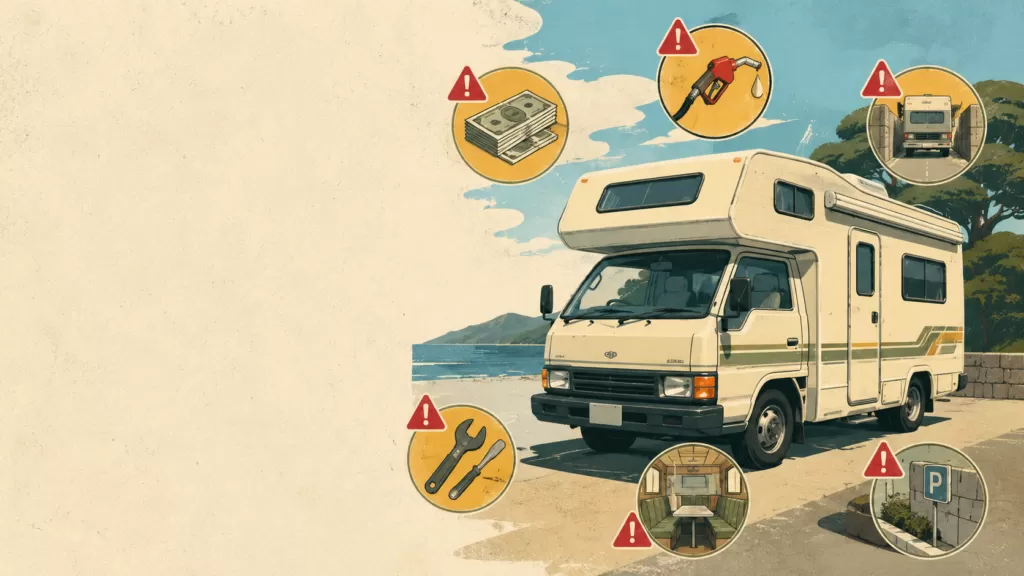
Buying a campervan and regretting it is more common than you might think. The typical story: attracted by the freedom of travel, the buyer finds that running costs, parking difficulties, and low actual usage turn into unwelcome surprises.
This article honestly covers the drawbacks you should know before buying or renting a campervan. It includes the weak points of both buying and renting, the annual cost break-even point, and real voices from people who felt buyer’s remorse. If you still want one after reading this, you’re well placed to make a decision you won’t regret.
7 Drawbacks of Buying a Campervan
① Running Costs of ¥250,000–800,000 Per Year
Annual running costs for campervans are roughly ¥250,000–350,000 for a kei campervan and ¥500,000–800,000+ for a cab-over. The five main expenses — vehicle tax, weight tax, vehicle inspection, insurance, and parking — occur every year whether you use the vehicle or not.
“I only used it 5–6 times a year but still paid ¥600,000 in running costs” is not an unusual situation. If annual usage is low, rental will work out cheaper overall.
② Parking Is Hard to Find
Cab-overs are 5–6m long and over 2.8–3m tall, so if you don’t have suitable parking at home you’ll need to rent a monthly space. But flat parking lots that accommodate vehicles over 2m tall and 5m long are scarce in urban areas, and monthly fees can reach ¥20,000–50,000.
Before buying, confirming that you can actually park the vehicle near home is the essential first check.
③ Poor Fuel Economy Adds Up on Trips
Real-world fuel economy is around 8–10km/L for van conversions and 6–9km/L for cab-overs — significantly worse than ordinary cars. Driving 1,500km around Hokkaido in a week in a cab-over means fuel costs alone of ¥28,000–43,000 (at ¥170/L). The fuel bill compounds with every trip in a way ordinary cars don’t.
④ Driving Takes Getting Used to and Is More Tiring
A 5–6m vehicle body is a real pressure for first-time drivers. Even with a reversing camera, parking in tight spaces, U-turns, and passing oncoming vehicles are nerve-wracking. The high ride height also makes the vehicle more susceptible to crosswinds, making long-distance motorway driving more tiring than in an ordinary car.
⑤ Usage Tends to Drop Below Expectations
Many buyers plan to “use it every month” before purchasing, but in practice work, family schedules, and weather get in the way. The average annual usage for a campervan is said to be around 20–40 days, and the lower the usage rate, the higher the cost per day.
⑥ Washing and Maintenance Is a Hassle
Most models are too large for automatic car washes, so you’re looking at hand washing or a specialist. The fitted-out components (FF heater, sub-battery, water system) also require maintenance separate from the vehicle itself, which means relying on a specialist if you don’t have the know-how.
⑦ Deterioration During Storage Requires Attention
If stored outdoors, the shell, interior, and waterproof seals are prone to UV degradation. Long periods of disuse also lead to battery self-discharge and tyre flat-spotting. A lifestyle where the vehicle rarely gets driven is, ironically, not well-suited to owning a campervan.
Know the Drawbacks of Renting Too
Renting has its own downsides relative to buying.
- Hard to book in peak season (July–August): In Hokkaido’s summer season, popular rental companies fill up 2–3 months in advance
- Every rental costs money: If you use it 30+ days a year, buying can work out cheaper
- You can’t customise it: Equipment and interior come as-is; no personal modifications
- Return time constraints: Return deadlines can reduce flexibility in your itinerary
New Chitose Airport / Tokachi-Obihiro Airport
Rent the Cabcon “Cresson Journey”
Base yourself at New Chitose Airport and compare rates, vehicle types, and pickup locations all in one place.
See details at Moving Inn →“Should I Buy or Rent?” Informed by the Drawbacks
| Buying Suits You If… | Renting Suits You If… |
|---|---|
| You plan to use it 30+ days a year | You’ll use it 20 days or fewer per year |
| You have parking at home | Parking is difficult to secure |
| You want to customise and build a connection with the vehicle | You want to try it before deciding |
| You want to head out on weekends whenever you like | You want a campervan 1–2 times a year |
| You can handle maintenance yourself | You don’t want ongoing running costs |
Real Voices from People Who Regretted Buying
When we look at the experiences of people who regretted buying a campervan, a few patterns emerge.
- “I couldn’t find parking and ended up paying ¥30,000/month. I spend more on parking than on travel.” (Cab-Over buyer, male, 40s)
- “My kids were small and we couldn’t get out as much as expected. One year we only used it 4 times.” (Van Conversion buyer, female, 30s)
- “Refuelling diesel is inconvenient. Rural areas sometimes have closed stations.” (Cab-Over buyer, male, 50s)
- “Finding a place to wash it was difficult, and leaving it dirty damaged the seals.” (Van Conversion buyer, male, 40s)
- “Crosswinds on motorways frightened me and I stopped enjoying driving it. I ended up using my ordinary car more.” (Cab-Over buyer, male, 30s)
The common thread is “used it less than expected” and “maintenance and management was more demanding than anticipated.” Setting a realistic annual usage plan before you buy is the single most effective way to avoid regret. For the specific patterns shared by people who ended up regretting their purchase, see 5 Common Traits of People Who Regret Buying a Campervan.
Buying vs. Renting: Annual Cost Comparison
Annual cost comparison by usage days (cab-over, rental at ¥30,000/day).
| Days Used Per Year | Buy (running costs ¥650,000 + depreciation ¥150,000) | Rent (¥30,000/day) | Difference |
|---|---|---|---|
| 10 days | ¥800,000/year | ¥300,000/year | Renting ¥500,000 cheaper |
| 20 days | ¥800,000/year | ¥600,000/year | Renting ¥200,000 cheaper |
| 27 days | ¥800,000/year | ¥810,000/year | Roughly equal (break-even) |
| 35 days | ¥800,000/year | ¥1,050,000/year | Buying ¥250,000 cheaper |
For a cab-over, the break-even point is approximately 27 days of use per year. For kei campervans and van conversions with lower running costs, the break-even point falls at even fewer days.
3 Checks to Avoid Regret
Confirming these three things before buying significantly reduces the risk of regret.
- Confirm parking: Can you secure a parking space at or near home that fits the vehicle dimensions?
- Plan realistic annual usage: Decide based on “days you can definitely use it,” not “days you’d like to use it”
- Try renting first: Before buying, rent the same type of vehicle to experience whether the driving, living space, and travel pace suit you
New Chitose Airport / Tokachi-Obihiro Airport
Rent the Cabcon “Cresson Journey”
Base yourself at New Chitose Airport and compare rates, vehicle types, and pickup locations all in one place.
See details at Moving Inn →Frequently Asked Questions (FAQ)
Q. What do people most often regret about buying a campervan?
“Low usage while running costs keep accumulating” is the most common regret. Many people plan to use it 20–30 days a year before buying, but end up using it fewer than 10 days in practice, pushing the cost per day to twice what they expected.
Q. Can you drive a campervan with a standard driving licence?
Kei campervans, van conversions, and most cab-overs can be driven on a standard licence. However, bus conversions and large-format models require a medium or heavy vehicle licence. Always check the licence category of the vehicle before buying or renting.
Q. Who finds that buying is worth it despite the drawbacks?
People who head outdoors on weekends as a lifestyle, have parking at home, and want to customise and build an attachment to their vehicle tend to find the running costs worthwhile. Thinking of it as a “tool you use hard” makes buyer’s remorse less likely.
Q. Any tips for avoiding regret when renting?
Book as early as possible for peak season (July–August) — popular Hokkaido rental companies fill up 2–3 months out. On your first rental, build in plenty of time and plan an itinerary where you’re not watching the clock for the return deadline.
Summary | Knowing the Drawbacks Is the Path to No Regrets
Most regrets come from buyers who didn’t know the basics before they bought. The fact that you’ve read this far means your risk of regret is already lower.
- Running costs, parking, fuel economy, and declining usage are the main post-purchase regrets
- For fewer than 27 days per year (cab-over benchmark), renting keeps total costs lower
- Before buying: confirm parking, plan realistic annual usage, and try renting first
- Renting also has drawbacks: hard to book in peak season and less flexibility
- Renting once or twice first to check whether the travel style suits you is the safest approach
Book a Campervan in Hokkaido
Moving Inn New Chitose Airport supports English booking and offers airport transfers.
Pick a campervan by what matters to you.
Rent at New Chitose Airport
See only the rental bases in Chitose, where the airport is.

![When and Where Can You See Harbor Seals at Cape Erimo? Kaze no Yakata Official Information, Viewing Season, and Windy-Day Notes [2026-27]](https://hokkaido-campingcar.jp/wp-content/uploads/2026/10/erimo-cape-lighthouse-768x511.jpg.webp)
![Where and Under What Conditions Can You See Diamond Dust in Hokkaido? How Cold a Morning It Takes, and Where It Appears [2026-27]](https://hokkaido-campingcar.jp/wp-content/uploads/2026/10/hokkaido-diamond-dust-nayoro-768x512.jpg.webp)
![Can You Drive to Hokkaido Jingu for Hatsumode? Parking, Crowds, and Where to Park and Walk [2027]](https://hokkaido-campingcar.jp/wp-content/uploads/2026/10/hokkaido-jingu-winter-torii-768x504.jpg.webp)
![Hokkaido Roads Over New Year [2026-27] | Expressway Sections Prone to Blizzard Closures, Forecast Congestion Days, No Holiday Discount, and New Chitose Airport Parking](https://hokkaido-campingcar.jp/wp-content/uploads/2026/10/hokkaido-winter-rural-road-edge-markers-768x432.jpg.webp)
![Where to See Sea Smoke (Kearashi) in Hokkaido: Rumoi’s Ogon-misaki and the Morning Conditions [2026-27]](https://hokkaido-campingcar.jp/wp-content/uploads/2026/10/rumoi-kearashi-sea-smoke-768x511.jpg.webp)
![Geminid Meteor Shower 2026 in Hokkaido: Peak Around 23:00 on December 14, Sapporo Moonset 20:40, and Staying Warm in a Winter Campervan [2026]](https://hokkaido-campingcar.jp/wp-content/uploads/2026/10/geminids-2026-hokkaido-768x575.jpg.webp)