How Much Does a Campervan Cost to Own? Annual Expenses Breakdown and Money-Saving Tips
A vehicle-by-vehicle breakdown of annual campervan ownership costs: taxes, insurance, inspection, parking, fuel, and consumables.
Pick a campervan by what matters to you.
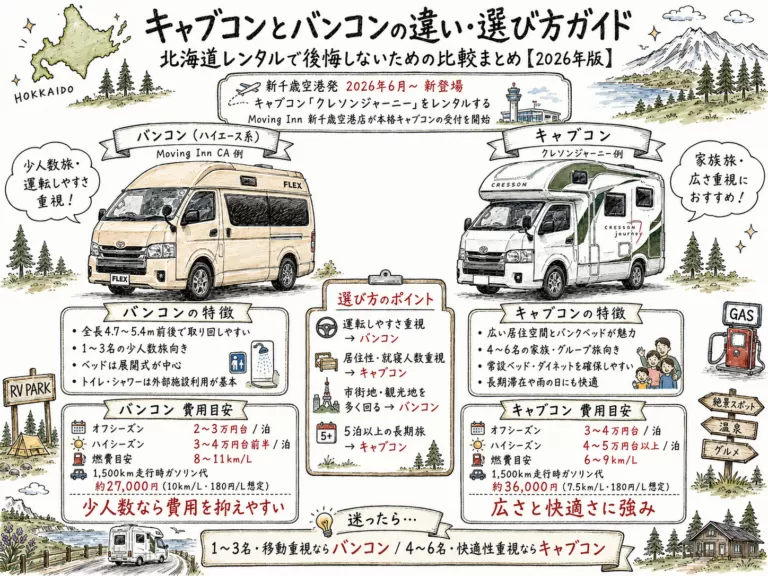
Rent at New Chitose Airport
See only the rental bases in Chitose, where the airport is.
Rent in winter (Dec–Mar)
Companies that rent through winter, listed apart from those that close.
Guide price
Moving Inn New Chitose Airport: HIACE van conversion from ¥22,000 per night. 20–30% off when booked 60–90 days ahead (official rate table, checked 15 Oct 2026).
Before you book: with an International Driving Permit if your country is in the Geneva Convention (for example the US, Australia, Singapore); Taiwan, Switzerland, Germany, France, Belgium and Monaco need your licence plus a Japanese translation (Tokyo Metropolitan Police). Questions in English: Moving Inn on WhatsApp. Every roadside station (michi-no-eki) must have free 24-hour toilets, and Hokkaido has 128 of them (MLIT).
Once you buy a campervan, how much will it cost per year? This is the number buyers want most but find hardest to track down in one place.
This article breaks annual costs into 6 categories — tax, insurance, inspection, parking, fuel, and consumables — and compares costs across cab-over, van conversion, and kei campervan types. It also covers the point at which people switch to rentals, so it should be useful if you’re deciding between buying and renting.
Annual Costs at a Glance

Annual campervan running costs fall into roughly three tiers depending on vehicle type.
| Vehicle Type | Estimated Annual Running Cost |
|---|---|
| Kei campervan | ¥400,000–700,000 |
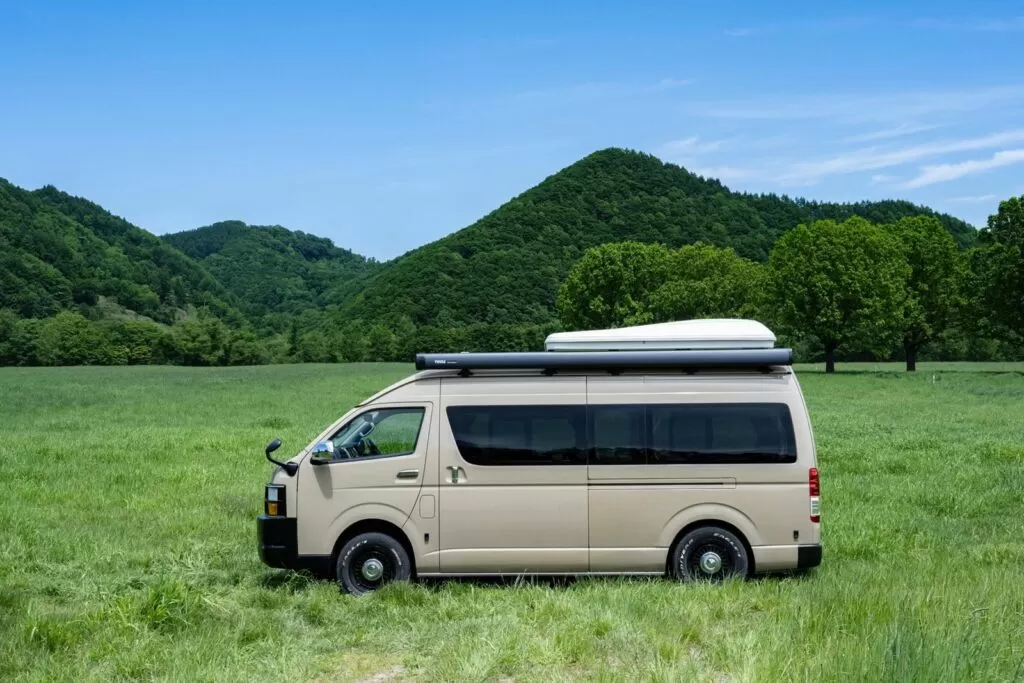
| Van conversion (HiAce etc.) | ¥600,000–1,000,000 |
| Cab-over (Camlord etc.) | ¥800,000–1,500,000 |
These figures include fuel and consumables. If you only count “tax and insurance,” a kei campervan fits within ¥200,000+ per year — but ongoing actual use adds more expenses. Let’s break down each category.
For vehicle type characteristics and differences, see the 7-type campervan guide.
6-Category Cost Breakdown
① Vehicle Tax: ¥10,000–60,000/year difference by type
Campervans are often registered as “special-purpose vehicles (8-number plate),” which means lower vehicle tax than equivalent passenger cars. But it varies by vehicle type.
| Vehicle Type | Annual Vehicle Tax |
|---|---|
| Kei campervan (light vehicle) | approx. ¥10,000 |
| Van conversion (8-plate registration) | ¥30,000–40,000 |
| Cab-over (8-plate registration) | ¥40,000–60,000 |
The 8-plate registration offers lower tax, but vehicle inspection criteria are stricter — the custom build must meet campervan certification requirements. When buying used, confirm the registration status in advance.
② Compulsory liability insurance: ¥15,000–20,000/year, fairly consistent
Compulsory liability insurance (JCI) is paid in 2-year installments at inspection time. For a standard 8-plate vehicle, about ¥22,000 for 2 years (approx. ¥11,000/year). Light vehicles (kei campervans) are about ¥17,000 for 2 years (approx. ¥8,500/year). Budget ¥15,000–20,000/year overall.
③ Voluntary insurance: ¥80,000–150,000/year with a campervan-specific plan
Voluntary insurance varies by vehicle type, age, no-claim rating, and coverage, but campervan insurance often costs more than for a regular car, because campervans are expensive and have special conversions.
- Kei campervan: ¥50,000–100,000/year
- Van conversion: ¥80,000–150,000/year
- Cab-over: ¥100,000–180,000/year
Insurance companies with campervan-specific plans can cover the custom build and loaded gear (outdoor equipment, household items) under the vehicle policy. Standard auto insurance may not cover the custom portion — confirm coverage scope before signing.
④ Vehicle inspection (shaken): ¥150,000–300,000 every 2 years; cab-overs are expensive
Inspection occurs every 2 years. Campervans include checks on custom build weight and electrical equipment (diesel heater, sub-battery etc.), so inspection costs tend to run higher than regular passenger cars.
| Vehicle Type | Inspection Cost (every 2 years) | Annual equivalent |
|---|---|---|
| Kei campervan | ¥80,000–150,000 | ¥40,000–75,000 |
| Van conversion | ¥120,000–200,000 | ¥60,000–100,000 |
| Cab-over | ¥150,000–300,000 | ¥75,000–150,000 |
Cab-overs are heavy with large tires, so replacement part costs climb. Inspection costs vary by shop, region, and vehicle condition — get quotes from multiple providers.
⑤ Parking: big regional variation, ¥10,000–50,000/month
Campervans — especially cab-overs over 2.8m tall — can’t use multi-story parking with height limits. You need outdoor flat parking or a dedicated campervan storage facility.
- Rural areas (Hokkaido, Tohoku etc.): approx. ¥10,000–20,000/month
- Regional cities (Sapporo, Sendai etc.): approx. ¥15,000–30,000/month
- Metropolitan / major cities: ¥30,000–50,000+/month
If you can park at home, this cost is zero. Parking ranges from ¥120,000–600,000/year by region — urban ownership costs require careful thought.
⑥ Fuel and consumables: ¥200,000–300,000/year depending on usage
Fuel costs depend on annual mileage and fuel economy. Using 8,000km/year and ¥170/L as a baseline:
| Vehicle Type | Fuel Economy | Annual Fuel Cost (8,000km) |
|---|---|---|
| Kei campervan | 15–18km/L | approx. ¥76,000–90,000 |
| Van conversion | 10–12km/L | approx. ¥110,000–140,000 |
| Cab-over | 7–9km/L | approx. ¥150,000–190,000 |
Many cab-overs return around 8km/L — 8,000km at that rate costs about ¥170,000 (¥170 × 8,000 ÷ 8). See the fuel economy comparison guide for more detail.
Consumables (tires, batteries, etc.): Budget ¥50,000–100,000/year for peace of mind. Four tires cost ¥40,000–150,000 (every 3–5 years); a sub-battery is ¥30,000–80,000 (every 3–5 years). Annualized, that’s ¥50,000–80,000 on its own.
Annual Running Cost Summary by Vehicle Type
Adding up all 6 categories:
| Cost Item | Kei | Van Conversion | Cab-Over |
|---|---|---|---|
| Vehicle tax | approx. ¥10,000 | ¥30,000–40,000 | ¥40,000–60,000 |
| JCI (annual equiv.) | approx. ¥9,000 | approx. ¥11,000 | approx. ¥11,000 |
| Voluntary insurance | ¥50,000–100,000 | ¥80,000–150,000 | ¥100,000–180,000 |
| Inspection (annual equiv.) | ¥40,000–75,000 | ¥60,000–100,000 | ¥75,000–150,000 |
| Parking (¥20,000/mo.) | ¥240,000 | ¥240,000 | ¥240,000 |
| Fuel (8,000km) | approx. ¥80,000 | approx. ¥130,000 | approx. ¥170,000 |
| Consumables / maintenance | ¥30,000–50,000 | ¥50,000–80,000 | ¥70,000–100,000 |
| Total (estimate) | ¥400,000–700,000 | ¥600,000–1,000,000 | ¥800,000–1,500,000 |
Parking costs vary widely by region — if you can store at home, subtract ¥240,000 from each total for a more accurate figure. These numbers also don’t include vehicle depreciation (amortization of purchase price).
4 Ways to Cut Running Costs

1. Choose a kei campervan
Tax, insurance, inspection, and tire costs are all smaller. For 1–2 person trips, the kei is the most economically rational choice from a running cost perspective.
2. Secure home parking space
Renting a ¥20,000/month parking space costs ¥240,000/year. Eliminating that with home storage cuts running costs significantly. Before buying a cab-over, confirm it fits at home — and check the height clearance (2.8m+).
3. Use a campervan-specific insurance plan
Ordinary auto insurance may not cover the custom portion. Using a campervan-specific plan provides appropriate coverage while avoiding over-insurance on parts that don’t need it. Compare multiple insurers for the best fit.
4. Control driving distance
Fuel and tire wear are proportional to mileage. At 8,000km/year for a cab-over, fuel alone is ¥170,000+. Cutting to 5,000km saves roughly ¥60,000 on fuel. Thinking “campervan = drive a lot” tends to push costs up — plan trips efficiently.
New Chitose Airport / Tokachi-Obihiro Airport
Rent the Cabcon “Cresson Journey”
Base yourself at New Chitose Airport and compare rates, vehicle types, and pickup locations all in one place.
See details at Moving Inn →Buying vs. Renting: When Does Renting Win?
A rough comparison: renting a campervan in Hokkaido typically costs ¥30,000–80,000/day for a van conversion or cab-over. If you travel 20 days per year, that’s ¥600,000–1,600,000 in rental fees alone.
Compared to the annual running costs above, buying starts to make financial sense when you use it more than about 20–30 days per year — but that’s before counting the vehicle purchase price itself.
Renting tends to win on cost when:
- You use it fewer than 15–20 days per year
- You live in a high-cost city and have no home parking
- You want to try different vehicle types
- You don’t want to deal with inspection, maintenance, or storage
Buying wins when you travel 30+ days per year, have home parking, and want to travel on your own schedule without booking constraints. There’s no single right answer — it comes down to your usage pattern and lifestyle.
Long-Term View: 3-, 5-, and 10-Year Total Cost Comparison
Compare buying a new van conversion (¥7,000,000) with renting the same class of vehicle (¥40,000/day × 5 trips/year = ¥200,000/year), and factor in the vehicle’s loss of resale value over time — the gap widens considerably.
| Period | Buying (vehicle depreciation + running costs) | Renting (5 trips/year) |
|---|---|---|
| 3 years | approx. ¥3,360,000 | ¥600,000 |
| 5 years | approx. ¥4,900,000 | ¥1,000,000 |
| 10 years | approx. ¥8,400,000 | ¥2,000,000 |
At 5 trips (about 10 days) per year, the gap exceeds ¥6,000,000 over 10 years. Rental pricing already includes insurance, maintenance, and parking, so there’s no risk of unexpected repair costs either.
Renting also means you can choose the vehicle to match your destination, season, and group size — a spacious cab-over for a Hokkaido summer trip, or a kei campervan to save money on a solo trip. Check license-type restrictions in the license guide as well.
New Chitose Airport / Tokachi-Obihiro Airport
Rent the Cabcon “Cresson Journey”
Base yourself at New Chitose Airport and compare rates, vehicle types, and pickup locations all in one place.
See details at Moving Inn →FAQ
Is there a way to reduce vehicle inspection costs?
Getting quotes from multiple inspection shops makes a difference. Some campervan-friendly shops understand 8-plate requirements and can do efficient work. User inspection (jibun de shaken) is possible for campervans but requires knowledge of the custom build standards — check with your registration authority first.
How much does it cost to maintain a used campervan?
Used campervans may have aging sub-batteries, water supply systems, or gas equipment — budget an extra ¥100,000–200,000 in the first year for unexpected repairs. Have a specialist inspection done before purchase to identify any issues in advance.
What is the 8-number plate (8ナンバー) and is it advantageous?
The 8-number plate (special-purpose vehicle) classification offers lower vehicle tax and in some cases lower insurance premiums. However, it requires the vehicle to meet specific campervan certification standards. It’s not something you can apply for on any vehicle — the build must qualify.
Book a Campervan in Hokkaido
Moving Inn New Chitose Airport supports English booking and offers airport transfers.
Pick a campervan by what matters to you.
Rent at New Chitose Airport
See only the rental bases in Chitose, where the airport is.