How Much Luggage Can a Campervan Actually Carry? Payload by Vehicle Type and Loading Tips (2026 Guide)
Using the formula maximum payload = gross vehicle weight − curb weight − (seating capacity × 55kg) from Japan's vehicle safety regulations, this guide covers a real kei-camper base-vehicle example and practical loading tips.
How Much Luggage Can a Campervan Actually Carry? Payload by Vehicle Type and Loading Tips (2026 Guide)
You can’t tell how much weight a campervan can actually carry just by looking at the catalog dimensions. Under Japan’s vehicle safety regulations, the gross vehicle weight is defined as the sum of the vehicle’s curb weight, its maximum payload, and 55kg per seating capacity. From that, maximum payload works out to “gross vehicle weight − curb weight − (seating capacity × 55kg).” That 55kg figure comes from Article 81, Paragraph 2, Item 1(a)(5) of Japan’s detailed notification defining the Road Vehicle Safety Regulations, where it’s used as the standard weight per passenger seat (Ministry of Land, Infrastructure, Transport and Tourism, detailed notification on Road Vehicle Safety Regulations, confirmed 2026-08-27). This guide uses that framework to lay out payload estimates by vehicle type and how to avoid overloading a rental vehicle.
For how to think about cargo space when bringing bikes on a cycling trip, see our Hokkaido cycling-and-campervan guide, and for a full trip packing list, see the Hokkaido campervan packing checklist. This guide focuses specifically on the weight side of the question: how many kilograms can you actually load?
Know the payload formula
There are three weight figures to know. “Curb weight” is the weight of the vehicle alone with fuel, coolant, and oil topped up (no passengers or cargo). “Gross vehicle weight” is the curb weight plus the standard weight of all seated passengers (55kg each) plus the maximum payload — the upper limit. “Maximum payload” is the difference between those two — the actual weight of cargo you can carry. As a formula:
Maximum payload = Gross vehicle weight − Curb weight − (Seating capacity × 55kg)
One thing worth noting: that “seating capacity × 55kg” figure is a standardized weight used for the legal calculation, not the actual body weight of the people riding. If four adults are traveling together and their combined actual weight exceeds 220kg (55kg × 4), the maximum-payload figure printed on the vehicle inspection certificate doesn’t change to reflect that. In practice, subtracting the actual body weight of your passengers (not the legal 55kg-per-person standard) from the certificate’s maximum payload gives you a more accurate sense of how much weight is left for cargo.
Payload guide for kei-campers — a real-world base-vehicle example
Kei-campers are built on commercial kei-car base vehicles (such as the Hijet Cargo or Every), so the payload ceiling is set by the base vehicle from the start. According to Daihatsu’s official specification sheet, the Hijet Cargo Deck Van G (2WD) has a curb weight of 920kg, a seating capacity of 4, and a maximum payload of 250kg (Daihatsu official site, Hijet Cargo main specifications, confirmed 2026-08-27). 250kg adds up fast once you combine four adults’ luggage, food, and bedding, which shows why a kei-camper is a vehicle where careful, minimal packing is essentially a given. The actual maximum payload after conversion into a campervan (once fitted out) shifts from the base-vehicle figure depending on the fit-out work, so confirm the exact number with the rental company or check the vehicle inspection certificate of the vehicle you’re renting.
Payload guide for vancons and cabcons — not officially tabulated after conversion
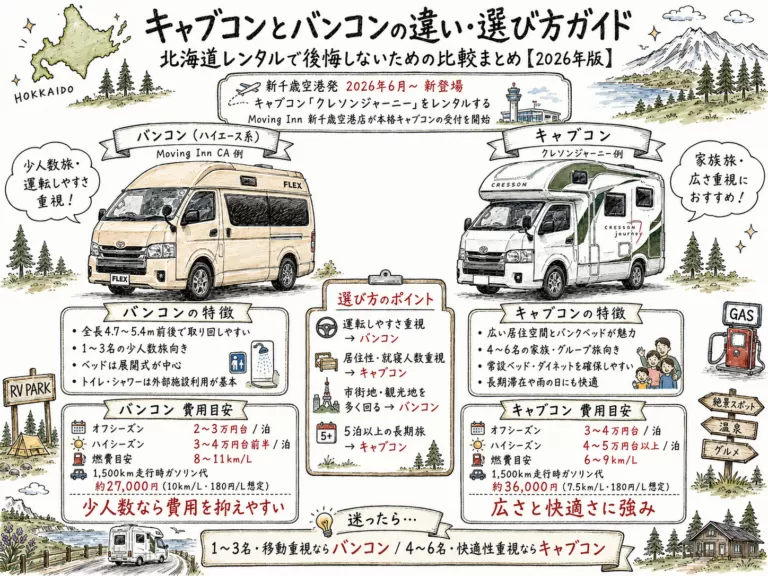
Our guide to the 7 types of campervans covers the basic differences between vehicle types, but vancons (HiAce-based, etc.) and cabcons (Camroad-based, etc.) get insulation, furniture, plumbing, batteries, and more fitted onto the base vehicle, so the finished vehicle’s curb weight ends up heavier than the base vehicle alone. This post-conversion curb weight and maximum payload is often not tabulated in any published resource from campervan builders, and varies by model, trim, and optional equipment. Stating a single number like “vancons run about X kg, cabcons run about Y kg” by vehicle category alone wouldn’t reflect reality, so this guide doesn’t state a specific post-conversion weight. To find the exact maximum payload, the most reliable approach is to check the figure on the vehicle inspection certificate of the specific vehicle you’re renting, either when you book or at pickup.
How to check using the vehicle inspection certificate
Rental campervans typically keep the vehicle inspection certificate on board. It lists “curb weight,” “gross vehicle weight,” “seating capacity,” and “maximum payload” — those four figures tell you the ceiling for what that vehicle can carry. If you’re planning to bring extra food, water, or camping gear for a large group, asking the rental company for “this vehicle’s maximum payload” specifically before you set out helps you avoid overloading on the day. This matters even more for long trips, large groups, or trips involving bikes or outdoor gear.
What happens if you overload
Loading cargo beyond the maximum payload — overloading — violates Japan’s Road Vehicles Act safety regulations. Beyond faster tire wear and worse fuel economy, it affects braking performance and cornering stability — it goes straight to driving safety. Campervans in particular have living space up top and a higher center of gravity, so the weight and placement of cargo affects driving stability more than it would in an ordinary passenger car. Don’t add cargo just because there’s still room in the storage space — keep the weight limit in mind.
Loading tip #1: keep heavy items low and centered
Heavy items — water jugs, portable power stations, toolboxes — stabilize the vehicle best when placed as low as possible and toward the front-to-back and side-to-side center of the vehicle. The opposite — concentrating heavy items at the rear, or high up such as on a roof rack — makes the vehicle more prone to swaying on curves or in strong wind. Secure cargo before driving so it can’t shift, and double-check that nothing will fly forward under hard braking.
Loading tip #2: pack by headcount × trip length, not “just in case”
Cargo weight tends to creep up through “just in case” packing. Rather than bringing a full trip’s worth of clothes and food, planning to restock along the way at coin laundries, supermarkets, and Michi-no-Eki lets you pack lighter and leaves more payload to spare. Our Hokkaido campervan packing checklist covers the full picture of what to bring — checking your list against your payload before you leave makes planning easier.
Loading tip #3: don’t forget the water tank and portable power station
Easy-to-overlook heavy items specific to campervans include the weight of a full onboard water tank and large-capacity portable power stations. Water weighs 1kg per liter, so filling a 40-liter tank alone adds 40kg. Large-capacity portable power stations can weigh over 10kg as well. These aren’t always thought of as “cargo,” but they do count toward the maximum payload calculation — plan your payload margin assuming the tank is full and your gear is fully loaded.
Bringing bikes or outdoor gear
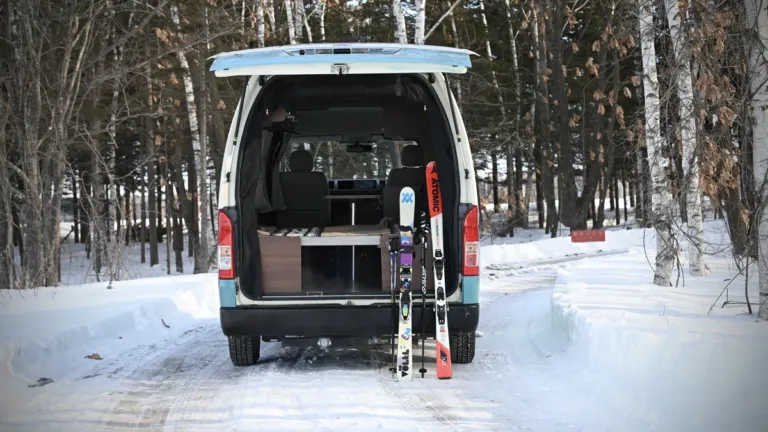
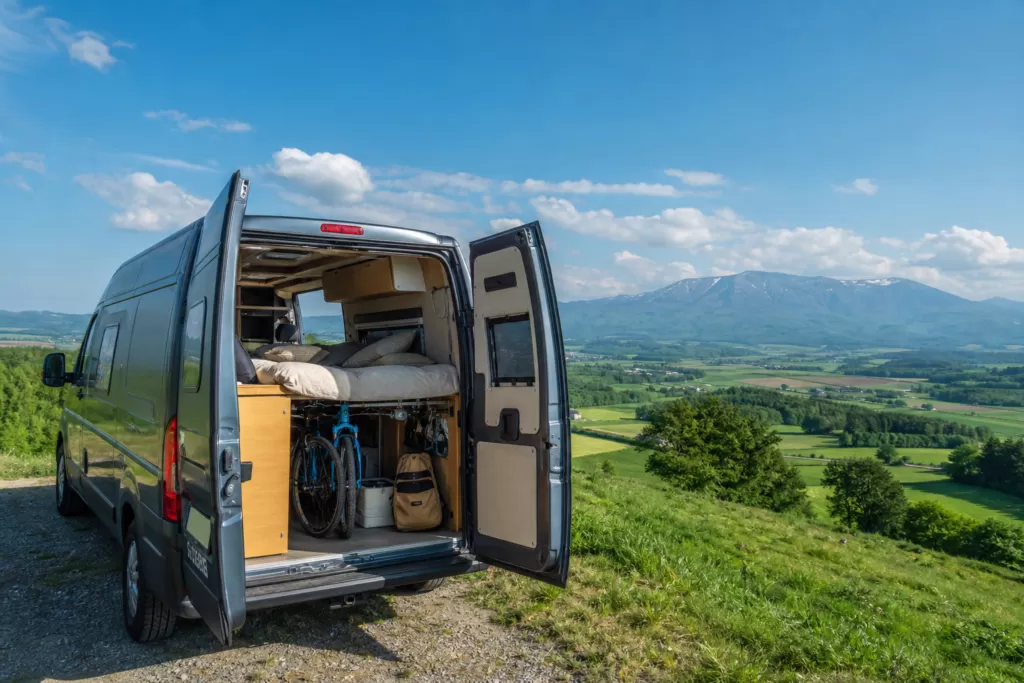
A road bike weighs roughly 7–10kg, and an e-bike can weigh over 20kg — bringing multiple bikes has a real effect on your available payload. For vehicle choice and cargo-space considerations for a cycling trip, see our Hokkaido cycling-and-campervan guide in detail. The same logic applies to kayaks, fishing gear, and ski equipment — estimate the total weight in advance before choosing your vehicle. For how many sets of skis or snowboards fit and where, see how to carry skis and snowboards in a campervan.
How vehicle choice connects to your driver’s license category
Campervans with a gross vehicle weight over 3.5 tonnes may be off-limits depending on your license category. See Can you drive a campervan on a regular license? for details on license categories by vehicle type. If you’re leaning toward a vehicle with a higher gross vehicle weight for extra payload margin, also confirm it falls within your license category. For expressway vehicle classes and tolls, see our Hokkaido expressway toll guide.
Compare Hokkaido campervan rentals
Check vehicle types, rates, and availability on the official site.
Compare rental companies →Quick-reference table: typical weights on the road
To help you get a feel for payload, here’s a rundown of typical weights you’ll encounter on a trip. Actual weights vary by product and capacity — use this as a planning-stage reference only.
| Item | Approximate weight |
|---|---|
| Full water tank (40 liters) | ~40kg |
| Large-capacity portable power station | 10–20kg |
| 3 days of food/drinks for a family of 4 | 10–20kg |
| 1 road bike | 7–10kg |
| 1 e-bike | 20kg+ |
| Suitcases/bags for 4 people | 30–50kg combined |
New Chitose Airport / Tokachi-Obihiro Airport
Rent the Cabcon “Cresson Journey”
Base yourself at New Chitose Airport and travel all across Hokkaido by campervan.
See details at Moving Inn →Frequently Asked Questions
Q: How is maximum payload calculated?
Maximum payload is gross vehicle weight minus curb weight minus the standard weight of all seats (55kg per seat). That 55kg figure comes from Article 81, Paragraph 2, Item 1(a)(5) of the Ministry of Land, Infrastructure, Transport and Tourism’s detailed notification on the Road Vehicle Safety Regulations (MLIT official site, confirmed 2026-08-27).
Q: What’s the payload like for a kei-camper?
As a base-vehicle example, the Daihatsu Hijet Cargo Deck Van G (2WD) has a curb weight of 920kg, seating capacity of 4, and a maximum payload of 250kg (Daihatsu official site, confirmed 2026-08-27). The actual figure after conversion changes depending on the fit-out, so check the vehicle inspection certificate of the vehicle you’re renting.
Q: What’s the payload like for a vancon or cabcon?
Post-conversion curb weight and maximum payload vary by builder, model, and options, and are often not published as a single uniform figure. For the exact number, check the vehicle inspection certificate of the vehicle you’re renting, or ask the rental company directly.
Q: What’s the problem with overloading?
Overloading violates Japan’s Road Vehicles Act safety regulations. Along with faster tire wear and worse fuel economy, it degrades braking performance and driving stability. Campervans have a higher center of gravity, so they’re more sensitive to load weight than an ordinary passenger car.
Q: How should I load cargo for stability?
Keep heavy items low and toward the front-to-back and side-to-side center of the vehicle for the best stability. Avoid concentrating heavy items at the rear or up high, since that makes the vehicle prone to swaying on curves or in strong wind.
Q: Does the water tank or portable power station count toward payload?
Yes. The weight of a full water tank (about 40kg for 40 liters) and large-capacity portable power stations are easy to overlook, so plan your payload margin assuming the tank is full and your gear is fully loaded.
Q: What should I watch for when bringing a bike?
A road bike weighs roughly 7–10kg, and an e-bike can weigh over 20kg — bringing multiple bikes has a real effect on your available payload. See our Hokkaido cycling-and-campervan guide for vehicle choice and cargo-space details.
Book a Campervan in Hokkaido
Moving Inn New Chitose Airport supports English booking and offers airport transfers.