Campervan Rental Troubles & How to Handle Them | Avoid Common Problems on Your Hokkaido Campervan Trip [2026 Edition]
Common troubles and solutions for Hokkaido campervan rental trips. Covers booking cancellations, vehicle breakdowns, accidents, parking issues, and getting lost—everything to know in advance.
Pick a campervan by what matters to you.
Rent at New Chitose Airport
See only the rental bases in Chitose, where the airport is.
Rent in winter (Dec–Mar)
Companies that rent through winter, listed apart from those that close.
Guide price
Moving Inn New Chitose Airport: HIACE van conversion from ¥22,000 per night. 20–30% off when booked 60–90 days ahead (official rate table, checked 15 Oct 2026).
Before you book: with an International Driving Permit if your country is in the Geneva Convention (for example the US, Australia, Singapore); Taiwan, Switzerland, Germany, France, Belgium and Monaco need your licence plus a Japanese translation (Tokyo Metropolitan Police). Questions in English: Moving Inn on WhatsApp. Every roadside station (michi-no-eki) must have free 24-hour toilets, and Hokkaido has 128 of them (MLIT).
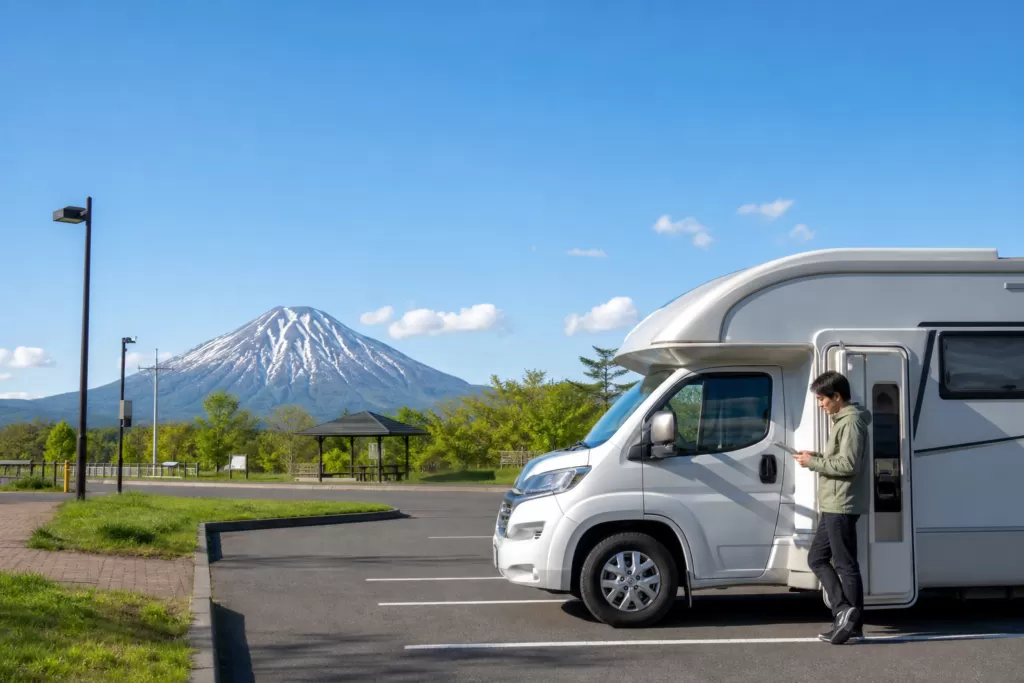
Campervan rental trips offer great freedom, which also means they are more prone to a different kind of trouble than hotel-based travel. “Couldn’t get a reservation,” “got lost and had no signal,” “the campsite was full”—knowing about these situations in advance means you can stay calm and act quickly if they happen. Picking the wrong vehicle type for your trip is another common source of regret, covered in 5 Common Traits of People Who Regret Buying a Campervan.
Hokkaido is vast, distances between cities are long, and there are many mountain stretches with no cell coverage. Moving with the same assumptions as on Honshu can lead to unexpected problems. This article summarizes specific responses for each type of trouble, as well as preparation you should do in advance.
New Chitose Airport / Tokachi-Obihiro Airport
Rent the Cabcon “Cresson Journey”
Base yourself at New Chitose Airport and compare rates, vehicle types, and pickup locations all in one place.
See details at Moving Inn →Booking-Related Problems
Can’t Get a Reservation on Your Preferred Dates
During peak season (July–August), many operators are fully booked three to four months in advance. Golden Week, Obon, and the Snow Festival (early February) also fill up early.
The standard approach is to contact multiple operators simultaneously. Prepare second and third-choice dates, and switching to off-peak months such as June or September will also reduce costs. Some operators allow waitlist registration—check when you call.
Didn’t Understand the Cancellation Policy
Cancellation fees for rental campervans increase as the departure date approaches. General guidelines are as follows (policies vary by operator):
| Cancellation Timing | Estimated Cancellation Fee |
|---|---|
| 30+ days before departure | 0–10% |
| 15–29 days before departure | 20–30% |
| 7–14 days before departure | 30–50% |
| 1–6 days before departure | 50–80% |
| Day of departure / no-show | 80–100% |
Always check the cancellation policy when booking, and consider travel insurance with trip cancellation coverage. Some plans also cover cancellations due to bad weather or illness.
Vehicle Problems
Breakdown / Unable to Drive
Flat tires, dead batteries, engine trouble—vehicles can stop working mid-rental. First, pull to a safe location and turn on your hazard lights. Then contact in the following order.
- Call the rental operator’s emergency number (listed in your rental agreement)
- Contact JAF (0570-00-8139) or your insurer’s roadside assistance
- On an expressway, use an emergency roadside phone or call 110
Most rental operators provide a 24-hour emergency contact. Confirm this number before picking up the vehicle and save it in your phone.
Flat Tire / Spare Tire
Large campervans often carry a spare tire and jack, but changing a tire yourself is dangerous given the vehicle’s weight. Pull to a safe spot on the shoulder, then contact the operator or JAF for roadside assistance. Attempting to do it yourself risks the vehicle tipping over.
Sub-battery (Auxiliary Power) Dead
Continuous use of air conditioning, a microwave, or a hair dryer can drain the sub-battery rapidly.
As a fix, charge it by driving (driving charges the battery—roughly half-full after two hours of driving). Moving to a campsite or RV park with shore power and charging from an external source is also effective. Reduce the use of high-draw devices and keep driving. Sub-battery capacity varies widely by vehicle, so check before renting to help you plan the trip.
Accident & Damage Problems
Accident Response Procedure
If an accident occurs, stay calm and act in the following order.
- If anyone is injured, call an ambulance (119)
- Report to the police on 110 (even property-only accidents must be reported)
- Record the other party’s contact details, license plate number, and insurance information
- Contact the rental operator’s emergency number
- Take plenty of photos of the scene and the damage with your smartphone
Even if you are at fault, skipping the police report can cause problems later. Always report to the police.
What Is the Non-Operation Charge (NOC)?
This is a fee charged to cover lost revenue while the campervan is being repaired due to an accident or breakdown. It is charged separately from the repair cost itself.
| Situation | Typical NOC Amount |
|---|---|
| Minor damage, vehicle still driveable | ¥30,000–¥50,000 |
| Damage where vehicle cannot be driven | ¥50,000–¥100,000+ |
Liability insurance may not cover the NOC. Always check when booking whether an NOC waiver option is available and what it costs. See the Campervan Booking & Comparison Guide for more details.
Damage/Dent Dispute at Return
Being held responsible for damage that was there before the rental is not uncommon. Always photograph the entire vehicle from all angles immediately after pickup to document pre-existing damage. Time-stamped photo data will prevent disputes later. Make sure all existing damage is noted on the operator’s inspection sheet.
Accommodation Problems
Roadside Station or Campsite Is Full
During peak summer season (July–August), popular roadside stations and campsites near tourist spots fill up early. Plan to arrive at your accommodation by 3–4 p.m. and list second and third backup options in advance.
Many RV parks accept advance reservations, making them reliably available even during peak season. They often have better facilities than roadside stations—use them actively.
Campsite Was Closed Without Warning
Many campsites close in late September to early October in autumn. Official site information is not always up to date, so calling ahead is more reliable. NAVITIME’s campsite search and Hokkaido tourism information sites also carry closure details.
Fresh Water Tank Empty / Wastewater Tank Full
This tends to happen in the latter half of a trip. Fresh water can be refilled at the kitchen facilities of campsites, RV parks, or roadside stations. Wastewater must be disposed of at designated waste-water disposal points—never dump it in nature or into roadside drains (this violates environmental regulations). Be conscious of usage from the start of the trip and deal with it before the tank is full.
Getting Lost & Communication Problems
Got Lost / No Cell Coverage
In mountain areas of eastern and northern Hokkaido, there are many stretches with no cell signal. Download offline maps in advance (via Google Maps on a Wi-Fi connection) so navigation works without a signal.
When you have no signal, drive to a roadside station, convenience store, or town and wait for signal to return. Carrying one printed Hokkaido road atlas lets you check directions even in the worst case.
Accidentally Drove Onto a Farm Road or Forest Track
Navigation apps sometimes route you onto farm roads or forest tracks. A large campervan may not be able to turn around on a narrow farm road. If you feel you are about to enter a narrow road, stop before turning in and reverse back to the main road—it is safer than continuing. Especially when driving alone, do not push your luck; return to the main road and re-check.
Weather & Health Problems
Bad Weather (Typhoon, Snowstorm, Blizzard)
Typhoons in summer, autumn gales, and winter blizzards can all affect your itinerary in Hokkaido. If bad weather is forecast, either move early or postpone travel to the next day.
Winter whiteouts (blowing snow reducing visibility to zero) are especially dangerous. Waiting at a roadside station or SA/PA until conditions improve is the only correct response. Building one “non-driving day” into your itinerary reduces stress significantly.
Illness
If you feel unwell on the road, do not push on—rest at a roadside station or accommodation. In Hokkaido, the next hospital can be over an hour away. Always carry basic medication (fever reducer, stomach medicine, motion sickness pills). For emergencies, calling 119 will get you appropriate guidance even over the phone.
5 Things to Prepare Before Departure
- □ Save emergency contacts (operator, JAF, family) in your phone
- □ Photograph the entire vehicle from all angles before departure to document pre-existing damage
- □ Check the sub-battery, gas, and kerosene (winter) levels
- □ Download offline maps
- □ List second and third backup accommodation options with their phone numbers
Trouble-by-Trouble Response Flowchart
Panic clouds judgment when something goes wrong. Deciding in advance “if this trouble occurs, I will do this” lets you respond calmly. Below is a summary of response flows by type of problem.
Vehicle Breakdown / Unable to Drive
In mountain areas where your location is hard to identify, giving the operator or JAF your GPS coordinates (findable in your map app) speeds up the response. If you have no signal, drive or walk to the nearest town or roadside building before calling.
Traffic Accident (Collision with Another Vehicle / Self-Damage)
- If anyone is injured, call an ambulance (119) first
- Report to the police on 110 (even property-only accidents must be reported; skipping it causes problems later)
- Record the other party’s name, phone number, license plate, insurance company, and policy number
- Photograph the scene, the damage, and the positions of both vehicles with your smartphone
- Contact the rental operator’s emergency number and report what happened
- Call your insurance company and follow its instructions
Illness / Medical Emergency
- Park in a safe place and don’t force yourself to keep moving
- If emergency care is needed, call 119 (describe your symptoms and they will direct you to the nearest hospital)
- For a minor illness (fever, stomachache, headache), rest at a roadside station or RV park and buy over-the-counter medicine at a nearby drugstore or convenience store
- Calling the “Emergency Consultation Center Sapporo” (#7119) lets you ask a nurse by phone whether you need to see a doctor (it covers Sapporo and nearby municipalities such as Ebetsu, Eniwa, Kitahiroshima, and Ishikari)
- If you haven’t recovered by the next day, change your itinerary and head to a hospital in town
Weather Deterioration (Typhoon / Blizzard / Gale)
- Each morning, check the Japan Meteorological Agency or NHK forecast for snowstorm or heavy snow warnings
- On days with a warning, stop driving and wait at a roadside station, service area, or RV park
- Never drive in a winter whiteout; stop and wait until visibility returns
- In a typhoon or gale, avoid parking under trees, below cliffs, or along rivers, and move to an open parking lot or roadside station
- Check the next day’s weather the night before; if bad weather is forecast, consider moving on to your next stop that same day
Preventing Return-Time Troubles
Nine out of ten return-time disputes can be prevented through preparation before departure. “Damage/scratches” and “fuel” are the most common issues at return—keep them in mind throughout the trip.
Photographing the Vehicle Before Departure
Photograph the entire vehicle immediately after pickup. Key points:
- Shoot all four sides (make sure the license plate is visible)
- Take close-ups of damage-prone areas: bumpers, side mirrors, lower door edges
- Cross-reference with any damage noted on the operator’s inspection sheet
- Photos taken with your phone’s camera app automatically record date and time—no extra steps needed
If you notice pre-existing damage not on the operator’s sheet, point it out verbally and ask for it to be added. This prevents “damage found after rental” being charged to you.
Confirming Full-Tank Return Policy
Most rental campervans must be returned with a full tank. Fill up at a gas station just before returning and keep the receipt.
- Research a gas station near the return location in advance (there may be few options on remote islands or in mountain areas)
- Some operators use a “no full-tank return required / mileage billing” system—check at booking
- Confirm the FF heater kerosene return rule too (full-tank return or usage billing)
Interior Cleaning Standards
Extra cleaning charges at return are a known issue. Standards vary by operator, but following these guidelines is usually fine:
- Remove all garbage (no leftover food, empty cans, bags)
- Wipe floors and seats (mud or food stains may trigger a cleaning charge)
- If there are lingering odors, open windows to air it out and use a deodorizing spray (especially after grilled fish or BBQ)
- Wash dishes and cooking utensils and return them to their original places
- Fold bedding (futon, blankets) and return as received
On the final day, stop at a roadside station or laundromat early and allow 30–60 minutes for cleaning and packing—this gives you a relaxed return. Washing the exterior at a self-service car wash near the return location makes a good impression (not required, but courteous).
New Chitose Airport / Tokachi-Obihiro Airport
Rent the Cabcon “Cresson Journey”
Base yourself at New Chitose Airport and compare rates, vehicle types, and pickup locations all in one place.
See details at Moving Inn →FAQ
Q1: Can I change a flat tire myself?
Large campervans often have a spare, but the vehicle’s weight makes self-repair dangerous. Pull to a safe spot, turn on your hazards, and call the operator or JAF (0570-00-8139) for roadside service.
Q2: What is the Non-Operation Charge (NOC)?
It is the fee charged to cover lost revenue while the vehicle is being repaired due to an accident or breakdown. For driveable damage it is typically ¥30,000–¥50,000; for non-driveable damage it can exceed ¥100,000. Always check at booking whether an NOC waiver option is available.
Q3: Can I always overnight at a roadside station?
Few roadside stations explicitly prohibit overnight stays, but extended stays and cooking are not permitted. Use them for a single-night rest and move on. Some roadside stations near popular spots become difficult to use during peak season.
Q4: Who pays if the vehicle breaks down during the rental?
Breakdowns from normal use are the operator’s responsibility. Damage from driving mistakes or negligence is the renter’s. Check the contents of the liability insurance, NOC option, and compensation plan before renting. Also be sure to understand exclusions (DUI, driving outside permitted areas, etc.).
Q5: What are the most common troubles on Hokkaido trips?
The issues most frequently mentioned in reviews and by operators are “accommodation full,” “sub-battery dead,” and “got lost (no signal).” All three can be addressed through preparation. Simply having backup accommodation options, knowing your battery usage limits, and pre-downloading offline maps will greatly improve your peace of mind on the road.
Book a Campervan in Hokkaido
Moving Inn New Chitose Airport supports English booking and offers airport transfers.
Pick a campervan by what matters to you.
Rent at New Chitose Airport
See only the rental bases in Chitose, where the airport is.
![When and Where Can You See Harbor Seals at Cape Erimo? Kaze no Yakata Official Information, Viewing Season, and Windy-Day Notes [2026-27]](https://hokkaido-campingcar.jp/wp-content/uploads/2026/10/erimo-cape-lighthouse-768x511.jpg.webp)
![Where and Under What Conditions Can You See Diamond Dust in Hokkaido? How Cold a Morning It Takes, and Where It Appears [2026-27]](https://hokkaido-campingcar.jp/wp-content/uploads/2026/10/hokkaido-diamond-dust-nayoro-768x512.jpg.webp)
![Can You Drive to Hokkaido Jingu for Hatsumode? Parking, Crowds, and Where to Park and Walk [2027]](https://hokkaido-campingcar.jp/wp-content/uploads/2026/10/hokkaido-jingu-winter-torii-768x504.jpg.webp)
![Hokkaido Roads Over New Year [2026-27] | Expressway Sections Prone to Blizzard Closures, Forecast Congestion Days, No Holiday Discount, and New Chitose Airport Parking](https://hokkaido-campingcar.jp/wp-content/uploads/2026/10/hokkaido-winter-rural-road-edge-markers-768x432.jpg.webp)
![Where to See Sea Smoke (Kearashi) in Hokkaido: Rumoi’s Ogon-misaki and the Morning Conditions [2026-27]](https://hokkaido-campingcar.jp/wp-content/uploads/2026/10/rumoi-kearashi-sea-smoke-768x511.jpg.webp)
![Geminid Meteor Shower 2026 in Hokkaido: Peak Around 23:00 on December 14, Sapporo Moonset 20:40, and Staying Warm in a Winter Campervan [2026]](https://hokkaido-campingcar.jp/wp-content/uploads/2026/10/geminids-2026-hokkaido-768x575.jpg.webp)