Complete Guide to Winter Camping Car Driving in Hokkaido | Snow Roads, Cold Weather & Overnight Tips [2026 Edition]
Pick a campervan by what matters to you.
Rent in winter (Dec–Mar)
Companies that rent through winter, listed apart from those that close.
Rent at New Chitose Airport
See only the rental bases in Chitose, where the airport is.
Guide price
Moving Inn New Chitose Airport: HIACE van conversion from ¥22,000 per night. 20–30% off when booked 60–90 days ahead (official rate table, checked 15 Oct 2026).
Hokkaido ski resorts by campervan →
Before you book: with an International Driving Permit if your country is in the Geneva Convention (for example the US, Australia, Singapore); Taiwan, Switzerland, Germany, France, Belgium and Monaco need your licence plus a Japanese translation (Tokyo Metropolitan Police). Questions in English: Moving Inn on WhatsApp. Every roadside station (michi-no-eki) must have free 24-hour toilets, and Hokkaido has 128 of them (MLIT).
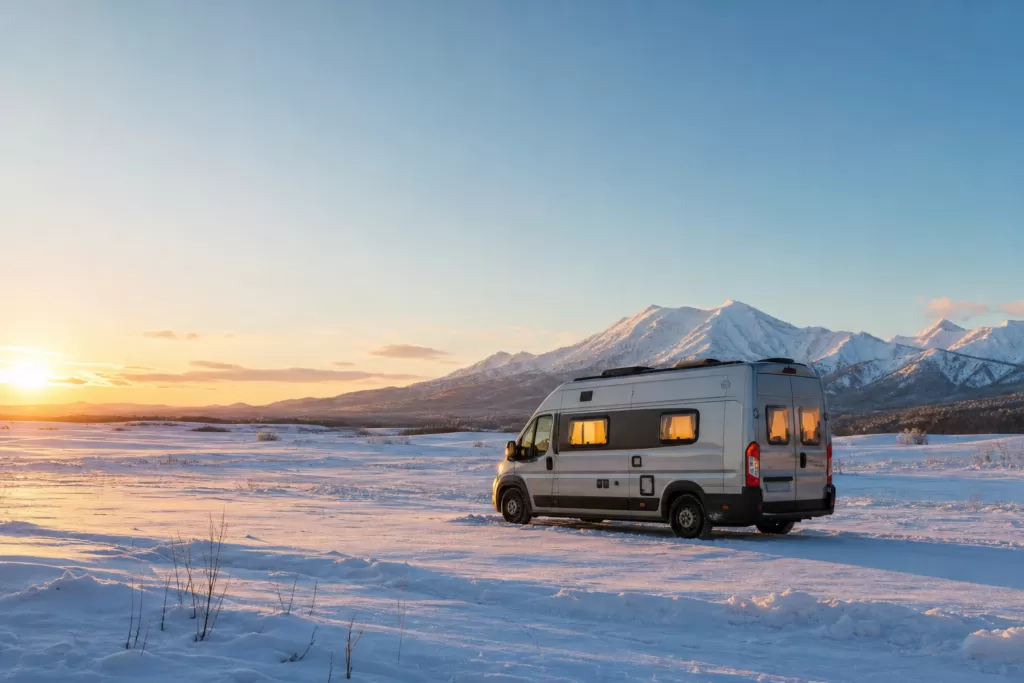
Hokkaido in winter offers a world unlike anything you can experience on the main island of Japan. Vast snowfields, frozen lakes, and drift ice lining the Okhotsk Sea coast — a camping car lets you explore all of it entirely at your own pace.
That said, a winter drive through Hokkaido requires thorough preparation to truly enjoy. This article covers everything from how to plan your route in a winter camping car, to safe overnight spots and choosing cold-weather gear.
New Chitose Airport / Tokachi-Obihiro Airport
Rent the Cabcon “Cresson Journey”
Base yourself at New Chitose Airport and compare rates, vehicle types, and pickup locations all in one place.
See details at Moving Inn →Why Travel Hokkaido in Winter by Camping Car
The Peace of Mind That Comes with Combined Transport and Accommodation
In Hokkaido winters, blizzards can reduce visibility and heavy snow can throw your plans to reach a hotel or inn completely off schedule. With a camping car, your vehicle is also your accommodation, so you can make on-the-spot decisions like “let’s just stay here tonight.”
Even when the weather turns suddenly, you can pull into a road station (Michi-no-Eki) or a safe parking area and wait for conditions to improve. This flexibility is a huge source of reassurance on a Hokkaido winter trip.
Exclusive Access to Dawn and Dusk Scenery
The most beautiful winter scenery in Hokkaido appears in the short windows just after sunrise and just before sunset. Hotel guests are tied to breakfast times and check-out schedules, but in a camping car you can be waiting at a scenic spot before the sun even rises.
The moment morning light spills across the hills of Biei, or the sun sinking into the ice horizon at Notsuke Peninsula — these are privileges unique to the camping car traveller.
Manage Wet Gear and Snow Equipment Right in the Vehicle
Winter activities like skiing, snowshoeing, and ice fishing leave your equipment wet or snow-covered. In a camping car you can dry everything out while driving to your next destination, making gear management far less of a hassle.
You also avoid the awkwardness of hauling bulky gear through a hotel lobby or common areas.
For skiing, the area-by-area ski resort list sums up airport distance and daily cost, which helps you choose a destination.
Recommended Model Routes for a Winter Camping Car Drive in Hokkaido
[4 Nights, 5 Days] Drift Ice and the Okhotsk Coast Route
The Okhotsk coastline, where drift ice arrives from early February to early March, is the single greatest highlight of Hokkaido in winter. Picking up your camping car at New Chitose Airport and looping around Eastern Hokkaido counterclockwise is the most efficient approach.
- Day 1: New Chitose to Obihiro (via Doto Expressway; dinner of Obihiro pork bowl)
- Day 2: Obihiro to Lake Akan (marimo moss and the frozen winter lake)
- Day 3: Lake Akan to Abashiri (Okhotsk Drift Ice Museum; drift ice icebreaker cruise)
- Day 4: Abashiri to Shiretoko (stop at Utoro hot spring; drift ice walk experience)
- Day 5: Shiretoko to New Chitose (via Nissho Pass; approx. 4 hours)
Total driving distance is approximately 750 km. Daylight is short in Eastern Hokkaido in winter — it gets dark by 4 pm. Keep daily driving under 200 km and leave yourself a comfortable schedule.
[3 Nights, 4 Days] Silvery Central Hokkaido, Furano & Biei Route
Close to New Chitose and packed with winter scenery, the area from central Hokkaido to Furano and Biei is particularly appealing for those who also want to ski or snowboard.
- Day 1: New Chitose to Sapporo (stroll through the Odori Park Snow Festival site)
- Day 2: Sapporo to Furano (snowy scenery at Farm Tomita; visit a ski resort)
- Day 3: Furano to Biei to Asahikawa (Blue Pond; Shirogane Onsen)
- Day 4: Asahikawa to New Chitose (stop at Asahiyama Zoo for winter special exhibits)
Total driving distance is a compact approximately 400 km. This route is also manageable for first-time winter camping car travellers in Hokkaido.
If you want something even shorter, starting from 3 days, also see winter model routes from New Chitose Airport for 3 and 4 days, calculated with real road distances and sunset times.
[2 Nights, 3 Days] Tokachi & Obihiro Food and Nature Route
For those nervous about long-distance driving, or who want to take their time with winter outdoor activities, the Tokachi area centred on Obihiro is the right choice.
- Day 1: New Chitose to Obihiro (about 2+ hours via Doto Expressway; Rokkatei main store, Indian curry, etc.)
- Day 2: Around Obihiro (ice fishing for smelt at Lake Nukabira; Otofuke road station)
- Day 3: Obihiro to New Chitose (stops at Koufuku Station and other sightseeing spots along the way)
The sweeping snowy plains of the Tokachi Basin are among the most dramatic Hokkaido landscapes there are. On a clear day you can see the Hidaka Mountains gleaming white in the distance.
How to Choose Overnight Spots for a Winter Camping Car Trip
Use Road Stations (Michi-no-Eki) That Stay Open in Winter
Most road stations in Hokkaido keep their car parks open in winter and accommodate overnight camping car stays. However, some facilities have their toilets and buildings closed during the cold months, so check ahead before you go.
Particularly easy-to-use winter road station overnight spots include Michi-no-Eki “Nakasatsunai” (near Obihiro), “Utoro Shirietoku” (Shiretoko), and “Drift Ice Street Abashiri.” All have year-round toilet access and cleared parking areas.
Use RV Parks and Paid Overnight Facilities
Staying overnight without electricity becomes tough in winter from a cold-weather standpoint. Using an RV park or paid overnight facility with power hookups saves fuel for your FF heater, and many sites also offer toilets and hot showers.
Fees typically run around 1,000 to 3,500 yen per night. You can check with your rental company for RV park information, or search for Hokkaido on the official RV Park website.
Use Hot Spring Towns as Your Base
Noboribetsu, Lake Toya, Lake Akan, Nukabira, Tokachigawa Onsen and other hot spring areas function perfectly as overnight bases in Hokkaido winters. The classic pattern is to visit a hot spring facility for a bath (around 500 to 1,000 yen) and then stay nearby — a winter camping car staple.
Some hot spring lodges will let you use their car park if you ask, but always call ahead to confirm. Showing up unannounced is inconsiderate, so please avoid it.
Must-See Scenic Spots in Hokkaido in Winter
The Ice Horizon at Notsuke Peninsula (Late January to March)
When Notsuke Bay freezes completely, a pure-white “ice horizon” stretches all the way to the edge of sight. Join a guided walking tour and you can walk on the frozen sea. The sheer openness, with nothing obstructing your view in any direction, is an experience found nowhere else.
When visiting by camping car, use the Notsuke Peninsula Nature Centre car park as your starting point. The road station Swan 44 Nemuro in Nemuro City is also close by and convenient as an overnight base.
Shirogane Blue Pond, Biei (Year-Round)
The Blue Pond near Shirogane Onsen in Biei is illuminated in winter too, offering a mystical scene surrounded by snow. Illuminations are typically held from November through March after sunset (around 5 pm to 9 pm; free admission).
The colour of the pond is muted during the day, so visiting for the illuminations is the way to go. If you stay at the road station Biei Shirogane Birke in Biei, you can enjoy the view twice — once at night and again the following morning.
Ice Bubbles at Lake Nukabira (January to February)
At Lake Nukabira in Kamishihoro, you can see “ice bubbles” — gas bubbles rising from the lake bed that have frozen in place. The sight of countless bubbles trapped inside clear ice has a gem-like beauty all its own.
Around Lake Nukabira there is the RV Park Higashi Daisetsu Nature Museum, which has powered pitches. Ice fishing for smelt is also available at the lake, making it a wonderfully well-rounded 1-night, 2-day activity base.
New Chitose Airport / Tokachi-Obihiro Airport
Rent the Cabcon “Cresson Journey”
Base yourself at New Chitose Airport and compare rates, vehicle types, and pickup locations all in one place.
See details at Moving Inn →For First-Time Snow Drivers: What to Know Before You Go, Especially If Driving on the Left Is New Too
If you are coming from a country that drives on the right, and both left-hand traffic and snowy roads in Japan are new to you, this section gathers what we want you to know before departure in one place. It comes down to three things. Drive slower than you normally would. Leave a longer gap to the vehicle ahead. If a snowstorm leaves you unable to see, do not keep driving; pull into somewhere you can stop safely. The content of this section is based on information published by Hokkaido Prefecture, the Hokkaido Prefectural Police, the Hokkaido Regional Development Bureau, the Civil Engineering Research Institute for Cold Region, and JAF (Japan Automobile Federation).
What to look for to decide to stop driving in a blizzard, a whiteout or on black ice is covered in stop or go on Hokkaido’s winter roads.
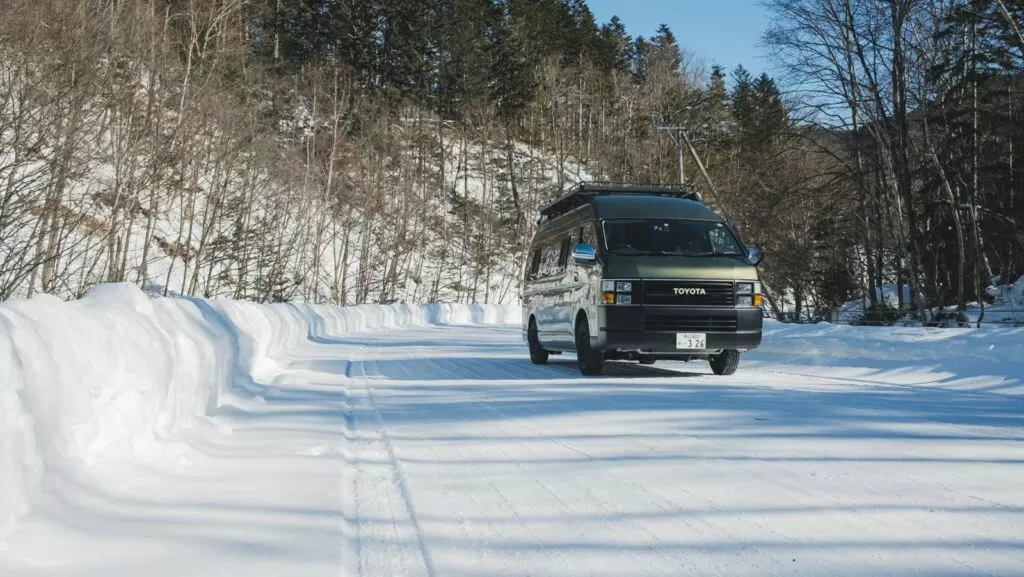
We will not repeat how to choose studless tires or 4WD, or the topics of heating and overnight parking here. For tires, see our article on when to switch to studless tires; for drive types, see our 4WD article.
Driving on the Left: The First Thing to Follow If You Come from a Right-Hand-Traffic Country
JAF’s English page lists the basic rule in Japan as drivers and cyclists keeping to the left. The same page also lists yielding to pedestrians, not using a mobile phone while driving and not staring at the car navigation screen, and not crossing the stop line at a red light (JAF, “Traffic Rules in Japan”, checked 2026-10-06).
Hokkaido’s English leaflet urges drivers to take particular care against collisions at intersections and to always check road signs (Dear Visitors to Hokkaido in Winter, checked 2026-10-06). Turning right means crossing the oncoming lane, so slow down well before the intersection and leave enough margin to stop even on an icy surface.
On pickup day, it helps to spend some time getting used to the driver’s seat over a short distance around the airport. For a guideline on daily driving distance, see “Limit Each Day’s Driving to 200 km” later in this section.
The Basics of Snow Driving: Go Slowly, Leave a Gap, Don’t Rush
Hokkaido’s English page “Driving on winter roads” says that an icy surface is about 10 times as slippery as a dry road in summer. Intersections, crosswalks, the approach to railroad crossings, bridges on cold days, and spots shaded by trees or buildings are especially slippery (Hokkaido, “Driving on winter roads”, posted 2026-03-27, checked 2026-10-06).
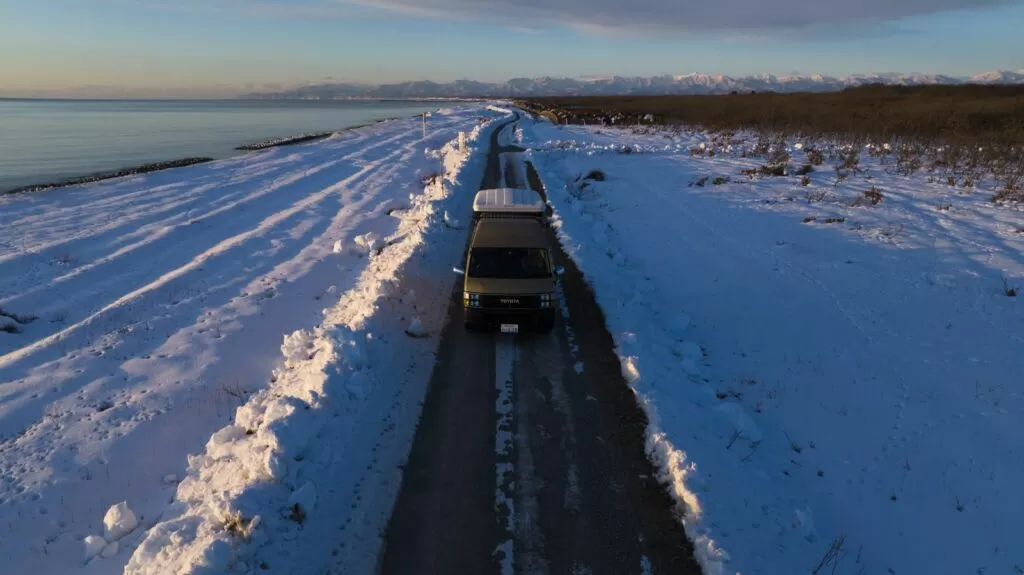
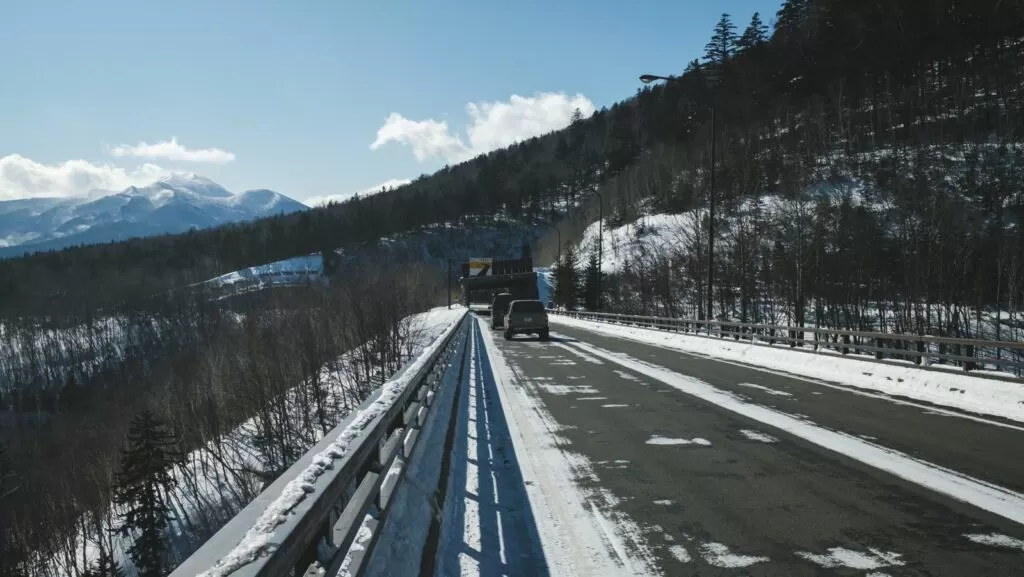
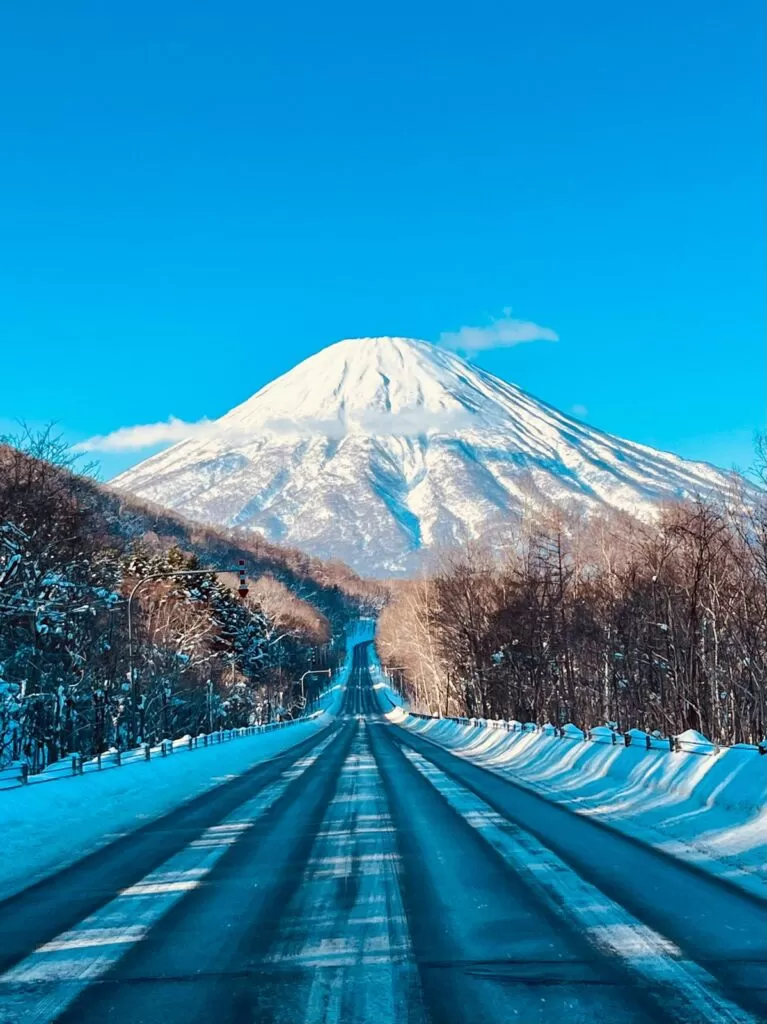
Both Hokkaido’s page on preventing traffic accidents in winter and JAF’s English page call for caution on bridges and at tunnel entrances and exits. The Hokkaido page also notes that skidding accidents are most likely from dusk until the next morning (Hokkaido, “Preventing Traffic Accidents in Winter”, posted 2026-02-12; JAF, “What to be careful of on snow-covered and icy roads”; both checked 2026-10-06).
According to JAF, “black ice,” where a wet-looking dark road surface is actually frozen, is especially dangerous on bridges, on elevated roads exposed to the wind, and near tunnel entrances and exits.
Official sources give different figures for speed and following distance. An English leaflet published on the Hokkaido Prefectural Police website (issued jointly by Hokkaido Prefecture, the Hokkaido Prefectural Police, and others; wording as of December 2016) says to drive “at least 10 km/h slower than in summer” and to keep “at least twice the usual following distance” (Four key points for safe winter driving, checked 2026-10-06). Hokkaido’s English page asks drivers to keep at least three times the following distance needed in summer. Since the numbers differ, going with the longer one is the safer choice, and all the more so in a heavy campervan.
Press the brake gently so the tires do not lock. When you brake hard and the ABS kicks in, the pedal may pulsate; Hokkaido’s page advises keeping the pedal pressed and steering to control the vehicle. JAF’s advice is to ease onto the accelerator when pulling away and to avoid sudden lane changes and hard braking.
Snow piled on the roof can slide onto the windshield when you brake and block your view, so clear it before you set off. For a vehicle with a high roof, it is best to ask the rental company how to clear the snow.
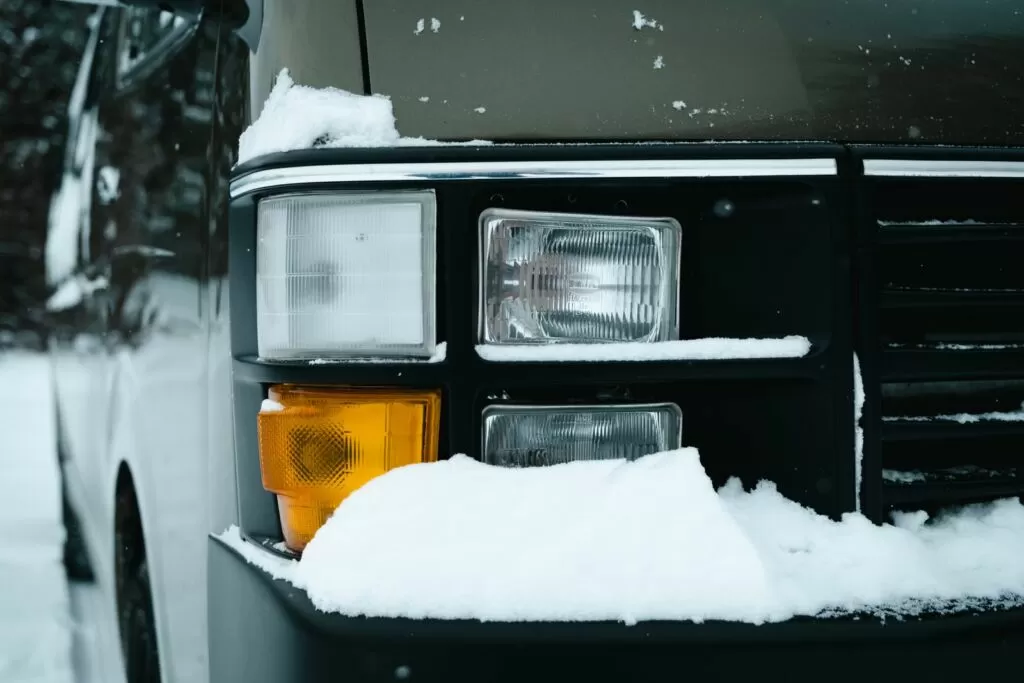
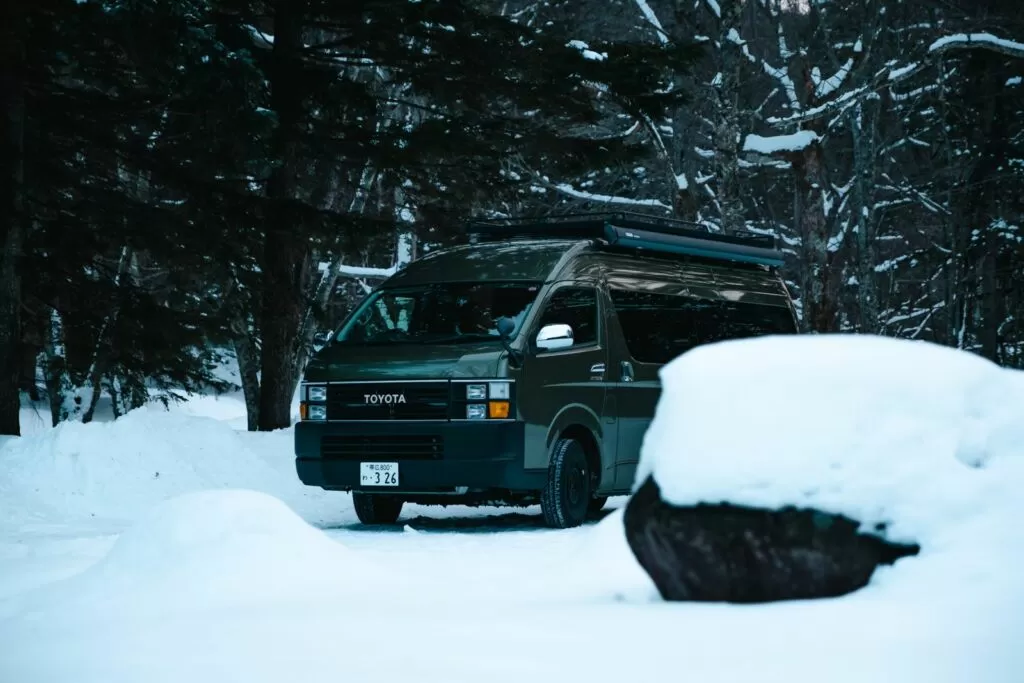
The Hokkaido Prefectural Police have also made an English video on winter driving. It is a video of about two minutes introducing three points: “slow down,” “lift off the accelerator and brake early,” and “plan with room to spare” (Hokkaido Prefectural Police official channel, checked 2026-10-06). You can use it as a check before you leave. The basic precautions are also covered in this article’s “What to Watch Out for When Driving on Winter Roads.”
The Arrow-Topped Posts Along the Road Mark Where the Road Edge Is
Along Hokkaido’s roads you will see rows of thin poles topped with an arrow shape. Their official name is fixed delineator posts, and they are commonly called “yabane” (arrow feathers).
According to a report by the Civil Engineering Research Institute for Cold Region, they were originally markers showing the road edge during snow clearing, and in recent years they have also been used as facilities that guide the driver’s line of sight when visibility is poor in a snowstorm (Civil Engineering Research Institute for Cold Region Monthly Report No. 636, May 2006, checked 2026-10-06). JAF’s English page also tells drivers to follow the arrows and reflective poles at the road edge.
The Sapporo Development and Construction Department of the Hokkaido Regional Development Bureau explains that, as a measure for places where snowstorms and blowing snow reduce visibility, solar-powered fixed delineator posts and self-illuminating delineators that change brightness according to visibility are being installed (Hokkaido Regional Development Bureau, Sapporo Development and Construction Department, “Sight-Guidance Facilities”, checked 2026-10-06). If the arrow posts become hard to see, take it as a signal to slow down and look for somewhere to stop.
If a Snowstorm Leaves You Unable to See Ahead, Decide Not to Keep Driving
Ahead of the February 2026 snowstorm, the Hokkaido Regional Development Bureau, the Hokkaido Transport Bureau, the Sapporo District Meteorological Observatory, and NEXCO East Japan Hokkaido Branch jointly issued this appeal: if it is difficult to drive safely, do not push on, and wait for the weather to improve at the nearest service area, parking area, or Michi-no-Eki (Appeal regarding snowstorms and heavy snow, February 5, 2026, checked 2026-10-06). Being able to wait at a Michi-no-Eki is one of the strengths of a campervan.
If you do end up in a whiteout, JAF’s English page advises turning on your hazard lights and stopping in a safe place. It also says that if you cannot move, snow blocking the exhaust pipe creates a risk of carbon monoxide poisoning, so clear enough snow for the exhaust to escape.
The appeal document above also says that when you ask for rescue, you should give your location as precisely as possible; that on national highways you can confirm your position from signs placed every 1 km at the roadside; and it lists the contact numbers: 110 for the police, 119 for the fire department, and #8139 for JAF. Please also note down the rental company’s emergency contact before you leave.
Check Winter Road Information Before You Leave and at Every Break
The appeal document above also lists information sources to check in bad winter weather. “Northern Road Navi” is a road information site run by the Civil Engineering Research Institute for Cold Region, and it provides snowstorm visibility information (Northern Road Navi, checked 2026-10-06).
For winter sunset times and how to arrive before dark, see “When Does It Get Dark in Hokkaido in Winter? December Sunset: Sapporo 16:03, Nemuro 15:45, and How to Plan Trips to Arrive in Daylight [2026-27]”.
The site itself notes that its foreign-language display is machine translation by a private automatic translation service and may differ from the Japanese.
The road information system provides traffic restriction information for national and prefectural roads, road weather, and images from about 120 national highway cameras, updated every 15 minutes (according to the same appeal document).
A source you can read in English is the “Hokkaido Travel Safety Information” site. Its top page can be switched between English, Chinese (Simplified and Traditional), and Korean, and it has sections on roads and weather (Hokkaido Travel Safety Information, checked 2026-10-06).
The same appeal document also explains in a diagram that road information boards display road closures and the like in English for foreign drivers. Roads that become impassable in winter are covered in our article on winter road closures.
Limit Each Day’s Driving to 200 km and Arrive While It’s Still Light
On this site, our guideline is a maximum of 200 km and 9 hours of driving per day. This is not an official standard; it is a rule this site set so that you can drive safely all the way. In winter, speeds stay low on snowy roads and the days are short, so even if a route looks like it is within 200 km on the map, there is little time to spare once you add breaks. Do not plan a day that exceeds this limit, and if you cannot find a place to stay, split the trip across more days.
Hokkaido’s page also recommends planning with room to spare so that you arrive while it is still light (the “Preventing Traffic Accidents in Winter” page above, checked 2026-10-06). Whether you can drive on a foreign license is covered country by country in our article on how to rent a campervan with a foreign license.
Equipment and Safety Measures for a Winter Camping Car Trip
Using the FF Heater and Managing Fuel
Winter nights in Hokkaido can drop below minus 20 degrees Celsius in inland areas. The FF heater (combustion-type warm-air heater) fitted to camping cars is essential — it heats the cabin without the engine running.
However, FF heaters run on diesel or kerosene, consuming roughly 0.2 to 0.5 litres per hour. One overnight stay (8 hours) can use up to around 4 litres. Petrol stations thin out outside urban areas in Hokkaido, so get into the habit of filling up whenever you have the chance rather than waiting until you are low.
In a diesel vehicle, the diesel fuel itself can thicken in the cold. When Hokkaido switches to cold-weather diesel, and what to watch for if you bring your own vehicle from Honshu, are covered in does diesel freeze in Hokkaido in winter?
Also watch for blocked exhaust vents during the night. Make it a habit to check the outside of the vehicle before going to sleep.
Checking Winter Tyres and Cold-Weather Equipment
Hokkaido roads carry a risk of ice from mid-November through early April. Rental camping cars are normally fitted with studless winter tyres, but always confirm before setting off. Check that the tread depth is at least 5 mm as well.
Winter equipment you should have in the vehicle:
- Snow brush and ice scraper (for clearing snow and ice from windows)
- Water-repellent spray and anti-freeze spray
- Tow rope and shovel (for self-rescue when stuck)
- Blankets and a warm sleeping bag (backup in case the heater fails)
- Rubber boots and spiked footwear (for icy surfaces)
What to Watch Out for When Driving on Winter Roads
The most dangerous hazard on Hokkaido winter roads is “black ice” — a thin invisible film of ice on what looks like normal asphalt. It forms most easily when temperatures are between minus 3 and 0 degrees Celsius. Slow down before intersections, on bridges, and on shaded sections of road.
Camping cars are heavier than ordinary passenger cars, so their stopping distance is longer. Keep a following distance at least twice the summer standard. Sudden braking or sharp steering inputs can cause a spin. If you get stuck, stay calm and try to work the vehicle free by gently rocking it forwards and backwards.
If you’d like a complete rundown of winter concerns — snow-covered roads, insulation, heating, and overnight parking — our guide to winter campervan travel worries in Hokkaido covers them all before you head out. Destination-by-destination lows and how to choose an FF heater, bedding, and power to match are covered in our guide to Hokkaido’s winter temperatures.
Estimated Rental Costs for a Winter Camping Car in Hokkaido
Typical Winter Rental Rates
When renting a camping car in Hokkaido, rates in winter (December to March) tend to be lower than in the peak summer season. Prices vary by vehicle type and rental company, but here is a rough guide:
- Mini camping car (2 passengers): 10,000 to 18,000 yen per night
- Van conversion / HiAce-style (4 passengers): 18,000 to 30,000 yen per night
- Cab-over / large vehicle (4 to 6 passengers): 30,000 to 50,000 yen per night
Demand picks up in line with the Snow Festival (early February) and drift ice season (February to early March), so book early for these periods. Weekends and public holidays in particular can be fully booked months in advance.
Points to Confirm When Renting
Winter rentals come with different considerations from summer. Ask the rental company about the following before booking:
- Confirmation that studless winter tyres are fitted (standard or optional extra)
- Whether an FF heater is installed, and a walkthrough on how to use it
- Emergency support procedure in case of breakdown or getting stuck
- Whether one-way rentals or returning to a different depot in winter is available
New Chitose Airport Pick-Up Is the Most Convenient Option
Most visitors arrive in Hokkaido by air, so choosing a rental company that offers pick-up and drop-off near New Chitose Airport saves a great deal of effort. Many operators run free shuttle services from the airport, so you will not need to wrestle heavy luggage onto public transport.
Several camping car rental companies are clustered in Chitose city, making it easy to compare options. Many offer early-booking discounts and multi-night rates, so once your itinerary is set, check their booking sites sooner rather than later.
Frequently Asked Questions (FAQ)
This will be my first time driving on the left and on snow. Can I drive in Hokkaido in winter?
Whether you can drive depends on the conditions of your license and on how comfortable you are, and this site cannot guarantee it. There are three points we want first-timers to follow. Slow down compared with summer and leave a longer gap to the vehicle ahead. Be especially careful on bridges and at tunnel entrances and exits. If a snowstorm leaves you unable to see, do not push on; wait at a Michi-no-Eki or similar. Please keep each day’s driving to a guideline of 200 km and 9 hours. This is this site’s own guideline, not an official standard. The details are in the “For First-Time Snow Drivers” section of this article (Hokkaido, “Preventing Traffic Accidents in Winter” https://www.pref.hokkaido.lg.jp/ks/cak/koutsuu/koutsuuanzen/winter.html, checked 2026-10-06).
Book a Campervan in Hokkaido
Moving Inn New Chitose Airport supports English booking and offers airport transfers.
Pick a campervan by what matters to you.
Rent in winter (Dec–Mar)
Companies that rent through winter, listed apart from those that close.
![When and Where Can You See Harbor Seals at Cape Erimo? Kaze no Yakata Official Information, Viewing Season, and Windy-Day Notes [2026-27]](https://hokkaido-campingcar.jp/wp-content/uploads/2026/10/erimo-cape-lighthouse-768x511.jpg.webp)
![Where and Under What Conditions Can You See Diamond Dust in Hokkaido? How Cold a Morning It Takes, and Where It Appears [2026-27]](https://hokkaido-campingcar.jp/wp-content/uploads/2026/10/hokkaido-diamond-dust-nayoro-768x512.jpg.webp)
![Can You Drive to Hokkaido Jingu for Hatsumode? Parking, Crowds, and Where to Park and Walk [2027]](https://hokkaido-campingcar.jp/wp-content/uploads/2026/10/hokkaido-jingu-winter-torii-768x504.jpg.webp)
![Hokkaido Roads Over New Year [2026-27] | Expressway Sections Prone to Blizzard Closures, Forecast Congestion Days, No Holiday Discount, and New Chitose Airport Parking](https://hokkaido-campingcar.jp/wp-content/uploads/2026/10/hokkaido-winter-rural-road-edge-markers-768x432.jpg.webp)
![Where to See Sea Smoke (Kearashi) in Hokkaido: Rumoi’s Ogon-misaki and the Morning Conditions [2026-27]](https://hokkaido-campingcar.jp/wp-content/uploads/2026/10/rumoi-kearashi-sea-smoke-768x511.jpg.webp)
![Geminid Meteor Shower 2026 in Hokkaido: Peak Around 23:00 on December 14, Sapporo Moonset 20:40, and Staying Warm in a Winter Campervan [2026]](https://hokkaido-campingcar.jp/wp-content/uploads/2026/10/geminids-2026-hokkaido-768x575.jpg.webp)