Can You Rent a Campervan in Hokkaido With a Foreign Driver’s License? Complete Guide by Nationality (2026 Edition)
For travelers from abroad who want to rent a campervan in Hokkaido, the first hurdle is a simple question: “Can I actually drive in Japan on my own license?” Get this wrong and you can be turned away at the counter on the day, and the whole trip falls apart. In fact, the single largest group of foreign visitors staying overnight in Hokkaido is travelers from Taiwan, who accounted for 21.8% of total overnight stays in the January–March 2026 quarter (Hokkaido District Transport Bureau, “Basic Tourism Data for Hokkaido,” June 30, Reiwa 8 / 2026). And a Taiwanese license cannot be used to drive in Japan with an International Driving Permit alone. This article walks through everything you need for renting a campervan in Hokkaido, in order: how to determine which license category you fall into, what documents you need, how to book, and what happens on pickup day.
The licensing rules described here were confirmed on the official Tokyo Metropolitan Police Department website on July 30, 2026. Rules can change, so before you depart, always check the official pages of the National Police Agency and the Tokyo Metropolitan Police Department, as well as the guidance from the rental company you book with.
New from New Chitose Airport — Available from June 2026
Rent the Cabcon “Cresson Journey”
Base yourself at New Chitose Airport and compare rates, vehicle types, and pickup locations all in one place.
See details at Moving Inn →What the Data Shows: Which Countries Are Visitors to Hokkaido Coming From?
According to the Hokkaido District Transport Bureau’s “Basic Tourism Data for Hokkaido” (June 30, Reiwa 8 / 2026), total overnight stays by foreign visitors in Hokkaido in the January–March 2026 quarter reached 4.34 million person-nights (4,340 thousand person-nights), broken down as 1.62 million in January, 1.685 million in February, and 1.034 million in March. This concentration in winter is a distinctive feature of Hokkaido tourism.
Here is the breakdown by country/region. Taiwan leads, followed by South Korea and China.
| Country/Region | Share of total overnight stays in Hokkaido (Jan–Mar 2026) | Driving in Japan |
|---|---|---|
| Taiwan | 21.8% | Requires license + certified Japanese translation |
| South Korea | 17.7% | Can drive with an International Driving Permit |
| China | 16.3% | Cannot drive with a mainland Chinese license |
| Hong Kong | 5.7% | Can drive with an International Driving Permit |
| Australia | 5.8% | Can drive with an International Driving Permit |
| United States | 5.6% | Can drive with an International Driving Permit |
| Thailand | 5.6% | Can drive with an International Driving Permit |
Source: Hokkaido District Transport Bureau, “Basic Tourism Data for Hokkaido” (June 30, Reiwa 8 / 2026, compiled from the Japan Tourism Agency’s “Accommodation Statistics Survey,” second preliminary figures). The driving-eligibility categories are based on information published by the Tokyo Metropolitan Police Department, and the reasoning behind each category is explained in the next section.
Of the top three countries/regions, Taiwan and China do not fall under “just bring an International Driving Permit and you’re fine.” Roughly 40% of foreign travelers renting campervans in Hokkaido fall into these two groups. Start by confirming exactly which pattern applies to you.
Curious why so many overseas travelers choose Hokkaido in the first place? We break down the four reasons — nature, food, snow, and hot springs — with primary-source data in Why Do People from Overseas Visit Hokkaido? [2026 Edition].
Question ① “Can I Drive in Japan on My Own License?” — Three Patterns to Check
There are three main ways someone holding a foreign license can drive in Japan. Which one applies to you completely changes what you need to prepare.
Pattern A: Driving with an International Driving Permit Based on the Geneva Convention
If your International Driving Permit was issued in the format defined by the 1949 Geneva Convention on Road Traffic, by a country that is party to that convention, you can drive in Japan. The list of contracting parties published by the Tokyo Metropolitan Police Department includes South Korea, Hong Kong, Macau, Singapore, Thailand, Malaysia, the Philippines, Australia, New Zealand, the United States, Canada, the United Kingdom, and others (Tokyo Metropolitan Police Department, “Information on Contracting Parties to the Geneva Convention”, confirmed July 30, 2026).
The format matters. An International Driving Permit issued under a treaty other than the Geneva Convention — such as the Vienna Convention — cannot be used to drive in Japan. The permit must also be valid on both counts: “within one year of issuance” and “within one year of your arrival in Japan” (Tokyo Metropolitan Police Department, “How to Drive in Japan With an International Driving Permit Obtained Overseas”, confirmed July 30, 2026).
To check what applies to your country in one table, see our country-by-country guide to driving a campervan in Hokkaido on your licence.
Pattern B: Driving With a Foreign License Plus a Certified Japanese Translation
Driver’s licenses issued in Switzerland, Germany, France, Belgium, Monaco, and Taiwan allow you to drive in Japan if you carry the original license together with a Japanese translation prepared by an organization designated by government ordinance. This method is valid only if it has not been more than one year since you arrived in Japan (Tokyo Metropolitan Police Department, “How to Drive in Japan With a Foreign Driver’s License From a Designated Country”, confirmed July 30, 2026).
Germany and Switzerland do not appear on the Tokyo Metropolitan Police Department’s list of Geneva Convention contracting parties. In other words, license holders from Germany and Switzerland must use this translation-based method rather than an International Driving Permit. France, Belgium, and Monaco do appear on the list of contracting parties, but the same page lists them as countries that do not issue the Geneva-format IDP, so an IDP from these three countries cannot be used in Japan. Instead, the page notes that you can drive in Japan by attaching a Japanese translation to your driver’s license issued by that country (Tokyo MPD — Geneva Convention countries, checked 2026-10-05). Tell your rental company before you depart that you’ll be using the translation route.
Pattern C: If Neither of the Above Applies
If you don’t fall under either the Geneva Convention contracting parties or the six countries/regions eligible for the translation route, you cannot drive in Japan on that foreign license as it stands. This is the case for licenses from mainland China (the People’s Republic of China): China does not appear on the Tokyo Metropolitan Police Department’s list of contracting parties, nor among the six countries/regions eligible for the translation method. To drive in Japan, you would need to convert to a Japanese driver’s license (the foreign-license conversion procedure). This isn’t realistic for a short-term trip, so consider having a travel companion do the driving instead, or plan an itinerary that combines public transportation.
For which license category is required for which vehicle type (including whether a campervan can be driven on a standard license), see Can You Drive a Campervan on a Standard License? A Quick Reference by Vehicle Type and License Category. The relationship between Japan’s license categories and a vehicle’s gross weight is judged the same way regardless of whether you hold a Japanese or foreign license.
Question ② “How Do Taiwanese License Holders Handle the Paperwork?” — Getting a Japanese Translation
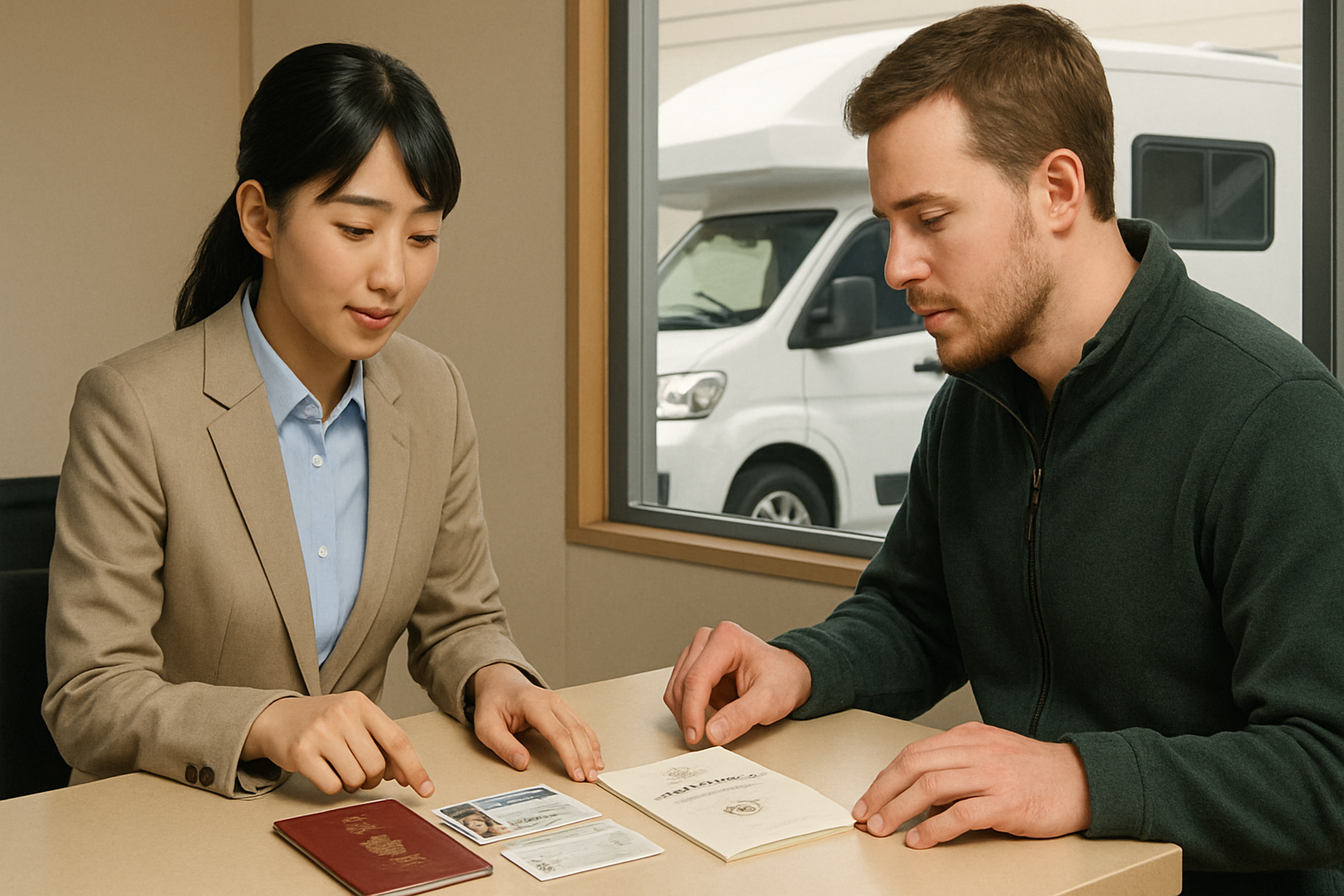
Travelers from Taiwan, the single largest group of visitors to Hokkaido, fall under Pattern B. If you hold a Taiwanese driver’s license, an International Driving Permit will not work in Japan even if you obtain one. What you need is the original Taiwanese license plus a Japanese translation prepared by an organization designated by government ordinance.
The Tokyo Metropolitan Police Department lists the following organizations as authorized to prepare the translation:
- The agency that issued the license, or that country’s embassy/consulate in Japan
- The Japan Automobile Federation (JAF)
- The Taiwan-Japan Relations Association (Taiwanese licenses only)
- ADAC, the German Automobile Club (German licenses only)
- Zip Plus Co., Ltd. (Taiwanese licenses only)
- The Japan Visitor Driving Support Association
If you’re coming from Taiwan, the most reliable approach is to obtain the translation locally before you depart. It’s also possible to get one from JAF after you arrive in Japan, but you’ll need to account for the office’s business days, processing time, and mailing time in your itinerary — if you plan to pick up your vehicle on the same day you land, this often won’t leave enough time. Since many Hokkaido travelers plan to pick up their campervan right after landing at New Chitose Airport, you should plan on having the translation ready before you arrive.
The translation has its own validity conditions: the underlying license itself must still be valid, and it must not have been more than one year since you arrived in Japan. Fees, required documents, and processing times vary by organization, so check with each official office before applying.
Documents to Bring on Pickup Day
Here’s everything above organized into the documents you’ll actually hand over at the counter on the day. The exact combination depends on which pattern applies to you.
| Pattern | Example countries/regions | Documents needed on pickup day |
|---|---|---|
| A: International Driving Permit | South Korea, Hong Kong, Singapore, Thailand, Australia, United States, Canada, United Kingdom, etc. | International Driving Permit in Geneva Convention format / home-country driver’s license / passport |
| B: Japanese translation | Taiwan, Germany, Switzerland, France, Belgium, Monaco | Home-country driver’s license (original) / Japanese translation from a designated organization / passport |
| C: Cannot drive | Mainland China, etc. | Cannot drive on the foreign license as is (conversion to a Japanese license required) |
On top of this, rental companies frequently also ask for a credit card in the contract holder’s own name, your booking confirmation, and your return flight ticket. Some companies place conditions on credit cards issued overseas, so confirming your payment method at the time of booking will save you trouble on the day.
Question ③ “When and How Should I Book?” — Finding a Multilingual Rental Base
The number of campervans available for rent in Hokkaido is limited, and they book up early during peak seasons. This is especially true in summer (July–August) and in winter (January–February), when foreign visitors are concentrated, meaning last-minute bookings often leave you with little choice of vehicle. For a general guide to booking timing, see When Should You Book a Campervan Rental? The Benefits of Booking Early and a Guide to Peak Seasons.
Some rental companies only have Japanese-language booking sites, while others offer English and Chinese pages. When you make an inquiry, here’s what’s worth confirming:
- Whether they accept rentals for holders of foreign licenses (including the Pattern B translation method)
- Whether pickup and return instructions can be given in English or Chinese
- Whether contract and insurance explanation materials are available in multiple languages
- Whether you can pay with a credit card issued overseas
- Whether airport transfer is available, and the latest possible pickup time
Differences in service and pricing by base are organized company by company in The Complete Comparison Guide to Hokkaido Campervan Rental Companies. If you’re basing your trip out of New Chitose Airport, pickup details are covered in The Complete Guide to Renting a Campervan at New Chitose Airport.
New from New Chitose Airport — Available from June 2026
Rent the Cabcon “Cresson Journey”
Base yourself at New Chitose Airport and compare rates, vehicle types, and pickup locations all in one place.
See details at Moving Inn →
Question ④ “I’m Nervous About the Driving Itself” — Japanese Roads and Campervan Size
Japan drives on the left with right-hand-drive vehicles. Even if you come from a country that also drives on the left, a campervan is wider, longer, and taller than an ordinary car, so after pickup, take some time in a large parking lot to get used to the vehicle before setting off. Pay particular attention to how wide the vehicle swings when turning right, passing oncoming traffic on narrow roads, and height restrictions at multi-story parking structures and tunnels.
Once you leave the built-up areas of Hokkaido, long stretches of single-lane-each-way straight road are common, and the driving itself tends to be relatively easy. That said, distances are long, so it’s safer to plan a schedule that doesn’t push your daily driving distance too far. Height restrictions and tips on choosing where to park are covered in The Complete Guide to Campervan Parking and Navigation.
If you’re visiting in winter, snow and icy road conditions add another layer of difficulty. Winter-specific points to check — whether studless tires and 4WD are available, how to use the FF heater, and how to protect your water tanks from freezing — are covered separately in Before Traveling Hokkaido by Campervan in Winter. Given how concentrated foreign overnight stays in Hokkaido are in winter, it’s not unusual for someone driving in Japan for the very first time to find themselves on snow-covered roads right away. Build extra time into your schedule.
Question ⑤ “What Happens if There’s an Accident or Breakdown?” — Insurance and the Waiver
Every rental contract comes with car insurance, but the scope of coverage and the deductible vary by company. In addition, Japanese rental cars have a concept called the Non-Operation Charge (NOC), under which the renter bears the cost of the rental company’s lost business while the vehicle is being repaired after an accident or breakdown. Many companies waive the NOC, along with other costs, if you sign up for a collision damage waiver, so confirm at contract time whether one is available and exactly what it excludes.
If you’re worried about the language barrier, it’s reassuring to get the emergency contact number and the step-by-step procedure for what to do in an accident on paper at pickup. In Japan, an accident must be reported to the police. Save the roadside assistance number on your phone as well.
Differences in insurance and coverage between companies are compared in The Complete Comparison Guide to Rental Companies.
Question ⑥ “Where Can I Stay Overnight?” — The Rules on Overnight Parking
Just because it’s a campervan doesn’t mean you can park anywhere you like and stay overnight. In Japan, the standard approach is to use “RV parks” or auto campsites that are set up specifically for overnight parking. Michi-no-Eki (roadside rest stops) allow parking for a nap, but they’re not intended for you to spread out gear and stay as if camping.
Things you should avoid include setting up a tarp or table in a parking lot, running a generator, leaving trash behind, and idling your engine for long periods. Idling in particular carries far — Hokkaido nights are quiet, so the sound travels.
Where to find overnight spots and the rules around them are covered in The Complete Guide to Overnight Parking in Hokkaido, and how to choose a Michi-no-Eki is covered in Top 20 Hokkaido Roadside Stations for Van-Sleeping.
Pre-Departure Checklist
- Have you confirmed which of Pattern A, B, or C applies to your license?
- (Pattern A) Is your International Driving Permit in Geneva Convention format, and is it within one year of issuance?
- (Pattern B) Have you obtained a Japanese translation locally, and is it from an organization designated by government ordinance?
- Are you carrying the original home-country driver’s license and your passport?
- Have you confirmed that your booked rental company accepts foreign licenses?
- Have you confirmed whether you can pay with a credit card issued overseas?
- Have you confirmed whether to sign up for a collision damage waiver, and what it covers?
- Have you built time into your itinerary to get used to driving after pickup?
- (If visiting in winter) Have you confirmed whether studless tires and 4WD are available?
Summary
For foreign travelers renting a campervan in Hokkaido, the first thing to nail down is your license pattern: can you drive with a Geneva Convention International Driving Permit, do you need the combination of your license plus a Japanese translation, or can you not drive on your foreign license at all? Taiwan, the largest source of foreign overnight stays in Hokkaido, falls into the group that needs the translation, and mainland China, the third largest, cannot drive at all. Get this one thing right, and everything else — booking, paperwork, insurance, and where to stay — just falls into place in order.
Frequently Asked Questions (FAQ)
Can I rent a campervan in Hokkaido with a foreign driver’s license?
The conditions depend on your country or region. If you hold an International Driving Permit issued by a Geneva Convention contracting party, you can drive. Licenses from Switzerland, Germany, France, Belgium, Monaco, and Taiwan let you drive using the combination of the original license and a Japanese translation from a designated organization. If neither applies to you, you cannot drive in Japan on that foreign license as it stands.
If I hold a Taiwanese license, can I drive by getting an International Driving Permit?
No. Taiwan is not on the Tokyo Metropolitan Police Department’s list of Geneva Convention contracting parties, so an International Driving Permit cannot be used to drive in Japan. Instead, attach a Japanese translation prepared by an organization such as the Taiwan-Japan Relations Association, JAF, or Zip Plus Co., Ltd. to your original Taiwanese driver’s license. If you plan to pick up your vehicle on the day you arrive, it’s most reliable to obtain the translation in Taiwan beforehand.
Is it true that a Chinese license cannot be used to drive?
Mainland Chinese licenses are not on the Tokyo Metropolitan Police Department’s list of Geneva Convention contracting parties, nor among the six countries/regions eligible for the Japanese translation method. As a result, you cannot drive in Japan on that foreign license as it stands, and would need to go through the procedure to convert to a Japanese driver’s license. Consider having someone else in your travel party do the driving, or plan an itinerary that combines public transportation.
What do I need to bring to the counter on pickup day?
If you’re using an International Driving Permit, you’ll need three items: the International Driving Permit, your home-country driver’s license, and your passport. If you’re using the Japanese translation route, you’ll need the original home-country driver’s license, the Japanese translation, and your passport. In addition, you’re often asked for a credit card in the contract holder’s own name and your booking confirmation, so have those ready as well.
Can I get service in English or Chinese?
It depends on the company. Some offer multilingual booking sites and guidance materials, while others are Japanese-only. Whether you can understand the pickup instructions is directly tied to your safety, so confirm which languages are supported when you book, and make sure you get the emergency contact and accident procedure on paper.
What should I be especially careful about when driving in Japan?
Two things: Japan drives on the left with right-hand-drive vehicles, and a campervan is larger than an ordinary car. Take time to get used to it in a wide, open space after pickup before setting off. If you’re driving in winter, snow and icy roads add another factor, so confirm whether studless tires and 4WD are available when you book, and keep your daily driving distance on the shorter side.
Can I park and stay overnight anywhere I like?
Use places specifically set up for overnight parking, such as RV parks or auto campsites. Michi-no-Eki allow parking for a nap, but they’re not intended for you to spread out gear and stay. Avoid setting up a tarp, running a generator, or idling your engine for long periods.
Book a Campervan in Hokkaido
Moving Inn New Chitose Airport supports English booking and offers airport transfers.
![Can You Rent a Campervan in Hokkaido in Winter (Dec–Mar)? Companies With Winter Closures and What to Check Before Booking [2026]](https://hokkaido-campingcar.jp/wp-content/uploads/2026/10/hokkaido-campingcar-rental-winter-open-eyecatch-768x432.webp)