How Cold Is Hokkaido in Winter? Sapporo Lows −6.4°C, Furano −14.4°C: Monthly Highs and Lows for 11 Towns (Nov–Feb) [2026]
How cold is Hokkaido in winter? In Sapporo the January normal high is −0.4°C and the low −6.4°C; Furano drops to −14.4°C.
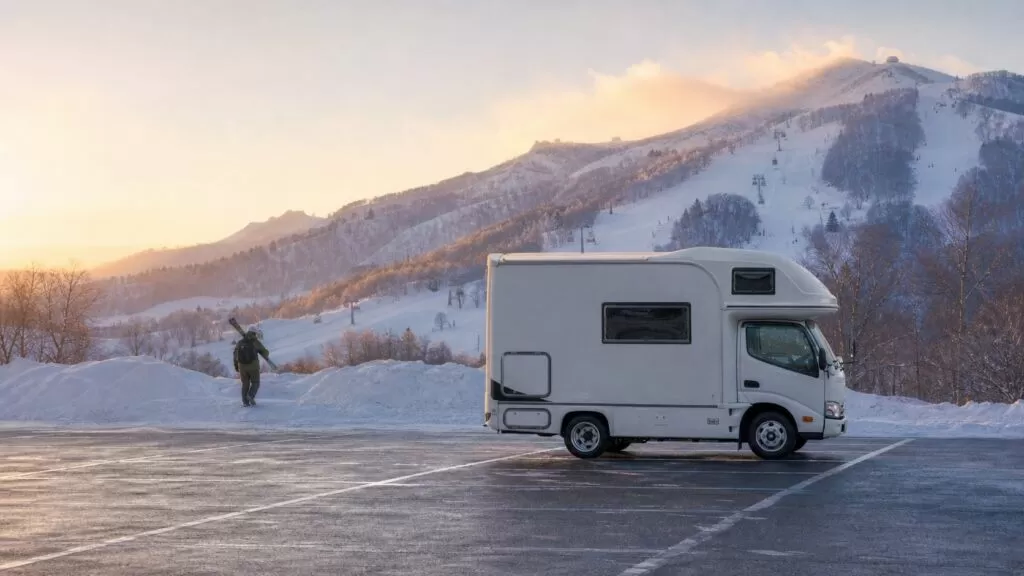
Hokkaido’s winter cold shows up clearly in the numbers: in Sapporo, January’s normal daily high is −0.4°C and the daily low is −6.4°C. Below freezing even in the daytime is simply what a normal January looks like. Move inland and the numbers drop further — Furano’s January low is −14.4°C, Obihiro’s is −13.0°C, and Chitose’s is −12.9°C. At 8 of 11 locations, the normal daily high in January falls below 0°C. Sleeping through that cold is what a campervan overnight in winter means, and the number that decides what gear you need is the low temperature at your destination.
This article lines up Japan Meteorological Agency normal values (1991–2020) across 11 locations for November through February, then walks through how to judge, from the outside air temperature, what happens to your water, electricity, gas, and condensation on the coldest nights, along with how to choose an FF heater, bedding, and power setup, and three questions worth asking a rental company. Winter driving, winter sightseeing, and easing worries about a winter trip each have their own article on this site, and we hand off to them at the end. If you want to see Hokkaido’s seasons as a whole first, our guide to the best time to visit is the place to start.
All temperatures in this article are Japan Meteorological Agency normal values (1991–2020), confirmed on 2026-09-02. Normal values average 30 years of daily figures into a typical-year guide, so an actual night can run colder or warmer than these numbers. In the week before you leave, always check the latest low-temperature forecast from the JMA or a local forecast source.
Compare Hokkaido Campervan Rentals
Compare heating equipment, bedding, winter rental terms, and rates side by side, so you can choose a vehicle that won’t leave you stuck on a night below freezing.
Compare rental companies and vehicles →Where Does Hokkaido’s Winter Actually Start? November and December Are Different Seasons
“Winter in Hokkaido” gets treated as one block, but November and December are worlds apart in the numbers. Sapporo’s November runs at a high of 8.7°C and a low of 1.6°C, with a monthly total snowfall depth of 30cm. By December, the high drops to 2.0°C, the low to −4.0°C, and snowfall jumps to 113cm. In a single month, the low falls by 5.6°C and the snowfall depth nearly quadruples. November is “the tail end of autumn with some snow mixed in”; real winter starts in December.
Inland areas step into winter earlier, though. Five locations already have a normal November daily low below 0°C: Furano at −2.1°C, Chitose at −1.7°C, Asahikawa at −1.5°C, Obihiro at −1.1°C, and Kushiro at −0.3°C. In that same November, Muroran sits at 3.5°C and Hakodate at 1.8°C, so whether you’re touring the coastal south or the inland areas changes the answer to “is it already winter, or still autumn.” Anyone planning a November trip should first read our guide to when Hokkaido’s first snow falls and how it affects your itinerary and our guide to when rental companies switch to studless tires — together they show what to look for when choosing a vehicle.
Across the three months from December to February, the numbers shift by location, but the quality of the cold doesn’t change much. Sapporo’s daily low is −4.0°C in December, −6.4°C in January, and −6.2°C in February — only a 0.2°C gap between January and February. Assume “February is already heading toward spring” and pack light, and you’ll get a night just as cold as January.
Your Destination Changes the Low by 8°C or More — Check the 11-Location Table for November Through February
January’s daily low ranges from −4.0°C in Muroran to −14.4°C in Furano — a 10.4°C spread within the same month, in the same Hokkaido. That’s a 10°C difference in morning cold. It’s why someone who picks up a campervan at New Chitose Airport and heads for Furano or Obihiro needs different gear than someone touring Hakodate or the Toya area.
The table below lines up JMA normal values for the daily high and low temperature (°C) and the monthly total snowfall depth (cm) from November through February across 11 locations. In each cell, the top line is “high / low” and the bottom line is snowfall.
| Location | Nov High / Low Snowfall | Dec High / Low Snowfall | Jan High / Low Snowfall | Feb High / Low Snowfall |
|---|---|---|---|---|
| Sapporo | 8.7 / 1.6 30cm | 2.0 / −4.0 113cm | −0.4 / −6.4 137cm | 0.4 / −6.2 116cm |
| Chitose (near New Chitose Airport) *1 | 8.9 / −1.7 10cm | 1.7 / −8.9 44cm | −1.1 / −12.9 63cm | −0.3 / −12.5 64cm |
| Hakodate | 10.0 / 1.8 18cm | 3.2 / −3.6 79cm | 0.9 / −6.0 91cm | 1.8 / −5.7 74cm |
| Muroran | 9.3 / 3.5 5cm | 2.9 / −1.8 27cm | 0.6 / −4.0 49cm | 1.0 / −4.0 45cm |
| Date (Toya area) *2 | 9.2 / 1.3 — | 2.7 / −3.9 — | 0.1 / −6.8 — | 0.9 / −6.8 — |
| Asahikawa | 6.2 / −1.5 82cm | −0.8 / −8.0 158cm | −3.3 / −11.7 125cm | −1.7 / −11.8 97cm |
| Furano | 6.4 / −2.1 72cm | −1.2 / −10.2 159cm | −3.7 / −14.4 145cm | −2.3 / −14.0 121cm |
| Obihiro | 8.4 / −1.1 10cm | 1.0 / −8.9 51cm | −1.5 / −13.0 52cm | −0.2 / −12.0 37cm |
| Kushiro | 8.9 / −0.3 4cm | 2.5 / −7.0 26cm | −0.2 / −9.8 32cm | −0.1 / −9.4 27cm |
| Abashiri (Shiretoko area reference) | 7.6 / 0.4 13cm | 0.7 / −6.0 71cm | −2.2 / −8.9 90cm | −2.0 / −9.6 69cm |
| Wakkanai | 6.3 / 1.3 41cm | 0.0 / −4.2 122cm | −2.4 / −6.4 129cm | −2.0 / −6.7 105cm |
Three ways to read this table. First, the daily low splits into a “coastal” group and an “inland” group. In January, Muroran, Hakodate, Date, Wakkanai, and Sapporo run −4.0 to −6.8°C, while Chitose, Asahikawa, Obihiro, and Furano run −11.7 to −14.4°C. With Abashiri at −8.9°C and Kushiro at −9.8°C sitting in between, the two sides differ by nearly 5°C. Set your gear by whichever side your destination falls on.
Second, inland locations have a bigger day-to-night swing. Obihiro’s January high is −1.5°C and low is −13.0°C, an 11.5°C spread; Chitose runs −1.1°C to −12.9°C, an 11.8°C spread. Normal sunshine hours are long there too — 188.2 hours in Obihiro and 186.7 hours in Kushiro in January — and on clear nights, the ground loses heat fast, so mornings get bitterly cold. Driving is easier in the daytime, but the overnight cold is harsher than in snowier Sapporo.
On mornings of severe winter cold, steam-like mist called sea smoke (kearashi) can rise from the sea along the coast. Where to see it and the morning conditions that favor it are in where to see sea smoke (kearashi) in Hokkaido.
Third, the Sea of Japan coast and northern Hokkaido have a “snow and cloud” kind of winter. Wakkanai’s January high is −2.4°C and low is −6.4°C, only a 4.0°C spread, with 129cm of snowfall and just 40.6 hours of sunshine. December sunshine there drops to 28.4 hours. Mornings don’t get as cold as inland, but daytime temperatures never climb either, and snow and wind keep coming. Even within “winter in Hokkaido,” the inland radiative-cooling type of cold and the Sea-of-Japan-side snowy, overcast type call for different kinds of preparation.
For reference, here are the January monthly average temperatures too: Sapporo −3.2°C, Hakodate −2.4°C, Muroran −1.8°C, Asahikawa −7.0°C, Obihiro −6.9°C, Furano −8.3°C, Chitose −6.1°C (same source, confirmed 2026-09-02). Inland areas sit 3–5°C below Sapporo.
On a Night the Low Falls Below −10°C, What Should You Judge From the Outside Temperature?
In Chitose, Asahikawa, Obihiro, and Furano, the normal daily low from December through February runs from −8.0°C to −14.4°C. A normal value is an average of daily lows, so read this as: a colder night than that is entirely ordinary. We won’t talk about cabin temperature here — it depends on the vehicle, where you park, and how you run the heater, and there’s no measured data to cite. Instead, here’s how to judge your vehicle’s four weak points from the outside-air number you see in a forecast.
Water: On a Night the Low Drops Below 0°C, Assume the Tank and Pipes Will Freeze
A campervan’s fresh-water tank, wastewater tank, pipes, and pump are often mounted near the outside of the body or under the floor, so if the outside air stays below 0°C overnight, the water inside freezes. Beyond just cutting off your water supply, freezing can crack the pipes or pump. Since every one of the 11 locations has a normal daily low below freezing from December through February, the question isn’t “will there be a night it freezes” — it’s “how do you handle water on the assumption it freezes every night.”
There are two things to decide. Before you book, confirm how the rental company handles winter water systems — usable, drained and lent out, or not usable at all. And if you assume they won’t be usable, plan a route where you drink bottled water and handle washing up or brushing your teeth at a Michi-no-Eki or hot spring’s washroom. It’s less convenient, but the worry of freezing and breaking something disappears.
Electricity: The Colder It Gets, the More You Use, and the Weaker the Battery Gets
An FF heater makes heat by burning fuel, but its blower fan and controls run on the sub-battery. The colder the night, the longer and harder the heater runs, so consumption rises. Batteries also lose performance in the cold, so a cold night puts a double squeeze on you: you use more while you have less available. If two or more cold nights are stacked in a row, build in one night at a stop with external power in between. Make that call while you’re still planning the itinerary.
Gas: A Cassette Stove Loses Power in Low Temperatures
Many people cook with a cassette stove inside the vehicle, but the gas in a cassette canister vaporizes poorly in the cold, so the flame weakens or won’t light at all. Keep the canister somewhere warm inside the vehicle, and cook after the heater has warmed the cabin. It’s also worth checking whether cold-weather-rated canisters are available and whether the rental company allows an open flame inside the vehicle at all.
Condensation: The Bigger the Gap With Outside Air, the More Water Forms on Windows and Walls
Moisture from sleeping people, combined with heater-warmed air, turns to water when it meets a cold window or wall. On a night the outside air drops below −10°C, the gap with the cabin is large, and by morning the inside of the windows can be frosted over. If bedding stays pressed against a wall overnight, it gets damp and loses its insulating power the next night. Three things shrink the damage: insulated window shades or mats, a short burst of ventilation before bed, and keeping bedding away from the walls.
Three Things You Need for a Night Below Freezing: an FF Heater, Bedding, and Power
Given those four weak points, choosing a winter vehicle comes down to three pieces of gear. We won’t cover clothing here, since it’s the same as any winter trip — what’s different about a campervan is what you need for the hours you’re asleep.
For shoes to walk outside the vehicle and a packing checklist for the trip, see Hokkaido winter trip: shoes and packing list.
1. FF Heater: If It’s Not Fitted, Rule Out December-Through-February Overnight Stays
An FF heater, which burns fuel to heat the cabin with the engine off, is the baseline piece of equipment for a winter campervan trip in Hokkaido. Michi-no-Eki and RV parks often ask visitors not to idle overnight, so heating the cabin by leaving the engine running is effectively not an option. Some people get through October on bedding alone, but from December through February, when the normal daily low is below freezing at every location, rule out any vehicle without an FF heater.
Among vehicles that have one, there’s still something to check: is the fuel a separate kerosene tank, or does it draw from the vehicle’s own fuel tank? With a separate tank, ask how many days it lasts and where you can refuel. Run out of fuel and the heater stops in the middle of the night, so multi-night stays need a refueling plan. How the heater works, the fuel differences, and cautions on using it are covered in our guide to how FF heaters work and how to use them.
2. Bedding: On a Night Below −10°C, a Winter-Grade Sleeping Bag (or Equivalent) Is the Baseline
Even with the FF heater running all night, your feet and the side near the wall still get cold. Many people turn the setting down to sleep, and that’s where bedding matters. Rental bedding ranges from “a single blanket” to “a winter sleeping bag” depending on the company, and the price list often doesn’t say which. If you’re staying somewhere inland where the normal low drops below −10°C, confirm whether there’s a winter sleeping bag, or bedding of equivalent thickness, for every person in your group. Bring your own if there isn’t enough — a thick sleeping bag takes up space, so ask where you can stow it so you’re not caught off guard on the day.
3. Power: For Two Nights or More, Build In One Night With External Power
The colder the nights stack up, the harder your sub-battery works. On the vehicle side, check whether it supports an external power input, whether it has an outlet you can run an appliance like an electric blanket from, and its approximate sub-battery capacity. On the itinerary side, build in one night at an RV park or campground with power for every two nights. Running an electric blanket lets you turn the FF heater down, which stretches both your fuel and your electricity.
Three Things to Ask When Comparing Rental Companies
Turning the above into questions to ask before you book: in winter Hokkaido, these three narrow down your candidates before rates or vehicle type even come into it.
- Winter rental terms: Do they rent out vehicles in winter at all? Is the water system usable, drained and lent out, or not usable? When do they switch to studless tires?
- Heating and bedding: Is an FF heater standard? What’s the fuel type, and does it need refueling? How many sets of bedding come standard, at what thickness, is extra winter bedding available, and do the windows have insulated mats?
- Power: Is there an external power input, an outlet for appliances, and what’s the approximate sub-battery capacity?
Some companies close for the winter or apply winter-only rental terms. The fastest path is to narrow your options to two or three candidates on our comparison page based on heating, equipment, and terms, then do a final check of each company’s winter conditions on their own official site.
Choose a Vehicle That Won’t Leave You Stuck on a Night Below Freezing
Compare FF heaters, bedding, winter rental terms, and rates side by side, narrow down your candidates, and confirm details on each company’s official site.
Compare Hokkaido rental companies →The Case for Driving in Winter Anyway, Winter Driving, and Remaining Worries — Each Has Its Own Article
We’ve spent this whole article on temperature, but Hokkaido has plenty that only shows up in winter — drift ice, the Snow Festival, frost clinging to trees on a clear inland morning. Our complete guide to a winter Hokkaido campervan trip lines up what you can see and when. Looking back at this article’s table, Obihiro and Kushiro’s long January sunshine hours (188.2 and 186.7 hours) mean cold but clear — once you know the numbers, a clear −13°C morning feels different.
Winter driving isn’t covered in this article. How to brake, what to do in a blizzard, how to get over a mountain pass, and the real-world details of choosing where to park overnight are the specialty of our guide to winter Hokkaido campervan driving. If this article’s table has you set on staying inland, that’s the next place to prepare.
For the worries underneath all this — “is it really okay to rent one in winter,” “what’s actually scary about freezing or heating” — our guide addressing every worry about a winter Hokkaido campervan trip answers them one by one. This article’s job was just to hand you the numbers.
Once the temperatures have helped you choose a region, the next question is where to sleep each night. Our 10-day winter itinerary sets out two courses from New Chitose Airport, one for January and one for February, with every day within 200 km.
Frequently Asked Questions
How Cold Does Hokkaido Get in Winter?
By Sapporo’s normal values (1991–2020), January runs a daily high of −0.4°C, a daily low of −6.4°C, and a monthly average of −3.2°C. Below freezing in the daytime is simply normal. Inland areas run a step colder: Furano’s January high is −3.7°C and low is −14.4°C, and Asahikawa’s high is −3.3°C and low is −11.7°C. Hakodate, in southern Hokkaido, runs a high of 0.9°C and a low of −6.0°C — only slightly warmer than Sapporo (Japan Meteorological Agency website, confirmed 2026-09-02).
How Different Is December From January in Hokkaido?
In Sapporo, December runs a high of 2.0°C and a low of −4.0°C, versus January’s high of −0.4°C and low of −6.4°C — December is a bit over 2°C warmer. Inland, though, the gap is smaller: Obihiro’s low is −8.9°C in December and −13.0°C in January, and Chitose’s is −8.9°C and −12.9°C. Even in December, inland areas normally see nights in the −8 to −10°C range, so plan your gear on the same standard as January (same source, confirmed 2026-09-02).
Is February Warmer Than January?
The daily low barely changes. Sapporo runs −6.4°C in January and −6.2°C in February; Furano runs −14.4°C and −14.0°C; Asahikawa runs −11.7°C and −11.8°C — every location differs by less than 1°C. What does change is sunshine: Sapporo goes from 90.4 hours in January to 103.5 hours in February, and Wakkanai from 40.6 to 74.7 hours. Days get brighter, but mornings stay just as cold as January. There’s no reason to pack lighter for February (same source, confirmed 2026-09-02).
Is a Winter Campervan Overnight Too Cold to Sleep Through?
It depends on your gear. With an FF heater, enough winter bedding for everyone, and a power plan in place, you can sleep through it even inland. On the other hand, avoid staying overnight from December through February in a vehicle without an FF heater. How far the cabin temperature actually drops depends on the vehicle and where you park — we haven’t cited measured figures in this article. Before you book, confirm heating, bedding, power, and winter rental terms with the rental company first.
Can You Use Water in a Campervan in Winter?
It depends on the company and the vehicle. Since every one of the 11 locations has a normal daily low below freezing from December through February, assume the water system will freeze. Some companies drain the system and lend the vehicle out that way, some make it unusable, and some keep it usable — confirm this before you book. If it’s not usable, plan to drink bottled water and handle washing up or brushing your teeth at a Michi-no-Eki or hot spring’s washroom, and the worry of freezing and breaking something goes away.
Where to Go Next
- 43 Things You Can Only Do in Winter Hokkaido, and Where to Sleep Nearby
- Hokkaido Winter Events 2027: 14 on a Map, With Where to Sleep
- When Is the Best Time to Visit Hokkaido by Campervan? Comparing Spring, Summer, Autumn and Winter Weather, Crowds and Cost [2026 Edition]
- What Is an FF Heater in a Camper Van? How It Works, How to Use It, Why You Need One for Hokkaido Winters, and How to Choose
- Everything You’re Worried About Before a Winter Hokkaido Campervan Trip, Answered — Snow Roads, Freezing, Heating and Overnight Stays
- Complete Guide to Winter Camping Car Driving in Hokkaido: Snow Roads, Cold-Weather & Overnight Tips [2026 Edition]
- Editor’s Picks: Top 15 Hokkaido Campervan Rentals [2026] | Compare by Area, Price & Purpose
Book a Campervan in Hokkaido
Moving Inn New Chitose Airport supports English booking and offers airport transfers.

![When and Where Can You See Harbor Seals at Cape Erimo? Kaze no Yakata Official Information, Viewing Season, and Windy-Day Notes [2026-27]](https://hokkaido-campingcar.jp/wp-content/uploads/2026/10/erimo-cape-lighthouse-768x511.jpg.webp)
![Where and Under What Conditions Can You See Diamond Dust in Hokkaido? How Cold a Morning It Takes, and Where It Appears [2026-27]](https://hokkaido-campingcar.jp/wp-content/uploads/2026/10/hokkaido-diamond-dust-nayoro-768x512.jpg.webp)
![Can You Drive to Hokkaido Jingu for Hatsumode? Parking, Crowds, and Where to Park and Walk [2027]](https://hokkaido-campingcar.jp/wp-content/uploads/2026/10/hokkaido-jingu-winter-torii-768x504.jpg.webp)
![Hokkaido Roads Over New Year [2026-27] | Expressway Sections Prone to Blizzard Closures, Forecast Congestion Days, No Holiday Discount, and New Chitose Airport Parking](https://hokkaido-campingcar.jp/wp-content/uploads/2026/10/hokkaido-winter-rural-road-edge-markers-768x432.jpg.webp)
![Where to See Sea Smoke (Kearashi) in Hokkaido: Rumoi’s Ogon-misaki and the Morning Conditions [2026-27]](https://hokkaido-campingcar.jp/wp-content/uploads/2026/10/rumoi-kearashi-sea-smoke-768x511.jpg.webp)
![Geminid Meteor Shower 2026 in Hokkaido: Peak Around 23:00 on December 14, Sapporo Moonset 20:40, and Staying Warm in a Winter Campervan [2026]](https://hokkaido-campingcar.jp/wp-content/uploads/2026/10/geminids-2026-hokkaido-768x575.jpg.webp)