Hokkaido October Temperature and Clothing Guide | Campervan Trips Differ Between Early and Late October [2026]
Hokkaido's October splits into two seasons: Sapporo goes from 18.7℃/10.3℃ early Oct to 14.3℃/6.1℃ late Oct. JMA data for 11 spots, plus clothing and rental-company checks for heaters, bedding, power.
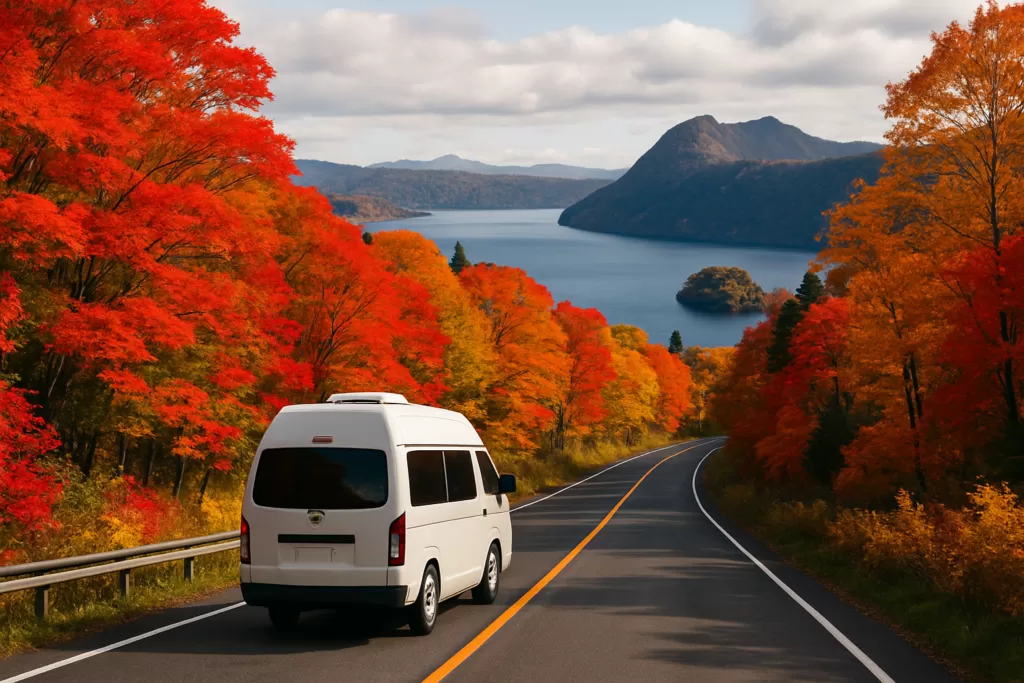
October in Hokkaido changes seasons partway through the month, from early to late October. Sapporo’s normal daily high temperature is 18.7°C in early October and 14.3°C in late October. The daily low drops from 10.3°C in early October to 6.1°C in late October. In inland Asahikawa and Furano, the late-October low falls into the 2°C range, and normal snowfall figures are already recorded for October (2cm in both Asahikawa and Furano). “Pack for autumn” only holds true through early October — late October calls for the kind of preparation you’d bring for the start of winter.
You can rent a campervan for this trip.
- Guide price (Moving Inn, New Chitose Airport, per night, tax included): HIACE van conversion from ¥22,000, Cresson Journey cab-over camper from ¥30,800. 20–30% off when booked 60–90 days ahead (official rate table, checked 15 Oct 2026)
This article lines up Japan Meteorological Agency normal values (1991–2020) across 11 locations by 10-day period, then translates those numbers into what to wear during the day, what to wear in the morning and evening, and what gear you need for a night in a campervan. For anyone about to rent a campervan, we’ve narrowed down the questions worth asking a rental company to three. If you want to see Hokkaido’s seasons as a whole first, our guide to the best time to visit is the place to start.
All temperatures in this article are Japan Meteorological Agency normal values (1991–2020), confirmed on 2026-09-02. Normal values are a typical-year guide, not a forecast for your specific travel dates. In the week before you leave, always check the latest forecast from the JMA or a local forecast source.
Compare Hokkaido Campervan Rentals
Compare heating equipment, bedding, rates, and pickup locations side by side, so you can choose a vehicle that won’t leave you cold on an October night.
Compare rental companies and vehicles →How Cold Is Hokkaido in October? Early and Late October Are Different Seasons
Using Sapporo as the benchmark, early October runs at almost the same temperature as late May. Late May’s normal values are a high of 19.8°C and a low of 10.7°C, versus a high of 18.7°C and a low of 10.3°C in early October — close enough that you can plan around early-summer clothing. Looking at it from the spring side, “early May is almost the same as mid-October” is covered in our guide to Hokkaido’s Golden Week and May temperatures.
By late October, though, the high drops to 14.3°C and the low to 6.1°C. In three weeks, the high falls by more than 4°C and the low by more than 4°C as well. Push on into November and the monthly average is 5.2°C, with a monthly average daily low of 1.6°C. In other words, late October isn’t “the end of autumn” — it’s already a step into the start of winter.
This drop is the single most overlooked point when planning an October trip to Hokkaido. If you built your itinerary back in September, your mental picture tends to freeze on “early-October Hokkaido” temperatures, and it’s easy to underestimate how cold the mornings actually get once you’re driving in late October. Once you’ve picked a destination and dates, the first thing to do is look up the numbers for the exact 10-day period you’ll be traveling in.
Morning Temperatures Vary by More Than 5°C Depending on Where You Go — Check the 11-Location Table by 10-Day Period
Hokkaido is large enough to swallow the whole of Honshu, so you can’t sum up “Hokkaido in October” with one number. Even within the same late-October period, the Pacific-coast city of Muroran has a low of 8.1°C, while inland Chitose (near New Chitose Airport) and Furano sit at 2.3°C — a 5.8°C gap in morning temperatures. Someone who picks up a campervan at New Chitose Airport and heads for Furano or Asahikawa needs to pack an extra layer compared with someone touring Hakodate or the Toya area in southern Hokkaido.
The table below lines up JMA normal values for the daily high and low temperature in early, mid-, and late October across 11 locations. Figures are listed as “high / low,” in °C.
| Location | Early Oct High / Low | Mid Oct High / Low | Late Oct High / Low |
|---|---|---|---|
| Sapporo | 18.7 / 10.3 | 16.4 / 7.9 | 14.3 / 6.1 |
| Chitose (near New Chitose Airport) *1 | 18.4 / 7.0 | 16.1 / 3.7 | 14.0 / 2.3 |
| Hakodate | 19.3 / 10.2 | 17.3 / 7.5 | 15.1 / 6.0 |
| Muroran | 18.1 / 11.9 | 16.1 / 9.5 | 14.1 / 8.1 |
| Date (Toya area) *2 | 18.6 / 9.4 | 16.4 / 6.6 | 14.3 / 5.4 |
| Asahikawa | 17.3 / 6.8 | 14.9 / 4.1 | 12.6 / 2.5 |
| Furano | 17.3 / 6.5 | 15.0 / 3.6 | 12.6 / 2.3 |
| Obihiro | 18.2 / 7.9 | 16.0 / 4.9 | 13.7 / 3.2 |
| Kushiro | 17.0 / 8.7 | 15.2 / 5.7 | 13.3 / 4.2 |
| Abashiri (Shiretoko area reference) | 17.2 / 9.3 | 15.1 / 6.8 | 13.0 / 5.1 |
| Wakkanai | 16.4 / 10.5 | 14.1 / 8.5 | 12.0 / 6.3 |
Three ways to read this table. First, daily highs across all 11 locations stay in the 16–19°C range in early October and the 12–15°C range in late October, with only about a 3°C spread between locations — daytime clothing is decided by the 10-day period more than by where you’re going. Second, daily lows vary far more by location: in late October they range from Muroran’s 8.1°C down to 2.3°C in Chitose and Furano — what you need for mornings, evenings, and overnight parking is decided by where you’re going. Third, eastern Hokkaido’s Kushiro and Abashiri look milder than the inland stations in early October, with lows in the 8–9°C range, but by late October they drop to 4–5°C. Don’t assume eastern Hokkaido is automatically easier than the inland stations.
For reference, here are the monthly figures too. October’s monthly average temperature is 12.1°C in Sapporo, 12.5°C in Hakodate, and 12.9°C in Muroran, versus 9.4°C in Asahikawa and 9.2°C in Furano. Normal monthly total snowfall depth is 2cm in both Asahikawa and Furano, 1cm in both Sapporo and Wakkanai, with 0cm in Abashiri and Chitose. Hakodate, Obihiro, Kushiro, Muroran, and Date have “no applicable data” for October snowfall (same source, confirmed 2026-09-02). In other words, in inland areas and northern Hokkaido, some years bring snow flurries in October.
What Should You Wear? Split It Into Three Layers — Daytime, Morning/Evening, and Overnight — and You Won’t Have to Guess
The mistake travelers make when translating temperature numbers into clothing choices is trying to get through the whole day in one outfit. Hokkaido in October has a big gap between daytime and early-morning temperatures — in late-October Chitose, the high is 14.0°C and the low 2.3°C, an 11.7°C spread. Split what you wear into three scenarios and you’ll pack less and hesitate less.
Daytime Driving and Sightseeing (Highs of 12–19°C)
In early October, a long-sleeve shirt with a shirt jacket or a thin hoodie is enough. With Hakodate’s early-October high of 19.3°C, there should be stretches of midday sun where you’ll want to take your outer layer off and walk around. The cabin warms up in the sun, so you can dress light while driving. If you’ll be out of the car for a long stretch at a sightseeing spot, though, packing a fleece in your daypack keeps you flexible.
In late October, daytime highs sit in the 12–15°C range. At Wakkanai (12.0°C) and Asahikawa/Furano (12.6°C), there are now places where you won’t want to take your jacket off even at midday. A realistic base layering is long sleeves + fleece + a wind-resistant outer layer (a light down jacket or a shell jacket), adding or removing one layer depending on sun and wind. Along the coast and at capes, wind chill drops the felt temperature below the number on paper, so something that covers your neck makes things more comfortable.
Going Out Morning and Evening, Getting Ready at a Michi-no-Eki (Lows of 2–12°C)
On an overnight-parking trip, the times you step outside — an evening shopping run, walking back from a night at a hot spring, using the restroom and getting ready in the morning — cluster around the morning and evening hours. This is where the low temperature figure matters. In early October it’s 6–12°C, and layering a fleece or a light down jacket is enough. In late October, inland (2.5°C in Asahikawa, 2.3°C in Furano, 2.3°C in Chitose, 3.2°C in Obihiro), the outside air in the morning is cold enough for frost. Pack a down jacket, a knit hat, and gloves not just “to bring along” but somewhere you can grab them instantly.
If you’re touring southern Hokkaido or the Pacific coast instead, even in late October it’s 8.1°C in Muroran, 6.0°C in Hakodate, and 5.4°C in Date — a step up from the inland 2°C range into the 5–8°C range, where a single light down jacket is enough for most people. This is exactly what we mean by “your destination decides how you prepare for the mornings.”
Overnight in the Campervan (From Bedtime to Wake-Up)
Your sleeping hours land right inside that day’s low-temperature window, spent entirely inside the vehicle. This is really a question of gear more than clothing, and we cover that in the next section. On the clothing side, the main point is to sleep in a thin long-sleeve top and bottoms, and add one pair of socks so your feet don’t get cold. Bundling up too much to sleep makes you sweat inside the bedding and leaves you cold toward dawn. The basic approach is to adjust with heating and bedding and keep your sleepwear on the light side.
A Night at 2–3°C: What Does a Campervan Actually Need?
Normal low temperatures in late-October Chitose, Furano, and Asahikawa run 2.3–2.5°C. Assuming you’ll spend a night at that temperature inside the vehicle, here’s a look at gear from three angles. How far the cabin temperature actually drops depends on the vehicle and where you park, and we don’t have measured data on that, so we won’t state a figure here. Instead, we’ll organize this around the question: what do you need to sleep through a night with outside air in the 2°C range?
1. Heating: Whether You Have an FF Heater Decides the Quality of Your Night
The heating most commonly used in campervans is the FF heater, which runs with the engine off. Michi-no-eki and RV parks often ask visitors not to leave the engine idling overnight, so parking overnight in an inland area in late October without an FF heater is a genuinely tough call. Some people get through early October in southern Hokkaido on bedding alone, but if you’re heading inland in late October, make an FF heater your first condition when choosing a vehicle. You can check how it works, how to use it, and how to think about fuel in our guide to how FF heaters work and how to use them.
2. Bedding: Check the Number of Sets and Their Thickness
Bedding in rental vehicles varies widely by company, from a single blanket up to a winter-grade sleeping bag. If you’re sleeping inland in late October with the FF heater running low, a single blanket won’t be enough for some people. Before you book, check three things: how many sets of bedding come as standard, whether extra bedding is available to rent, and whether there’s space to bring your own thick sleeping bag if you need one. If you’re traveling as a family of four, also check that four full sets of bedding are actually available.
3. Power: If You’re Staying Multiple Nights, Build In a Stop With External Power
The FF heater’s fan, cabin lighting, and phone charging all draw power from the sub-battery. Consumption that’s no problem for one night adds up once you string together two or three cold nights in a row. For trips of three nights or more, build in one stop at an RV park or campground with external power partway through, so you have a day to recharge from shore power. On the vehicle side, asking before you book whether it supports an external power input and whether it has an outlet you can run an appliance like an electric blanket from will make on-the-day decisions much easier.
Three Things to Check When Comparing Rental Companies
Translating the three points above into questions to ask when comparing companies:
- Heating equipment: Is the FF heater standard, optional, or not fitted at all? If you’re touring inland in late October, narrow your search to vehicles where it’s standard
- Bedding rental: How many sets come standard and how thick are they? Whether extra bedding can be rented, and whether there’s storage space for a sleeping bag you bring yourself
- Power for multi-night stays: Whether there’s an external power input, whether there’s an outlet you can run appliances from, and the sub-battery’s approximate capacity
These three points are often left out of vehicle pages and price lists, so they tend to be things you end up asking about directly. Our comparison page lets you compare rental bases by heating and equipment conditions, so the fastest approach is to narrow your options down to two or three companies there, then do a final check on each one’s official site.
Choose a Vehicle That Won’t Leave You Cold in October
Compare heating equipment, bedding, pickup locations, and rates side by side, narrow down your candidates, then confirm the details on each company’s official site.
Compare Hokkaido rental companies →Why Drive Hokkaido in October Anyway, and What to Watch for on Late-October Mountain Passes
We’ve been talking about the cold, but October has clear strengths as a month to explore Hokkaido by campervan. One is that it’s the month when autumn foliage moves down from the mountains to the lowlands — what you see changes depending on which week you go and where, so we’ll leave the route planning to our complete autumn foliage drive guide for Hokkaido. Another is that with the summer holiday crowds gone, parking lots and hot springs at sightseeing spots become much easier to use. Nights in the campervan are also free of the sticky, sleepless heat of summer.
By late October, the first snowfall becomes a real possibility. As noted below the table, Asahikawa and Furano already carry normal October snowfall figures, and our guide to when Hokkaido’s first snow falls and how it affects your itinerary covers how to plan around it. A trip built specifically around seeing the first snow is possible too, but when a rental company switches its vehicles to studless (winter) tires varies from company to company, so reading our guide to studless tire timing and how rental companies handle winter tires first adds one more condition to your vehicle search.
Three cautions cover it. Sunset is much earlier than in summer, so plan to reach that night’s stop by around 4 pm. Autumn is said to be a period of increased sika deer activity, so slow down on rural roads in eastern and northern Hokkaido for deer darting out after dusk. And on inland roads and mountain passes in late October, with lows in the 2–3°C range, road surfaces can freeze on bridges and in shaded spots in the morning, so avoid crossing passes early in the morning and check road conditions before you set out. Keep these three points in mind and October is an easy month to drive in Hokkaido.
Frequently Asked Questions
Is Hokkaido Cold in October?
The answer changes between early and late October. Sapporo’s normal values (1991–2020) are a high of 18.7°C and a low of 10.3°C in early October, and a high of 14.3°C and a low of 6.1°C in late October. You can get around in ordinary autumn clothing in early October, but late October is cold enough that you’ll want a down jacket morning and evening, and in inland Asahikawa and Furano, the low drops into the 2°C range (Japan Meteorological Agency website, confirmed 2026-09-02).
Does It Snow in Hokkaido in October?
In some years, yes. JMA normal values list a monthly total October snowfall depth of 2cm in both Asahikawa and Furano, 1cm in both Sapporo and Wakkanai, with 0cm in Abashiri and Chitose, and no applicable data for Hakodate, Obihiro, Kushiro, Muroran, or Date (confirmed 2026-09-02). Think of this as flurries in inland areas and northern Hokkaido in late October, not snow that settles on the ground in the lowlands. We cover how first snow relates to your itinerary in the first-snow article linked above.
Is an October Night in a Campervan Too Cold to Sleep Through?
It comes down to your equipment. With an FF heater and enough bedding for everyone traveling, you can sleep through even an inland night in late October. On the other hand, staying overnight in Asahikawa or Furano in late October without an FF heater is something to avoid. Before you book, confirm three things with the rental company: heating equipment, the number of bedding sets, and whether external power is available.
Do I Need a Down Jacket for October Clothing?
If you’re going in late October, bring one. In southern Hokkaido in early October (Hakodate’s early-October low is 10.2°C), a fleece is enough on most days, but inland and in eastern Hokkaido in late October (3.2°C in Obihiro, 4.2°C in Kushiro), going outside morning and evening gets uncomfortable without a down jacket. A thin down jacket doesn’t take up much space, so packing one is a safe bet regardless of destination.
Early or Late October — Which Is Better for a Campervan Trip?
For temperature and ease of driving alone, early October wins. Daytime highs sit in the 16–19°C range, and the morning chill stays within 6–12°C. Late October trades the risk of first snow and frozen roads for foliage down in the lowlands and quieter sightseeing spots. If you choose late October, make an FF heater and the timing of winter tires conditions of your vehicle search. Our guide addressing every worry about a winter Hokkaido campervan trip is a useful reference for that step into winter. December through February’s deep-winter temperatures and gear are covered in our guide to Hokkaido’s winter temperatures.
Where to Go Next
- 43 Things You Can Only Do in Winter Hokkaido, and Where to Sleep Nearby
- Hokkaido Winter Events 2027: 14 on a Map, With Where to Sleep
- When Is the Best Time to Visit Hokkaido by Campervan? Comparing Spring, Summer, Autumn and Winter Weather, Crowds and Cost [2026 Edition]
- What Is an FF Heater in a Camper Van? How It Works, How to Use It, Why You Need One for Hokkaido Winters, and How to Choose
- When Does Hokkaido’s First Snow Fall? How It Affects Your Campervan Trip and Last-Minute Adjustments (2026 Edition)
- Complete Guide to Hokkaido Campervan Autumn Foliage Drive 2026 | From Daisetsuzan to Hakodate
- Editor’s Picks: Top 15 Hokkaido Campervan Rentals [2026] | Compare by Area, Price & Purpose

![When and Where Can You See Harbor Seals at Cape Erimo? Kaze no Yakata Official Information, Viewing Season, and Windy-Day Notes [2026-27]](https://hokkaido-campingcar.jp/wp-content/uploads/2026/10/erimo-cape-lighthouse-768x511.jpg.webp)
![Where and Under What Conditions Can You See Diamond Dust in Hokkaido? How Cold a Morning It Takes, and Where It Appears [2026-27]](https://hokkaido-campingcar.jp/wp-content/uploads/2026/10/hokkaido-diamond-dust-nayoro-768x512.jpg.webp)
![Can You Drive to Hokkaido Jingu for Hatsumode? Parking, Crowds, and Where to Park and Walk [2027]](https://hokkaido-campingcar.jp/wp-content/uploads/2026/10/hokkaido-jingu-winter-torii-768x504.jpg.webp)
![Hokkaido Roads Over New Year [2026-27] | Expressway Sections Prone to Blizzard Closures, Forecast Congestion Days, No Holiday Discount, and New Chitose Airport Parking](https://hokkaido-campingcar.jp/wp-content/uploads/2026/10/hokkaido-winter-rural-road-edge-markers-768x432.jpg.webp)
![Where to See Sea Smoke (Kearashi) in Hokkaido: Rumoi’s Ogon-misaki and the Morning Conditions [2026-27]](https://hokkaido-campingcar.jp/wp-content/uploads/2026/10/rumoi-kearashi-sea-smoke-768x511.jpg.webp)
![Geminid Meteor Shower 2026 in Hokkaido: Peak Around 23:00 on December 14, Sapporo Moonset 20:40, and Staying Warm in a Winter Campervan [2026]](https://hokkaido-campingcar.jp/wp-content/uploads/2026/10/geminids-2026-hokkaido-768x575.jpg.webp)