Complete Guide to Hokkaido Campervan Autumn Foliage Drive 2026 | From Daisetsuzan to Hakodate
Hokkaido's autumn foliage runs from early September at Daisetsuzan to mid-November in Hakodate — a 2.5-month window.
Pick a campervan by what matters to you.
Rent in winter (Dec–Mar)
Companies that rent through winter, listed apart from those that close.
Rent at New Chitose Airport
See only the rental bases in Chitose, where the airport is.
Guide price
Moving Inn New Chitose Airport: HIACE van conversion from ¥22,000 per night. 20–30% off when booked 60–90 days ahead (official rate table, checked 15 Oct 2026).
Hokkaido ski resorts by campervan →
Before you book: with an International Driving Permit if your country is in the Geneva Convention (for example the US, Australia, Singapore); Taiwan, Switzerland, Germany, France, Belgium and Monaco need your licence plus a Japanese translation (Tokyo Metropolitan Police). Questions in English: Moving Inn on WhatsApp. Every roadside station (michi-no-eki) must have free 24-hour toilets, and Hokkaido has 128 of them (MLIT).
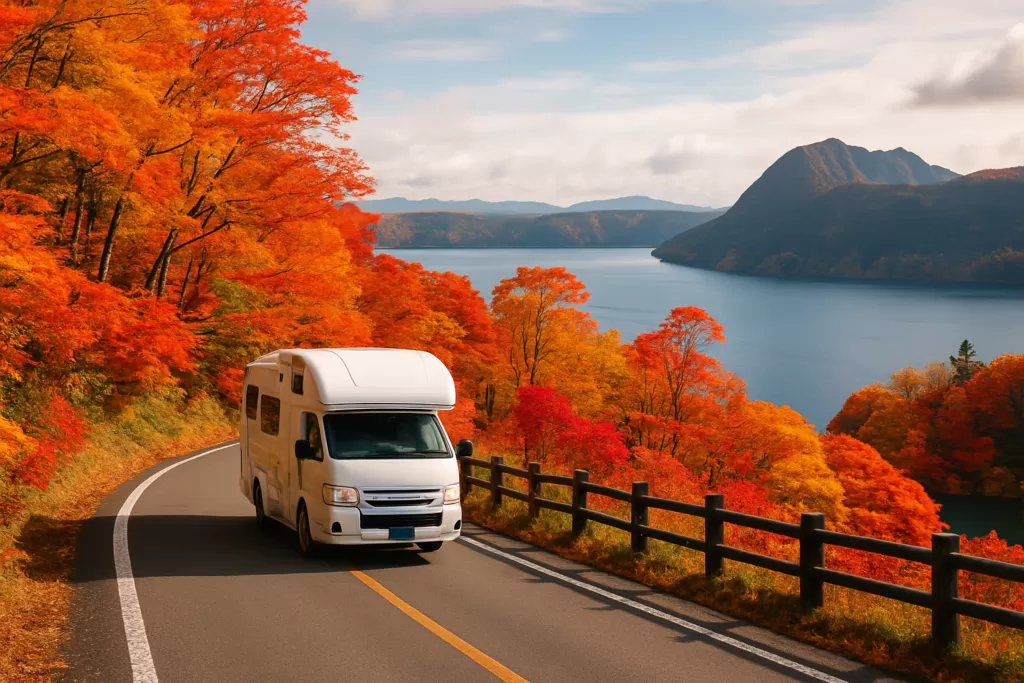
Hokkaido’s autumn foliage travels from Daisetsuzan in early September all the way down to Hakodate by mid-November — a roughly two-and-a-half-month window. Unlike Honshu, where peak color lasts barely a week, the season here is long enough to follow the color as it descends. A campervan lets you move with the foliage front instead of being tied to fixed hotel reservations. This guide covers the 2026 peak forecast, area-by-area foliage spots and overnight parking options, an 11-day model route from Daisetsuzan to southern Hokkaido, rental rates and booking timing, and practical tips on clothing, weather, and traffic.
New Chitose Airport / Tokachi-Obihiro Airport
Rent the Cabcon “Cresson Journey”
Base yourself at New Chitose Airport and compare rates, vehicle types, and pickup locations all in one place.
See details at Moving Inn →2026 Hokkaido Foliage Forecast and Best Season
Hokkaido’s foliage progresses from higher elevations to lower ones, and from north to south. The vanguard is the Daisetsuzan range, where the summits of Kurodake and Asahidake typically peak in early to mid-September — earning the title of Japan’s earliest autumn color. By late September the mid-slope zones (Ginsendai, Kogen Onsen) hit their stride; in early October the foliage reaches Shiretoko Pass, Lake Akan, and Lake Shikaribetsu; by mid-to-late October it descends to Jozankei, Lake Shikotsu, and Lake Toya near Sapporo. The finale is the Hakodate and Onuma area, which peaks from late October to mid-November. In 2026, a warm summer may push the peak 2–5 days later than average, but the sequence never changes. As a rule of thumb: late September = Daisetsuzan mid-slopes; early October = eastern Hokkaido; mid-to-late October = central and southern Hokkaido.
Set up a system for checking current foliage conditions. Daisetsuzan: the Sounkyo and Asahidake visitor centers post weekly photo updates. Shiretoko: the Shari Town Tourism Association. Lakes Shikotsu and Toya: local tourism association SNS accounts. Hakodate: official information from “Hakodate MOMI-G Festa.” Check twice — one week before departure and the day before — and swap early-trip plans with low-elevation spots if color is running late, or move mountain activities to day one if it is running ahead. This flexibility is the campervan advantage.
| Area | Typical Peak | Key Spots |
|---|---|---|
| Daisetsuzan Summit | Early–mid September | Kurodake, Asahidake Sugatami |
| Daisetsuzan Mid-slope | Mid–late September | Ginsendai, Kogen Onsen, Sounkyo |
| Eastern Hokkaido / Shiretoko | Early–mid October | Shiretoko Pass, Lake Akan, Onneto |
| Central / Shikotsu-Toya | Mid–late October | Lake Shikotsu, Lake Toya, Jozankei |
| Southern / Hakodate | Late October–mid November | Onuma Quasi-National Park, Kaseien |
Daisetsuzan Foliage Season and Campervan Overnight Spots
Daisetsuzan is where autumn arrives first in Japan. Take the Asahidake Ropeway to Sugatami Station (approx. 1,600 m) and you will find the groundcover foliage of chinguruma and the red of Ural mountain ash spreading across the plateau by mid-September. On the Sounkyo side, the Kurodake Ropeway and the Ginsendai–Kogen Onsen zone (mid-to-late September) are the highlights. During the peak period — typically around the September public holidays — private vehicle access to Ginsendai and Kogen Onsen is restricted; visitors park at the Lakeside parking area and transfer to a shuttle bus. Campervans can park at Lakeside (large-vehicle bays available), so the standard strategy is to arrive the night before, sleep in the campervan, and catch the first shuttle in the morning. Overnight bases in the area: Sounkyo Auto Campsite (open through late September) or an RV park in Asahikawa. Hot springs are nearby (Sounkyo Kurodake no Yu, etc.). Mornings in late September can drop near freezing, so book a vehicle with an FF heater.
Approaching from the Asahidake side, park at the paid lot (¥500) at the Asahidake Ropeway base station and walk the 1.7 km loop trail from Sugatami Station — about one hour, mostly on boardwalks, no technical gear required, but carry rain gear since weather changes fast at 1,600 m. You can soak at Asahidake Onsen or Tenjinkyo Onsen, and heading down to Higashikawa town gives access to a supermarket and laundromat near “Michiksakan.” Sounkyo and Asahidake are about two hours apart by road, so allow one overnight per side if you want to see both. Mikuni Pass (1,139 m, Hokkaido’s highest national highway point) offers a panoramic view of golden birch forest in late September to early October — easily included when routing from Sounkyo toward Obihiro. For the Sugatami Pond loop and three other walking routes through Hokkaido’s autumn color, see Hokkaido Autumn Foliage Trekking by Campervan.
Eastern Hokkaido / Shiretoko Foliage Route and Highlights
Early October belongs to eastern Hokkaido. Shiretoko Pass on Route 334 is carpeted with Erman’s birch gold against the backdrop of Mt. Rausu, typically peaking in early-to-mid October. The pass closes for winter in late October or November, so the two or three weeks before closure are the window. On the Utoro side, the elevated boardwalk at Shiretoko Five Lakes is easy to walk even in October; combine it with the Furepe Falls trail for a half-day circuit. Lake Akan shores peak in early-to-mid October, and Onneto at the foot of Mt. Meakan pairs a vivid lake color with autumn foliage. Overnight options include Lake Akan Campsite (open through early October). The Shiretoko National Campground in Utoro closes at the end of September, so secure a place to stay in Utoro in advance for October. This same window overlaps with the salmon run in rivers around Utoro; see Watching the Salmon Run in Hokkaido by Campervan for spots and timing to pair with the foliage. For a deeper dive into eastern Hokkaido spots, overnight parking, and routing, see the dedicated article “Eastern Hokkaido Autumn Foliage × Campervan Guide.”
Mashu and Kussharo pair naturally with Shiretoko. Lake Mashu’s First Observatory offers a blue lake framed by Erman’s birch foliage in early-to-mid October; the Sunayu area on Lake Kussharo shore is a 0-minute walk from the parking lot to the lakeside. Tsubetsu Pass and Bihoro Pass overlap sea-of-cloud mornings with autumn color — sleeping in the campervan at the pass lot to catch sunrise is one of the joys of this travel style. The Marimo Festival at Lake Akan runs in early October; combine it with a day-use hot spring in the resort district (Lake Akan no Mori Hotel, etc., ¥700–1,500). In eastern Hokkaido, where distances between sites are long, capping each day at two sightseeing stops prevents fatigue.
Lake Shikotsu and Lake Toya Foliage and Hot-Spring Camping
Mid-to-late October brings color to the lake district within one to two hours of Sapporo and New Chitose Airport. At Lake Shikotsu, the classic combination is the Sansentetsubashi bridge area and the reflection of Mt. Eniwa on the lake surface; the Poropinai side gets ideal morning light. Lake Toya’s shoreline loop road (about 37 km) doubles as a foliage drive route; Sobetsu Park along the way offers a panoramic view of the lake, the central island, and Mt. Yotei. The area’s strength is its density of hot springs and campsite facilities. Morapp Campsite at Kyukamura Shikotsu (open through mid-October), Green Stay Toya, and Zaiden Campsite near the water all have campervan-compatible bays, and the Toyako Onsen resort strip offers day-use bathing (¥700–1,000). Routing through Jozankei (peak: early-to-mid October) from Sapporo lets you slot in the Hoppyokyo Dam foliage on the same day. Evening views of the Toyako resort lights from the lakeshore are a bonus; mid-October nights in this central-Hokkaido lake zone stay relatively mild.
Jozankei also works as a Sapporo-area pre-night stop. Its peak runs early-to-mid October; Futami Suspension Bridge gorge and the nearby Hoppyokyo Dam (electric bus transfer; dam lake + foliage) are the two main draws. After a soak in Jozankei Onsen, drive over Nakayama Pass toward Lake Toya and the journey itself becomes a foliage drive. The roadside station “Boyo Nakayama” at Nakayama Pass has a wide view of Mt. Yotei and the foliage, and its famous age-imo (fried potato) is a perfect break. Note that lakeside parking at both Shikotsu and Toya is mostly standard-size bays; cab-over campervans should choose end bays or large-vehicle spaces and avoid overhanging.
Hakodate and Southern Hokkaido Foliage and Overnight Spots
Southern Hokkaido is the last area to see autumn color in Hokkaido, with the peak running from late October to mid-November. Two spots are central. Onuma Quasi-National Park spreads lake, islets, and foliage against the backdrop of Mt. Komagatake; the lakeside loop road and the Island Path trail (approx. 50 min) peak from late October to early November. Kaseien (Miharu Park) in Hakodate city holds a nighttime foliage illumination during “Hakodate MOMI-G Festa” (typically late October to mid-November) — one of the few spots in Hokkaido where you can see autumn color after dark. Overnight options: city-center RV parks such as “RV Park Hakodate Ryokuendori,” conveniently placed for the morning market and Goryokaku sightseeing. On the Onuma side, Higashi-Onuma Campsite (free, open through October) sits right on the lake. Even in November, daytime temperatures in southern Hokkaido hover around 10°C, and serious snowfall has not yet begun — which is why ending a traverse route in southern Hokkaido makes sense.
While you are in Hakodate, weave in “autumn flavors.” The morning market from October to November features autumn salmon and ikura alongside squid; switching your in-van breakfast to market shopping instantly elevates the trip. Goryokaku Park’s cherry-tree-lined moat also turns color in late October to early November, and viewed from the Goryokaku Tower the star-shaped outline is traced in autumn red and gold. At Onuma, buying the classic Onuma dango from a lakeside stall and walking the trail is the standard move. Southern Hokkaido stays road-freeze-free well into November, making it the reassuring final chapter for first-time autumn drivers in Hokkaido.
11-Day Campervan Foliage Route (Daisetsuzan → Shiretoko → Southern Hokkaido)
A 10-night, 11-day traverse chasing the foliage front across the whole island. Assume a late-September departure; total driving distance is approximately 1,250 km to Hakodate (approximately 1,550 km if you drive back to Sapporo to return the vehicle). Can be structured as a round trip from Asahikawa or Sapporo.
- Days 1–2 (Asahikawa → Sounkyo): Arrive at Sounkyo on day one for an overnight stay. Early morning of day two, take the shuttle from Lakeside parking to Ginsendai. Hike to Akadake First Garden and back; afternoon on the Kurodake Ropeway. Sleep at Sounkyo.
- Day 3 (Sounkyo → Lake Akan, approx. 180 km): Drive via Sekihoku Pass and Kitami to Lake Akan. Camp at Lake Akan Campsite.
- Day 4 (Lake Akan → Utoro, approx. 185 km): Stop at Onneto, then head through Shari to Shiretoko. Overnight in Utoro (book a place to stay in advance).
- Day 5 (Shiretoko Pass and Five Lakes): Morning: drive to Shiretoko Pass and back. Afternoon: walk the Five Lakes elevated boardwalk. Stay a second night in Utoro.
- Day 6 (Utoro → Teshikaga, approx. 110 km): Take in the yellow birch leaves against the blue lake from Lake Mashu’s First Observatory, then continue to Teshikaga. Camp at Mashu-ko Campground (Mashu no Mori).
- Day 7 (Teshikaga → Obihiro, approx. 160 km): Cross to Tokachi via Ashoro. A detour to Lake Shikaribetsu is about 120 km round trip from Obihiro, so add another night in Tokachi if you want to include it. Sleep at an RV park in Obihiro.
- Day 8 (Obihiro → Lake Shikotsu, approx. 180 km): Head toward Chitose via Nissho Pass or the Doto Expressway. Arrive at Lake Shikotsu in the evening; camp at Morapp.
- Day 9 (Lake Shikotsu → Lake Toya, approx. 80 km): Take it slow around the lake, visit Sobetsu Park, then bathe at Toyako Onsen. Sleep at the Lake Toya shore.
- Day 10 (Lake Toya → Onuma → Hakodate, approx. 160 km): Head south along Uchiura Bay; explore Onuma Park. Evening: nighttime foliage illumination at Kaseien (if the event is running). Sleep at an RV park in Hakodate.
- Day 11 (Hakodate sightseeing → return): Morning market and Goryokaku, then one-way return in Hakodate or drive back to Sapporo for vehicle return (Hakodate → Sapporo is approx. 310 km, beyond the 200 km daily guideline; allow two extra days).
If you only have five days, cut to either the first half (Sounkyo to Shiretoko) or the second half (Shikotsu to Hakodate) — the structure stays intact. One-way (drop-off) rentals are available from a limited number of companies and typically carry a surcharge of ¥20,000–50,000.
This itinerary has no buffer days, so when you finalize the plan, build in the flexibility to turn day 7 or day 10 into a weather-adjustment day. Daisetsuzan foliage can shift by several days due to typhoons or early snow, and Shiretoko Pass occasionally closes in bad weather. Being able to shift one day dramatically reduces the chance of “came all this way and saw nothing but fog.” Cap driving at about 200 km and 9 hours per day (including breaks) to keep the balance between sightseeing and rest.
Rental Campervan Rates and Booking Timing for Foliage Season
September and October sit one tier below the July–August peak season, in what operators call “semi-high season.” Rough daily rates: van conversions ¥15,000–22,000; cab-over campervans ¥20,000–30,000. Most companies are 20–30% cheaper than summer, and weekday rates in late October drop further. The exception is the September Silver Week holidays, when rates and availability mirror peak summer. If you are targeting Daisetsuzan foliage during that window, book 2–3 months ahead — i.e., by June or July. For weekday departures outside holiday periods, one month ahead usually still leaves options. The sweet spot: departure Monday through Thursday in the final week of September, which often coincides with the Ginsendai peak at weekday rates. Always confirm FF heater availability when booking; it makes or breaks overnight comfort in autumn. Multi-night discounts (often 10–20% for 7+ days) can save tens of thousands of yen on an 11-day trip.
Beyond price, evaluate companies on three points. (1) Base location: the Sapporo / New Chitose area has the largest fleet; Asahikawa base cuts two hours off the approach to Daisetsuzan. (2) Equipment: beyond the FF heater, sub-battery capacity and a microwave affect in-vehicle comfort significantly. (3) Return policy: since sunset comes early in foliage season, a company that allows late returns (or a next-morning return option) reduces pressure on the final day. Use booking-site calendars to compare availability across multiple bases side by side, and confirm the cancellation policy (charges typically begin 30 days out) before you commit.
| Period | Van Conversion/day | Cab-over/day | Booking Lead Time |
|---|---|---|---|
| September holidays | ¥20,000–25,000 | ¥28,000–35,000 | 2–3 months ahead |
| Sep–Oct weekdays | ¥15,000–20,000 | ¥20,000–27,000 | 1 month ahead |
| Late October | ¥13,000–18,000 | ¥18,000–25,000 | 2–3 weeks ahead |
New Chitose Airport / Tokachi-Obihiro Airport
Rent the Cabcon “Cresson Journey”
Base yourself at New Chitose Airport and compare rates, vehicle types, and pickup locations all in one place.
See details at Moving Inn →Practical Info: Clothing, Weather, and Traffic Tips
Dress in two layers: “autumn in town, early winter on the mountain.” Daisetsuzan mid-slopes in late September see morning temperatures of 0–5°C; add wind and it feels sub-zero. Pack a fleece, a windproof shell, and gloves in the campervan. Town-level daytime temperatures of 15–20°C are fine with just a long-sleeved shirt. From mid-October onward, pass surfaces can freeze. If your itinerary crosses Sekihoku, Mikuni, or Nissho Pass in late October, confirm at booking that the vehicle is already on winter tires (Hokkaido rental companies rotate their fleets in mid-October). Three traffic-avoidance tactics: (1) Catch the first shuttle (around 6 a.m.) for Ginsendai and Kogen Onsen. (2) Do Shiretoko Five Lakes and Onuma in the morning and use afternoons for driving. (3) For Sounkyo during September holidays and Jozankei during October holidays, arrive the night before and camp, then start early in the morning. Sunset moves to 4 p.m. in October, so the rule “sightseeing done by 3 p.m., at the overnight spot before dark” keeps your schedule intact. After most campsites close in mid-October, water fill-up and dump stations will be RV-park dependent — plan the back half of the trip around year-round facilities.
Packing checklist: Warmth — fleece, windproof shell, gloves, knit hat, electric blanket (for powered sites). In-vehicle comfort — condensation squeegee, insulating window shades, LED lantern, hot-water bottle. Driving — sunglasses (low morning/evening sun), de-icing spray (from late October). Photography — tripod (for early-morning lake reflections). Most items are available as rental options or at local home centers, but the electric blanket and insulating window shades have an outsized impact on sleep quality, so bring those from home.
Two driving alerts. First, Ezo deer: October and November are the rutting season, when road-crossing incidents hit their annual peak. Especially at dusk and at night on mountain passes and the long straight roads of eastern Hokkaido, slow down and assume there is a second deer behind any one you spot. Second, first snow: the first snow on flat ground typically falls in late October to early November, but passes can see snow from mid-October. For itineraries that cross mountain passes after October 15, check the daily road condition forecast every morning and be ready to reroute to coastal roads if ice is forecast.
For the full picture on autumn clothing, packing, food, and seasonal cost estimates, see our Hokkaido Campervan Autumn Travel Guide.
Summary
Hokkaido’s autumn foliage season runs two and a half months, from early September at Daisetsuzan to mid-November in Hakodate — giving campervans a unique advantage: you can move to wherever the color is peak instead of being locked into a hotel schedule. The September holiday period books out fast, so if Daisetsuzan is your target, reserve by June or July. For a deeper dive into eastern Hokkaido, see the Eastern Hokkaido Foliage Guide. Check vehicle availability on each company’s calendar and start building your 2026 autumn plan now.
Whether 2026 turns out to be a banner year for color will not be clear until September, but with a campervan you can move to wherever the peak is happening — dramatically reducing the risk of bad timing. Book early, finalize the destination just before departure. That is the essence of this style of travel.
Book a Campervan in Hokkaido
Moving Inn New Chitose Airport supports English booking and offers airport transfers.
Pick a campervan by what matters to you.
Rent in winter (Dec–Mar)
Companies that rent through winter, listed apart from those that close.

![When and Where Can You See Harbor Seals at Cape Erimo? Kaze no Yakata Official Information, Viewing Season, and Windy-Day Notes [2026-27]](https://hokkaido-campingcar.jp/wp-content/uploads/2026/10/erimo-cape-lighthouse-768x511.jpg.webp)
![Where and Under What Conditions Can You See Diamond Dust in Hokkaido? How Cold a Morning It Takes, and Where It Appears [2026-27]](https://hokkaido-campingcar.jp/wp-content/uploads/2026/10/hokkaido-diamond-dust-nayoro-768x512.jpg.webp)
![Can You Drive to Hokkaido Jingu for Hatsumode? Parking, Crowds, and Where to Park and Walk [2027]](https://hokkaido-campingcar.jp/wp-content/uploads/2026/10/hokkaido-jingu-winter-torii-768x504.jpg.webp)
![Hokkaido Roads Over New Year [2026-27] | Expressway Sections Prone to Blizzard Closures, Forecast Congestion Days, No Holiday Discount, and New Chitose Airport Parking](https://hokkaido-campingcar.jp/wp-content/uploads/2026/10/hokkaido-winter-rural-road-edge-markers-768x432.jpg.webp)
![Where to See Sea Smoke (Kearashi) in Hokkaido: Rumoi’s Ogon-misaki and the Morning Conditions [2026-27]](https://hokkaido-campingcar.jp/wp-content/uploads/2026/10/rumoi-kearashi-sea-smoke-768x511.jpg.webp)
![Geminid Meteor Shower 2026 in Hokkaido: Peak Around 23:00 on December 14, Sapporo Moonset 20:40, and Staying Warm in a Winter Campervan [2026]](https://hokkaido-campingcar.jp/wp-content/uploads/2026/10/geminids-2026-hokkaido-768x575.jpg.webp)