Top 10 Summer Spots in Hokkaido by Campervan [2026 Guide]
Discover the best summer destinations in Hokkaido by campervan — from Furano lavender fields and Shiretoko World Heritage Site to Cape Soya at Japan's northernmost tip.
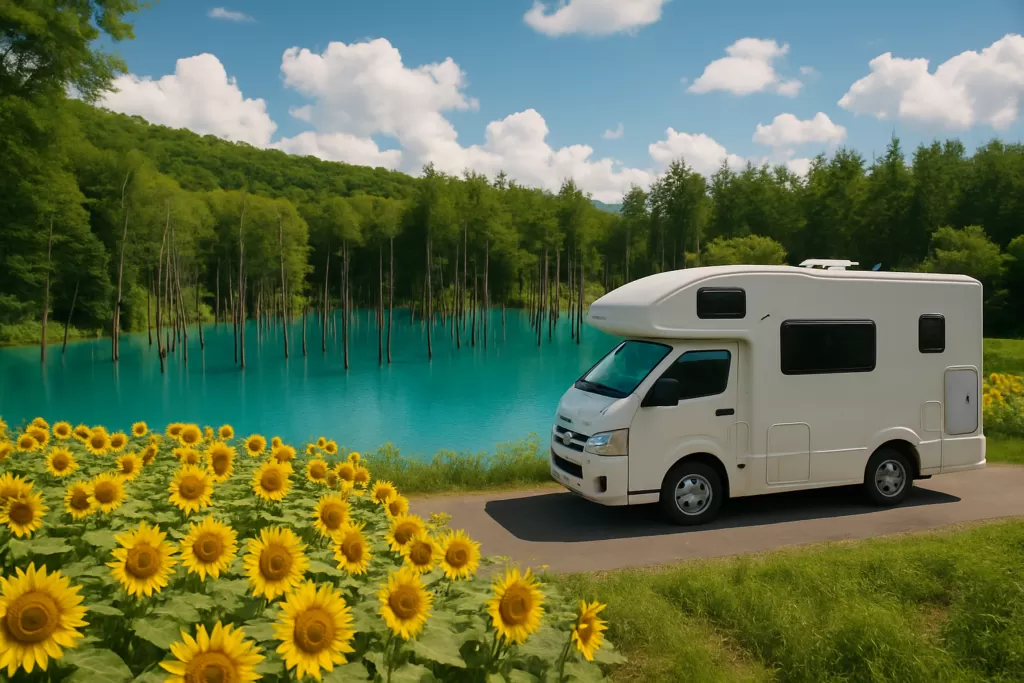
Top Summer Spots in Hokkaido by Campervan | Complete Guide to Scenic Routes in Eastern, Northern & Southern Hokkaido
Hokkaido’s summer is brief. The two months from July through August form a golden window when lavender blooms and Shiretoko wildlife overlap. Traveling by campervan during this period lets you stay near the best viewpoints and linger as long as you like — no hotel schedules holding you back. Here is a curated guide to the top spots and model itineraries for a Hokkaido summer campervan trip.
New Chitose Airport / Tokachi-Obihiro Airport
Rent the Cabcon “Cresson Journey”
Base yourself at New Chitose Airport and compare rates, vehicle types, and pickup locations all in one place.
See details at Moving Inn →Why a Campervan Is the Best Way to Explore Hokkaido in Summer
Exclusive Access to Early-Morning and Late-Evening Scenery
Iconic spots like the hills of Biei and Shiretoko Goko lakes look their best at dawn and dusk. With a campervan, you can overnight at a nearby Michi-no-Eki (roadside station) or RV park and arrive before the tour buses show up. In the Furano-Biei area, the lavender fields at 6 a.m. are practically deserted.
Cut Costs by Combining with a Ferry
Shin Nihonkai Ferry and Pacific Ferry both accept campervans on board, letting you sleep during the crossing and skip hotel fees. The Niigata–Otaru route takes about 18 hours — rest up on the ship and start sightseeing the moment you dock.
A Dense Network of Roadside Stations and RV Parks
Hokkaido has 128 Michi-no-Eki, and registered RV parks with power hookups, toilets, and showers now exceed 40 locations. Even during the peak summer season, advance booking ensures a comfortable overnight stay.
Furano & Biei Area — Lavender and Rolling Hill Scenery
Farm Tomita (Nakafurano)
The quintessential Hokkaido lavender destination. Peak bloom is typically early-to-mid July. Beyond the lavender, the “Irodori no Hatake” (colorful field) with poppies, cosmos, and salvia in layers is spectacular. Parking accommodates large vehicles, but early-morning entry is recommended for campervans.
Blue Pond & Shirogane Onsen, Biei
Aluminum ions flowing from Shirahige Falls create the striking cobalt-blue pool. Morning mist drifting over the water adds an ethereal quality. Shirogane Onsen, just minutes away, offers day-use bathing — a perfect recovery stop. The nearby “Bieigawa Onsen” costs around ¥500 and is a local favorite.
Tokachidake Bogakudai Viewpoint (Kamifurano)
A free parking area at 930 m elevation frames the grand silhouette of Mt. Tokachidake. Alpine flowers bloom through summer, and early-morning sea of clouds is a bonus. The lot is open to large vehicles, though the gravel surface requires caution for low-clearance campervans. Temperatures can drop below 10°C after sunset — pack layers.
Mt. Tokachidake has been at Volcanic Alert Level 3 (entry restrictions) since September 12, 2026. You can still drive up to Bogakudai, but Hokkaido Prefectural Route 966 is closed between Bogakudai and Tokachidake Onsen. Before you go, check the Japan Meteorological Agency volcano information for Tokachidake and the latest notices from Biei Town and Kamifurano Town (checked 2026-10-08).
Shiretoko Area — Overnighting Near a UNESCO World Heritage Site
Shiretoko Goko Lakes (Shari)
Five crater lakes in the core zone of the Shiretoko World Natural Heritage Site. From May 10 to July 31 (brown bear activity season), ground-level trails can only be walked on a tour led by a registered guide; from August 1 (vegetation protection season) you can walk them after attending a short lecture (the raised boardwalk to the first lake remains open freely). Park in the paid lot and join an early-morning guided tour. The Michi-no-Eki “Utoro Shirietoku” makes a great pre-stay spot with views over the Sea of Okhotsk.
Shiretoko Pass & Rausu Side (Rausu)
The highest point of National Route 334 at 738 m offers close-up views of Mt. Rausu and, on clear days, Kunashiri Island. Dropping into Rausu reveals a rugged fishing-town atmosphere. “Kuma-no-Yu,” a free wild hot spring in Rausu Onsen, is the real deal used by locals. The Michi-no-Eki in Rausu has ample parking and tends to be quiet overnight.
Utoro Coast & Sightseeing Cruises
For Shiretoko’s sea cliffs and wildlife together, the cruise from Utoro Port is a must. Options run 90 minutes to 3 hours, with good odds of spotting brown bears on shore and dolphin pods. Campervans can wait onboard-ready in the lot, and staying the night nearby makes the first departure (around 6 a.m.) easy to catch.
Eastern Hokkaido — Kushiro Shitsugen, Lake Mashu & Lake Akan
Kushiro Shitsugen & Hosooka Observatory (Kushiro Town)
Hosooka Observatory overlooks Japan’s largest wetland, stunning when morning fog rolls across the marsh. Campervans can park and access the viewpoint directly. Pair it with a sunset canoe tour on the Kushiro River for a wetland experience from both above and water level. The Michi-no-Eki “Shiranukakoiton” nearby is a popular overnight stop with great views.
Lake Mashu & Io-zan Sulfur Mountain (Teshikaga)
One of the world’s clearest lakes, famously shrouded in mist. Both the First and Third Observatories have spacious parking for campervans. The nearby Io-zan vents steam dramatically from the ground — easily combined in a single visit. Mitsono Onsen and the free wild bath “Karamatsu-no-Yu” are worthwhile detours.
Lake Akan & Marimo Exhibition Center (Akan, Kushiro)
The only place in the world to see natural marimo (spherical algae) up close. A cruise to Churui Island lets you observe them in their habitat while taking in the surrounding volcanic landscape. The Akan Onsen resort strip has multiple day-use baths, and evening Ainu cultural shows at “Lost Kamuy” add a rich nighttime dimension.
Northern Hokkaido — Cape Soya, Sarobetsu Wetland & the Gateway to Rebun Island
Cape Soya (Wakkanai)
Standing at Japan’s northernmost point is a milestone in any campervan journey. The Soya Hills wind farm set against open grassland is quintessentially Hokkaido. The cape’s parking area is large, and arriving early rewards you with minimal crowds. There are no Japan RV Association–certified RV parks in the Soya region, so use roadside stations or campsites for the night before.
Sarobetsu Wetland & Teshio River (Toyotomi / Horonobe)
In July, yellow Ezo-Kanzo (day lilies) blanket the wetland — sometimes called the “northern lavender.” The boardwalk at Sarobetsu Wetland Center unfolds a panorama of the marsh with Mt. Rishiri in the background. “Toyotomi Onsen” nearby is a distinctive petroleum-scented spring that draws visitors from across Japan seeking its reputed benefits for skin conditions.
Ferry Terminal for Rebun & Rishiri Islands (Wakkanai Port)
Heartland Ferry departs Wakkanai Port for both islands. Campervans can be driven aboard, but the narrow roads on Rebun and Rishiri require care with a large vehicle. Most travelers prefer leaving the campervan in Wakkanai’s paid long-stay lots and boarding the ferry unencumbered.
Recommended Model Itineraries for a Hokkaido Summer Campervan Trip
8 Days / 7 Nights — Eastern Hokkaido Loop
Pick up your campervan near New Chitose Airport and loop eastern Hokkaido counterclockwise. Day 1: Furano-Biei lavender. Day 2: Obihiro pork-bowl lunch, cross Tokachi Plain. Days 3–4: Shiretoko. Day 5: Kushiro Shitsugen. Day 6: Lake Akan and Lake Mashu. Day 7: Hidaka via Obihiro. Day 8: Return to New Chitose. Total distance roughly 1,200–1,400 km — a relaxed, sustainable pace.
6 Days / 5 Nights — Furano & Northern Hokkaido Focus
Combines lavender with Japan’s northernmost tip. Day 1: Arrive Asahikawa, overnight Biei. Day 2: Furano lavender. Day 3: Asahikawa Zoo, head north toward Nayoro. Day 4: Sarobetsu Wetland. Day 5: Wakkanai and Cape Soya. Day 6: Return to Asahikawa. National Route 40 from Asahikawa to Wakkanai is about 250 km; Michi-no-Eki “Bifuka” and “Otoinepp” are convenient rest and overnight stops along the way.
3 Key Points for Choosing Overnight Spots
Hokkaido overnight options fall into three main types: ① Michi-no-Eki (free, toilets only, no power); ② RV parks (¥1,000–3,000, usually with power and showers); ③ Campgrounds (paid, more immersive nature experience). During peak season (mid-July to August), popular RV parks fill up one to two weeks in advance — early booking is essential. At Michi-no-Eki, follow facility rules and avoid running the engine for extended periods while parked.
New Chitose Airport / Tokachi-Obihiro Airport
Rent the Cabcon “Cresson Journey”
Base yourself at New Chitose Airport and compare rates, vehicle types, and pickup locations all in one place.
See details at Moving Inn →Book a Campervan in Hokkaido
Moving Inn New Chitose Airport supports English booking and offers airport transfers.

![Campgrounds Near Tokachi-Obihiro Airport: 8 Sites Within 30 km, Compared by Vehicle Access, Power and Price [2026]](https://hokkaido-campingcar.jp/wp-content/uploads/2026/10/photo-obihiro-airport-featured-pl232-768x512.jpg.webp)
![Campgrounds Near Hakodate Airport: 12 Sites Within 30 km, Compared by Vehicle Access, Power and Price [2026]](https://hokkaido-campingcar.jp/wp-content/uploads/2026/10/photo-hakodate-airport-featured-hl4722-768x484.jpg.webp)