Hokkaido Campervan Autumn Travel Guide | Autumn Foliage Spots, September–October Costs & Tips [2026 Edition]
Complete guide to Hokkaido campervan rental autumn trips (Sep–Oct). Covers foliage spots, peak season at Daisetsuzan and Sounkyo, autumn cost estimates, and travel tips.
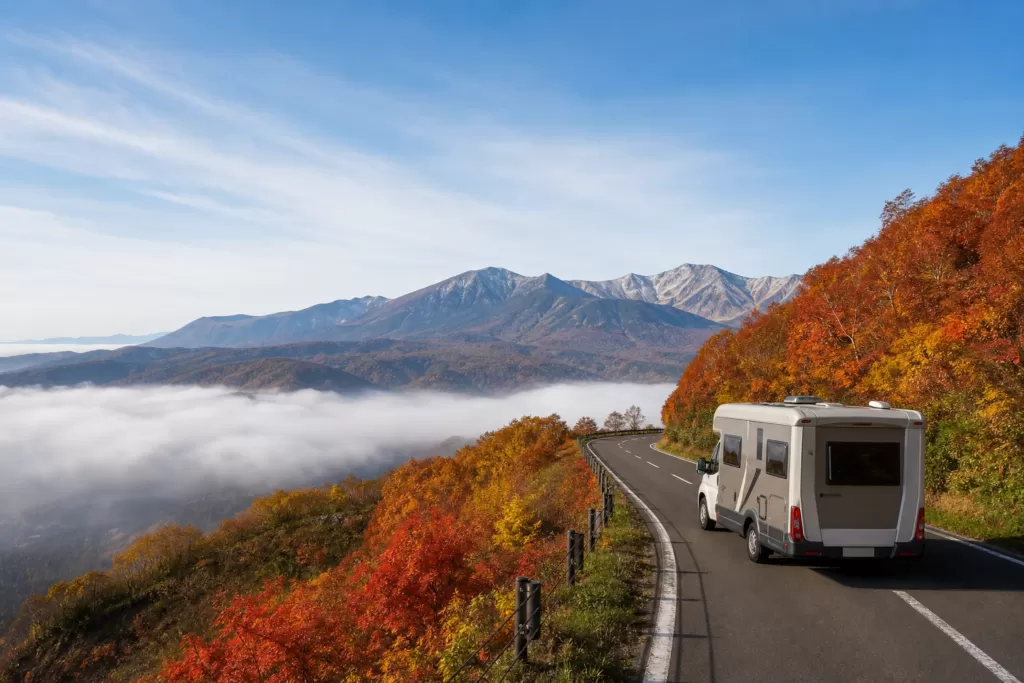
Autumn in Hokkaido (September–October) is one of the best seasons for a campervan trip. Summer crowds have eased, rental rates return to standard levels, and the scenery is packed with highlights—autumn foliage at Daisetsuzan, cosmos fields, and harvested farmland. Temperature swings can be large, so warm clothing is a must, but overall it is a very comfortable time to travel.
The Daisetsuzan range sees Hokkaido’s earliest autumn colors, with foliage starting to turn as early as late August. As September progresses, peak color moves through Sounkyo, Mikuni Pass, and Shiretoko Pass, and by October the roadside trees in the lowlands turn yellow and orange. Chasing the foliage while traversing Hokkaido is the true pleasure of an autumn trip.
New Chitose Airport / Tokachi-Obihiro Airport
Rent the Cabcon “Cresson Journey”
Base yourself at New Chitose Airport and compare rates, vehicle types, and pickup locations all in one place.
See details at Moving Inn →Estimated Costs for September–October
| Vehicle Type | Estimated nightly rate (Sep–Oct) | Comparison with peak season (Jul–Aug) |
|---|---|---|
| Kei camper | approx. ¥13,000–¥22,000 | about 50–65% of peak rates |
| Van conversion | approx. ¥20,000–¥38,000 | about 55–70% of peak rates |
| Cab-over | approx. ¥26,000–¥55,000 | about 55–65% of peak rates |
Rentals run 30–50% cheaper than the summer peak. Total costs for a 3-night 4-day trip can be estimated using the Hokkaido Campervan 3-Night 4-Day Cost Simulation. With fewer crowds in autumn, same-day route changes are also relatively easy.
For a season-independent overview — cost simulations, model routes, and Michi-no-Eki overnight parking rules — see our Complete Guide to Hokkaido Campervan Travel.
However, the foliage peak at Daisetsuzan and Sounkyo (mid to late September) draws large numbers of visitors. The Asahidake Ropeway and hotels and parking lots in Sounkyo fill up on weekends, so aim to travel on weekdays or arrive early in the morning for a more relaxed experience.
Hokkaido Autumn Foliage Calendar (by Month)
| Period | Peak Area | Representative Spots |
|---|---|---|
| Late Aug – Early Sep | Daisetsuzan range (Asahidake, Kurodake) | Asahidake, near Kurodake summit |
| Mid – Late Sep | Eastern & Northern Hokkaido inland | Sounkyo, Mikuni Pass, Shiretoko Pass |
| Late Sep – Early Oct | Central & Southern Hokkaido mountains | Lake Shikotsu area, Jozankei, Onuma |
| Early – Mid Oct | Plains & urban areas | Tree-lined streets & parks across Hokkaido |
Peak timing can shift by one to two weeks depending on the year. The summit of Daisetsuzan (2,291 m) can see its first snowfall as early as early September, which often makes the news. Check current conditions on the official Asahidake Ropeway website or SNS before heading out.
Key Autumn Spots and Highlights
Daisetsuzan / Asahidake (Hokkaido’s Earliest Foliage)
The area around Sugatami Station (elevation 1,600 m) on the Asahidake Ropeway peaks in late August to early September. The striking red berries of rowan trees and golden dwarf birches can be seen two to three months earlier than on Honshu. The loop trail around Sugatami Pond, just a short walk from the ropeway exit, takes about one hour round-trip and is accessible even for those with limited fitness. See the Daisetsuzan & Sounkyo Campervan Drive Guide for more details. For Asahidake’s Sugatami Pond loop and three other autumn walking routes across Hokkaido, see Hokkaido Autumn Foliage Trekking by Campervan.
Sounkyo & Mikuni Pass
Sounkyo (Kamikawa Town) peaks from mid-September to early October; the foliage set against sheer columnar-jointed cliff faces is one of Hokkaido’s most spectacular scenes. Combining a day-trip soak at the Sounkyo hot springs adds warmth to the foliage experience. Mikuni Pass (National Route 273) is Hokkaido’s highest national-road pass (1,139 m) and offers a sweeping panorama of Matsumi Bridge and the Daisetsuzan autumn colors. Parking is limited, so arrive early in the morning.
Shiretoko Pass (Mid–Late September)
Shiretoko Pass (National Route 334, elevation 738 m) typically closes for winter in late October to early November, so the foliage season is also your last chance to visit. The primeval-forest colors with Mt. Rausu as a backdrop are grand, and on clear days you can even see Kunashiri Island. Winds are strong and temperatures low near the pass, so warm outerwear is essential. See the Shiretoko Campervan Rental Travel Guide for more details.
Coral Grass (Salicornia) at Lake Notoro (Early–Mid September)
On the shores of Lake Notoro near Abashiri, coral grass (Akkeishi grass / glasswort) turns the landscape a vivid crimson. It is one of Japan’s largest colonies, and the contrast between the red grass reflected in the lake and the blue sky is striking. The peak lasts only about two weeks, so check local information beforehand to catch it in time. See the Abashiri & Lake Saroma Campervan Drive Guide for more details.
Cosmos and Autumn Scenery in Biei & Furano
By September, the farmlands of Biei and Furano transform with cosmos, late-blooming sunflowers, and brown fields after the barley harvest—a calmer, more subdued palette than the summer lavender and flower fields. Shikisai-no-Oka (Biei Town) still has cosmos blooming in September, and with fewer tourists than summer, it is a great time for photography.
Lake Akan & Lake Mashu in Autumn
At Lake Akan in eastern Hokkaido, the foliage of the surrounding forest is reflected on the water from late September. Lake Mashu is famous for fog, but autumn brings relatively more clear days, and the combination of its cobalt-blue surface and the surrounding autumn colors is magnificent. Ezo deer are also frequently spotted in this season—walk along the lakeshore before or after dawn and you may encounter them.
For a detailed foliage drive route, area-by-area peak calendar, and overnight parking spots, see our Complete Guide to Hokkaido Campervan Autumn Foliage Drive.
Autumn Harvest Gourmet
Hokkaido’s autumn is a treasure trove of food. With a campervan, you can shop for ingredients at roadside stations and farm stands and cook inside the vehicle—one of the big advantages of this style of travel.
Potatoes & Corn
Hokkaido potato harvest runs from late August through October. Farm stands in eastern Hokkaido producing regions—Obihiro, Shihoro, Bihoro—sell freshly harvested potatoes at low prices. Sweet corn varieties such as Yume-no-Corn and Pure White peak in August–September; boiled corn is sold at roadside stations and farm shops. If you’d rather harvest it yourself than just buy it, our Harvest Experiences by Campervan Guide covers Sapporo Satoland, Kururu no Mori, and the Itadakimasu Company farm picnic.
Pacific Saury & Autumn Salmon
Nemuro and Akkeshi are famous for autumn saury (sanma), which peaks in September. Akkeshi also produces oysters year-round, but autumn is a particularly good time. Buying fresh seafood at markets and direct-sale shops near the ports of Kushiro and Nemuro, then grilling it in your campervan, is a special autumn treat. Autumn chum salmon runs up rivers across Hokkaido in September–October, and salmon roe (ikura, sujiko) can be found cheaply at roadside stations and fishery co-ops. For spots and timing to watch the salmon run itself, see Watching the Salmon Run in Hokkaido by Campervan.
New Rice & Soba
Horokanai is Japan’s largest soba-producing area, and freshly harvested new-crop soba becomes available in September–October. If you are traveling in northern Hokkaido, a stop at a Horokanai soba restaurant is well worth it. Hokkaido-grown new rice varieties (Yumepirika, Nanatsuboshi, etc.) also start appearing around October.
Clothing & Cold-Weather Preparation for Autumn Travel
Hokkaido’s autumn features large temperature swings—differences of more than 10°C between day and night are common. Layering is the basic strategy.
September Clothing Guide
Daytime temperatures hover around 20°C, but mornings and evenings can drop below 10°C. Always bring a light fleece or down jacket. In mountain areas (Asahidake, Shiretoko Pass), daytime temperatures of 10–15°C and strong winds make a windproof, waterproof outer layer essential.
October Clothing Guide
In October, nights below 5°C become more frequent; inland and northern Hokkaido can approach 0°C. A three-layer system—thermal inner layer (e.g., Heattech), mid-layer fleece, and outer down jacket—is standard. Gloves, a hat, and a neck warmer will also come in handy.
Check the Campervan’s Heating System
From late September through October, an FF heater (combustion heater) is essential for keeping the interior warm at night. When booking, confirm that the vehicle has an FF heater installed. Vehicles with electric heaters only may be insufficient when outdoor temperatures drop low.
Autumn Accommodation Spots
Watch Out for Campsite Closing Dates
Many campsites close in late September to early October. Closing dates vary by facility, so check the official website in advance. From October onward, planning accommodation around RV parks and roadside stations is the realistic approach.
Hot Spring–Adjacent RV Parks
As temperatures fall in autumn, RV parks next to hot spring facilities become especially valuable. Sounkyo, Lake Akan, Noboribetsu, and Kawayu Onsen all have RV parks or hot spring facilities with parking. The cycle of warming up inside the van, then soaking in an outdoor hot spring, greatly enhances comfort on autumn trips.
Overnight Stays at Roadside Stations (Michi-no-Eki)
Hokkaido has 128 roadside stations; in autumn they are far less crowded than in summer, making them relatively easy to use. However, roadside stations are rest facilities—extended stays and cooking are considered poor etiquette. Use them for a single-night rest and move on in the morning.
Recommended Itinerary Routes
Asahikawa Departure: Daisetsuzan & Eastern Hokkaido Foliage – 5 Nights 6 Days (September)
- Day 1: Pick up in Asahikawa → Asahidake (foliage ropeway) → Stay at Asahidake Onsen
- Day 2: Sounkyo (Kurodake foliage & hot spring) → Mikuni Pass → Stay in Obihiro
- Day 3: Obihiro (farm stand, potatoes) → Kushiro Marsh → Stay in Kushiro
- Day 4: Lake Akan → Lake Mashu → Shiretoko Pass → Stay in Utoro
- Day 5: Shiretoko → Lake Notoro (coral grass) → Stay in Abashiri
- Day 6: Abashiri / Memanbetsu → Return to Asahikawa
New Chitose Departure: Furano & Northern Hokkaido Foliage – 4 Nights 5 Days (Early October)
- Day 1: Pick up in New Chitose → Biei (cosmos, rolling hills) → Stay near Asahikawa
- Day 2: Asahikawa → Asahidake (lower slopes foliage) → Stay in Sounkyo
- Day 3: Sounkyo → Mikuni Pass → Obihiro → Stay in Obihiro
- Day 4: Obihiro → Hidaka (ranches, horses) → Stay at Lake Shikotsu
- Day 5: Lake Shikotsu (foliage) → Return to New Chitose
Autumn Travel Cautions
Snow on Mountain Roads (From October Onward)
From mid-October, snow begins at higher elevations such as Asahidake, Daisetsuzan, and Shiretoko Pass. Shiretoko Pass typically closes for winter in late October to early November. Check road conditions on the Hokkaido Development Bureau’s “Hokkaido Road Information” website (verified: May 2026).
Bear Activity
In autumn, Hokkaido’s brown bears (Higuma) are active as they bulk up before hibernation. Extra caution is needed on mountain trails, forest roads, and riverbanks, especially in early morning and at dusk. Carry a bear bell and move in groups.
Fog & Dense Fog
The Lake Mashu area, Kushiro, and the eastern coastal regions are prone to dense autumn fog. Morning fog often lifts by around 10 a.m., but slow down and drive carefully through dense fog.
How to Plan a Manageable Autumn Hokkaido Route
Hokkaido is vast; if you try to do too much, you can end up driving 400–500 km a day and spending the whole trip on the road. For autumn trips, keep daily driving to within 150–200 km and allow plenty of time at foliage spots.
Eastern Hokkaido Foliage Route (Daisetsuzan → Sounkyo → Mikuni Pass → Obihiro, 3 Nights 4 Days)
Pick up the campervan near Asahikawa Airport or Asahikawa Station and head toward Asahidake—an efficient way to cover eastern Hokkaido’s foliage zone in early to mid September.
- Day 1: Pick up in Asahikawa → Asahidake Ropeway (Sugatami Pond loop, 1 hr) → Stay at Asahidake Onsen (driving: approx. 60 km)
- Day 2: Asahidake Onsen → Sounkyo (Kurodake Ropeway & hot spring) → Mikuni Pass (Matsumi Bridge viewpoint) → Stay at Nukabira Onsen (driving: approx. 130 km)
- Day 3: Nukabira Onsen → Taushubetsu River Bridge (early morning; often underwater in autumn) → Obihiro (pork bowl, farm stand) → Stay in Obihiro (driving: approx. 100 km)
- Day 4: Obihiro → return in Asahikawa (if you picked up at New Chitose Airport: Obihiro → return at New Chitose Airport via the expressway) (driving: approx. 200 km)
Mikuni Pass has only 2–3 parking spots, so weekday mornings between 8–10 a.m. are best. Taushubetsu River Bridge usually starts to go under the water around June and is submerged by around August–October, so in autumn it is often not visible (this varies by year). Check the bridge’s current status posted by the Kamishihoro Tourism Association before you go.
Northern Hokkaido Route (Asahikawa → Biei → Furano → Sounkyo, 2 Nights 3 Days)
A compact loop ideal for shorter trips or those departing and returning to Asahikawa. Distances between sights are relatively short, leaving more time for sightseeing than driving.
- Day 1: Pick up in Asahikawa → Biei (Shikisai-no-Oka, Patchwork Road) → Furano (Farm Tomita, cosmos) → Stay in Furano or Kamifurano (driving: approx. 80 km)
- Day 2: Furano → Asahikawa → Asahidake Ropeway (Sugatami Pond) → Stay at Asahidake Onsen (driving: approx. 90 km)
- Day 3: Asahidake Onsen → Sounkyo (Kurodake, hot spring, columnar basalt cliffs) → Return to Asahikawa (driving: approx. 120 km)
Total driving distance for 2 nights 3 days: approximately 290 km. Daily mileage is low, making it a manageable itinerary even for first-time campervan drivers. From October, tourist numbers in Biei and Furano drop sharply, letting you enjoy the rolling hills in quiet.
Basic Route Planning Principles
- Foliage peaks earlier at higher elevations: Daisetsuzan (approx. 1,600 m) peaks in early September; lowland trees don’t peak until mid-October—a difference of over a month
- Stay flexible with the weather: if clear, head to Shiretoko Pass; if rainy, spend time at a hot spring or roadside restaurant—always have a backup plan
- Eastern Hokkaido distances are long: it is more than 150 km straight-line from Lake Akan to Shiretoko, so allow at least 4 nights if covering eastern Hokkaido
- Campsite closures: from October, base your overnight plans around RV parks and roadside stations (as noted above)
New Chitose Airport / Tokachi-Obihiro Airport
Rent the Cabcon “Cresson Journey”
Base yourself at New Chitose Airport and compare rates, vehicle types, and pickup locations all in one place.
See details at Moving Inn →FAQ
Q1: Are there many insects in Hokkaido in September?
Horseflies, gnats, and mosquitoes decrease dramatically compared to summer (July–August). Even in the mountains, insect levels are nothing like summer, and spending time outdoors is comfortable. However, horseflies can still linger in mountain valleys in early September, so bring long sleeves and insect repellent just in case.
Q2: Can I use campsites in October?
Most campsites close from October onward. Even if a campsite is still open, nighttime temperatures can drop to 0–5°C, so sufficient insulation and heating are required. Basing October overnight stays at RV parks and roadside stations is the safer approach.
Q3: How crowded is it during the autumn foliage season?
The foliage peak at Daisetsuzan and Sounkyo (mid to late September) draws tour buses and private cars in large numbers. The Asahidake Ropeway can have one to two-hour waits on weekends. Other areas are less crowded than summer and easy to travel stress-free.
Q4: What vehicle type is best for an autumn Hokkaido campervan trip?
A van conversion is sufficient in September, but for October a cab-over or van conversion equipped with an FF heater is recommended. Nighttime temperatures can approach 0°C, so insulation and heating capability greatly affect comfort. Always confirm the heating setup when selecting a vehicle.
Q5: How many nights is ideal for an autumn Hokkaido trip?
To enjoy foliage across multiple areas, aim for 4 nights 5 days to 6 nights 7 days. If you want to cover both Daisetsuzan and eastern Hokkaido, 5 or more nights gives you breathing room. A 3-night 4-day itinerary focused on the Asahikawa area is also popular as a cost-and-schedule balance.
Book a Campervan in Hokkaido
Moving Inn New Chitose Airport supports English booking and offers airport transfers.

![When and Where Can You See Harbor Seals at Cape Erimo? Kaze no Yakata Official Information, Viewing Season, and Windy-Day Notes [2026-27]](https://hokkaido-campingcar.jp/wp-content/uploads/2026/10/erimo-cape-lighthouse-768x511.jpg.webp)
![Where and Under What Conditions Can You See Diamond Dust in Hokkaido? How Cold a Morning It Takes, and Where It Appears [2026-27]](https://hokkaido-campingcar.jp/wp-content/uploads/2026/10/hokkaido-diamond-dust-nayoro-768x512.jpg.webp)
![Can You Drive to Hokkaido Jingu for Hatsumode? Parking, Crowds, and Where to Park and Walk [2027]](https://hokkaido-campingcar.jp/wp-content/uploads/2026/10/hokkaido-jingu-winter-torii-768x504.jpg.webp)
![Hokkaido Roads Over New Year [2026-27] | Expressway Sections Prone to Blizzard Closures, Forecast Congestion Days, No Holiday Discount, and New Chitose Airport Parking](https://hokkaido-campingcar.jp/wp-content/uploads/2026/10/hokkaido-winter-rural-road-edge-markers-768x432.jpg.webp)
![Where to See Sea Smoke (Kearashi) in Hokkaido: Rumoi’s Ogon-misaki and the Morning Conditions [2026-27]](https://hokkaido-campingcar.jp/wp-content/uploads/2026/10/rumoi-kearashi-sea-smoke-768x511.jpg.webp)
![Geminid Meteor Shower 2026 in Hokkaido: Peak Around 23:00 on December 14, Sapporo Moonset 20:40, and Staying Warm in a Winter Campervan [2026]](https://hokkaido-campingcar.jp/wp-content/uploads/2026/10/geminids-2026-hokkaido-768x575.jpg.webp)