Hokkaido Campervan Winter Travel Guide | Drift Ice, Snow Festival & Cold-Weather Tips [2026 Edition]
Complete guide to Hokkaido campervan rental winter trips (Dec–Feb). Covers drift ice, Sapporo Snow Festival, cold-weather gear, anti-freeze measures, and winter-ready rental operators.
Pick a campervan by what matters to you.
Rent at New Chitose Airport
See only the rental bases in Chitose, where the airport is.
Rent in winter (Dec–Mar)
Companies that rent through winter, listed apart from those that close.
Guide price
Moving Inn New Chitose Airport: HIACE van conversion from ¥22,000 per night. 20–30% off when booked 60–90 days ahead (official rate table, checked 15 Oct 2026).
Before you book: with an International Driving Permit if your country is in the Geneva Convention (for example the US, Australia, Singapore); Taiwan, Switzerland, Germany, France, Belgium and Monaco need your licence plus a Japanese translation (Tokyo Metropolitan Police). Questions in English: Moving Inn on WhatsApp. Every roadside station (michi-no-eki) must have free 24-hour toilets, and Hokkaido has 128 of them (MLIT).
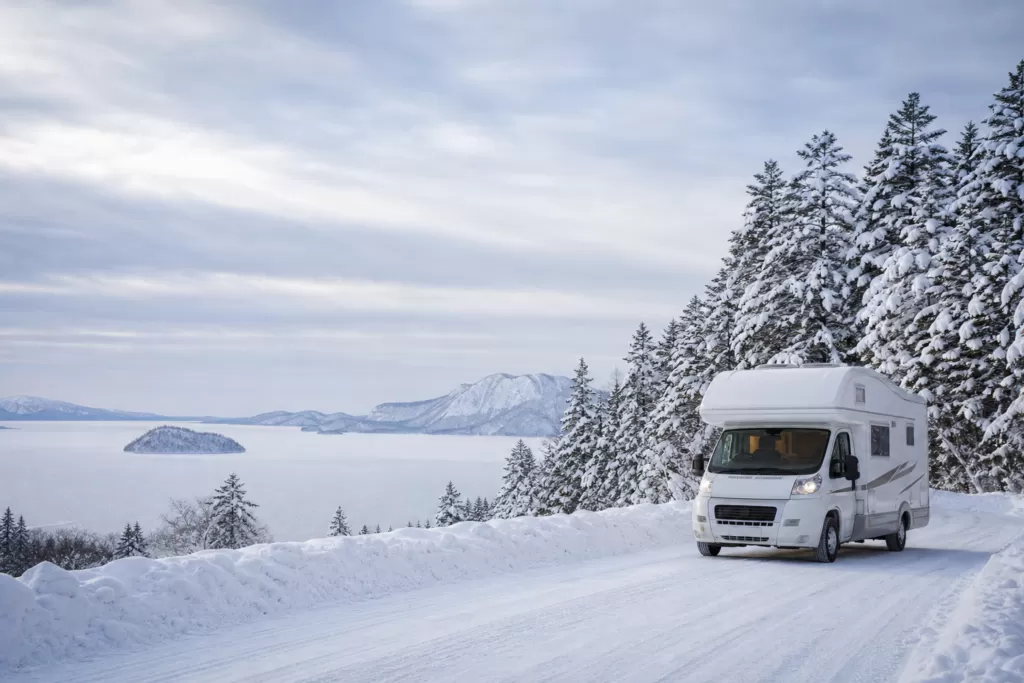
Winter in Hokkaido (December–February) is the most challenging season for a campervan trip. However, drift ice, the Sapporo Snow Festival, ice fishing on Lake Akan, and Niseko’s powder snow offer experiences available nowhere else and at no other time. With the right equipment and preparation, traveling Hokkaido by campervan in winter is entirely feasible.
Far fewer rental operators offer winter-ready vehicles than in the summer season, so early inquiries are essential. This article provides specific details on costs, equipment, routes, and safety measures.
Estimated Winter Travel Costs (December–February)
| Vehicle Type | Estimated nightly rate (Dec–Feb) | Notes |
|---|---|---|
| Kei camper | Winter-ready models only – inquire | Very few winter-ready vehicles available |
| Van conversion (winter-ready) | approx. ¥20,000–¥45,000 | FF heater & studded tires required |
| Cab-over (winter-ready) | approx. ¥30,000–¥70,000 | Enhanced insulation & heating |
Special equipment requirements push rates up in winter. With fewer winter-capable operators available, early booking is as critical as during peak season. Compare rates and operators in the Budget Campervan Rental Guide.
For a season-independent overview — cost simulations, model routes, and Michi-no-Eki overnight parking rules — see our Complete Guide to Hokkaido Campervan Travel.
During the Snow Festival (February), Sapporo hotels fill up and charge premium rates, so some travelers use a campervan to cut accommodation costs while sightseeing. A practical approach is to base yourself at a roadside station or RV park outside the city center and use public transit to get in.
Essential Winter Campervan Equipment
Winter (Studless) Tires
Driving on Hokkaido roads in winter without studless snow tires is impossible. Winter-ready operators supply vehicles already fitted with studless tires. Before renting, always confirm that the vehicle has studless tires. Attempting to drive Hokkaido from December onward on summer tires is out of the question.
FF Heater (Combustion Heater)
An FF heater burns kerosene or gas to provide heat even with the engine off. An electric heater alone cannot keep you warm when outdoor temperatures in Hokkaido drop below −10°C. You will need to run the FF heater continuously throughout the night. Check the kerosene tank level daily and always know where you can refill at a gas station as you travel.
Water Pipe Freeze Prevention
Water tanks and drain pipes can freeze. Winter-ready operators usually provide vehicles with insulated, heater-equipped freeze-prevention systems. Even so, in regions where temperatures drop below −15°C (Obihiro, Asahikawa, Rikubetsu, etc.), freezing can occur overnight. Check the water tank every morning; if freezing is suspected, drive to raise the interior temperature before attempting to deal with it.
Know the Road Closures & Restrictions
Shiretoko Pass (Prefectural Road 87) is closed in winter, and some roads near the Asahidake Ropeway are also partially closed. Driving onto unplowed farm or forest roads risks getting stuck. Before setting out, check road conditions on the Hokkaido Development Bureau’s “Hokkaido Road Information” website (verified: May 2026).
Winter-Only Experiences in Hokkaido
Three of the best-known ones are below. We also checked 43 things you can only do in winter Hokkaido against official sources — drift ice cruises, ice fishing, dog sledding, ice villages and snow festivals — and paired each with the nearest RV park that stays open through the winter.
For the Geminid meteor shower and staying warm while you wait, see “Geminid Meteor Shower 2026 in Hokkaido: Peak Around 23:00 on December 14, Sapporo Moonset 20:40, and Staying Warm in a Winter Campervan [2026]”.
Sapporo Snow Festival (Early February)
This world-famous winter event is held in early February each year. Giant snow and ice sculptures line Odori Park (near Susukino). Evening illumination transforms the scene, offering different views by day and night. Parking a campervan in the city center is impractical during peak weekend crowds; leave it at a location outside the center and use the subway instead. Check the official Snow Festival website for dates and venue maps.
Drift Ice Sightseeing (Late January–March, Abashiri & Mombetsu)
The period when drift ice reaches the Okhotsk coast—late January through early March—offers scenery unique to Hokkaido in winter. Timing and volume of drift ice vary by year. Check the official websites of Mombetsu and Abashiri cities, or the Okhotsk Drift Ice Information Center, for 2026 ice arrival conditions.
The icebreaker “Aurora” in Abashiri (run by Higashinihonkai Ferry) and the “Garinko-go” in Mombetsu are popular winter activities; both require advance reservations and fill up on weekends during ice season. Book early. “Drift Ice Walk” experiences—where you walk on the sea ice—are also available in Utoro (Shiretoko) and similar locations, operated as guided tours. See the Abashiri & Lake Saroma Campervan Drive Guide for more details.
Ice Fishing at Lake Akan (January–March)
In winter, Lake Akan freezes over completely, allowing visitors to drill holes in the ice and fish for smelt (wakasagi)—a pastime known as “ice fishing.” Tours that let you fry and eat your catch on the spot are popular. The Ainu Kotan village’s hot springs and craft shops at Lake Akan add more to the experience.
Niseko & Furano Ski Resorts (December–March)
Niseko is world-famous for its powder snow and draws skiers from Australia and Europe. Parking the campervan at the ski resort lot, skiing all day, then returning to a warm meal inside the van can be more cost-effective than staying at a resort hotel. The same style works at Rusutsu Resort and Furano Ski Area.
Winter Hot Springs (Noboribetsu, Jozankei, Kawayu)
Hokkaido has many hot spring areas, and winter is the season for snow-view open-air baths. Noboribetsu Onsen, Jozankei Onsen (Sapporo’s Minami Ward), and Kawayu Onsen (Teshikaga) all accept day-trip bathers. On a campervan trip, soaking in a hot spring to warm yourself thoroughly before sleeping makes a huge difference to comfort.
If skiing is part of the trip, compare airport distances and daily costs in the area-by-area ski resort list before you decide.
Winter Safety Measures
Whiteout Conditions
The greatest winter danger in Hokkaido is the “whiteout”—blizzard or drifting snow that reduces visibility to zero, making even road markings invisible. If a “blizzard warning” or “blowing snow advisory” is in effect, stop driving. Pulling over at a roadside station, SA/PA, and waiting for conditions to improve is the only correct response.
Black Ice
When temperatures drop below −5°C, the road surface can turn into black ice, which looks indistinguishable from wet pavement but causes the vehicle to spin under hard braking. Even studless tires are no guarantee against this; be especially cautious at city intersections, on bridge surfaces, and on shaded straight stretches. Reduce speed and keep a following distance at least three times the normal amount.
Fuel & Kerosene Management
The FF heater consumes kerosene. Consumption varies with temperature and run time, but running it all night at −10°C can consume 1–2 liters of kerosene. Check the kerosene tank level every morning and always know where you can refill. Some areas of eastern Hokkaido have few gas stations, so plan accordingly.
Emergency Communication
There are areas in mountain regions with no cell phone coverage. Let family or friends know your itinerary and planned locations. Register JAF (0570-00-8139) and the operator’s emergency number in your phone in advance. If immobilized on a highway, use the emergency phone or call 110.
Have the Courage to Stop
Winter Hokkaido travel will sometimes require you to abandon your plans and stop moving. “Move today if tomorrow’s weather is going to worsen,” “wait at a roadside station until the blizzard passes”—this kind of flexibility is what keeps winter travel safe. Build slack into your itinerary and aim to keep daily driving under 200 km in winter. For location-by-location November–February temperatures and how to judge your gear from them, see our guide to Hokkaido’s winter temperatures.
Winter Overnight Stay Precautions
Safety is the top priority for overnight stays in winter. Please follow these precautions without exception.
Carbon Monoxide Poisoning Risk
This is the most critical safety warning. Sleeping with all windows fully closed while using an FF heater or stove can cause carbon monoxide poisoning. CO is colorless and odorless, making it especially dangerous because symptoms can go unnoticed.
Prevention:
- When using a heater, open a window every 30–60 minutes to ventilate.
- Never sleep with the engine running.
- We recommend installing a CO detector in the vehicle.
- If you experience headache, nausea, or dizziness, open a window immediately and get fresh air.
Managing Condensation
Temperature differences in winter cause condensation inside the vehicle. Condensation can lead to mold and battery deterioration.
Prevention:
- Sleep with a window cracked slightly (even 5 cm helps).
- Sun shades on windows reduce heat loss and condensation.
- Wipe down condensation on windows promptly in the morning.
- Open windows during daytime drives to air out the interior regularly.
Preventing Frozen Water Lines
Temperatures below −10°C are not unusual in winter Hokkaido. The campervan toilet, shower, and water lines can freeze.
Prevention:
- Wrap water connection points with foam insulation or thermal tape.
- Use the toilet and shower before sleeping to prevent overnight freezing.
- Check water connection points in the morning and thaw with warm water if needed.
- Some campgrounds have freeze-prevention facilities — check in advance.
Related article: The Hokkaido Overnight Stay Guide covers non-winter overnight stay information in detail.
How to Find a Winter-Ready Operator
When choosing a campervan rental operator for winter, confirm the following:
- Are studless tires installed?
- Is an FF heater (kerosene or gas-type) fitted?
- Are the water/drain pipes protected against freezing?
- Is there a 24-hour emergency contact?
- Are there winter driving-area restrictions?
Because suitable operators are scarce, we strongly recommend contacting and booking before the end of October or November. Check directly with each operator in the Top 15 Hokkaido Campervan Rental Recommendations to confirm winter availability.
New Chitose Airport / Tokachi-Obihiro Airport
Rent the Cabcon “Cresson Journey”
Base yourself at New Chitose Airport and compare rates, vehicle types, and pickup locations all in one place.
See details at Moving Inn →Recommended Winter Routes
New Chitose Departure: Snow Festival & Niseko Skiing – 2 Nights 3 Days (February)
- Day 1: Pick up at New Chitose → Sapporo (Snow Festival, Odori Park, evening lights) → Stay near Niseko
- Day 2: Niseko ski resort (full day skiing) → Goshiki Onsen → Stay in Niseko
- Day 3: Lake Shikotsu (winter scenery) → Return to New Chitose
Asahikawa Departure: Drift Ice & Eastern Hokkaido Route – 4 Nights 5 Days (February)
- Day 1: Pick up in Asahikawa → Asahikawa city (zoo, check winter hours) → Stay near Asahikawa
- Day 2: Asahikawa → Kitami → Abashiri (icebreaker “Aurora”) → Stay in Abashiri
- Day 3: Abashiri → Lake Mashu (winter scenery) → Lake Akan (ice fishing) → Stay at Lake Akan
- Day 4: Lake Akan → Obihiro (pork bowl, sweets) → Stay in Obihiro
- Day 5: Obihiro → New Chitose → Return to Asahikawa (overland)
How to Plan Your Winter Route
The most important rule for winter campervan travel is to build in “non-driving days.” Plan assuming one or two days where you may be unable to move due to blizzard or ice, and keep daily driving to within 150 km as a safety baseline. Below are examples of realistic winter routes.
For winter road-trip plans from New Chitose Airport, see “Can You Drive Hokkaido in Winter? Hokkaido Winter Itinerary: 3 Days/2 Nights and 4 Days/3 Nights from New Chitose Airport, Planned by Real Roads and Sunset”.
Drift Ice Route (Asahikawa → Mombetsu → Abashiri, 3 Nights 4 Days, Jan–Feb)
A route covering the main drift ice areas of Mombetsu and Abashiri, departing from and returning to Asahikawa. The Okhotsk coast can have relatively calm days compared to inland areas, but a blizzard can suddenly reduce visibility; plan to wrap up each day’s activities by early afternoon.
- Day 1: Pick up in Asahikawa → Asahikawa city (Asahiyama Zoo, winter hours) → Stay at RV park near Asahikawa (driving: approx. 20 km)
- Day 2: Asahikawa → Kitami → Mombetsu (Garinko-go drift ice tour) → Stay in Mombetsu (driving: approx. 200 km) *This is the longest day—weather check mandatory
- Day 3: Mombetsu → Abashiri (icebreaker “Aurora” → Mt. Tento, Okhotsk Drift Ice Museum) → Stay in Abashiri (driving: approx. 120 km)
- Day 4: Abashiri → Memanbetsu Airport → Return to Asahikawa (fly or drive) (driving: approx. 60 km + flight or expressway)
Note: National Route 238 between Mombetsu and Abashiri (along the Okhotsk coast) is prone to blowing snow. Inland National Route 39 may carry lower blizzard risk. Always check the day’s forecast before setting out, and be prepared to stay another night in Mombetsu if conditions are bad. Garinko-go and Aurora both require advance reservations; they sell out weeks in advance on weekends during ice season.
Snow Festival Route (New Chitose → Sapporo → Otaru, 2 Nights 3 Days, February)
A route timed to the Sapporo Snow Festival in early February. Parking a campervan in central Sapporo is difficult, so basing yourself at an RV park or roadside station in the suburbs and taking the subway/bus into the city center is the realistic approach.
- Day 1: Pick up at New Chitose → Stay at Kitahiroshima RV park (or around Eniwa/Chitose) → Take subway to Sapporo, Odori Park (Snow Festival daytime visit) (driving: approx. 30 km)
- Day 2: Train to Odori Park (evening illumination) → Next morning head toward Otaru → Otaru (canal, souvenirs, seafood bowl) → Stay near Otaru (driving: approx. 60 km)
- Day 3: Otaru → Yoichi (whiskey distillery tour) → Return to New Chitose (driving: approx. 100 km)
During the Snow Festival (early February), Sapporo city hotels are uniformly expensive and fully booked. Being able to stay in a suburban campervan with FF heat and visit the city for only the cost of transit is a major financial advantage.
High-Risk Areas for Ice & Blizzards
When planning your winter route, be aware that the following areas and roads carry the highest risks:
- Eastern Hokkaido in general: Obihiro, Rikubetsu, Abashiri can drop below −20°C; black ice is most prevalent here. Never wander onto farm roads.
- National Route 12 (Sapporo–Asahikawa): Blowing snow and whiteouts occur in blizzards. Use the expressway (Doo Expressway) preferentially.
- National Route 38 (Furano–Obihiro): Many mountain passes; high nighttime icing risk. Avoid night driving.
- National Route 274 (Yubari–Tokachi): Nissho Pass (1,022 m) can close in winter. Check traffic information in advance.
- Shiretoko, Prefectural Road 87: Closed for winter (November–April). Impassable in winter.
The Hokkaido Development Bureau’s “Hokkaido Road Information” (verified: May 2026) provides real-time road closures and chain requirements. Make it a habit to check before departure and each morning.
New Chitose Airport / Tokachi-Obihiro Airport
Rent the Cabcon “Cresson Journey”
Base yourself at New Chitose Airport and compare rates, vehicle types, and pickup locations all in one place.
See details at Moving Inn →FAQ
Q1: Are there operators that rent campervans in Hokkaido in winter?
Some operators have winter-ready vehicles (studless tires, FF heater, freeze-protected plumbing). Year-round operators are limited, so we recommend contacting and booking by November. Check directly with each operator in the Top 15 recommendations to confirm winter capability.
Q2: How cold does it get in Hokkaido in winter?
Central Hokkaido / Sapporo: −10 to −15°C. Inland eastern and northern Hokkaido (Obihiro, Asahikawa, Rikubetsu, etc.): can reach −20 to −30°C. An FF heater is mandatory and must run all night. You can check historical temperatures at each location via the Japan Meteorological Agency’s AMeDAS data.
Q3: Can I drive the eastern Hokkaido route (Abashiri, Akan) in winter?
Yes, but eastern Hokkaido temperatures are extremely low (sometimes below −15°C) and black ice/blowing snow risks are high. Studless tires, an FF heater, adequate fuel, and confirmed emergency contacts are all essential. Be prepared to stop and wait if weather deteriorates.
Q4: What are the most important precautions for a winter Hokkaido campervan trip?
The most critical skill is deciding to stop driving in bad weather. Driving in a whiteout or blizzard is extremely dangerous and causes accidents every year. Check weather forecasts frequently, limit daily distance, and build generous slack into your itinerary. For a full breakdown of gear, heating, and overnight cold-weather concerns, our winter campervan travel FAQ covers them one by one.
Q5: How much does heating cost on a winter campervan trip?
An FF heater can consume about 1–2 liters of kerosene per night. At roughly ¥130–160 per liter (as of 2026), that works out to about ¥200–400 per night in heating costs. Consumption increases on colder nights. Compared to total trip costs, kerosene is a relatively minor expense.
Book a Campervan in Hokkaido
Moving Inn New Chitose Airport supports English booking and offers airport transfers.
Pick a campervan by what matters to you.
Rent at New Chitose Airport
See only the rental bases in Chitose, where the airport is.
![When and Where Can You See Harbor Seals at Cape Erimo? Kaze no Yakata Official Information, Viewing Season, and Windy-Day Notes [2026-27]](https://hokkaido-campingcar.jp/wp-content/uploads/2026/10/erimo-cape-lighthouse-768x511.jpg.webp)
![Where and Under What Conditions Can You See Diamond Dust in Hokkaido? How Cold a Morning It Takes, and Where It Appears [2026-27]](https://hokkaido-campingcar.jp/wp-content/uploads/2026/10/hokkaido-diamond-dust-nayoro-768x512.jpg.webp)
![Can You Drive to Hokkaido Jingu for Hatsumode? Parking, Crowds, and Where to Park and Walk [2027]](https://hokkaido-campingcar.jp/wp-content/uploads/2026/10/hokkaido-jingu-winter-torii-768x504.jpg.webp)
![Hokkaido Roads Over New Year [2026-27] | Expressway Sections Prone to Blizzard Closures, Forecast Congestion Days, No Holiday Discount, and New Chitose Airport Parking](https://hokkaido-campingcar.jp/wp-content/uploads/2026/10/hokkaido-winter-rural-road-edge-markers-768x432.jpg.webp)
![Where to See Sea Smoke (Kearashi) in Hokkaido: Rumoi’s Ogon-misaki and the Morning Conditions [2026-27]](https://hokkaido-campingcar.jp/wp-content/uploads/2026/10/rumoi-kearashi-sea-smoke-768x511.jpg.webp)
![Geminid Meteor Shower 2026 in Hokkaido: Peak Around 23:00 on December 14, Sapporo Moonset 20:40, and Staying Warm in a Winter Campervan [2026]](https://hokkaido-campingcar.jp/wp-content/uploads/2026/10/geminids-2026-hokkaido-768x575.jpg.webp)