When Does It Get Dark in Hokkaido in Winter? December Sunset: Sapporo 16:03, Nemuro 15:45, and How to Plan Trips to Arrive in Daylight [2026-27]
Dec 22, 2026 sunset: Sapporo 16:03, Nemuro 15:45. December sunrise, sunset and daylight for 8 Hokkaido cities, sunshine gaps, and how to arrive before dark.
Pick a campervan by what matters to you.
Rent in winter (Dec–Mar)
Companies that rent through winter, listed apart from those that close.
Rent at New Chitose Airport
See only the rental bases in Chitose, where the airport is.
Guide price
Moving Inn New Chitose Airport: HIACE van conversion from ¥22,000 per night. 20–30% off when booked 60–90 days ahead (official rate table, checked 15 Oct 2026).
Hokkaido ski resorts by campervan →
Before you book: with an International Driving Permit if your country is in the Geneva Convention (for example the US, Australia, Singapore); Taiwan, Switzerland, Germany, France, Belgium and Monaco need your licence plus a Japanese translation (Tokyo Metropolitan Police). Questions in English: Moving Inn on WhatsApp. Every roadside station (michi-no-eki) must have free 24-hour toilets, and Hokkaido has 128 of them (MLIT).
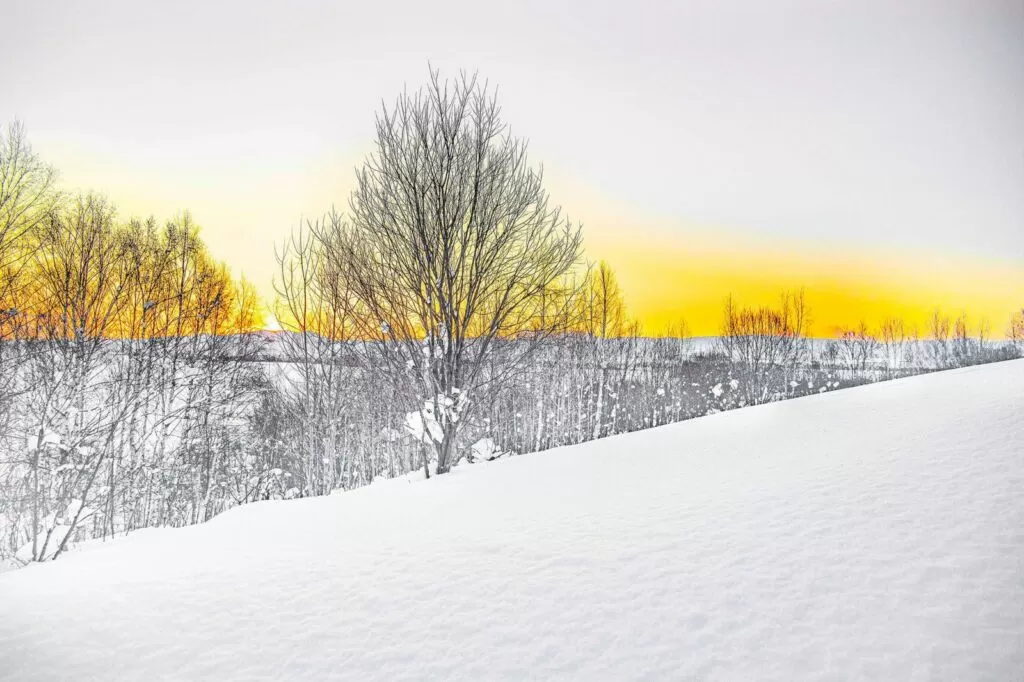
In December, sunset in Hokkaido comes around 16:00 in Sapporo and as early as the 15:40s in Nemuro. On December 22, 2026, Sapporo has sunrise at 7:03 and sunset at 16:03, giving 9 h 00 min of daylight. This article is for people touring Hokkaido by campervan in December and January who need to decide “what time do I have to reach my stop?” It tables sunrise and sunset for eight cities and then explains how to plan a day so that you finish driving while it is still light (National Astronomical Observatory of Japan (NAOJ) Ephemeris Computation Office, "Koyomi for Each Location" (Kakuchi no Koyomi), Sapporo, confirmed October 14, 2026).
Three conclusions first. Around the winter solstice (December 22), it is mainly sunrise that moves; sunset barely changes through December. Sunset in Nemuro in the east and Hakodate in the west differs by 25 minutes. And the distance you drive in a day should be worked out backwards from the time you reach your stop, 30 minutes before sunset.
Compare Hokkaido campervan rentals
Base yourself at New Chitose Airport and compare rates, vehicle types, and pickup locations all in one place.
Compare rental companies and vehicles →When does it get dark in Hokkaido in December? Sunset falls between the late 15:00s and early 16:00s
On December 22, 2026, sunset is at 16:03 in Sapporo, 16:10 in Hakodate, 15:56 in Asahikawa, 15:56 in Obihiro, 15:51 in Kushiro, 15:48 in Abashiri, 15:53 in Wakkanai and 15:45 in Nemuro (National Astronomical Observatory of Japan (NAOJ) Ephemeris Computation Office, "Koyomi Calculator" (Koyomi no Keisan) and "Koyomi for Each Location", Nemuro, confirmed October 14, 2026). Only Sapporo and Hakodate get a sunset after 16:00; the other six cities are in the 15:00s.
Sunset is the moment the sun disappears below the horizon, not the moment it turns pitch black. Even so, on cloudy or snowy days visibility gets poor well before sunset. It is safer to aim for a target a little earlier than sunset instead of planning to “finish driving by sunset.” How to set that target is covered in a later section.
Sapporo, Hakodate, Asahikawa, Kushiro and more: sunrise, sunset and daylight hours in 8 cities
The table lines up three dates for eight cities: December 1, the winter solstice (December 22) and December 31. “Daylight hours” is sunset minus sunrise, calculated by us. Even on the same date, December 22, the range runs from 9 h 09 min in Hakodate to 8 h 43 min in Wakkanai, a gap of 26 minutes.
| City | Dec 1 (sunrise / sunset) | Dec 22 (sunrise / sunset) | Dec 31 (sunrise / sunset) |
|---|---|---|---|
| Sapporo | 6:46 / 16:01(9 h 15 min) | 7:03 / 16:03(9 h 00 min) | 7:06 / 16:09(9 h 03 min) |
| Hakodate | 6:44 / 16:08(9 h 24 min) | 7:01 / 16:10(9 h 09 min) | 7:04 / 16:16(9 h 12 min) |
| Asahikawa | 6:44 / 15:55(9 h 11 min) | 7:01 / 15:56(8 h 55 min) | 7:04 / 16:03(8 h 59 min) |
| Obihiro | 6:38 / 15:54(9 h 16 min) | 6:55 / 15:56(9 h 01 min) | 6:58 / 16:02(9 h 04 min) |
| Kushiro | 6:33 / 15:49(9 h 16 min) | 6:51 / 15:51(9 h 00 min) | 6:53 / 15:57(9 h 04 min) |
| Abashiri | 6:37 / 15:46(9 h 09 min) | 6:55 / 15:48(8 h 53 min) | 6:57 / 15:54(8 h 57 min) |
| Wakkanai | 6:52 / 15:52(9 h 00 min) | 7:10 / 15:53(8 h 43 min) | 7:13 / 15:59(8 h 46 min) |
| Nemuro | 6:29 / 15:43(9 h 14 min) | 6:47 / 15:45(8 h 58 min) | 6:50 / 15:51(9 h 01 min) |
Even in Wakkanai, which has the shortest days, there are 8 h 43 min of daylight throughout December. With daylight on most days under nine hours, leaving late in the morning as you would in summer visibly cuts the time you can use for driving.
Is the winter solstice the day of the earliest sunset? How many minutes things move over December
According to the NAOJ Rekiyōkō (calendar almanac), the winter solstice in 2026 is December 22 (Rekiyōkō 2026, confirmed October 14, 2026). It is the day with the shortest daylight, but the earliest sunset falls on other days. In Sapporo, sunset is 16:00 from December 3 to 15, so there is a whole stretch in early December with sunsets earlier than the solstice’s 16:03.
The reason is that sunrise moves more than sunset. Looking at the three dates in the table, from December 1 to 31 sunset becomes only 8 minutes later in Sapporo and 8 minutes later in Hakodate. Sunrise, on the other hand, becomes 20 to 21 minutes later in all eight cities. The change in December darkness is bigger on the morning side (“later mornings”) than on the evening side (“earlier evenings”), and thinking of it that way makes planning easier.
| City | Earliest sunset in December | Dates when that time occurs |
|---|---|---|
| Sapporo | 16:00 | Dec 3–15 |
| Hakodate | 16:06 | Dec 6–11 |
| Asahikawa | 15:53 | Dec 7–13 |
| Obihiro | 15:53 | Dec 4–15 |
| Kushiro | 15:48 | Dec 4–14 |
| Abashiri | 15:45 | Dec 4–15 |
| Wakkanai | 15:50 | Dec 7–13 |
| Nemuro | 15:42 | Dec 4–14 |
How different are east and west? Sunset in Nemuro and Hakodate, Sapporo and Kushiro
On December 22, sunset is at 16:10 in Hakodate and 15:45 in Nemuro, a 25-minute difference. Sunrise is at 7:01 in Hakodate and 6:47 in Nemuro, so in the east, Nemuro gets both its morning and its evening earlier, and the entire daylight window is shifted forward. Between Sapporo (sunrise 7:03, sunset 16:03) and Kushiro (6:51, 15:51), both sunrise and sunset differ by 12 minutes (sources as in the previous tables, confirmed October 14, 2026).
On a trip from Sapporo to eastern Hokkaido, assume that the same “16:00” arrives sooner in Nemuro and Kushiro. When it still looks bright at 16:00 in Sapporo, it is already 9 minutes past sunset in Kushiro. Set your arrival time at your eastern Hokkaido stop earlier than you would going by Sapporo.
For the Geminid meteor shower and staying warm while you wait, see “Geminid Meteor Shower 2026 in Hokkaido: Peak Around 23:00 on December 14, Sapporo Moonset 20:40, and Staying Warm in a Winter Campervan [2026]”.
Hours of sunshine in December differ a lot between Wakkanai and Obihiro
Although the time from sunrise to sunset is nearly the same in all eight cities, the hours of actual sunshine vary greatly by region. Comparing December sunshine hours in the JMA climatological normals (1991–2020), Kushiro has 175.6 hours and Obihiro 172.0 hours, against 28.4 hours in Wakkanai and 58.1 hours in Asahikawa. Per day, that is about 5.5 hours in Obihiro and about 0.9 hours in Wakkanai (monthly normals for Obihiro and Wakkanai, confirmed September 24, 2026. The per-day figure is the monthly total divided by 31).
The figures of 82.7 hours for Sapporo, 91.5 hours for Hakodate and 117.4 hours for Abashiri are taken from the same table. Normals are a guide to typical years, not a forecast for the day. Even so, the gap is clear: Wakkanai and Asahikawa get little sun, while Obihiro and Kushiro keep more of it. On days when you pass through low-sunshine areas, assume it will get dark before sunset and arrive earlier.
| City | December sunshine hours (monthly total) | Per day |
|---|---|---|
| Kushiro | 175.6 hours | approx. 5.7 hours |
| Obihiro | 172.0 hours | approx. 5.5 hours |
| Abashiri | 117.4 hours | approx. 3.8 hours |
| Hakodate | 91.5 hours | approx. 3.0 hours |
| Sapporo | 82.7 hours | approx. 2.7 hours |
| Asahikawa | 58.1 hours | approx. 1.9 hours |
| Wakkanai | 28.4 hours | approx. 0.9 hours |
If it gets dark around 16:00, how many km can you drive in a day? Work backwards from your arrival time
Our guideline is up to 200 km and 9 hours of driving per day (model route for a trip around Hokkaido). We do not loosen this limit in winter. In winter, however, daylight itself is only about nine hours. A plan that uses up all nine hours of driving is the same as a plan that keeps driving after sunset. In winter, “arrive before dark” takes effect first, and the day ends before you reach the distance limit.
Here is how to work backwards. First, look up sunset for the city where you are staying that day in the table. Next, subtract 30 minutes from that time and use the result as your “arrival target.” The 30-minute margin is this site’s own suggestion, not an official standard. Finally, set your departure after sunrise and treat the time until the arrival target as your available time, including breaks and refueling.
| City where you are staying | Sunset on December 22 | Arrival target (30 minutes before sunset) |
|---|---|---|
| Sapporo | 16:03 | 15:33 |
| Hakodate | 16:10 | 15:40 |
| Asahikawa | 15:56 | 15:26 |
| Obihiro | 15:56 | 15:26 |
| Kushiro | 15:51 | 15:21 |
| Abashiri | 15:48 | 15:18 |
| Wakkanai | 15:53 | 15:23 |
| Nemuro | 15:45 | 15:15 |
For example, on a day you reach Sapporo on December 22, the arrival target is 15:33. If you leave at 8:30, after sunrise (7:03), you have about 7 hours including breaks. The distance that fits in those 7 hours is that day’s limit. On days when icy roads or congestion hold you up, change your destination to a town closer by. Checking the winter closure sections in advance in Hokkaido roads that close in winter means fewer changes to your itinerary.
New Chitose Airport / Tokachi-Obihiro Airport
See Moving Inn campervans
Check vehicle types, rates, and availability on the official site.
View details at Moving Inn →What to watch most in evening driving? Deer activity overlaps with sunset
On collisions with Ezo deer (Hokkaido sika deer), the Hokkaido Government says that more than 70% of them happen between 16:00 and 24:00 and that the peak of Ezo deer activity is around sunrise and sunset. About 41% of annual accidents are concentrated in October and November, but the time-of-day pattern is the same in December. Because December sunset falls between the late 15:00s and early 16:00s, it overlaps with rush-hour traffic (Hokkaido Government, Department of Environment and Lifestyle, "Preventing traffic accidents involving Ezo deer", confirmed October 14, 2026).
The Abashiri Development and Construction Department also urges drivers to “take full care in the early morning, evening and night, when Ezo deer are often seen” and to “slow down if you see a deer on the road.” Deer often move in groups, and a second and third follow after the first has crossed (Hokkaido Regional Development Bureau, Abashiri Development and Construction Department, "Drive with care for Ezo deer", confirmed October 14, 2026). Around sunset, put speed before distance. The season for deer accidents and what to do are covered separately in when Ezo deer collisions increase, and who to contact.
For icy evening roads, as part of snow driving in general, see before traveling Hokkaido by campervan in winter and the complete winter driving guide. This article does not give figures for the times of day when ice forms. Before you leave, check the latest road information from the road administrator.
By when should you decide tonight’s stop? Two hours before sunset is the deadline
In winter Hokkaido, two hours before sunset (around 14:00 in the Sapporo area on December 22) is a good time to make the final check on where you will stay that day (this site’s suggestion). At that time, compare the remaining distance with your arrival target, and if you will not make it, switch to a stop closer by. If you decide late, you end up looking for a place in an unfamiliar town in the dark.
Switching is easier if you pick two candidate places to stay before you leave. For places where you can stay overnight in winter, 13 RV parks and Michi-no-Eki open in winter lists results checked against the official websites. Assuming you refuel before sunset, check the rural refueling plan in gas station conditions and also keep 43 24-hour stations where you can refuel at night in mind as a backup if night falls.
For how to plan the whole trip, an example of a 10-day winter loop of Hokkaido is in the 10-day winter Hokkaido model course. For December temperatures, see our winter temperature article.
What to check around sunset the day before and on the morning of departure
Here is everything above rearranged in order, for the day before and the day itself. Start by looking up sunset in the table.
- Day before: look up sunset for the city where you are staying in the table and set an arrival target 30 minutes earlier
- Day before: check that your plan does not have you setting off before sunrise (around 7:00 in Sapporo in late December)
- Day before: decide on one backup stop in a town closer by
- Morning of: check the weather and road information, and move the arrival target earlier still on cloudy or snowy days
- Midday: two hours before sunset, compare the remaining distance with your arrival target
- Evening: around sunset, slow down for deer, and finish refueling by sunset
Frequently asked questions (FAQ)
Q. What time does it get dark in Hokkaido in December?
On December 22, 2026, sunset is at 16:03 in Sapporo, 16:10 in Hakodate, 15:56 in Asahikawa and Obihiro, 15:51 in Kushiro and 15:45 in Nemuro (National Astronomical Observatory of Japan (NAOJ) Ephemeris Computation Office, confirmed October 14, 2026). On cloudy or snowy days, it feels dark before sunset.
Q. Is the winter solstice the day of the earliest sunset?
No. In Sapporo, sunset is 16:00 from December 3 to 15, and those days continue to be earlier than the solstice, December 22 (16:03). The solstice is the day with the shortest daylight, and sunrise keeps getting later or stays level until the end of December (National Astronomical Observatory of Japan (NAOJ) Ephemeris Computation Office, confirmed October 14, 2026).
Q. How different is sunset between Nemuro in the east and Hakodate in the west?
On December 22, sunset is 16:10 in Hakodate and 15:45 in Nemuro, so Nemuro is 25 minutes earlier. Between Sapporo and Kushiro the difference is 12 minutes. On days you head to eastern Hokkaido, plan to reach your stop earlier than you would going by Sapporo (National Astronomical Observatory of Japan (NAOJ) Ephemeris Computation Office, confirmed October 14, 2026).
Q. How much do December sunshine hours differ by region?
In the JMA climatological normals, December sunshine is 175.6 hours in Kushiro and 172.0 hours in Obihiro, against 28.4 hours in Wakkanai and 58.1 hours in Asahikawa. Wakkanai and Asahikawa get little and Obihiro and Kushiro get a lot. Normals are a guide to typical years (Japan Meteorological Agency, confirmed September 24, 2026).
Q. How many km can you drive per day in winter?
Our guideline is still up to 200 km and 9 hours of driving per day in winter, and we do not loosen it. Because reaching your stop 30 minutes before sunset takes effect first, the day actually ends short of 200 km. Work backwards from that day’s sunset to get your arrival target.
Q. How should I prepare for deer when driving in the evening?
According to the Hokkaido Government, more than 70% of deer accidents happen between 16:00 and 24:00. Slow down around sunset, and if you see a deer on the road, slow down and proceed at a crawl. Others may jump out one after another behind the first (Hokkaido Government and Hokkaido Regional Development Bureau, Abashiri Development and Construction Department, confirmed October 14, 2026).
Q. By when should I decide tonight’s stop?
Our suggestion is two hours before sunset. For the Sapporo area on December 22, around 14:00, compare the remaining distance with your arrival target. If you will not make it, switch to the closer stop you chose the day before.
Pages to read next
- Before traveling Hokkaido by campervan in winter
- Hokkaido winter campervan driving: the complete guide
- A 10-day winter model course around Hokkaido
- 13 RV parks and Michi-no-Eki in Hokkaido where you can stay overnight in winter
- Hokkaido roads that close in winter
Book a Campervan in Hokkaido
Moving Inn New Chitose Airport supports English booking and offers airport transfers.
Pick a campervan by what matters to you.
Rent in winter (Dec–Mar)
Companies that rent through winter, listed apart from those that close.