Gas Stations on a Hokkaido Camper Trip | Refueling Plans and Rural Area Tips [2026 Edition]
Based on data from Japan's Agency for Natural Resources and Energy and the Hokkaido Bureau of Economy, Trade and Industry (confirmed Aug 27, 2026): gas station trends in Hokkaido and how to plan refueling in rural areas.
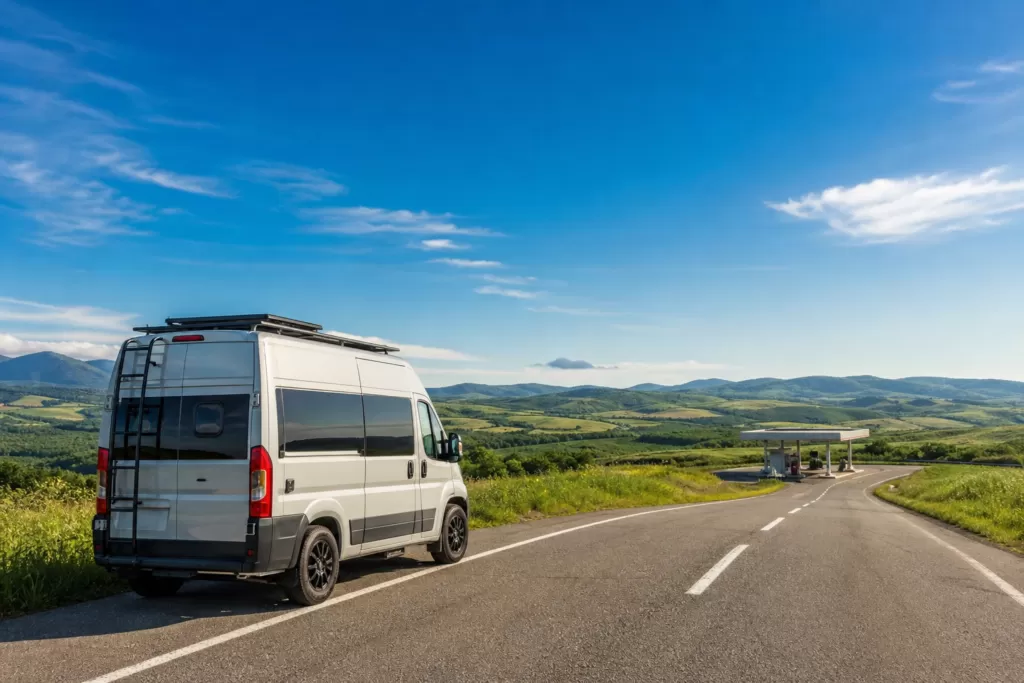
The biggest difference between a Hokkaido camper trip and driving on Honshu is the spacing between gas stations. According to data published by the Hokkaido Bureau of Economy, Trade and Industry and the Agency for Natural Resources and Energy, the number of gas stations in Hokkaido fell from 2,081 in FY2010 to 1,668 in FY2023. The agency defines a “gas station scarcity area” (SS kaso-chi) as a municipality with three or fewer gas stations, and the number of such municipalities nationwide has grown by about 100 over the past decade, reaching 372 (out of 1,718 municipalities nationwide) as of the end of FY2023 (Agency for Natural Resources and Energy, “SS Kaso-chi Taisaku ni Tsuite,” confirmed 2026-08-27). Cities and towns rarely have a problem, but once you’re in the rural parts of eastern or northern Hokkaido, it’s entirely possible to find yourself with “no gas station for dozens of kilometers.”
This article covers how to plan refueling for a camper trip around Hokkaido, and what to watch for specifically in rural areas with fewer gas stations. The figures here are drawn from published data by the Agency for Natural Resources and Energy and the Hokkaido Bureau of Economy, Trade and Industry; municipality-level detail can be checked individually in that source data. Refueling rules right before returning the vehicle are covered in the Pre-Return Checklist, so this article focuses on refueling planning during the trip itself.
New Chitose Airport / Tokachi-Obihiro Airport
Rent the Cab-Con “Cresson Journey”
Base yourself at New Chitose Airport and compare rates, vehicle types, and pickup locations all in one place.
See details on Moving Inn →Does Hokkaido really have fewer gas stations?
In short: comparing prefectures, Hokkaido doesn’t so much have fewer gas stations as it has a wider area for each one to cover. Per the Ministry of Economy, Trade and Industry’s figures, the number of gas stations in Hokkaido fell from 1,750 in FY2020 to 1,668 in FY2023 — a drop of 82 over three years (enecho.meti.go.jp, hkd.meti.go.jp, confirmed 2026-08-27). Gas station numbers are declining nationwide, but because Hokkaido is so large, each station tends to cover a wider area than in similarly-sized prefectures on Honshu. Nationwide, 372 municipalities (as of the end of FY2023) qualify as “gas station scarcity areas” (three or fewer stations in the municipality), an increase of roughly 100 municipalities over the past decade (Agency for Natural Resources and Energy, “SS Kaso-chi Taisaku ni Tsuite,” confirmed 2026-08-27). A prefecture-by-prefecture breakdown isn’t published in that source, so we can’t confirm how many Hokkaido municipalities qualify — but rural areas of eastern and northern Hokkaido do tend to have wider gaps between stations, so it’s worth checking ahead of time whether your planned route passes through a stretch with few gas stations.
Which areas have fewer gas stations?
Around Sapporo, New Chitose Airport, Hakodate, and Asahikawa, gas station spacing isn’t much different from urban areas on Honshu. What to watch out for is eastern Hokkaido (the rural parts of Kushiro, Nemuro, and Tokachi) and northern Hokkaido (Soya and northern Kamikawa), where some stretches between settlements run for dozens of kilometers without a station. The Dohoku Bifuka-Nayoro Camper Trip Guide also covers touring routes in the northern area — if your long-distance route includes these areas, check the location of gas stations along your route with a car nav or map app before setting out. Many rural gas stations are open during the day but closed at night or early morning, so it’s also worth checking opening hours.
Trend in the number of gas stations in Hokkaido
| Fiscal Year | Gas stations in Hokkaido |
|---|---|
| FY2010 | 2,081 |
| FY2020 | 1,750 |
| FY2021 | 1,736 |
| FY2022 | 1,707 |
| FY2023 | 1,668 |
Source: Agency for Natural Resources and Energy, “Number of Gasoline Retailers and Gas Stations” (enecho.meti.go.jp/category/resources_and_fuel/distribution/hinnkakuhou/250730.html) and published data from the Hokkaido Bureau of Economy, Trade and Industry (confirmed 2026-08-27). That’s a drop of 413 stations — roughly 20% — over 13 years, and the trend may well continue. The latest figures and municipality-level detail are updated periodically on the Agency’s site, so check the primary source linked above for the exact current numbers.
Why starting with a full tank is the golden rule
Filling up before you leave your rental company’s base (around New Chitose or Obihiro Airport, for example) gives you a lot more slack in your refueling plan later on. Distances between destinations in Hokkaido are long, and it’s common for a sightseeing detour to add more mileage than you expected. Especially on the first day heading toward eastern or northern Hokkaido, it’s worth making a habit of filling up near your base before setting out, so you’re not scrambling over fuel level once you’re in an area with fewer stations. As a rule of thumb, refuel at the next station once you’re below half a tank — that way, even if you hit a stretch with no station where you expected one, you have room to adapt.
Thinking about a camper’s fuel economy and driving range
Campers are larger and heavier than an ordinary passenger car, so fuel economy tends to be worse. Since mileage varies a lot by vehicle type, load, and air conditioner use, this article won’t state a specific mileage figure. If you want a rough estimate, ask your rental company about the fuel tank capacity and approximate mileage when you sign the contract, and work out roughly “how far a full tank gets you” on day one — that makes it much easier to plan refueling. Keep in mind that mileage tends to worsen with a heavy load, heavy air conditioner use in midsummer, or heater use in early morning or late autumn, and build in extra margin on your refueling timing accordingly.
Can you refuel late at night or early morning? How to spot 24-hour stations
Major cities like central Sapporo, New Chitose Airport, Asahikawa, and Hakodate have multiple 24-hour self-service stations, but hours get shorter the further you go into rural areas, and it’s not unusual for a station to be closed on Sundays and public holidays. If you’re planning overnight driving or a long drive in the early hours, check the location of 24-hour stations along your route on a map app ahead of time, and refuel earlier rather than risk running low outside operating hours. The Hokkaido Expressway Rest Area (SA/PA) Overnight Parking Guide is also a useful reference if you’re combining this with overnight parking at rest areas.
Self-service vs. full-service: an easy way to choose, even as a first-timer
Gas stations in Hokkaido are a mix of self-service and full-service (staffed). At self-service stations you operate the nozzle yourself, and if you haven’t checked your camper’s fuel filler location and fuel type (regular gasoline or diesel) ahead of time, you can end up fumbling. Diesel-engine cab-cons and van-cons in particular need diesel fuel, so check the pump display carefully to avoid grabbing the regular or premium nozzle by mistake. If you’re unsure, a full-service station makes it simple — just tell the staff the fuel type and that you want a full tank. Some rural stations are full-service only, so even if you can’t tell in advance which type a station is, you can just follow the signage once you’re there.
Planning refueling in areas with no cell signal
Some stretches of eastern and northern Hokkaido have weak or no cell signal. Assuming you may not be able to search for gas stations in real time on a map app, it’s worth saving the locations of stations along your planned route as an offline map or screenshot before you set out. Pre-departure preparation if you’re arriving by ferry is covered in the Complete Guide to Ferries and Campers in Hokkaido, and toll costs for driving on the expressway are covered in the Hokkaido Expressway Toll Guide — both worth checking when planning a long-distance route.
Refueling planning checklist
Checking the following before you set out will help you stay calm even in areas with fewer gas stations.
- Filled up before leaving the rental company’s base?
- Confirmed the fuel type (regular or diesel) in the contract?
- Checked whether your route includes a stretch with fewer stations (rural eastern/northern Hokkaido, etc.)?
- Checked opening hours and closed days for stations in that stretch?
- If driving overnight or early morning, located 24-hour stations along the route?
- Saved gas station locations for offline use, in case of weak signal?
- Set a rule of thumb — refuel at the next station once below half a tank?
New Chitose Airport / Tokachi-Obihiro Airport
Rent the Cab-Con “Cresson Journey”
Base yourself at New Chitose Airport and compare rates, vehicle types, and pickup locations all in one place.
See details on Moving Inn →Summary: prepare for areas with fewer gas stations by “starting full” and “refueling early”
The number of gas stations in Hokkaido fell from 2,081 in FY2010 to 1,668 in FY2023 (enecho.meti.go.jp, hkd.meti.go.jp, confirmed 2026-08-27). Nationwide, “gas station scarcity areas” (municipalities with three or fewer stations) have been increasing over the past decade, and routes through rural eastern and northern Hokkaido tend to have wider gaps between stations. If your route includes those areas, keeping three things in mind — starting with a full tank at your base, refueling early once below half a tank, and checking gas station locations along your route ahead of time — makes it much easier to avoid scrambling when you can’t find a station. The Complete Hokkaido Camper Model Course Guide is also a useful reference for planning an overall long-distance route.
Frequently asked questions
What should I do if I’m about to run out of gas in Hokkaido?
If the low-fuel warning light comes on and you’re in an area with a distant next station, avoid pushing on and consider calling the roadside assistance number you were given at contract signing. Checking gas stations along your route ahead of time and making a habit of refueling once you’re below half a tank is the best way to avoid getting into this situation in the first place.
Where exactly are gas stations especially sparse in eastern and northern Hokkaido?
Rural parts of Kushiro, Nemuro, and Tokachi, and some areas of Soya and northern Kamikawa, have wide gaps between gas stations across settlements. The Agency for Natural Resources and Energy defines a “gas station scarcity area” as a municipality with three or fewer stations, and 372 municipalities nationwide qualify (as of the end of FY2023). A prefecture-by-prefecture breakdown isn’t included in that published data, so we can’t confirm how many Hokkaido municipalities qualify (confirmed 2026-08-27). Whether your planned route includes a stretch with sparse stations is worth checking individually on a map app before you set out.
Should I put in regular gasoline or diesel?
It depends on the vehicle. Diesel-engine cab-cons and van-cons need diesel fuel, while gasoline-engine kei-campers need regular gasoline. Always confirm the fuel type when signing the contract, and check the pump display before refueling.
Are there places to refuel late at night?
Major cities like central Sapporo, New Chitose Airport, Asahikawa, and Hakodate have multiple 24-hour self-service stations. Rural areas have shorter operating hours at many stations, so if you’re planning to drive late at night or early morning, it’s worth checking the location of 24-hour stations ahead of time.
Is it OK to use a self-service station even if I’ve never used one before?
As long as you know the fuel type (regular or diesel) and where the filler is located, the operation itself isn’t difficult. If you’re unsure, choose a full-service station instead — just tell the staff the fuel type and that you want a full tank, and they’ll take care of it.
Book a Campervan in Hokkaido
Moving Inn New Chitose Airport supports English booking and offers airport transfers.
![Campgrounds Near Tokachi-Obihiro Airport: 8 Sites Within 30 km, Compared by Vehicle Access, Power and Price [2026]](https://hokkaido-campingcar.jp/wp-content/uploads/2026/10/photo-obihiro-airport-featured-pl232-768x512.jpg.webp)
![Campgrounds Near Hakodate Airport: 12 Sites Within 30 km, Compared by Vehicle Access, Power and Price [2026]](https://hokkaido-campingcar.jp/wp-content/uploads/2026/10/photo-hakodate-airport-featured-hl4722-768x484.jpg.webp)