Is Driving a Campervan Hard? 7 Points Beginners Struggle With and How to Handle Them
A campervan handles very differently from a regular car.
Pick a campervan by what matters to you.
Rent at New Chitose Airport
See only the rental bases in Chitose, where the airport is.
Rent in winter (Dec–Mar)
Companies that rent through winter, listed apart from those that close.
Guide price
Moving Inn New Chitose Airport: HIACE van conversion from ¥22,000 per night. 20–30% off when booked 60–90 days ahead (official rate table, checked 15 Oct 2026).
Before you book: with an International Driving Permit if your country is in the Geneva Convention (for example the US, Australia, Singapore); Taiwan, Switzerland, Germany, France, Belgium and Monaco need your licence plus a Japanese translation (Tokyo Metropolitan Police). Questions in English: Moving Inn on WhatsApp. Every roadside station (michi-no-eki) must have free 24-hour toilets, and Hokkaido has 128 of them (MLIT).
Introduction: Is Driving a Camper Van Really That Hard?
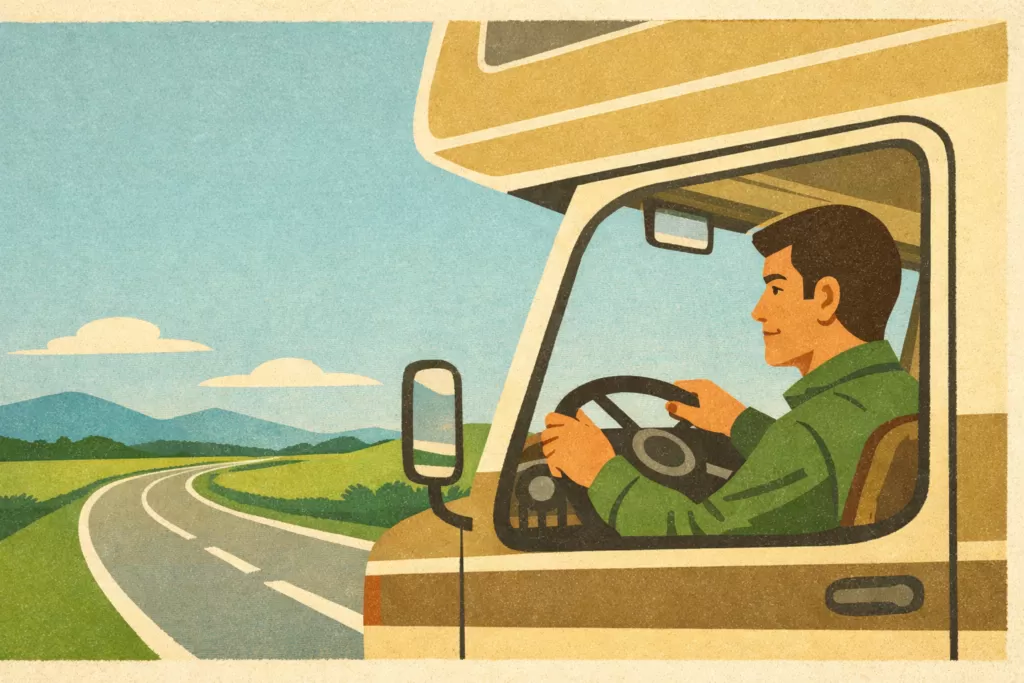
Around 100 people search “is driving a camper van difficult” every month. The short answer: if you can drive a regular car, you’ll get the hang of it within 1–2 hours once you know the key points. That said, if you approach it the same way you’d drive a sedan, you’ll find yourself drifting out of your lane or struggling to park — and thinking “this is harder than I expected.”
This guide covers the “7 Tips for Driving a Camper Van” — everything you need to read the night before your rental to feel confident, including advice for long-distance drives across Hokkaido. For license requirements, see our Camper Van License Guide; for differences between vehicle types, see our Camper Van Type Comparison Guide.
New Chitose Airport / Tokachi-Obihiro Airport
Rent the Cabcon “Cresson Journey”
Base yourself at New Chitose Airport and compare rates, vehicle types, and pickup locations all in one place.
See details at Moving Inn →3 Basics to Know Before You Drive
① Memorize Your Vehicle’s Dimensions
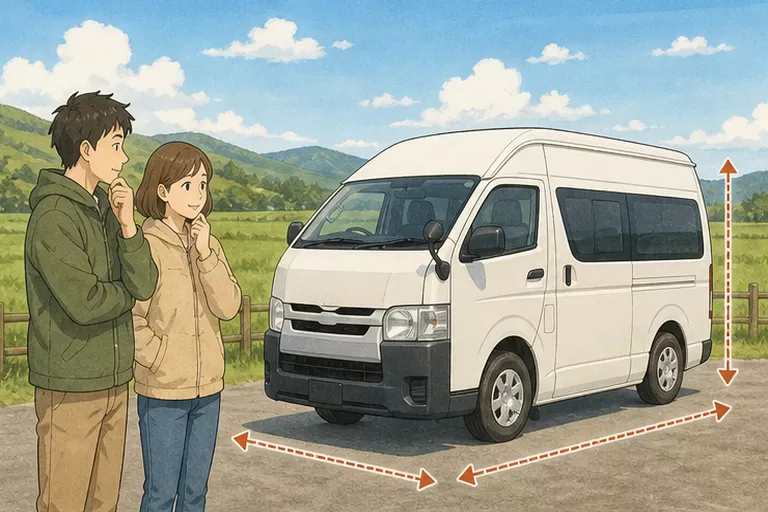
The first thing you should always do is write down the overall length, width, and height of the vehicle you’ll be driving.
| Vehicle Category | Approx. Length | Width | Height |
|---|---|---|---|
| Kei Camper Van | Approx. 3.4m | 1.48m | 1.9–2.0m |
| Van Conversion (HiAce-based) | Approx. 4.7–5.4m | 1.88m | 2.1–2.3m |
| Cab-over Camper (Camroad-based) | Approx. 5.0–5.3m | 2.05–2.20m | 2.8–3.1m |
The most critical dimension is height. You rarely think about clearance in a regular car, but cab-over campers stand over 2.8m tall — and every year, accidents occur when drivers hit multi-story car parks, low bridges, drive-throughs, or gas station canopies. Say “2.8 meters” out loud until it sticks, and consider putting a sticky note at eye level as a reminder.
② Seat Position and Mirror Setup
Many cab-over campers have a cab-forward design where the driver sits ahead of the front axle. This means you need to turn the steering wheel later than you would in a regular car. To compensate, slide your seat slightly further back than usual so your elbows have a gentle bend, then adjust your side mirrors so the rear tires of your vehicle are just visible at the bottom edge. This one adjustment makes it much easier to judge your vehicle’s position on the road.
③ Three-Point Pre-Departure Check
Before pulling out, always confirm these three things:
- Lock all interior storage: Cupboards, the refrigerator, and drawers can fly open while driving and scatter your belongings.
- Shore power and water hoses: Driving off with the power or water hookup still connected is a surprisingly common mistake.
- Entry door and pop-up roof: Forgetting to lower a pop-up roof section before driving is a reliable way to destroy it at the first low clearance you encounter.
4 Tips to Keep in Mind While Driving
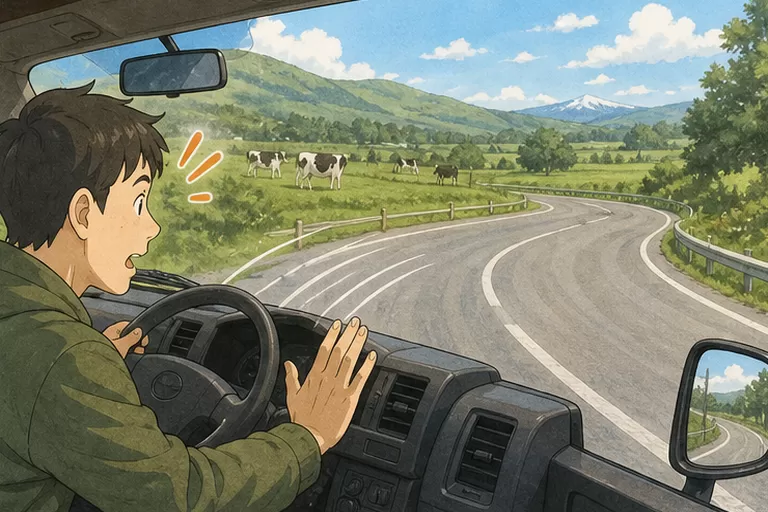
④ Brake 30% Earlier Than You Think You Need To
A camper van weighs 1.5 to 2 times as much as a regular car (around 3 tonnes for a cab-over). If you brake the same way you normally would, your stopping distance will feel about 1.5 times longer. Simply committing to braking 30% earlier than usual will dramatically reduce your rear-end collision risk and keep your passengers comfortable.
⑤ Swing Wide on Curves and Turns
Vehicles over 5 meters long have a significant difference between the paths traced by the front and rear wheels (known as off-tracking). If you steer into a turn at the same moment you would in a regular car, the rear wheels are likely to mount the curb — a common type of accident. The trick is to pull slightly forward first, then make a wider turn. Picture how a truck navigates an intersection and you’ll have the right mental model.
⑥ Handling Crosswinds and Steering Corrections
Along Hokkaido’s coastlines, on bridges, and through mountain passes, camper vans are especially vulnerable to crosswinds. Tall cab-over models can be thrown significantly when exiting a tunnel or passing a large truck — a phenomenon known as “fishtailing.”
The fix is straightforward:
- On expressways, aim to drive about 10 km/h below the speed limit
- Hold the steering wheel with both hands at the “ten and two” position — grip lightly, don’t white-knuckle it
- If the wind pushes you, make small corrective inputs rather than jerking the wheel back
These habits alone will significantly reduce your accident risk.
⑦ On Highways, 90 km/h Is Your Sweet Spot
Above 100 km/h, wind resistance increases sharply and fuel efficiency drops noticeably in a camper van. Real-world testing shows that cruising at 90 km/h improves fuel economy by 10–15%. On long Hokkaido drives, locking in a 90 km/h cruise speed improves comfort, economy, and safety all at once. For a detailed breakdown, see our Camper Van Fuel Efficiency Comparison Guide.
Parking, Reversing, and Navigating Narrow Roads
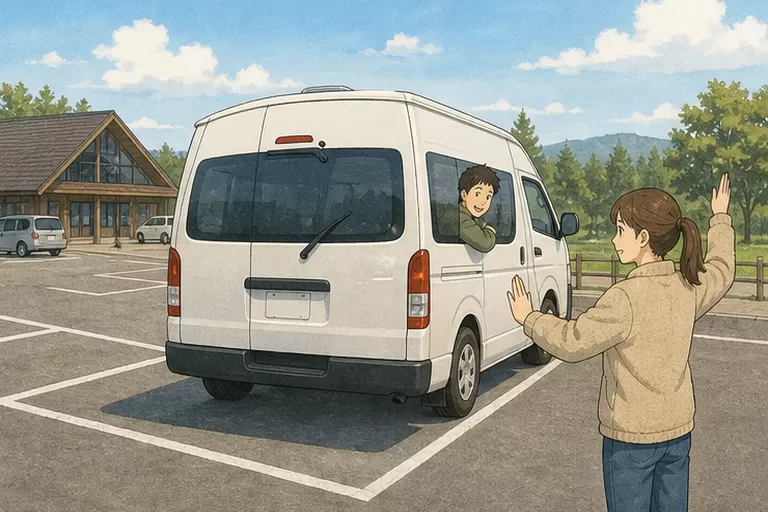
Plan Your Parking Spots in Advance
The biggest source of stress in a camper van is arriving somewhere to find there’s nowhere to park. Convenience stores and supermarkets often lack oversized spaces, so the golden rule for rest stops is to stick to Michi-no-Eki roadside stations, RV parks, and large retail complexes. Be sure to check the etiquette and rules for Michi-no-Eki stations in Hokkaido.
Reversing: Windows Down, Go Slow, Spotter if Possible
Even with a rear-view camera, you won’t see obstacles along the sides of your vehicle. Roll down the windows and use your ears as well as your eyes. If you have passengers, have someone get out and guide you. “Take your time and start over” is the single best accident-prevention strategy when reversing.
On Narrow Roads: Back Out Rather Than Push Through
GPS navigation occasionally routes you down farm tracks or mountain paths. Pressing on with an optimistic “I think I can fit” can leave you unable to turn around, forcing a multi-kilometer reverse. The moment a road feels too narrow to pass an oncoming vehicle, reverse immediately to the nearest wide point — it’s always the safest choice.
Driving-Specific Cautions for Hokkaido
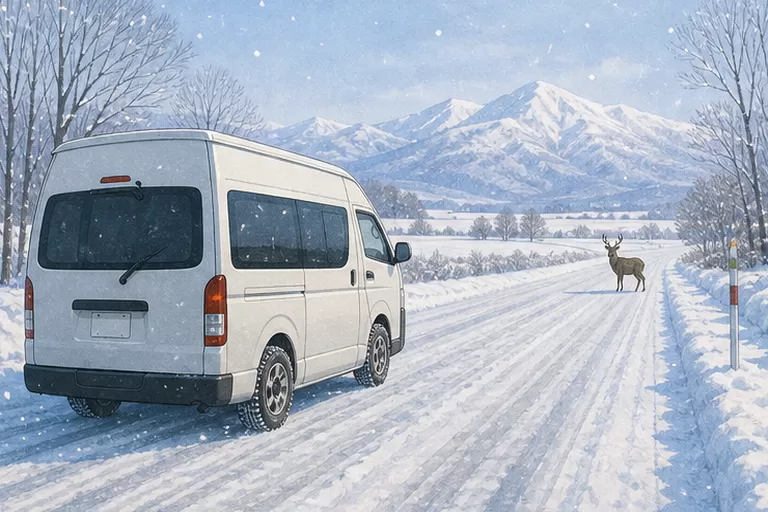
- Ezo deer darting onto the road: Slow down around dawn and dusk. A collision can result in costly repairs even with comprehensive insurance.
- Long straight roads: Drowsiness and speed-blindness set in quickly — take a break at least every two hours. This is especially important on long-distance routes like the Abashiri and Lake Saroma area.
- Winter road conditions: Never take chances on packed snow or black ice. When renting in winter, choose a plan that includes studless snow tires as standard (see our Winter Hokkaido Camper Van Guide).
It’s also worth reviewing your rental insurance and coverage details before departure, so you’re prepared in case of an unexpected incident.
Frequently Asked Questions (FAQ)
Q1. Can I drive a camper van on a standard driver’s license?
Most van conversions and cab-over campers fall within the standard license category, but this depends on the vehicle’s gross weight and passenger capacity. Check our Camper Van License Guide for details.
Q2. Is highway driving scary?
If you stick to a 90 km/h cruise, you’ll actually feel more stable than in a regular car. The only time it gets nerve-wracking is if you try to force an overtake.
Summary: Master “Brake Early” and “90 km/h Cruise” and You’ll Be Fine
Driving a camper van is something anyone can do safely and enjoyably once they know the key points. Of the seven tips covered today, make sure you put these three into practice from day one: say your vehicle height out loud until it’s memorized, brake 30% earlier than usual, and cruise at 90 km/h. Those three habits alone will eliminate most of the anxiety around driving.
Hokkaido’s wide-open roads are one of the best stages in the world for a camper van trip. Stay calm, take it easy, and by day three you’ll be driving with the same confidence you’d have in your own car.
Book a Campervan in Hokkaido
Moving Inn New Chitose Airport supports English booking and offers airport transfers.
Pick a campervan by what matters to you.
Rent at New Chitose Airport
See only the rental bases in Chitose, where the airport is.

![Hokkaido Winter Trip: Shoes & Packing List [2026] – 2,060 Sapporo Fall Transports and a Pre-Departure Checklist](https://hokkaido-campingcar.jp/wp-content/uploads/2026/10/hokkaido-winter-trip-shoes-packing-eyecatch-768x432.webp)
![Snow Cancels Your New Chitose Airport Flight? Rebooking Rules and Campervan Rental Delays [2026]](https://hokkaido-campingcar.jp/wp-content/uploads/2026/10/new-chitose-airport-snow-cancellation-eyecatch-768x432.webp)