Michi-no-Eki Manners Guide [2026] | Why Some Stations Restrict Overnight Parking, Rules & Alternatives
A complete guide to campervan etiquette and prohibited behaviors at Michi-no-Eki (roadside stations).
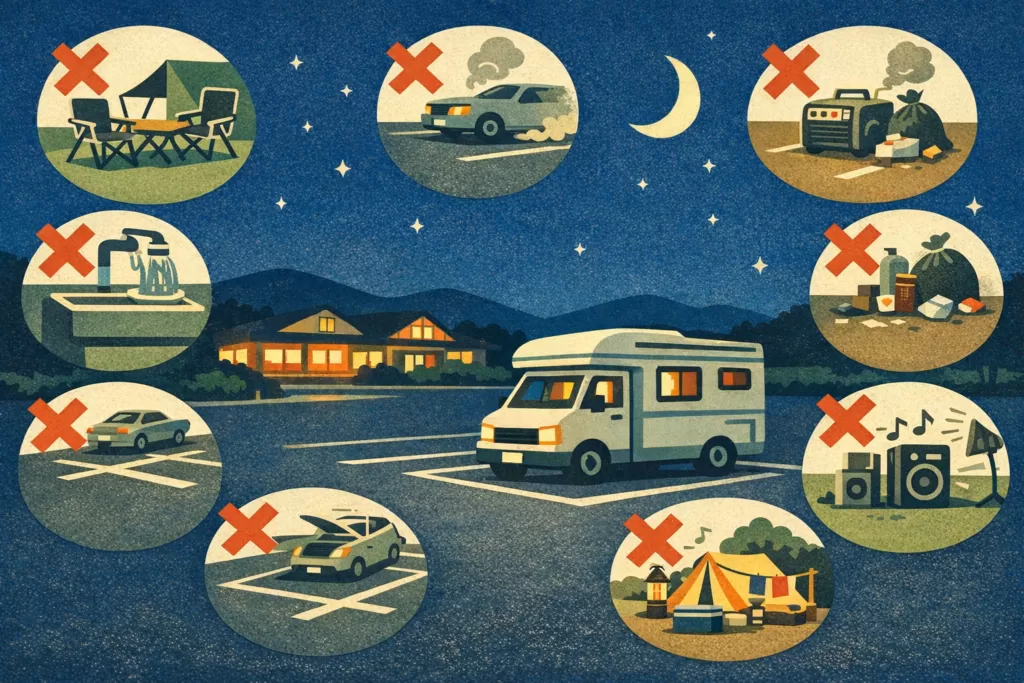
Planning a campervan trip in Japan? Before you pull into a roadside station (道の駅, Michi-no-Eki) for the night, it helps to know what’s actually confirmed. In August 2026 we checked the official websites of 96 of Hokkaido’s 128 roadside stations, plus 10 additional stations outside Hokkaido that had previously appeared on lists like this one. Across all of them, we found no official notice banning overnight parking. Two stations ask visitors to limit their stay — Sarufutsu Park (Hokkaido) asks visitors not to use the lot for overnight stays, and Ito Marine Town (Shizuoka) asks campervans not to stay long-term due to limited parking. Both are requests, not posted bans.
You can rent a campervan for this trip.
- Guide price (Moving Inn, New Chitose Airport, per night, tax included): HIACE van conversion from ¥22,000, Cresson Journey cab-over camper from ¥30,800. 20–30% off when booked 60–90 days ahead (official rate table, checked 15 Oct 2026)
This guide covers: what we could confirm for the stations below, why some facilities discourage overnight stays, the 8 rules to follow, and where to go if a station isn’t a good fit.
What We Found When We Checked Official Sources
Every station below was checked directly against official sources in August 2026 (see notes for links and dates). One entry from an earlier version of this list, Chojagahara Parking Lot (Oita), has been removed — it is a mountain trailhead parking area in Aso-Kuju National Park, not a registered roadside station. Always confirm directly with the facility before your trip, as policies can change.
| Station Name | Prefecture / Region | Notes |
|---|---|---|
| Michi-no-Eki Papasland Satsuru | Hokkaido | Unconfirmed — the official website (papasland-satturu.com) could not be reached due to an expired SSL certificate as of Aug 2026 |
| Michi-no-Eki Shiretoko Rausu | Hokkaido | No mention of overnight parking on the official site. Source: hokkaido-michinoeki.jp/michinoeki/2217/ (checked Aug 2026) |
| Michi-no-Eki Sarufutsu Park | Hokkaido | Official site asks visitors not to use the station for overnight stays — a request, not a posted ban. Source: sarufutsu.jp/road_station/information/ (checked Aug 2026) |
| Michi-no-Eki Bifuka (Bifuka Island) | Hokkaido | No mention of overnight parking on the official site. Note: Bifuka Island is an adjacent forest park (campground/cottages), a separate facility from the station’s own parking lot. Source: bifukaonsen.com/roadside_station/ (checked Aug 2026) |
| Michi-no-Eki Marine Town Ito | Shizuoka | Official site asks campervans not to stay long-term, citing limited parking space — a request, not a posted ban. Generator use is separately prohibited. Source: ito-marinetown.co.jp/facilities/access/ (checked Aug 2026) |
| Michi-no-Eki Narusawa | Yamanashi | No mention of overnight parking on the official site. Parking and restrooms are listed as available 24 hours. Source: ja-narusawamura.com (checked Aug 2026) |
| Michi-no-Eki Kaikoku Shimoda Minato | Shizuoka | No mention of overnight parking on the official site. Source: kaikokushimodaminato.co.jp/information (checked Aug 2026) |
| Michi-no-Eki Tenki Tenki Tango | Kyoto | No mention of overnight parking on the official site. Source: tenkitenki-mura.jp/visit/ (checked Aug 2026) |
| Michi-no-Eki Maze Miki no Sato | Gifu | No mention of overnight parking on the official site. Source: mikinosato.co.jp (checked Aug 2026) |
| Michi-no-Eki Udaji Muro | Nara | No mention of overnight parking on the official site. Source: michi-no-eki-udajimurou.jp (checked Aug 2026) |
| Michi-no-Eki Shinguu | Hyogo | No mention of overnight parking on the official site. Source: r.goope.jp/michinoeki0548/info (checked Aug 2026) |
| Michi-no-Eki Oku Kumano Kodo Hongu | Wakayama | No mention of overnight parking on the official site. Source: wakayama-mikumano.jp/honguu/guidance/index.php (checked Aug 2026) |
| Michi-no-Eki Oboke | Tokushima | No mention of overnight parking on the official site. Source: yamashiro-info.jp (checked Aug 2026) |
| Michi-no-Eki Koibito no Seichi Utazu Rinkai Park | Kagawa | No mention of overnight parking on the official site. Note: the parking lot is listed as partially closed 10 PM–7 AM on Fri/Sat/Sun/holidays/day before holidays. Source: utazu-umihotaru.jp (checked Aug 2026) |
Note: All entries above reflect our August 2026 check of official sources (linked in each row). This list is not exhaustive, policies vary by facility, and pages can change without notice. When in doubt, call the facility or check their official website before arrival.
Why Do Some Roadside Stations Restrict Overnight Parking? 3 Key Reasons
Japan’s roadside stations were originally designed as rest stops and local product showcases — not campgrounds. Where a facility does restrict overnight stays, here’s why:
1. Accumulation of Etiquette Violations
Improper waste disposal, noise late at night, cooking with strong-smelling ingredients, running generators — a small number of visitors behaving poorly led many facilities to prohibit overnight stays entirely. It’s a collective responsibility problem: one bad actor affects everyone.
2. Consideration for Nearby Accommodations
Local inns, hotels, and campgrounds have lobbied roadside station operators to restrict free overnight parking. From their perspective, campers using a free parking lot instead of paying for accommodation creates unfair competition.
3. Facility Management Issues
Security patrols, toilet cleaning, and parking lot management all cost money. When campervan travelers stay multiple nights, use toilet facilities heavily, and occupy prime parking spaces, it strains the facility’s resources beyond what a daytime rest stop requires.
8 Rules for Overnight Parking at Roadside Stations
At stations where overnight parking is still permitted, follow these rules to keep it that way:
- 1. Check before you arrive. Confirm the station’s current policy on their official website or by phone. Policies change.
- 2. Use the station’s services. Buy something — local products, food, fuel. It’s a small gesture that justifies your use of the parking lot.
- 3. Do not stay multiple consecutive nights. Roadside stations are rest stops, not long-term campsites. Move on after one night.
- 4. Keep noise to a minimum after 10 PM. No generators, no loud music, keep conversations quiet.
- 5. Dispose of all waste properly. Take your trash with you. Do not use station waste bins for campsite-generated garbage.
- 6. Do not cook outside your vehicle. Outdoor cooking creates smoke and odors that bother other visitors. Use your vehicle’s internal cooking facilities.
- 7. Park considerately. Do not take up multiple spaces or block access routes. Park normally.
- 8. Keep toilet use brief and tidy. Roadside station toilets are not shower facilities. Leave them clean for other users.
Alternatives When Your Planned Station Has a Ban
Getting turned away from a roadside station doesn’t have to derail your trip. These alternatives are designed for campervan travelers:
RV Parks (RVパーク)
Japan’s RV park network has expanded rapidly. Facilities typically offer electrical hookups, water access, and proper waste disposal. Costs range from ¥1,500 to ¥3,500 per night. For Hokkaido, see our Hokkaido RV Park guide for locations and pricing.
Free Parking Areas (Non-Roadside Station)
Municipal parking lots, scenic overlooks, and harbor parking areas are often usable overnight at no charge. These lack facilities but work well if you are self-sufficient. Always check local signage — some areas have time restrictions.
Auto Campgrounds
Auto campgrounds (オートキャンプ場) allow vehicle-side camping with hookup options. Reservations are usually required in peak season (July–August in Hokkaido). Costs are typically ¥2,000–¥5,000 per night.
Frequently Asked Questions
Is overnight parking at roadside stations legal in Japan?
There is no national law prohibiting overnight parking at roadside stations. However, individual facilities can and do set their own rules. Where a station posts a ban, you are obligated to follow it. Ignoring posted restrictions can result in being asked to leave by security staff.
How do I check if a specific roadside station allows overnight parking?
Check the station’s official website under 施設案内 (facility information) or 駐車場 (parking). If there’s no information online, call the station directly. Many stations also post signs at the parking lot entrance.
Can I stay two nights at the same roadside station?
Even where overnight parking is permitted, consecutive multi-night stays are frowned upon and may be explicitly prohibited. The standard etiquette is one night only. If you need to stay in the area for multiple nights, use an RV park or campground.
Are there roadside stations in Hokkaido that welcome campervans?
Yes — many Hokkaido roadside stations tolerate or even welcome overnight campervan visitors, particularly in rural areas. Our Top 20 Hokkaido Roadside Stations for Overnight Stays lists the most campervan-friendly options.
What happens if I ignore a ban sign?
Security staff patrol most stations overnight and will knock on your window and ask you to leave. In repeat or serious cases, facilities may involve local police. Beyond the legal risk, ignoring bans contributes to more stations adopting restrictions — making it harder for all campervan travelers.
New Chitose Airport / Tokachi-Obihiro Airport
Rent the Cabcon “Cresson Journey”
Base yourself at New Chitose Airport and compare rates, vehicle types, and pickup locations all in one place.
See details at Moving Inn →Summary
Overnight parking policies at roadside stations vary across Japan. Our August 2026 check of official sources — 96 of Hokkaido’s 128 stations plus 10 stations elsewhere in Japan — found no confirmed bans; two facilities ask visitors to limit their stay, which is a request rather than a ban. Rules can still differ by facility and season, so the solution is simple: check before you go, follow the 8 rules where parking is allowed, and have an RV park or campground as backup.
Planning a Hokkaido campervan trip? Browse rental bases near major roadside station clusters on our Hokkaido Campervan Rental comparison site — filter by area, vehicle type, and price to find the right match for your route.
![When and Where Can You See Harbor Seals at Cape Erimo? Kaze no Yakata Official Information, Viewing Season, and Windy-Day Notes [2026-27]](https://hokkaido-campingcar.jp/wp-content/uploads/2026/10/erimo-cape-lighthouse-768x511.jpg.webp)
![Where and Under What Conditions Can You See Diamond Dust in Hokkaido? How Cold a Morning It Takes, and Where It Appears [2026-27]](https://hokkaido-campingcar.jp/wp-content/uploads/2026/10/hokkaido-diamond-dust-nayoro-768x512.jpg.webp)
![Can You Drive to Hokkaido Jingu for Hatsumode? Parking, Crowds, and Where to Park and Walk [2027]](https://hokkaido-campingcar.jp/wp-content/uploads/2026/10/hokkaido-jingu-winter-torii-768x504.jpg.webp)
![Hokkaido Roads Over New Year [2026-27] | Expressway Sections Prone to Blizzard Closures, Forecast Congestion Days, No Holiday Discount, and New Chitose Airport Parking](https://hokkaido-campingcar.jp/wp-content/uploads/2026/10/hokkaido-winter-rural-road-edge-markers-768x432.jpg.webp)
![Where to See Sea Smoke (Kearashi) in Hokkaido: Rumoi’s Ogon-misaki and the Morning Conditions [2026-27]](https://hokkaido-campingcar.jp/wp-content/uploads/2026/10/rumoi-kearashi-sea-smoke-768x511.jpg.webp)
![Geminid Meteor Shower 2026 in Hokkaido: Peak Around 23:00 on December 14, Sapporo Moonset 20:40, and Staying Warm in a Winter Campervan [2026]](https://hokkaido-campingcar.jp/wp-content/uploads/2026/10/geminids-2026-hokkaido-768x575.jpg.webp)