Complete Guide to Using External Power in Your Campervan | From Connection to Safety Tips for Beginners
A beginner-friendly guide to using external power (AC100V) in your campervan.
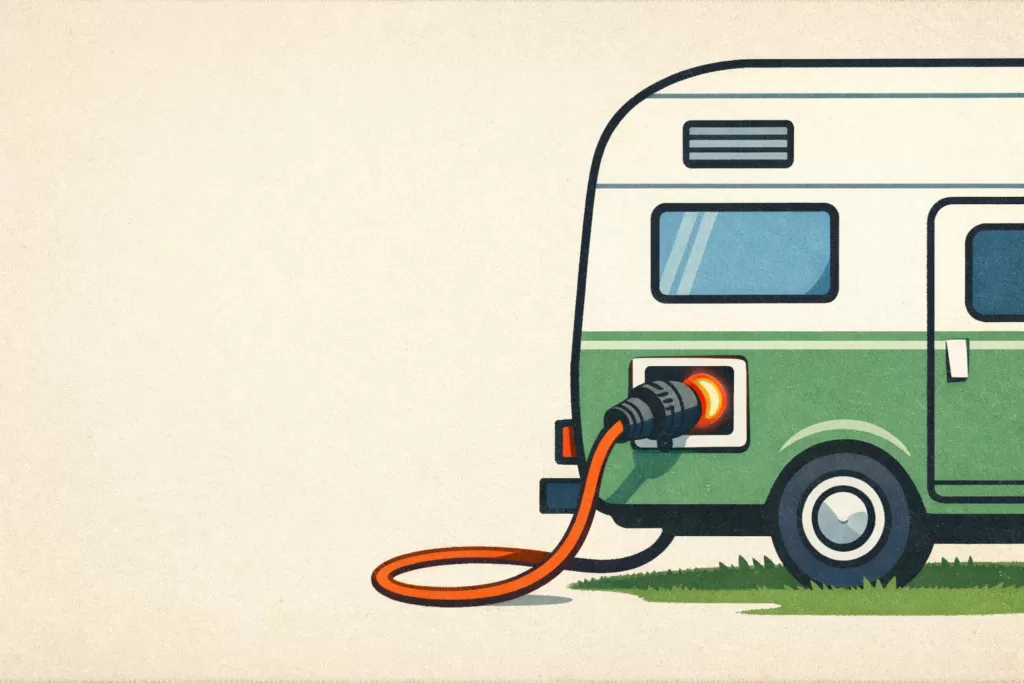
Introduction: External Power Makes Campervan Travel Dramatically More Comfortable
Campervans come standard with alternator charging and a sub-battery, but running the air conditioner or microwave for extended periods drains the battery quickly. That’s where external power (AC100V) available at RV parks and auto-campsites comes in handy.
With external power, you can:
- Run the air conditioner all night even in the height of Hokkaido’s summer
- Use a microwave, hair dryer, and electric kettle just like at home
- Start the next day’s journey with a fully charged sub-battery
These are major benefits. However, incorrect connections can trip breakers or, in the worst case, damage equipment. This article explains the mechanism, connection steps, and troubleshooting of external power in a way that’s easy to understand for first-timers.
What Is External Power? (Understand the Mechanism in 30 Seconds)
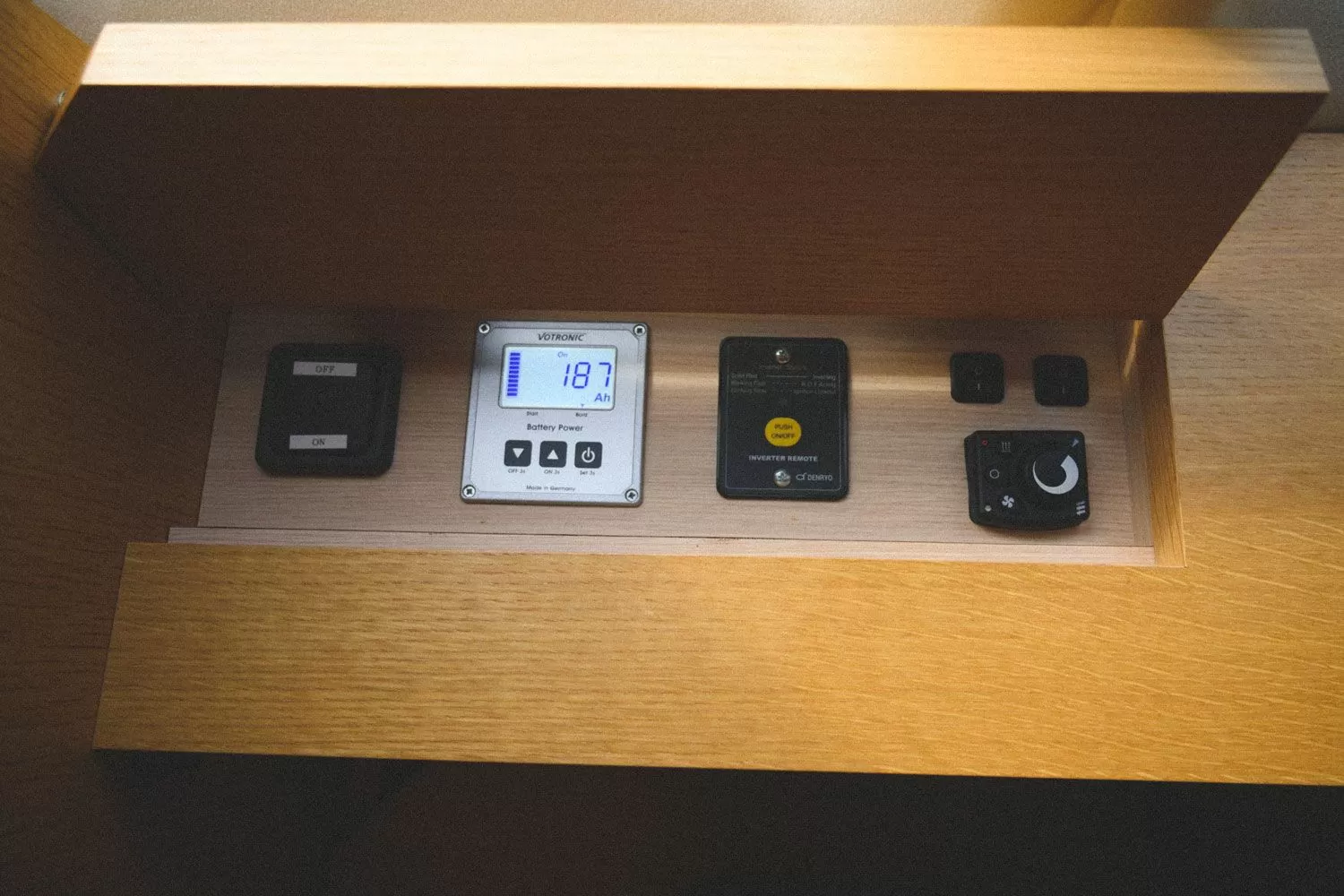
External power is a system that draws household electricity into the campervan through an AC100V outlet installed on the vehicle body from a facility (RV park, auto-campsite, or home). The electricity taken in:
- Is directly supplied to interior outlets (microwave, air conditioner, etc.)
- Simultaneously charges the sub-battery (split by the onboard converter)
It serves these two roles. While connected to external power, you can use appliances “just like home outlets,” and the sub-battery charges itself automatically.
Always Check the Available Capacity (Amperage)
Each facility has a set capacity. The standard is 15A (= 1,500W). Exceeding this trips the facility’s breaker. Remember: running a microwave (1,300W) + hair dryer (1,200W) simultaneously will instantly trip it.
| Facility Type | Common Capacity | Usage Image |
|---|---|---|
| RV Park | 1,500W (15A) | AC + refrigerator + microwave (one at a time) |
| Auto-campsite | 1,000W (10A) | Microwave alone / AC alone |
| Home | 1,500W (15A) | Same as RV park |
For general RV park information, also read our RV Park Guide.
External Power Cord Types and How to Choose
External power cords for campervans come in two types depending on the shape of the vehicle’s outlet.
① Waterproof Inlet Type (Mainstream)
The mainstream shape for HiAce-based van conversions and domestic cab-over campervans. Requires a dedicated waterproof connector cord that varies by vehicle. Rental vehicles generally provide one.
② Grounded 3-Prong Plug Type
Some vehicles can use a standard grounded 3-prong plug. If buying an extension cord, always choose VCT 2.0 sq, grounded, 15A rated. Cheap thin extension cords pose heating and fire risks.
Recommended Cord Length
| Use | Recommended Length |
|---|---|
| Standard RV park | 5–10m |
| Home charging (from outdoor outlet) | 10–15m |
| Campsite (powered site) | 10–15m |
Overly long cords cause voltage drop, so don’t go longer than necessary.
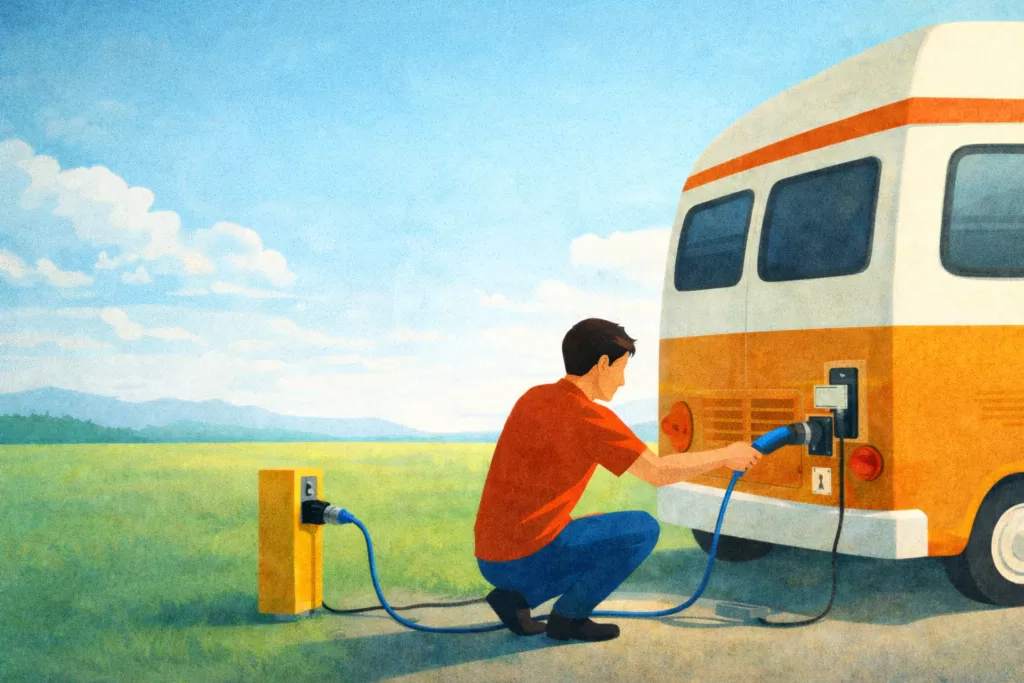
Connection Steps | The Correct Order for Beginners
STEP 1. Turn Off Major Appliances Inside the Vehicle
To prevent tripping breakers, turn off the air conditioner, microwave, and hair dryer beforehand.
STEP 2. Confirm the Facility’s Breaker Is OFF
RV park power boxes often have lever-type breakers. Turn it OFF before inserting the cord.
STEP 3. Connect Vehicle Side First, Then Facility Side
Always connect in this order: vehicle inlet → facility outlet. Reversing the order risks electric shock or short circuit.
STEP 4. Turn the Facility Breaker ON
AC100V now flows into the vehicle. Start the microwave or air conditioner as needed.
STEP 5. Disconnect in Reverse Order
Turn facility breaker OFF → unplug from facility → unplug from vehicle. Forgetting to unplug the cord before driving is a common mistake, so always do a 3-point check before departure.
New Chitose Airport / Tokachi-Obihiro Airport
Rent the Cabcon “Cresson Journey”
Base yourself at New Chitose Airport and compare rates, vehicle types, and pickup locations all in one place.
See details at Moving Inn →Common Troubles and Solutions
① Breaker Keeps Tripping
90% of the time it’s simultaneous wattage overload. The rule is to use the microwave, AC, and hair dryer one at a time. If it still trips, the facility may share a breaker with other sites.
② Cord Is Getting Hot
Using a thin extension cord or keeping the cord bundled causes overheating. Stop use immediately and replace with an appropriately rated cord.
③ Worried About Leakage in Rain
External power cords are waterproof for outdoor use, but never place connectors where puddles can form. Keep connectors slightly elevated off the ground and cover with a plastic bag for safety.
④ Sub-battery Not Charging
Check that the onboard converter switch isn’t turned OFF. Rental vehicles should have “sub-battery charging mode” ON by default, but check to be safe.
Recommended Hokkaido Spots with External Power
- RV Parks (40+ in Hokkaido): ¥2,000–3,500/night with power, water, and toilets
- Auto-campsites: Always book powered sites. Summer sites sell out early
- Michi-no-eki + Campervan Sites: Some locations like Shirogane Birke offer paid power
For detailed spot selection, read our Hokkaido Car-camping Spot Guide and RV Park Guide.
Along with external power, it’s also good to check toilet availability in advance. See our Complete Campervan Toilet Guide.
Power Consumption Reference Table for Major Appliances and Simultaneous-Use Rules
The rule of thumb is “1,500W total or less,” but which appliances you can run together depends on their wattage. Get familiar with the wattage of common appliances so you know which combinations won’t trip the breaker.
| Appliance | Approx. Power Draw | Share of the 15A (1,500W) Limit |
|---|---|---|
| Air conditioner (cooling/heating) | 500–900W | 33–60% |
| Microwave (500W setting) | approx. 1,300W | 87% |
| Hair dryer (low) | approx. 600W | 40% |
| Hair dryer (high) | approx. 1,200W | 80% |
| Electric kettle | 800–1,000W | 53–67% |
| Electric blanket (max) | approx. 50–100W | 3–7% |
| Fridge (built-in) | approx. 30–60W | 2–4% |
| Phone charging (×4 devices) | approx. 80W | 5% |
Examples of safe combinations you can run at the same time:
- Air conditioner (700W) + fridge (50W) + phone charging (80W) = 830W total → OK
- Microwave (1,300W) + fridge (50W) = 1,350W total → Just OK (keep everything else off)
- Microwave (1,300W) + hair dryer on high (1,200W) = 2,500W total → Breaker trips immediately
Using External Power in Winter | Guide to Running an FF Heater and Electric Blanket Together
External power matters even more when using a campervan during Hokkaido’s winter (November–March). An FF heater runs on fuel (diesel or kerosene), so its electrical draw is small, but it’s worth doing the math when combining it with other electrical devices in the cabin.
FF Heater Power Draw
An FF heater uses electricity for combustion. It draws about 10–15A (12V DC) at startup, and roughly 1–3A (12V) continuously while running. Converted to AC100V, that’s only about 12–36W while running — small enough that it has essentially no impact on external power’s 15A limit.
Recommended Winter Combinations (on a 15A Supply)
| Device | Power Draw | Total | Verdict |
|---|---|---|---|
| FF heater running | approx. 30W (AC equivalent) | approx. 280W | ✅ Plenty of headroom |
| Electric blanket (low–medium) × 2 | approx. 50–100W × 2 | ||
| Phone charging × 4 | approx. 80W | ||
| FF heater + 2 electric blankets | 230W | 230W | ✅ Safe |
| FF heater + electric blanket + microwave | 1,530W | 1,530W | ⚠️ Over 15A — turn the microwave off right after use |
Winter precautions:
- The external power cable’s connectors can freeze in snow and ice — check the connection point before plugging in
- Cold makes the cord stiff and more prone to breaking — don’t run it somewhere it will be stepped on
- FF heater fuel (diesel) needs to be topped up separately — electricity doesn’t replace fuel
- Once the cabin warms above +10°C, switching to just the electric blanket and stopping the FF heater saves fuel
Complete Recovery Steps When the Breaker Trips
There’s no need to panic if the breaker trips. Follow these steps calmly and you’ll be back up in 2–3 minutes.
STEP 1. Turn Off All Appliances Inside the Vehicle
Make sure to turn off high-draw devices like the air conditioner, microwave, and hair dryer. If you restore power while they’re still on, it will trip again the instant you reconnect.
STEP 2. Find and Reset the Facility’s Breaker
RV park power boxes are installed per parking space. Confirm the lever-style breaker is in the “OFF” (down) position, then push the lever up to “ON.” If you can’t find the box, ask facility staff.
STEP 3. Turn Appliances On “One at a Time” to Find the Cause
After restoring power, turn devices on one at a time, in order. Whichever device trips the breaker again tells you which combination is the problem.
Checkpoints If It Keeps Tripping
- If the facility has a 10A contract: even a microwave alone (1,300W) exceeds 10A (1,000W) and won’t work. Check the facility’s capacity with staff
- If the breaker is shared with a neighboring site: your neighbor’s power draw is added to yours. The facility may be able to move you to a separate circuit if you ask
- Loose cord connection: unplug and replug the connector to check the contact
- If the vehicle’s own breaker has tripped: check the breaker box inside the vehicle rather than the facility’s — often located under the passenger seat or in an under-floor compartment
FAQ
Q1: Is external power required?
Not required. For 1–2 nights, alternator charging and sub-battery are sufficient. For 3+ nights, summer AC use, or continuous winter FF heater operation, it’s strongly recommended.
Q2: Can I charge at home with a regular outlet?
An outdoor outlet (waterproof, grounded) works fine. Extension cords must be 15A rated, VCT 2.0 sq or larger.
Q3: What’s the difference from a portable power station?
A portable power station is a standalone rechargeable battery; external power is a connection pathway drawing facility electricity. Using both together provides peace of mind on longer trips.
Q4: What happens if I exceed 1,500W?
The facility breaker trips. If it trips, turn all appliances OFF, then restore the facility breaker.
Summary | “Follow the Order · Don’t Exceed Capacity · Don’t Forget to Unplug”
External power is an essential skill that takes campervan travel comfort to the next level. Just remember these three rules:
- Connect in order: vehicle side → facility side
- Keep simultaneous use under 1,500W
- Never forget to unplug before driving
Follow these three and you can use external power safely without trouble.
New Chitose Airport / Tokachi-Obihiro Airport
Rent the Cabcon “Cresson Journey”
Base yourself at New Chitose Airport and compare rates, vehicle types, and pickup locations all in one place.
See details at Moving Inn →Book a Campervan in Hokkaido
Moving Inn New Chitose Airport supports English booking and offers airport transfers.

![When and Where Can You See Harbor Seals at Cape Erimo? Kaze no Yakata Official Information, Viewing Season, and Windy-Day Notes [2026-27]](https://hokkaido-campingcar.jp/wp-content/uploads/2026/10/erimo-cape-lighthouse-768x511.jpg.webp)
![Where and Under What Conditions Can You See Diamond Dust in Hokkaido? How Cold a Morning It Takes, and Where It Appears [2026-27]](https://hokkaido-campingcar.jp/wp-content/uploads/2026/10/hokkaido-diamond-dust-nayoro-768x512.jpg.webp)
![Can You Drive to Hokkaido Jingu for Hatsumode? Parking, Crowds, and Where to Park and Walk [2027]](https://hokkaido-campingcar.jp/wp-content/uploads/2026/10/hokkaido-jingu-winter-torii-768x504.jpg.webp)
![Hokkaido Roads Over New Year [2026-27] | Expressway Sections Prone to Blizzard Closures, Forecast Congestion Days, No Holiday Discount, and New Chitose Airport Parking](https://hokkaido-campingcar.jp/wp-content/uploads/2026/10/hokkaido-winter-rural-road-edge-markers-768x432.jpg.webp)
![Where to See Sea Smoke (Kearashi) in Hokkaido: Rumoi’s Ogon-misaki and the Morning Conditions [2026-27]](https://hokkaido-campingcar.jp/wp-content/uploads/2026/10/rumoi-kearashi-sea-smoke-768x511.jpg.webp)
![Geminid Meteor Shower 2026 in Hokkaido: Peak Around 23:00 on December 14, Sapporo Moonset 20:40, and Staying Warm in a Winter Campervan [2026]](https://hokkaido-campingcar.jp/wp-content/uploads/2026/10/geminids-2026-hokkaido-768x575.jpg.webp)