Types of Camper Vans in Japan: All 7 Types Explained — Van Conversion, Cab-over, Kei Campervan [2026]
There are 7 types of campervans in total.
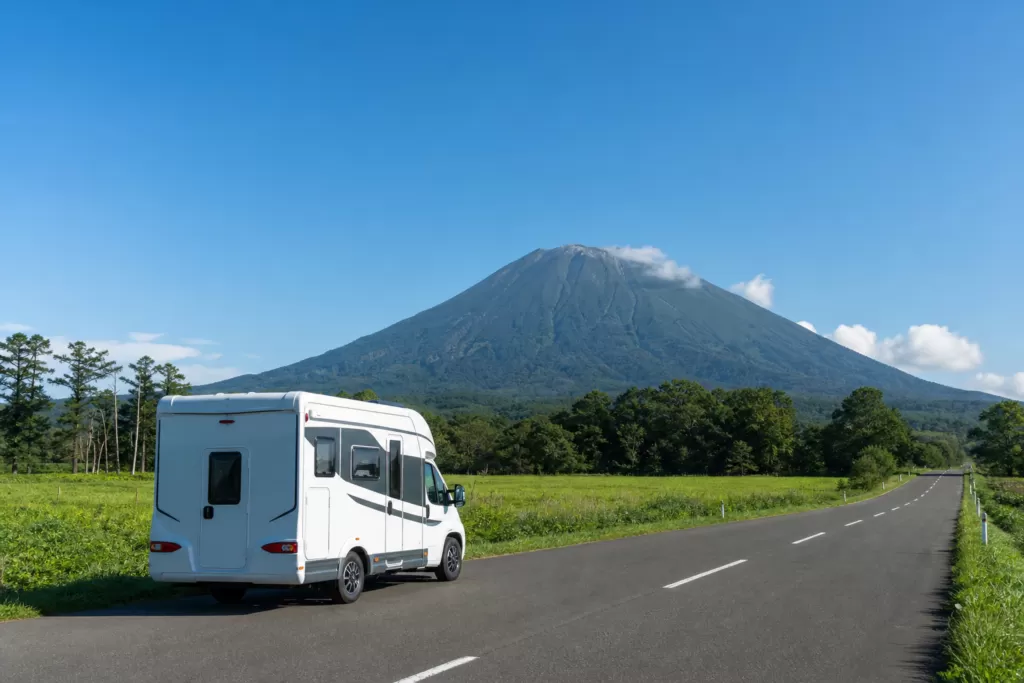
“There are so many types of campervans, I don’t know which to choose” — we hear this often.
Campervans fall into 7 main types, each with different shapes, sizes, prices, and licence requirements. Choosing without knowing the types can mean renting a vehicle that doesn’t match your travel style. This article organises the features of each type and also covers which works best for a Hokkaido trip.
New Chitose Airport / Tokachi-Obihiro Airport
Rent the Cabcon “Cresson Journey”
Base yourself at New Chitose Airport and compare rates, vehicle types, and pickup locations all in one place.
See details at Moving Inn →The 7 Types of Campervans
Campervans divide into the following 7 types based on the base vehicle and construction method. Start by getting a feel for the whole picture.
| Type | Base vehicle | Sleeping capacity | Licence required | New vehicle price |
|---|---|---|---|---|
| Van conversion (bankon) | Van (HiAce etc.) | 2–5 | Standard licence | ¥3M–¥8M |
| Cab-over conversion (cabcon) | Above truck cab | 4–8 | Standard licence | ¥5M–¥15M |
| Kei campervan | Kei (minicar) | 1–2 | Standard licence | ¥1M–¥4M |
| Bus conversion (buscon) | Microbus | 6–10 | Medium / large licence | ¥10M–¥30M |
| Truck camper (torakyan) | Truck bed | 2–6 | Standard licence | ¥2M–¥8M |
| Camping trailer | Towed trailer | 2–8 | Standard (varies by size) | ¥2M–¥10M |
| Full conversion (furukon) | Large bus custom-built | 8–12 | Large licence | ¥30M+ |
Let’s look at the features of each in turn.
① Van Conversion (Bankon)
A converted one-box van such as a HiAce or Caravan. The most widely available type in Japan, and also the most common type stocked by Hokkaido rental companies.
Van conversion features
- Compact at around 5 m long — manageable in multi-storey car parks and tourist spot parking
- Looks similar to a regular van — low visibility as a campervan
- Most models create sleeping space by folding seats flat
- Pop-up roof models increase sleeping capacity
| Advantages | Disadvantages |
|---|---|
| Driveable on a standard licence (under 3.5t GVW) | Limited living space |
| Relatively good fuel economy (8–10 km/L) | Models without fixed beds require set-up every night |
| Easy to manoeuvre in town and on narrow roads | Not suited to large groups (4+) |
| Lower rental price than other types | Tall people may have headroom issues |
Suited to solo travellers, couples, and families of 3–4. Also the easiest type for first-time campervan users. Reading up on driving tips before you go is a good idea.
② Cab-over Conversion (Cabcon)
A campervan with the living space extending over the truck cab, creating a bank bed above the driver. Works well with long Hokkaido trips and can be used as a “moving hotel”. Detailed explanation in What is a Cab-over? Features, Advantages & Disadvantages.
Cab-over conversion features
- Permanent sleeping in the bank bed above the driver’s cab
- Interior height ~180 cm — you can walk around standing up
- Many models include sink, hob, fridge, shore power and FF heater
- Large models sleep 4–8 people
| Advantages | Disadvantages |
|---|---|
| High liveability — suited to long trips | Large body won’t fit multi-storey car parks |
| Fixed bed means no set-up / pack-down | Fuel economy slightly worse (6–9 km/L) |
| Good equipment saves on hotel costs | Rental price is higher |
| Driveable on a standard licence (most models) | More affected by strong crosswinds |
For trips of a week or more, saving on accommodation often makes the total cost lower. See our 1-week cost simulation.
③ Kei Campervan
The most compact type, based on a kei vehicle (Hijet, Every, etc.). Growing in popularity thanks to low running costs and ease of use. Details for Hokkaido in our Kei Campervan Rental — Hokkaido Edition.
Kei campervan features
- Around 3.4 m long — fits in any car park
- Sleeping space for 1–2 people
- Fuel economy 10–13 km/L — keeps fuel costs down even on Hokkaido’s long drives
- Lowest rental price of any type (¥8,000–¥15,000/day)
| Advantages | Disadvantages |
|---|---|
| Lowest cost | Sleeping limited to 1–2 people |
| Easy to drive — reassuring for beginners | Low payload |
| Can handle narrow roads and mountain passes | Motorway speed limited to 100 km/h |
| Easy to park at roadside stations | Watch for crosswinds in Hokkaido |
Perfect for solo travellers and couples who want to keep costs down. Pairs well with Hokkaido overnight parking spots.
④ Bus Conversion (Buscon)
A large campervan based on a microbus — sometimes called a “mobile villa” for its ability to carry large groups in comfort.
Bus conversion features
- Large vehicle around 7–9 m long
- Wide living space sleeping 6–10+ people
- Well-equipped: kitchen, toilet, shower, sofa, etc.
- High ceiling — free movement through the interior
Most bus conversions require a medium or large licence. Always confirm before renting. Suited to large groups and those seeking a luxurious Hokkaido experience.
⑤ Truck Camper (Torakyan)
A type with a camping unit mounted on a truck bed. Usually based on a 4WD truck, with strong capability on snow and rough roads.
Truck camper features
- Usually 4WD-based — handles snow, gravel, and unpaved roads well
- Camping unit can be removed to use the truck separately
- Excellent for outdoor activities
Suited to travellers who want to explore eastern and northern Hokkaido areas with many unpaved roads, or those pursuing serious outdoor activities like fishing and mountain climbing.
⑥ Camping Trailer
A type where the living unit is towed by a separate vehicle. The most popular format in Europe and North America, and growing in Japan too.
Camping trailer features
- The towed unit doesn’t self-propel, so more space can be dedicated to living
- You can unhitch the car at the campsite and drive around for sightseeing
- Trailers under 750 kg can be towed on a standard licence
Suited to travellers who want to use a campsite as a base for exploring Hokkaido. Works well paired with RV parks.
⑦ Full Conversion (Furukon)
The highest-grade campervan — a large bus custom-built throughout. Sometimes called a “moving luxury hotel,” with new prices from ¥30 million to over ¥100 million.
Full conversion features
- Around 10–12 m long
- Luxurious fittings: leather seats, large TV, full kitchen, private toilet, shower
- Requires a large vehicle licence
For those wanting a once-in-a-lifetime special trip. A handful of Hokkaido rental companies handle them.
For a Hokkaido Trip — Which Type is Most Practical?
Hokkaido has conditions that differ from Honshu: long driving distances, large temperature swings, snow roads, and abundant roadside stations. Choosing with these factors in mind reduces the risk of regret.
| Travel style | Best type | Why |
|---|---|---|
| Solo or couple on a budget | Kei campervan | Lowest rental cost. Good fuel economy keeps fuel bills low on long drives |
| Family of 4–5 for a week or more | Cab-over conversion | Fixed bed + sink + fridge — use as a moving hotel. Comfortable for long distances |
| First campervan experience | Van conversion | Easy to drive, fits tourist-spot car parks. Most rental companies stock them |
| Off-road in eastern / northern Hokkaido | Truck camper (4WD) | Strong on snow and gravel roads |
| Group / large party luxury trip | Bus or full conversion | Comfortable for 6+. Can stay at roadside stations and scenic spots |
| Winter Hokkaido travel | Cab-over (with FF heater) | Most models include a standard FF heater — comfortable inside even at −20°C |
| Travel with pets | Van or cab-over conversion | Many pet-friendly bases. Space to travel together inside |
| Family trip with children | Cab-over conversion | Spacious interior and fixed bed — children can relax comfortably |
Three points for choosing a campervan in Hokkaido
① Check for an FF heater
Even in summer, Hokkaido temperatures can fall below 10°C at night in some areas. If you’re renting in spring, autumn, or winter, confirm that the vehicle has an FF heater.
② Calculate fuel costs from your driving distance
Driving 200–300 km per day is not unusual on an eastern/northern Hokkaido itinerary. Use our fuel economy comparison and build fuel costs into your budget.
③ Check for one-way (drop-off) availability
If you want to fly into New Chitose and return from Hakodate Airport, choosing a one-way capable company increases flexibility. The models and companies offering this are limited — check in advance.
If planning a route starting from the Hakodate / southern Hokkaido area, our Hakodate Campervan Rental Comparison is also useful.
New Chitose Airport / Tokachi-Obihiro Airport
Rent the Cabcon “Cresson Journey”
Base yourself at New Chitose Airport and compare rates, vehicle types, and pickup locations all in one place.
See details at Moving Inn →Types Available to Rent in Hokkaido and Price Guide
| Type | Approx. price per day | Availability in Hokkaido |
|---|---|---|
| Kei campervan | ¥8,000–¥15,000 | ◯ Growing number of companies |
| Van conversion | ¥15,000–¥25,000 | ◎ Almost all companies |
| Cab-over conversion | ¥25,000–¥45,000 | ◯ Major companies |
| Bus / full conversion | ¥50,000+ | △ A few companies only |
| Truck camper | ¥20,000–¥35,000 | △ A few companies only |
To compare prices, equipment, and reviews across companies:
If You’re Unsure, Start with Group Size and Trip Length
- 1–2 people, 2–3 nights → Kei campervan or van conversion
- 3–5 people, around a week → Van conversion or cab-over conversion
- 5+ people, longer trips → Cab-over or bus conversion
In Hokkaido, any type will give you a wonderful experience. The quickest way to find your fit is to try renting first.
For details on choosing a rental company and a full cost breakdown:
If this is your first campervan rental, the Beginner’s Guide to Campervan Rental covers everything from choosing a vehicle to the booking process.
Frequently Asked Questions
Q1: Can I drive a campervan on a standard (regular) licence?
Most van conversions, cab-over conversions, kei campervans, and truck campers are driveable on a standard licence. However, models with a GVW over 3.5t require a semi-medium or medium licence. Bus and full conversions require a medium or large licence — confirm before booking. See our Campervan Licence Requirements article for full details.
Q2: Which type is best for a Hokkaido trip?
It depends on your travel style. For a week+ family trip, a cab-over conversion; for a budget solo or couple trip, a kei campervan; for first-timers, a van conversion. For spring/autumn/winter travel, a cab-over with an FF heater is the safest choice.
Q3: Which is more comfortable — a cab-over or a van conversion?
Liveability is higher in a cab-over: fixed bed, standing headroom. On the other hand, a van conversion is easier to drive and less stressful in tourist-spot car parks. For trips of a week or more, a cab-over; for 2–3 night short trips, a van conversion is the easier choice.
Q4: How much does renting cost?
In Hokkaido, approximate daily rates are: kei campervan ¥8,000–¥15,000; van conversion ¥15,000–¥25,000; cab-over conversion ¥25,000–¥45,000. For detailed 1-week cost estimates, see this article.
Book a Campervan in Hokkaido
Moving Inn New Chitose Airport supports English booking and offers airport transfers.

![When and Where Can You See Harbor Seals at Cape Erimo? Kaze no Yakata Official Information, Viewing Season, and Windy-Day Notes [2026-27]](https://hokkaido-campingcar.jp/wp-content/uploads/2026/10/erimo-cape-lighthouse-768x511.jpg.webp)
![Where and Under What Conditions Can You See Diamond Dust in Hokkaido? How Cold a Morning It Takes, and Where It Appears [2026-27]](https://hokkaido-campingcar.jp/wp-content/uploads/2026/10/hokkaido-diamond-dust-nayoro-768x512.jpg.webp)
![Can You Drive to Hokkaido Jingu for Hatsumode? Parking, Crowds, and Where to Park and Walk [2027]](https://hokkaido-campingcar.jp/wp-content/uploads/2026/10/hokkaido-jingu-winter-torii-768x504.jpg.webp)
![Hokkaido Roads Over New Year [2026-27] | Expressway Sections Prone to Blizzard Closures, Forecast Congestion Days, No Holiday Discount, and New Chitose Airport Parking](https://hokkaido-campingcar.jp/wp-content/uploads/2026/10/hokkaido-winter-rural-road-edge-markers-768x432.jpg.webp)
![Where to See Sea Smoke (Kearashi) in Hokkaido: Rumoi’s Ogon-misaki and the Morning Conditions [2026-27]](https://hokkaido-campingcar.jp/wp-content/uploads/2026/10/rumoi-kearashi-sea-smoke-768x511.jpg.webp)
![Geminid Meteor Shower 2026 in Hokkaido: Peak Around 23:00 on December 14, Sapporo Moonset 20:40, and Staying Warm in a Winter Campervan [2026]](https://hokkaido-campingcar.jp/wp-content/uploads/2026/10/geminids-2026-hokkaido-768x575.jpg.webp)