Can You Actually Sleep Warm in a Hokkaido Campervan in Winter?
Can You Actually Sleep Warm in a Hokkaido Campervan in Winter?
If you are planning a January or February trip to Hokkaido and looking at a campervan instead of a hotel room, this is usually the first question that actually matters — not which van, not which route, but whether you will be warm enough to sleep. It comes up constantly in the enquiries we see, and it comes up on Reddit too, from people already mid-trip. We looked at what we could actually confirm, and we are being upfront about what we could not.
Why this question keeps coming up
Among the enquiries we track, questions about winter sleeping conditions and equipment are among the largest single group we see in English — people asking directly whether a van will be too cold, and separately, whether it has heating that works with the engine switched off. One enquiry, from a couple planning a stop somewhere outside Sapporo, Otaru or Hakodate, asked plainly where they could park and sleep, and whether it would be too cold. Another, from a pair travelling in November, asked for heating that runs overnight without the engine running, insulation, bedding, studded tyres and four-wheel drive in the same message. These are not separate concerns — they are one concern, asked from different angles.
English-language forums show the same pattern from a different direction. On Reddit’s skiing community, people describe renting a “sleeper van” to chase storms and follow the snow across Hokkaido’s ski regions, treating the van as both transport and lodging for a backcountry trip. The vocabulary is different from a typical rental enquiry, but the underlying question is identical: will I be warm enough to actually sleep in this thing.
What an FF diesel heater actually does
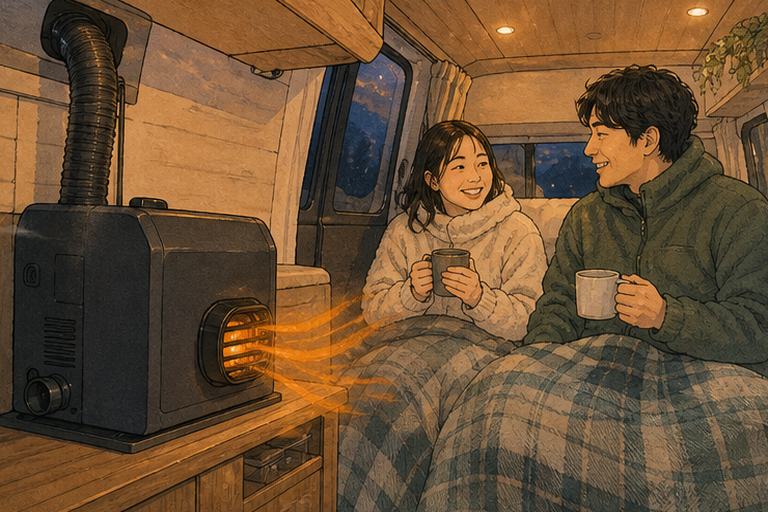
The specification that separates a van you can sleep in overnight from one you cannot is an FF (forced-flue) diesel heater. It draws fuel from the vehicle’s own tank and runs independently of the engine, which means it can keep heating the cabin all night without you idling the engine — something you generally should not do anyway, for carbon monoxide safety and for noise at a shared parking area.
The problem is that “winter equipped” is a vague claim, and it does not tell you whether a specific van has an FF heater fitted. Fleets are not uniform — some models in an operator’s line-up may have one and others may not, and at least one Hokkaido operator we looked at suspends particular models from its fleet entirely over winter rather than sending them out with inadequate heating.
So the practical move, and the one we’d make ourselves before booking, is to stop asking “is it winter equipped” and start asking a narrower question by name: does this specific vehicle have an FF diesel heater fitted, and does it run with the engine off? A confident, specific answer to that question tells you more than any marketing line about winter readiness. For Moving Inn, we asked: every HIACE and every Cresson Journey in the fleet has an FF heater, and every vehicle has studless tires and 4WD (interview with Moving Inn, October 6, 2026). For any other model or operator, ask the question above by name before you book.
Insulation, bedding and tyres: the rest of the checklist
Heating is the headline item, but it is not the only thing that decides whether you sleep well. The same enquiry that asked about heating also asked, in the same breath, about insulation, bedding, studded tyres and four-wheel drive — and that grouping is worth keeping intact when you contact an operator, because the questions are connected in practice.
- Insulation — how much heat the cabin loses once the heater is off, and how quickly it cools if you step outside. Ask what the walls and windows are built from; a single-glazed panel van and a purpose-built camper behave very differently overnight.
- Bedding — whether a proper winter-rated sleeping bag or duvet is provided, or whether you need to bring your own. If you already own cold-weather gear, bring a bag rated well below what you think you’ll need — a margin of error costs you almost nothing in the boot and saves a bad night.
- Studded or winter tyres — standard on a genuine winter rental fleet in Hokkaido, but worth confirming rather than assuming, particularly if you are comparing operators. Some rental cars picked up outside Hokkaido are not fitted with winter tyres at all.
- Four-wheel drive — not strictly a heating question, but it belongs on the same checklist because it affects where you can safely reach in the evening, which in turn affects where you end up parking for the night.
None of this replaces the FF heater question — it sits alongside it. A well-insulated van with good bedding and no heater is still a cold night; a heater in a van with no insulation still leaks warmth fast the moment it cycles off.
How cold does it actually get
We are not going to give you a single number for how cold a Hokkaido winter night is, because it depends on where you are, and we have not verified a general figure from a primary source. What we can point to is a specific, sourced example: one RV park’s own published guidance, cited in traveller discussion, warns that overnight temperatures at its site can fall below minus twenty degrees Celsius. That is a warning from the facility itself about its own location, not a claim about Hokkaido as a whole, and inland areas away from the coast tend to run colder than towns near the sea.
What that number tells you practically is this: treat any night in inland Hokkaido in January or February as far below freezing, plan your heating and bedding for a genuinely cold night rather than a mild one, and do not assume a location is fine just because a nearby town’s forecast looks moderate. A campsite in a valley or near open farmland can run noticeably colder overnight than the airport town you flew into.
Where you’re actually allowed to park and sleep
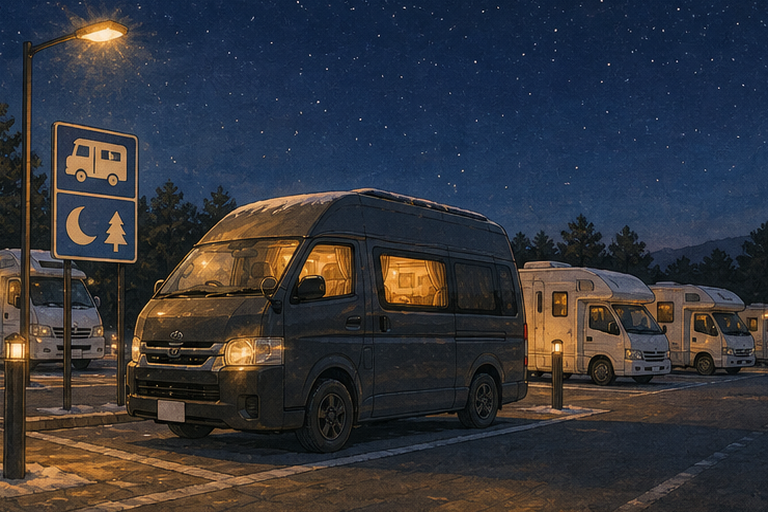
Staying warm only matters if you are somewhere you are actually permitted to stop overnight, and this is the part first-time visitors most often get wrong. Michi-no-eki (roadside stations) are rest facilities for drivers, not campsites — most do not give permission to stay the night, whatever informal practice you may read about online. RV parks and campgrounds are the places set up for it, and in winter a meaningful number of them close entirely or reduce services, so a summer list of overnight spots is not a reliable guide to what is open in January.
We are not going to tell you that a ski resort car park is a safe bet for overnight parking. Resorts set their own rules, and most do not permit sleeping in the lot regardless of what you may have heard from other travellers — check with the specific resort rather than assuming, and treat “sleeper van at a ski area” as something to confirm locally, every time, not a general right. For a fuller look at which specific facilities we could confirm as open through this winter, with sources, see our winter campervan planning page.
What to ask before you book
If you take one thing from this page into your booking enquiry, make it this list, asked as direct questions rather than accepted as a general assurance:
- Does this specific vehicle have an FF diesel heater, and does it run with the engine off?
- What insulation does the cabin have, and is winter-rated bedding included or do I need to bring my own?
- Are studded or winter tyres fitted as standard, and is four-wheel drive available?
- Where, specifically, am I permitted to park overnight on this route, and which of those places are actually open in the month I’m travelling?
We work most closely with Moving Inn, which runs bases at New Chitose Airport and at Tokachi-Obihiro Airport, and it is the operator whose winter set-up we have looked into in most detail — though not every one of these questions has a confirmed answer yet for every vehicle in its fleet, which is exactly why we are telling you to ask by name rather than assume. Other operators may suit your dates or route better; our full comparison lives on the main site.
Frequently asked questions
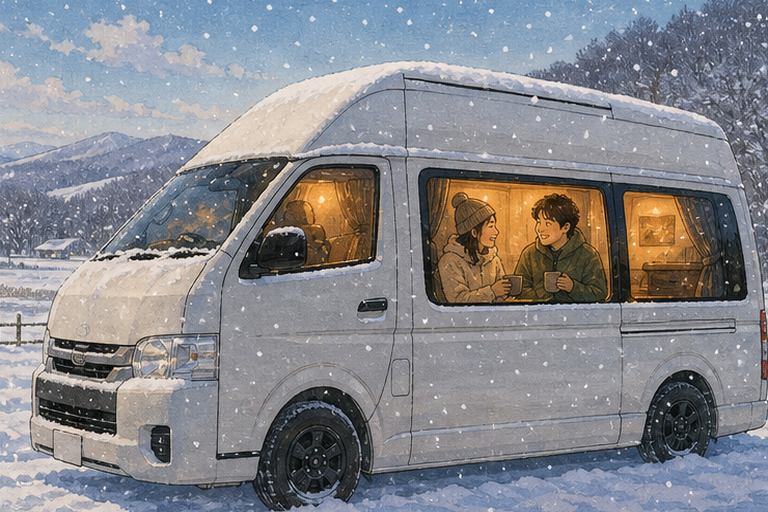
Will I actually be warm enough to sleep?
With a working FF diesel heater running overnight, yes, that is what it is designed for. Without one, a Hokkaido winter night — especially inland, away from the coast — is a genuinely difficult night’s sleep. Confirm the heater before anything else.
Does every van in a rental fleet have an FF heater?
No, and this is the mistake to avoid. “Winter equipped” is a general claim that can cover very different setups. Ask the operator by name: does this vehicle have an FF diesel heater fitted, and does it run with the engine off overnight.
How cold does it get overnight?
We have not confirmed a single figure for Hokkaido overall. One RV park’s own published guidance warns that its site can fall below minus twenty degrees Celsius overnight — a warning about its specific location, not a general average. Plan for far below freezing rather than a mild figure, particularly inland.
Can I park anywhere and sleep, if the heater is good enough?
No — heating and legality are separate questions. Roadside stations (michi-no-eki) are rest facilities, not campsites, and most do not permit overnight stays. Ski resort car parks set their own rules and most do not allow sleeping in them. Use RV parks and campgrounds confirmed open for the season you’re travelling in.
Is bedding provided, or should I bring my own?
This varies by operator and vehicle, so ask directly rather than assuming. If you already own cold-weather gear, bringing a sleeping bag rated well below what you think you’ll need is a reasonable precaution regardless of what’s supplied.
Do I need four-wheel drive and studded tyres?
Studded or winter tyres should be standard on any genuine Hokkaido winter rental — confirm this rather than assuming, especially if comparing operators. Four-wheel drive isn’t strictly required everywhere, but it affects which routes and parking spots you can reach safely in the evening, so it’s worth asking about alongside your route plan.
Book a Campervan in Hokkaido
Moving Inn New Chitose Airport supports English booking and offers airport transfers.

![Monbetsu Drift Ice Festival 2027 [Feb 11–14]: Dates, Ice Sculptures, Garinko-go Icebreaker, Parking and Access by Campervan](https://hokkaido-campingcar.jp/wp-content/uploads/2026/10/monbetsu-hl999-768x576.jpg)
![Hokkaido New Year Weather and What to Wear | Sapporo, Hakodate, Asahikawa, Obihiro Mornings and Evenings, and Heavy-Snow Years [2026-27]](https://hokkaido-campingcar.jp/wp-content/uploads/2026/10/hokkaido-new-year-holiday-weather-eyecatch-768x432.webp)
![Hokkaido Illumination 2026-27 [Dates]: Sapporo Starts Nov 20, Plus Otaru, Asahikawa, Obihiro & Hakodate for Campervan Trips](https://hokkaido-campingcar.jp/wp-content/uploads/2026/10/hokkaido-illumination-2026-eyecatch-768x432.webp)
![What to Do in Tokachi in Winter: Dog Sledding, Snowshoeing, the Shikaribetsu Ice Village, and Staying at Kitanomori [2027]](https://hokkaido-campingcar.jp/wp-content/uploads/2026/10/tokachi-winter-dogsled-1-768x432.jpg)