Bad Weather Preparedness for Hokkaido Campervan Travel | How to Safely Handle Rain, Strong Winds, Dense Fog, and Heavy Snow [2026 Edition]
Hokkaido's weather is notoriously unpredictable.
Pick a campervan by what matters to you.
Rent at New Chitose Airport
See only the rental bases in Chitose, where the airport is.
Rent in winter (Dec–Mar)
Companies that rent through winter, listed apart from those that close.
Guide price
Moving Inn New Chitose Airport: HIACE van conversion from ¥22,000 per night. 20–30% off when booked 60–90 days ahead (official rate table, checked 15 Oct 2026).
Before you book: with an International Driving Permit if your country is in the Geneva Convention (for example the US, Australia, Singapore); Taiwan, Switzerland, Germany, France, Belgium and Monaco need your licence plus a Japanese translation (Tokyo Metropolitan Police). Questions in English: Moving Inn on WhatsApp. Every roadside station (michi-no-eki) must have free 24-hour toilets, and Hokkaido has 128 of them (MLIT).
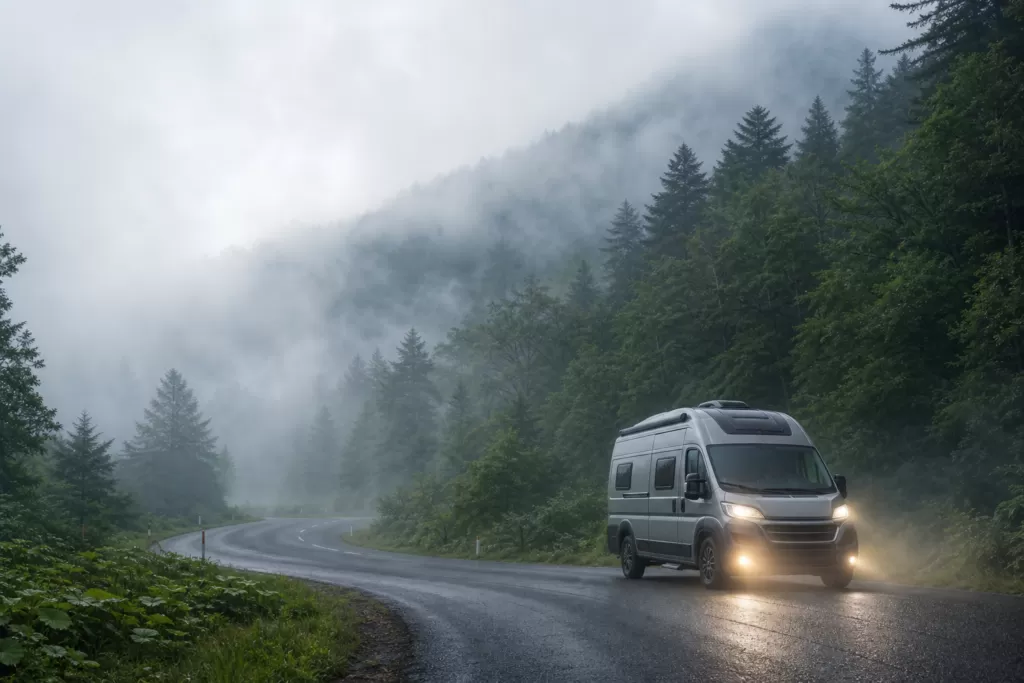
Hokkaido is known for its rapidly changing weather. Even on a clear morning, rain can start falling by afternoon, and in summer, sudden dense fog can reduce visibility to near zero. This is part of what makes campervan travel in Hokkaido so exciting — but without proper preparation, it can also become a significant risk. This article explains Hokkaido’s unique weather patterns and provides concrete guidance on how to drive, where to park, and how to stay comfortable during rain, strong winds, dense fog, and snowfall.
Campervans are larger and have a higher center of gravity than ordinary passenger cars, making them more susceptible to adverse weather. That said, with the right knowledge and judgment, you can travel safely even on bad-weather days. In fact, deciding “today is a rest day, not a driving day” can open up a relaxed itinerary filled with roadside stations and hot spring visits.
For cost simulations, model routes, and Michi-no-Eki overnight parking rules — the fuller picture of Hokkaido campervan travel — see our Complete Guide to Hokkaido Campervan Travel.
Hokkaido’s Unique Weather Risks and Seasonal Trends
Hokkaido’s climate differs significantly from Honshu, and weather forecasts alone may not capture everything. Below is a summary of each season’s characteristics and the weather risks that campervan travelers should pay special attention to.
Spring (April–May): Residual Snow and Low-Pressure Fronts
Even in April, residual snow remains in inland and mountainous areas, and passes can be closed. In the Tokachi and Kitami regions, freezing can persist even on relatively low passes. If you assume spring temperatures based on Honshu experience, you’ll be surprised by the cold nights — bring bedding suitable for midwinter.
Spring also sees frequent low-pressure systems passing through, causing sustained strong winds. The Pacific side tends to get strong southerly winds, while the Sea of Japan side experiences higher waves. If you’re planning to use the ferry, get into the habit of checking the weather forecast the day before departure.
Summer (June–August): Okhotsk High and Dense Fog
Hokkaido summers are cooler and more comfortable than Honshu, but in the Tokachi region (Kushiro, Nemuro, Shiretoko, etc.), dense fog caused by the Okhotsk High is frequent from June to July. Kushiro is famously known as a “foggy city,” and visibility of just a few dozen meters is not uncommon. August brings more sunshine along the Pacific coast, but evening fog and localized heavy rain still require caution.
Autumn (September–October): Typhoons and First Snow
September is when typhoons can approach or make landfall in Hokkaido. Power outages and road closures can persist after a typhoon passes; in 2018, the Hokkaido Eastern Iburi Earthquake struck right after Typhoon Jebi, and the quake caused a blackout across all of Hokkaido. From October onward, snow begins to fall in mountainous areas, and early morning freezing on mountain passes begins. Driving on summer tires in mountain areas after late October is dangerous.
Winter (November–March): Snow, Blizzards, and Frozen Roads
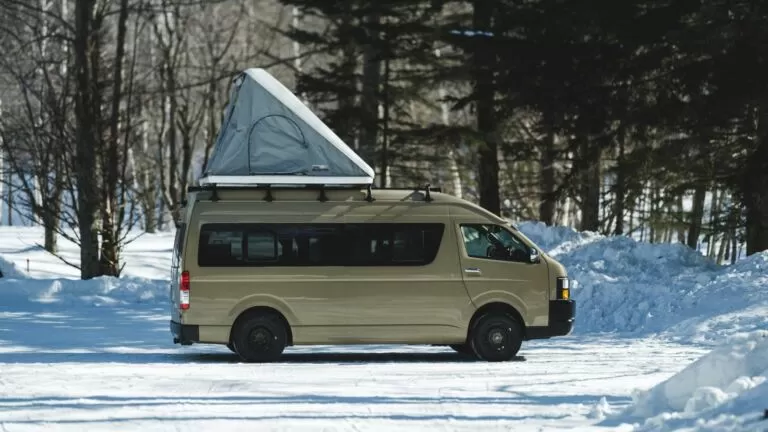
Winter campervan travel is for experienced travelers. Risks include whiteout conditions from blizzards, black ice on roads, and getting stuck in snowdrifts. If you plan to travel in winter, studded winter tires, a shovel, a tow rope, and reliable emergency communication are all prerequisites. Some rental companies restrict their rental areas depending on winter road conditions, so check in advance. For a full rundown of winter concerns — snow driving, insulation, heating, and where to park overnight — see our guide to worry-free winter travel in Hokkaido.
Driving and Camping in Rain: Moisture and Condensation Control
On rainy days in a campervan, it’s not just reduced visibility while driving that’s a problem. Moisture and condensation inside the vehicle directly impact the quality of your overnight stay.
Tips for Driving in Rain
Campervans have a high roof and a large windshield, which means the effective range of the wipers may feel narrower than in a regular car. In rainy conditions, reduce speed by 10–20 km/h and increase following distance. Cab-over campervans in particular are heavy, which extends braking distance in an emergency stop.
Hokkaido’s main roads (national and prefectural highways) are well-maintained with wide shoulders, but farm roads and forest roads deteriorate rapidly in rain. Avoid unpaved roads during or after rain. If a campsite access road is gravel or dirt, there is a risk of getting stuck in mud after rain.
Choosing a Camping Spot on Rainy Days
On rainy days, prioritize roadside stations (Michi-no-Eki), rest areas, and RV parks. A flat, paved parking space has no flooding risk and lets you relax even with rain pattering on the roof. Sloped, gravelly, or grassy free campsites can become muddy in rain, making departure difficult the next morning.
RV parks are especially convenient when it rains. With an external power supply, you can run the air conditioner overnight for a comfortable stay. RV parks are located throughout Hokkaido — search “RV Park Hokkaido” to find a full list.
Practical Condensation and Moisture Control
Condensation forms more readily the greater the difference between outside air temperature and the temperature inside the vehicle. Especially in spring and autumn mornings, all windows may be completely fogged up. Left untreated, mold and stains can develop — deal with it promptly.
The most effective way to prevent condensation is ventilation. Opening a window slightly to bring in outside air reduces the temperature difference and suppresses condensation. On rainy days, you can’t open windows wide, so use a vent (ventilator) or insert a dedicated “ventilation shade” in the window to allow a small amount of airflow.
The air conditioner’s dry (dehumidifying) mode is also effective. With an external power supply or while the engine is running, just 30 minutes of operation can significantly reduce interior humidity. Portable dehumidifiers consume 100–200W of power — running them for long periods on the sub-battery alone may leave you short on power the next morning. Use them only with external power or while driving.
| Method | Effectiveness | Conditions / Notes |
|---|---|---|
| Ventilation (ventilator) | High | Usable even in rain. Watch for insects and rain blowing in |
| Air conditioner (dry mode) | High | External power supply or engine running |
| Portable dehumidifier | High | High power consumption. External power supply only |
| Silica gel / moisture absorbers | Supplemental | Insufficient for the whole vehicle; best for localized spots like closets |
| Wipe down with microfiber towel | Immediate | 5 minutes every morning is enough to keep things clean |
Try to be mindful of the moisture added by your own breath before sleeping. During sleep, a person exhales approximately 300–400 ml of water vapor. With two passengers and no ventilation, 600–800 ml of water vapor will fill the vehicle by morning. Just 5–10 minutes of ventilation before bed makes a significant difference in morning condensation.
Compare Hokkaido Campervan Rentals
Base yourself at New Chitose Airport and compare rates, vehicle types, and pickup locations all in one place.
Compare Rental Companies & Prices →Handling Strong Winds and Crosswinds: Choosing Where to Park
Hokkaido has many open plains and coastlines with little shelter, making it prone to strong winds. Especially in the Tokachi, Kitami, and Sea of Japan coast areas, wind speeds exceeding 10 m/s are not uncommon from spring through autumn. Campervans — particularly cab-over types — have a high profile and large cross-sectional area, making them strongly affected by crosswinds.
Driving Precautions in Strong Winds
When crosswinds exceed 10 m/s, a cab-over campervan will start to sway left and right. At over 15 m/s, handling becomes unstable, and on exposed sections like bridges or coastlines, gusts can push you out of your lane.
Keep the following in mind when driving in strong winds:
- Reduce speed: The effect of wind increases with the square of speed. Dropping from 60 km/h to 50 km/h significantly improves stability
- Keep a firm grip on the steering wheel: Always hold the wheel with both hands to react to gusts
- Watch for bridges and tunnel exits: These locations tend to concentrate gusts
- Be careful when passing large trucks: Turbulence occurs when passing or being passed
- Check wind restriction information: Use the Hokkaido Road Information system to check for road closures and restrictions in advance
When wind speeds of 20 m/s or more are forecast, consider staying put rather than traveling. The ability to decide “we’re not driving today” is one of the great strengths of campervan travel.
Choosing a Parking Spot in Strong Winds
Even when parked, a cab-over campervan is affected by the wind. On particularly windy nights, the vehicle can rock and make sleep impossible. Keep the following in mind when choosing a parking spot:
- Park in the lee of a windbreak or building: Trees or buildings can significantly reduce rocking
- Avoid coastlines, riverbanks, and open lots: Areas without shelter expose the vehicle directly to the wind
- Park with the nose or rear facing into the wind: Broadside to the wind causes maximum rocking. Pointing the nose or rear into the wind cuts it by more than half
- Avoid slopes and embankments: Risk of tipping increases in strong winds
Roadside station parking lots often have buildings around them, making it easier to find a sheltered spot. Some Michi-no-Eki even have dedicated RV/large vehicle spaces that are in the shadow of the main building. Taking a moment to check wind direction on arrival and parking in the least exposed orientation goes a long way toward a good night’s sleep.
Driving in Dense Fog and Deciding When to Stop
If you’re traveling in eastern Hokkaido, plan for fog not as a possibility but as a given. In the Kushiro and Nemuro areas, the normal number of foggy days in June–July is about 16–20 per month (Japan Meteorological Agency, 1991–2020 normals), and spending the entire morning in fog is not unusual.
Rules for Driving in Dense Fog
Where fog or similar conditions cut visibility to 50 meters or less on ordinary roads, or 200 meters or less on expressways and motorways, the Road Traffic Act requires you to turn on your headlights and tail lights even in daytime. If your vehicle has fog lights, turn those on too. However, high beams cause light to scatter in fog and actually reduce visibility — drive on low beam.
- Reduce speed significantly: With 50 m visibility, aim for 30 km/h or less
- Increase following distance to 2–3 times normal
- Do not use hazard lights while moving: Following vehicles may think you are stopped
- Follow the white lines and center line: Safer than using guardrails or curbs as your guide
- If fog thickens, don’t push on — pull over and wait in a safe location
Planning Your Trip Around Fog
Fog in eastern Hokkaido often clears up in the afternoon. Spending the morning at a roadside station or hot spring and starting to drive after noon is a well-established local practice. Letting go of the Honshu habit of “leaving early to cover more ground” and embracing the patience to wait for the fog to lift will raise the quality of your Hokkaido trip.
On days when dense fog is expected, consider switching to indoor activities: museums, hot springs, or local restaurants. Kushiro’s Washo Market, Akan Kohan Onsen, and Nemuro’s escalope (a local Western-style dish) are just a few of the spots you can enjoy regardless of visibility. When the distant scenery is hidden by fog, pivoting to nearby food and hot springs is a mindset shift that enriches the journey.
How to Check Fog Information
Getting into the habit of checking the following sources before departure will help minimize risk:
- Japan Meteorological Agency fog and visibility information — detailed hourly forecasts for each area
- Hokkaido Road Information — real-time road closures due to fog and blizzards
- NEXCO East (East Nippon Expressway) road information (Japanese) — speed restrictions and closures on expressways due to fog
- Ask roadside station staff: Local knowledge is the most reliable. Feel free to ask, “When does the fog usually clear up today?”
New Chitose Airport / Tokachi-Obihiro Airport
Rent a Cab-Over Campervan “Creason Journey”
Base yourself at New Chitose Airport and travel all across Hokkaido by campervan.
View Details on Moving Inn →Preparing for Sudden Snowfall and Ice on the Roads
In Hokkaido, the first snow can fall on high-altitude passes in the Daisetsuzan range as early as late September to early October. By mid-October, passes at 400–500 m elevation can also see snow and ice. While “snow in October” might be surprising on Honshu, in Hokkaido it is perfectly normal.
When to Switch to Winter Tires
Most rental campervan companies switch to studded winter tires around late October to early November. If your trip is in mid-October or later, we strongly recommend asking at the time of booking: “Are the tires winter tires?” Driving on icy roads with non-winter tires is extremely dangerous, and in some cases, self-caused accidents may not be covered by insurance.
Basic Rules for Driving in Snow and Ice
Even with winter tires, driving a campervan on snowy roads requires considerable care. The heavy body means braking distances are longer than for a passenger car.
- Avoid sudden acceleration, braking, or steering: Perform all actions slowly and smoothly
- Increase following distance to 3–4 times normal: Braking distance on ice can be 5–10 times that on dry pavement
- Take hills slowly: Use engine braking actively on downhill sections
- Watch for black ice: Bridges, shaded spots, and tunnel exits near 0°C are prone to freezing; the surface can look indistinguishable from dry pavement
- Avoid early-morning drives before snow-clearing is complete: Snow plows may still be operating between 4–6 AM. Take care when passing on narrowed roads
Snow Management During Overnight Stays
If snow accumulates overnight while you are parked, there are essential tasks before you depart in the morning:
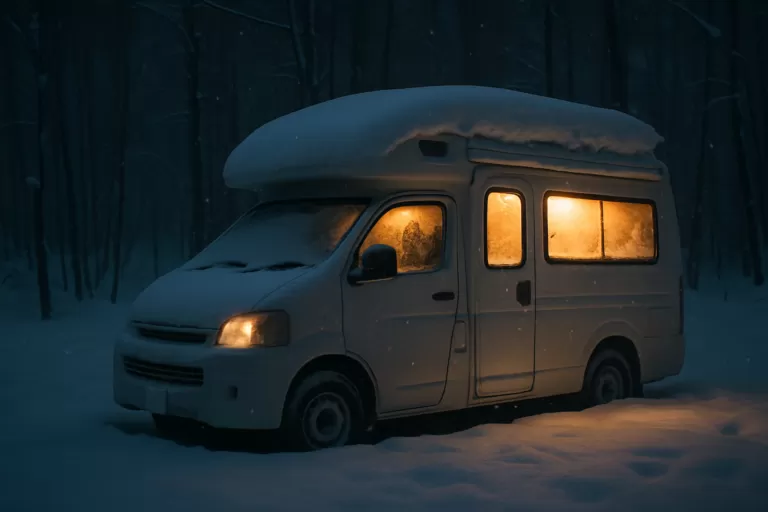
- Clear snow from the roof: Campervans have a wide roof that accumulates snow easily. Snow falling from the roof while driving is dangerous for following vehicles. Always keep a scraper/snow brush inside the vehicle
- Clear snow from lights and the license plate: Essential for both visibility and legal compliance
- Check around the exhaust pipe: Before starting the engine, make sure the exhaust pipe area is not blocked by snow. Starting the engine with a blocked exhaust creates a risk of carbon monoxide poisoning
- If the parking brake is frozen: If temperatures drop overnight with the handbrake applied, the brake pads may freeze and the vehicle won’t move. On nights when snowfall and sub-zero temperatures are expected, consider releasing the handbrake and using wheel chocks instead
Emergency Equipment to Avoid Getting Stranded in Heavy Snow
In Hokkaido, blizzards close national highways and cause long standstills every year. Especially in inland areas of the north and east, a blizzard can intensify quickly, reducing visibility to zero in 30 minutes. The following equipment is not “nice to have” — for autumn and winter travel, treat it as mandatory:
| Equipment | Purpose |
|---|---|
| Folding shovel | Clearing snow from around tires / self-rescue |
| Tow rope | Assistance when stuck |
| Scraper (snow brush) | Clearing snow from roof and windows |
| Warm clothing / blankets | Maintaining body temperature during a standstill |
| Emergency food & water (2-day supply) | Prepared for extended waits |
| Mobile battery pack | Keeping smartphone communications alive |
| Flare / LED warning light | Making your presence known during a standstill |
If a standstill drags on, running the engine for heat will deplete fuel. Check the fuel gauge regularly and make it a habit to fill up before long-distance drives. When stopped in a blizzard, switch the engine off whenever you can; if you must keep it running, clear the snow around the exhaust pipe frequently. Opening a window alone does not always keep carbon monoxide out.
What to Do When a Blizzard Blocks Your View or Leaves You Stuck
Traffic accidents in low-visibility conditions such as blizzards occur on straight roads outside urban areas in 52.1% of cases. This is because blowing snow from the snowbanks along the road sweeps across the road and creates a whiteout (Hokkaido Prefectural Police, "The Reality of Traffic Accidents in Low-Visibility Conditions Such as Blizzards," Reiwa 4 (2022), checked 2026-10-15).
When visibility drops, slow down to a speed at which you can stop within the distance you can see, and turn on your lights. If driving becomes difficult, stop in a safe place and turn on your hazard lights. The Hokkaido Prefectural Government advises that if you feel in danger in blowing snow, you should not push on, and should wait for the weather to improve at a Michi-no-Eki, convenience store, or gas station (Hokkaido Prefectural Government, checked 2026-10-15).
Here are the steps if you cannot move.
- Do not leave the vehicle, unless you are certain of a place to take shelter or someone who can help rescue you. In a blizzard you can lose track of where you are, and you can be hit by a following vehicle (Hokkaido Prefectural Police).
- Turn on the hazard lights, and signal that you are stopped with a stop sign or a brightly colored cloth (Hokkaido Prefectural Police).
- Ask a road service such as JAF, or a nearby house, for rescue. If you have no one to ask, call 110 (police) or 119 (fire and ambulance) and wait for rescue inside the vehicle. Give your location as accurately as you can (Hokkaido Prefectural Government and Hokkaido Prefectural Police).
- If you are buried in snow, turn off the engine. If you have no choice but to run it, clear the snow around the muffler frequently (Hokkaido Prefectural Government).
- If you have no choice but to leave the vehicle and evacuate, leave a note with your contact details inside, and leave the key in the vehicle (Hokkaido Prefectural Government).
Having a window open does not necessarily make you safe. Depending on conditions, the danger can be higher than with the windows closed (Hokkaido Prefectural Police and Hokkaido Prefectural Government, checked 2026-10-15). We explain the danger of a snow-blocked muffler in detail in What to Check to Sleep Warm When Overnight Parking in Winter.
For checking before you leave, the Hokkaido Regional Development Bureau’s “Winter Road Driving Mindset” recommends looking at weather and traffic conditions and making a plan that does not strain you (checked 2026-10-15). For road information, Kita no Michi Navi, run by the Civil Engineering Research Institute for Cold Region, has a “Mountain Pass (Blizzard) Information” section. You can check which roads close in winter in our winter road closures article. On a day when a blizzard is forecast, you can also decide not to drive and wait where you are staying.
Frequently Asked Questions (FAQ)
Q: Can I cook inside the campervan on a rainy day?
If the campervan has cooking equipment (such as an IH cooktop), you can cook inside even when it’s raining. If you use a gas stove indoors, there is a risk of carbon monoxide poisoning — always open the ventilator to ensure airflow. Cassette gas stoves and burners are in principle for outdoor use. On rainy days, you can also cook under the porch (the awning over the sliding door), or take advantage of the food courts and restaurants at roadside stations.
Q: What should I do if a typhoon is approaching?
If a typhoon may approach or make landfall in Hokkaido, your top priority should be to stop traveling and wait in a safe parking location. Ideally, choose a roadside station, rest area, or RV park with covered or enclosed parking. Absolutely avoid coastlines, riverbanks, and exposed hilltops. Even after the typhoon passes, road closures, landslides, and flooding may persist. Before departing, always check the Hokkaido Road Information system to confirm roads are passable. Keep the rental company’s emergency contact number handy.
Q: Which weather app or service is best for Hokkaido travel?
The Japan Meteorological Agency’s official website (jma.go.jp) provides free hourly forecasts and warnings/advisories. For apps, “Weathernews” and “tenki.jp” tend to reflect Hokkaido’s localized weather fairly accurately. For the Tokachi region in particular, Weathernews with its fog forecasts is easy to use. The ideal approach is to combine a pinpoint forecast with a wider regional forecast, and check twice — the night before and on the morning of your departure.
Q: Is there a real risk of a campervan tipping over in strong winds?
The risk is not zero while driving or parked, but with appropriate precautions it is controllable in practical terms. While driving, reduce speed to below 40 km/h in sections where wind speeds of 15 m/s or more are forecast, and drive especially cautiously on bridges and along coastlines. When parked, choose the lee side of a windbreak or building and point the nose or rear into the wind to significantly reduce rocking. If a gale warning has been issued for wind speeds of 25 m/s or more, the safe decision is to stop traveling.
Q: Where should I go on a bad-weather day instead of forcing myself to sightsee?
In Hokkaido campervan travel, “don’t drive or sightsee on bad-weather days” is often the right answer. Leisurely browsing local produce at a roadside station, soaking in a hot spring for half a day, or enjoying regional cuisine at a nearby diner is not at all inferior to scenic sightseeing on a sunny day. Specifically, Asahikawa ramen, Obihiro pork rice bowl, Otaru seafood bowl, and Kushiro robata grilling are all highly satisfying culinary options available regardless of the weather. The space to enjoy reading, watching a movie, or cooking inside the vehicle as the “margin of the journey” is what makes a Hokkaido campervan trip truly rich.
Book a Campervan in Hokkaido
Moving Inn New Chitose Airport supports English booking and offers airport transfers.
Pick a campervan by what matters to you.
Rent at New Chitose Airport
See only the rental bases in Chitose, where the airport is.