Winter Overnight Parking in Hokkaido: Why RV Parks Come First, Not Michi-no-Eki | Power, Toilets, Baths, and Winter Closures [2026-27]
Why plan Hokkaido winter overnight parking around RV parks, not Michi-no-Eki: JRVA conditions, January lows, 4 year-round parks, closure checks, checklist.
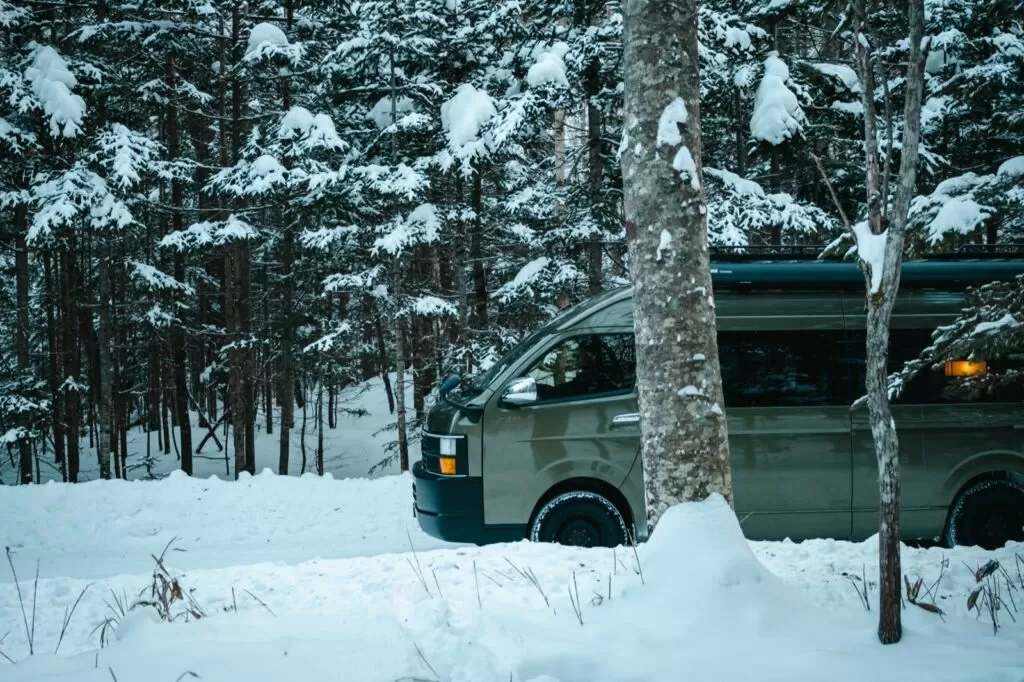
If you plan to sleep in your vehicle in Hokkaido in winter, the safe approach is to build your stops around RV parks certified by the Japan RV Association (JRVA), not Michi-no-Eki roadside stations. There are three reasons. You need electricity to run a heater on a below-freezing night, you can choose facilities that must offer a toilet open 24 hours, and the Ministry of Land, Infrastructure, Transport and Tourism (MLIT) describes Michi-no-Eki as rest facilities where it asks people to refrain from overnight stays.
This article is an entry point for people staying overnight in a campervan in winter Hokkaido. It answers, in order: why RV parks come first, what an RV park is, which facilities are open in winter, how to check winter closures, and what to bring and look at on the day. For the winter operating status of each facility, we leave that to our article checking 13 RV parks and Michi-no-Eki for winter overnight stays on their official sites and do not repeat it here.
Compare Hokkaido campervan rentals
Base yourself at New Chitose Airport and compare rates, vehicle types, and pickup locations all in one place.
Compare rental companies and vehicles →Why Plan Winter Overnight Parking in Hokkaido Around RV Parks, Not Michi-no-Eki
In summer, you can get by with a nap at a Michi-no-Eki and a move to somewhere else if that does not work out. In winter the nights are long, it is below freezing outside, and your options for moving again shrink. That is why the order is: decide where you will sleep first.
There are four criteria for choosing. Is there electricity to run a heater? Is the toilet usable all night? Can you park on a plowed surface? Is a bath not too far away? For RV parks, JRVA makes electricity, a 24-hour toilet, and proximity to a bathing facility conditions of certification (the original wording is quoted under the next heading). Michi-no-Eki are places the national government has positioned as rest facilities, and none of the four criteria is something they guarantee.
One more point. Winter cold in Hokkaido is on a different scale from the rest of Honshu. The table below shows that the normal January minimum temperature is −6.4℃ in Sapporo and −13.0℃ in Obihiro. To avoid ending up in that cold with nowhere to stay, you secure your place to sleep first. That is what “RV parks first” means in practice.
What Is an RV Park? The Conditions Set by the Japan RV Association
The Japan RV Association (JRVA) describes an RV park as “a vehicle-overnight space that meets the conditions set by JRVA and has been certified.” The items listed on its official page as required to open one are: a parking space of 4 m wide by 7 m long, a toilet available 24 hours, a 100V power supply (20A or more per vehicle recommended), a bathing facility within 15 minutes by car, waste disposal, access at any time, and availability for multi-day stays (JRVA “RV Park” page, checked 2026-10-13).
Three of these matter in winter. Power is the foundation for heating and appliances. A 24-hour toilet means you do not have to go out looking for one in the middle of the night. If a bathing facility is within 15 minutes, you can wash off sweat and chill in a hot bath before sleeping. Because the conditions call for “relaxed entry and exit restrictions,” they also suit winter itineraries in which you arrive after dark.
However, these conditions are the standard for certification. Whether those facilities are working in winter is a separate matter that differs from one facility to the next. Snow removal, toilet freeze protection, and winter operation of the power supply are not part of the standard. That is why the second half of this article has a dedicated section on how to check winter closures.
You can search certified RV parks on the dedicated RV park site RV-Park.jp by prefecture and by facilities (power available, 24-hour toilet, nearby bathing facility, on-site bathing facility, and so on) (checked 2026-10-13). For Hokkaido, our own list of RV parks in Hokkaido collects them in a form that lets you narrow down to facilities that also operate in winter.
Michi-no-Eki Are Rest Facilities. For Winter Overnight Stays, the Government Says It “Asks You to Refrain”
MLIT’s Road Consultation Office (“Michi no Soudanshitsu”) answers as follows about sleeping in a vehicle in a Michi-no-Eki parking lot: “Taking a nap in your vehicle to recover from fatigue during a drive is fine. However, we basically ask people to refrain from using public spaces such as parking lots for overnight stays.” It continues, “Some Michi-no-Eki also provide separate parking spaces for overnight stays,” and asks people to check each station’s website for details (MLIT Road Consultation Office, checked 2026-10-13).
To sum up in four points: the government’s position is not a “ban” but a “request to refrain.” Naps are allowed, and it would like overnight use to be avoided. In the range we checked, we also found no station whose own official site explicitly says “car camping is prohibited.” Conversely, the official page of RV Park Akan Tancho no Sato in Kushiro says, “Please refrain from using parking lots other than the RV park for overnight stays” (same page, checked 2026-10-13). Even where it is not banned, the line drawn is that these are not places prepared as suitable for sleeping. How we checked is documented in our list of Hokkaido Michi-no-Eki where overnight parking is prohibited.
“Not written” does not mean “allowed to stay.” In winter in particular, a nap meant to be short easily runs until morning, and the way you run your heater can easily bother others. Detailed etiquette for using Michi-no-Eki is collected in 8 manners for overnight parking at Michi-no-Eki.
How Cold Are Winter Nights? January Lows Are −6.4℃ in Sapporo and −13.0℃ in Obihiro
The table below lines up the monthly average of the daily minimum temperature in January at eight locations, from the Japan Meteorological Agency’s normal values (1991–2020). Normals are a guide to a typical year, not a forecast for the day. In the week before departure, check the latest figures from the Japan Meteorological Agency or local forecasts.
| Location | January daily minimum (℃) | January daily maximum (℃) |
|---|---|---|
| Muroran | −4.0 | 0.6 |
| Hakodate | −6.0 | 0.9 |
| Sapporo | −6.4 | −0.4 |
| Kushiro | −9.8 | −0.2 |
| Asahikawa | −11.7 | −3.3 |
| Chitose (around New Chitose Airport) | −12.9 | −1.1 |
| Obihiro | −13.0 | −1.5 |
| Furano | −14.4 | −3.7 |
If you pick up a vehicle at New Chitose Airport and head inland to Furano or Obihiro, assume the minimum on the nights you stay will be 6 to 8℃ lower than in Sapporo (a difference of 6.6℃ in Obihiro and 8.0℃ in Furano). Several locations also have daytime highs below freezing. What gets you through a night in this cold is a heater you can run with the engine off, and the power for that is the topic of the next heading. Temperatures and gear by location are covered for 11 locations in Hokkaido winter temperatures and gear for overnight parking.
What Changes With Power? You Can Keep the Heater and an Electric Blanket Running
Campervan heating is premised on an FF heater, which makes heat from fuel. Even so, blowers and controls use electricity from the sub-battery. At a site with external power, you can spend the night without worrying about the battery level, and you can also use appliances such as an electric blanket. If cold nights run two or more in a row, put one night at a site with power in your itinerary. That is enough to decide on.
One caution here. That power is “available” is separate from how many amps you can use on it. The JRVA standard is “20A or more per vehicle recommended,” which is not mandatory. For example, RV Park Akan Tancho no Sato in Kushiro lists “power available (15A)” (same official page, checked 2026-10-13). A single electric blanket is fine in many cases, but stacking high-wattage appliances such as an electric heater could trip the supply, so it is safest to ask “how many amps?” when you book.
What to check in your gear for sleeping warm, and why you must not sleep with the engine running, are covered in What to check to sleep warm in a winter campervan. This article covers only the point that power is the first condition when choosing where to stay.
At Michi-no-Eki in Winter, Toilets and Snow Removal Differ by Station
People often say, “Some Michi-no-Eki close their toilets in winter” and “the snow-cleared area of the parking lot differs from summer.” On these two points, we could not find an official statement from MLIT or the Hokkaido Regional Development Bureau in this check (as of 2026-10-13). So we do not write them as a general rule, and turn them into an action before departure. On the official site or the news section of the Michi-no-Eki you plan to use, check how the toilet is handled in winter (open 24 hours, or closed at night) and the snow removal status of the parking lot.
Some things could be confirmed. The RV park at Akan Tancho no Sato says for toilets, “Please use the Michi-no-Eki’s 24-hour toilet,” and states that there is no water supply facility (official page, checked 2026-10-13). In other words, at an RV park attached to a Michi-no-Eki, there are cases where you rely on the Michi-no-Eki’s facilities for the toilet. Whether “the toilet is usable all night” cannot be settled by the RV park’s name alone; you need to look at where the toilet is.
If you choose a Michi-no-Eki itself, 20 Michi-no-Eki for overnight parking and how to tell official confirmation shows up front how to check on the official site. In winter, add “toilet,” “snow removal,” and “opening hours” to those checks.
Choose Your Bath: A Hot Spring on Site, or Within 15 Minutes by Car
Winter overnight parking works on the assumption that plumbing may freeze, so there are fewer occasions to wash dishes or yourself in the vehicle. In exchange, whether there is a bath near where you stay shapes the quality of the night. The JRVA standard is “a bathing facility nearby (within 15 minutes by car),” which includes both a hot spring on the premises and nearby day-use baths (JRVA “RV Park” page, checked 2026-10-13).
There are two ways to choose. At an RV park with a hot spring attached or on the grounds, you can get in as soon as you arrive and not go outside again until you sleep. For the nearby type, check the day-use bath’s opening hours beforehand. Hours differ by facility, so on days when you arrive late you may not be able to get in. RV-Park.jp’s search has filters for “on-site bathing facility” and “nearby bathing facility,” which you can use when building your itinerary (checked 2026-10-13).
Which RV Parks Are Open in Winter? We Rechecked the 4 Confirmed Year-Round Facilities on Their Official Pages Today
In our check of 13 RV parks and Michi-no-Eki in Hokkaido on their official sites, 4 facilities were confirmed as open year-round including winter, 5 officially announced a winter closure, 2 had partial operation where only some facilities stop, and 2 were unconfirmed with no statement and needed a phone call (13-facility article, checked 2026-09-08). As an entry point, we reviewed only the 4 year-round facilities on their official pages. The check date is 2026-10-13.
| Facility (area) | Operating status as stated | Power | Toilet | Water | Snow removal statement |
|---|---|---|---|---|---|
| RV Park Kutchan (Kutchan) | “Open every day of the year” | Power at all 17 sites (page last updated 2023-11-01) | No statement on winter operation for this item | Hot water from the deep sink at the washstand, available 24 hours | None |
| RV Park Johnny Base (Asahikawa) | Winter operation from 11-01 to the end of March. Ask by phone for terms of use and prices | Could not confirm a statement for this item | Same as left | Same as left | None |
| RV Park Tokachi Wakka no Mori (Shimizu) | “Available year-round” | RV park sites (with power) are listed on the facility page as a plan for Kurumatabi members only | “A warm flush toilet all year round” | Kitchen and washstand have hot water year-round | None |
| RV Park Akan Tancho no Sato (Kushiro) | “Open every day of the year” (temporary closures when Akai Beret is closed) | Power available 15A (10 sites in total), no power (9 sites in total) | Uses the Michi-no-Eki’s 24-hour toilet | No water supply facility | None |
Three things can be read from this. Even among year-round facilities, none of the 4 mentions winter snow removal on its official page. Akan Tancho no Sato says on its official page, “In winter, temperatures may drop below −20℃,” and assumes you have cold-weather gear. Wakka no Mori describes its winter facilities in the most detail, stating that a warm flush toilet and a kitchen with hot water are available year-round.
Many facilities also close in winter. Sapporo Koganeyu Sakura RV Park and the RV park at Engaru Town Hotel Sunshine officially announce a winter closure (checked 2026-09-08). The full set of 13 facilities is in the same article, and a list of facilities in Hokkaido that you can narrow by winter operation is in the RV park list. If you are staying near a ski area, you can see nearby facilities in winter stopovers at 6 large ski resorts.
New Chitose Airport / Tokachi-Obihiro Airport
See Moving Inn campervans
Check vehicle types, rates, and availability on the official site.
View details at Moving Inn →How Do You Check a Winter Closure? Examples of Official Wording, and 3 Items to Ask by Phone
Official sites word this quite differently from facility to facility. Some write “open every day of the year” or “available year-round”; some write “winter operation from November 1 to the end of March, conditions by phone”; some write “RV park closed December to March.” Even among places that are all called “RV parks,” you cannot tell whether you can stay in winter until you read the wording (each official site and Kurumatabi facility page, checked 2026-10-13).
Settling on an order for reading keeps you from getting lost. First, whether the operating period field includes winter. Next, whether there are winter notes for individual facilities (such as “water not available in winter”). Last, where a hotel or hot spring is the parent business, the main facility may operate year-round while the RV park sites are handled differently. For example, Engaru Town Hotel Sunshine states, “The hotel is open year-round; the RV park is closed from December to March” (Kurumatabi facility page, checked 2026-10-13).
For anything the official site does not state, ask by phone. There are three items to ask.
- Operation and snow removal: Do they accept guests on the day you stay? Are the sites and the paths on the grounds plowed? Can you get in during hours when staff are absent?
- Power: Is it available in winter? Up to how many amps? Is it fine to assume you will use a heater or an electric blanket?
- Toilet and water: Can you use it at night? Are there days when it stops because of freezing? Does the water run in winter?
Ask about whether a reservation is needed on the same call. Akan Tancho no Sato accepts advance reservations from 6 months ahead and also allows same-day check-in if there is space (official page, checked 2026-10-13). Some facilities, such as Uenewsaru Midori in Kiyosato, Shiretoko, are locked and cannot take guests when staff are absent, so plan an itinerary that does not rely on “just showing up on the day.”
How Do You Stay Safe Inside the Vehicle on a Winter Night? Do Not Sleep With the Engine Running
Even if it is cold, avoid sleeping with the engine running. If the exhaust pipe is blocked by snow, exhaust gas can enter the vehicle. The premise is to choose a heating method that does not rely on the engine, such as the vehicle’s built-in FF heater. The reasons, and what to check to sleep warm, are explained in order in What to check to sleep warm in a winter campervan.
If you want to clear up your winter worries all at once, the article that resolves worries about winter campervan trips answers them in the order of snowy roads, freezing, and heating. For driving itself, see the complete guide to winter campervan driving, and for tires, when to switch to studless tires is the specialist article. If you arrive late, you no longer have time to look for a plowed spot, so plan to get to where you stay before sunset.
What to Check Before the Day? A Summary Table and Checklist
We rearrange what we have covered so far into what to check and where to look.
| What to check | Where to look | If it is not written |
|---|---|---|
| Winter operating period | The facility’s official site, the Kurumatabi facility page | Confirm by phone |
| Power (availability and amps) | The facilities section of the official site | Confirm by phone |
| Whether the toilet is usable at night | The facilities section of the official site. For a Michi-no-Eki-attached park, that station’s information | Confirm by phone, or on the Michi-no-Eki’s official site |
| Snow removal | The news section of the official site | Confirm by phone |
| Location and opening hours of bathing facilities | The facility’s information, the official site of the day-use bath | Check the opening hours first |
| Whether a reservation is needed, and reception hours | The reservation section of the official site | Confirm by phone |
Here is a checklist for the day before departure and the day of.
- I confirmed from the official site’s operating period that it is open on my night
- I checked the amps of the power and estimated whether it is enough for the appliances I will use
- I know where the toilet is at night
- I asked by phone about snow removal where I will stay (or read the official notice)
- I checked the bath’s opening hours and the distance to it
- For facilities that need a reservation, I made one (and confirmed reception hours)
- I checked the minimum temperature forecast for where I will stay within the week before departure
- I am moving on a schedule that arrives before sunset (not searching for a place on dark snowy roads)
- I confirmed the heating method on the assumption that I will not sleep with the engine running
Campsites with power are also candidates for a place to stay. You can choose from the list of campsites and auto campsites in Hokkaido, which you can narrow by power availability and vehicle access. However, “it has campsites” and “you can sleep in a vehicle there” are different things, so check winter operation and whether overnight parking is allowed at each facility.
Frequently Asked Questions (FAQ)
Can I do winter overnight parking in Hokkaido at a Michi-no-Eki?
MLIT recognizes naps, but says overnight use of parking lots is “basically something we ask people to refrain from” (MLIT Road Consultation Office, checked 2026-10-13). It is a request to refrain, not a ban. In winter there is more to worry about with power, toilets, and snow removal, so the safe approach is to plan your stops around RV parks.
What is the difference between an RV park and an ordinary campsite?
An RV park is a vehicle-overnight space certified by meeting conditions set by JRVA. The conditions include a 24-hour toilet, a 100V power supply, and a bathing facility within 15 minutes by car (JRVA, checked 2026-10-13). However, winter snow removal and winter operation of facilities are not part of the conditions, so you need to check each facility.
How cold is it at night in winter?
The normal January daily minimum is −6.4℃ in Sapporo, −11.7℃ in Asahikawa, −13.0℃ in Obihiro, and −14.4℃ in Furano (Japan Meteorological Agency, 1991–2020 normals, checked 2026-10-13). These are a guide for a typical year, not a forecast for the day.
What is good about an RV park with power?
You can use a heater and an electric blanket without worrying about the battery level. The amps differ by facility, and Akan Tancho no Sato lists 15A (official page, checked 2026-10-13). Ask when you book whether it is enough for the power draw of the appliances you will use.
What about toilets and snow removal at Michi-no-Eki in winter?
They appear to differ by station, and we could not find an official uniform statement in this check (as of 2026-10-13). Before departure, check how the toilet is handled in winter and the snow removal in the parking lot on the official site or news section of the Michi-no-Eki you plan to use.
Which RV parks are open in winter?
The 4 facilities confirmed as year-round on their official pages are Kutchan, Johnny Base (Asahikawa), Tokachi Wakka no Mori (Shimizu), and Akan Tancho no Sato (Kushiro) (checked 2026-10-13). For Johnny Base, the guidance is to confirm winter terms of use by phone. The full set of 13 facilities is in the 13-facility confirmation article.
If it says “year-round,” can I stay in winter with peace of mind?
Being open and having power, toilets, and snow removal available in winter are separate matters. For all 4 facilities, there was no statement on snow removal on the official page (checked 2026-10-13). Ask by phone about the 3 items of operation, power, and toilet and water before you book.
Is it okay to sleep with the engine running?
Avoid it. If the exhaust pipe is blocked by snow, exhaust gas can enter the vehicle. Choose a heating method you can use with the engine off, such as an FF heater.
Pages to Read Next
- Which RV Parks and Michi-no-Eki in Hokkaido Allow Winter Overnight Parking? We Checked 13 Facilities One by One on Their Official Sites
- Winter Campervan Overnight Parking in Hokkaido: What Should You Check to Sleep Warm?
- List of RV Parks in Hokkaido | Rates, Power, Hot Springs, and 38 Facilities Open in Winter
- Hokkaido Winter Temperatures | November–February Minimums and Gear for Campervan Overnight Parking
- 6 Large Ski Resorts in Hokkaido: Where Can You Park Overnight Nearby in Winter?
Book a Campervan in Hokkaido
Moving Inn New Chitose Airport supports English booking and offers airport transfers.