Where Can You See Shima-enaga in Hokkaido? Asahiyama Memorial Park and Nopporo Forest Park in Sapporo, Winter Tips, and Etiquette [2026-27]
Shima-enaga is Hokkaido's long-tailed tit subspecies. Where two Sapporo parks' official pages say it can be seen, winter timing, misses, etiquette, parking.
Pick a campervan by what matters to you.
Rent in winter (Dec–Mar)
Companies that rent through winter, listed apart from those that close.
Rent at New Chitose Airport
See only the rental bases in Chitose, where the airport is.
Guide price
Moving Inn New Chitose Airport: HIACE van conversion from ¥22,000 per night. 30% off when booked 90 days ahead, 20% off at 60 days (official site, checked 20 Nov 2026).
Hokkaido ski resorts by campervan →
Before you book: with an International Driving Permit if your country is in the Geneva Convention (for example the US, Australia, Singapore); Taiwan, Switzerland, Germany, France, Belgium and Monaco need your licence plus a Japanese translation (Tokyo Metropolitan Police). Questions in English: Moving Inn on WhatsApp. Every roadside station (michi-no-eki) must have free 24-hour toilets, and Hokkaido has 128 of them (MLIT).
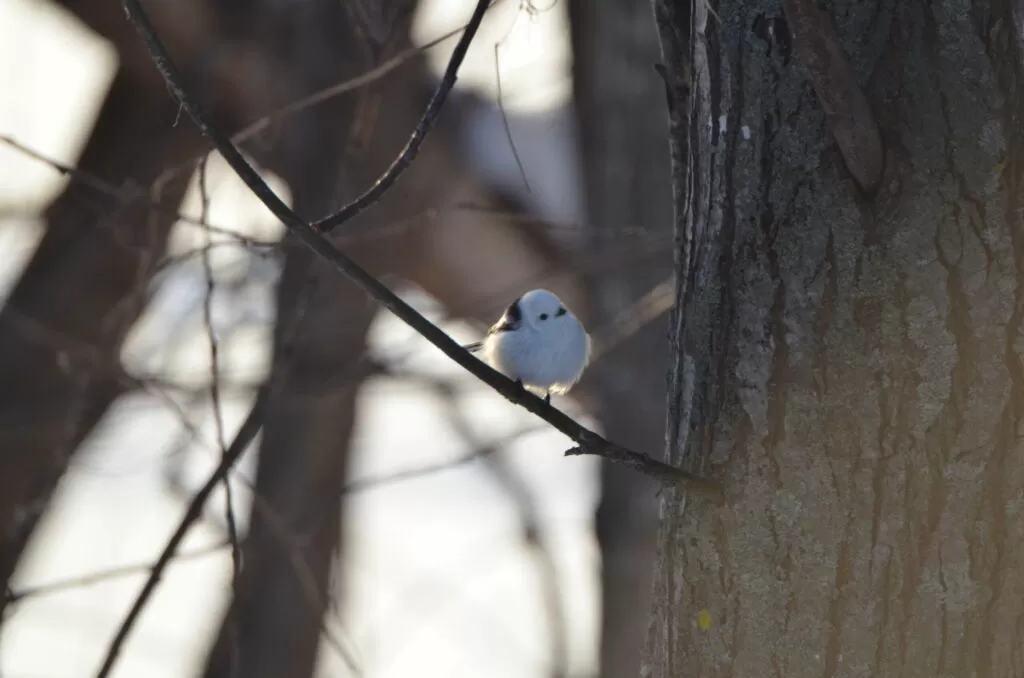
Shima-enaga is a subspecies of the long-tailed tit that lives in Hokkaido. The guide page for Nopporo Forest Park, run by the Hokkaido Museum, lists Shima-enaga among the wild birds seen in the park. Sapporo’s Asahiyama Memorial Park also publishes Shima-enaga observation reports on the park’s official website (both checked 2026-11-02).
Winter is an easier season to look for them: a City of Sapporo document says they “can be seen even on lowland areas.” But these are wild birds, and a visit does not guarantee a sighting. Asahiyama Memorial Park’s bird information for March 2026 also says “there were days when they could not be seen.” This article lays out the places, timing, and etiquette that the official pages give, in the parks’ own words.
Compare Hokkaido campervan rentals
Base yourself at New Chitose Airport and compare rates, vehicle types, and pickup locations all in one place.
Compare rental companies and vehicles →Is Shima-enaga found only in Hokkaido? How does it differ from the long-tailed tit?
The April 2023 newsletter from the Asahiyama Memorial Park Management Office describes Shima-enaga as a “subspecies” of the long-tailed tit, and says that long-tailed tits from Honshu southward have a black band on the face. Among Hokkaido’s wild birds, it says, Shima-enaga, Miyama-kakesu (a jay), and Shirohara-gojukara (a nuthatch) look clearly different from their Honshu subspecies (Asahiyama Memorial Park Management Office, “Akagera Tsushin” newsletter, April 2023 issue, checked 2026-11-02).
The City of Sapporo page explains that Shima-enaga is whiter in both body and face than the long-tailed tit of Honshu, and also gives the nickname “snow fairy.” A blog by the Hokkaido Regional Environment Office of the Ministry of the Environment says it lives only in Hokkaido in the world (Sapporo City, “Let’s Color in Living Things!”, Hokkaido Regional Environment Office, Ministry of the Environment, “Winter Fairy”, both checked 2026-11-02).
When can you see Shima-enaga? Why many people look for them in winter
The City of Sapporo document says they stay in the mountains in summer and can also be seen on lowland areas in winter. What can be confirmed officially is that you can look in trees in winter parks and in the city. A blog from the Ministry of the Environment’s Kamikawa office reports that Shima-enaga came to the rowan tree in front of the office on a February morning (checked 2026-11-02).
Their flocks are described officially too. The Ministry of the Environment’s blog explains that Shima-enaga forms mixed flocks with Japanese tits and varied tits. If you find a tree where several kinds of small birds are moving together, Shima-enaga may be among them.
For time of day, a December 2016 post from Asahiyama Memorial Park is a clue. It says they are most often seen from sunrise to just before noon, and that they may also appear in the afternoon until a little before sunset.
Winter days in Sapporo get dark early, so check sunset times in our article on what time it gets dark in Hokkaido in winter (Asahiyama Memorial Park, “If You Want to See Shima-enaga”, posted December 18, 2016, updated June 25, 2017, checked 2026-11-02).
Where do official pages say they can be seen?
Two places: Asahiyama Memorial Park in Sapporo, and Nopporo Forest Park, which the Hokkaido Museum introduces. I limited this to places named on the managers’ official pages, not personal accounts.
| Place | Official description | Parking (official) |
|---|---|---|
| Asahiyama Memorial Park (Chuo Ward, Sapporo) | The park’s official bird information page keeps posting updates on Shima-enaga sightings. It reports sightings in the valley west of the “Mori-no-Ie” (Forest House), from the Munich Forest to the Portland Forest, and in the larch woodland north of the Forest House (post from winter 2016) | Two lots, 119 spaces in total, 6:00–22:00, free. The second lot is closed in winter |
| Nopporo Forest Park (Sapporo, Ebetsu, and Kitahiroshima) | “About 140 species of wild birds can be seen, including the black woodpecker, a natural monument, as well as the Ural owl, blue-and-white flycatcher, narcissus flycatcher, Shima-enaga, Japanese tit, and great spotted woodpecker.” | Osawa, Tomanbetsu, Mizuho, and Todoyama entrances: “available 24 hours.” Kinento (Monument) entrance and in front of the Historical Village of Hokkaido: 7:00–17:00. Main gate: 7:00–22:00 |
Can you reach Asahiyama Memorial Park by subway and bus? And by car?
The official access guide says to take the JR Hokkaido Bus Asahiyama Park Line (En 13, Loop En 13) from Maruyama Park Station on the Tozai subway line, about 15 minutes. Get off at “Asahiyama Koen-mae” and walk about 4 minutes to the rest house. The park is open 24 hours, and the parking lots are available from 6:00 to 22:00 (Asahiyama Memorial Park Access, checked 2026-11-02).
The second parking lot is closed in winter, so in winter you will use the first lot. Asahiyama Memorial Park’s official site says “we may close the park suddenly if there are signs or sightings of animals in the park.” On the morning you go, check the notices on the official site.
New Chitose Airport and Tokachi-Obihiro Airport
See Moving Inn campervans
Check vehicle types, rates, and availability on the official site.
See details at Moving Inn →If you are traveling by car in winter, check tires and the rental period first. They are covered in our article on when to switch to winter tires and our article on campervan rentals available in winter.
Where do you enter Nopporo Forest Park? If you want to see Shima-enaga
Nopporo Forest Park is a 2,053 ha forest designated a prefectural nature park in 1968. Most of it is national forest, and some areas are designated bird and wildlife sanctuaries. The Hokkaido Museum page says that walking trails run throughout, and cross-country skiing can be enjoyed in winter (Hokkaido Museum, “Nopporo Forest Park”, checked 2026-11-02).
There are five entrances (Hokkaido Prefectural Government, “Nopporo Forest Park”, checked 2026-11-02). The official pages do not say which paths are best for seeing Shima-enaga. The forest is large, so decide how far you will walk using the park map (available as a PDF from the Hokkaido Museum page) before you go in.
Are there days you go and don’t see them?
Yes. Asahiyama Memorial Park’s bird information for March 3, 2026 says of Shima-enaga: “There were days this week when they could not be seen, and there were fewer sighting reports than last week.”
It goes on: “So far this winter, trees where they came frequently had been found in at least three places, but that was only for a time, and they eventually stopped coming” (Asahiyama Memorial Park bird information, March 3, 2026, checked 2026-11-02).
It says that even at a place the park’s managers watch, there were weeks when they could not be seen. Rather than waiting at one spot, it is easier to plan a schedule that lets you go back on another day.
What are the etiquette rules? What about feeding or getting too close?
The official Nopporo Forest Park page contains the following. “Feeding wild animals, approaching them closely, or following them persistently” is subject to penalties under the Hokkaido Prefectural Natural Parks Ordinance. Driving vehicles anywhere other than designated places such as parking lots, and bringing in dogs, are also “prohibited” (Hokkaido Museum, “Nopporo Forest Park”, checked 2026-11-02).
To photographers, it says: “In recent years, many people have been visiting to photograph birds. In addition to concern about the effect on wildlife of crowding and occupying a spot for a long time, there have been scattered reports of trouble among park users, so we ask everyone to follow good manners and use the park considerately.”
The same page also says: “From early spring to mid-June, the breeding season, we may ask you to refrain from using the trails in some sections.”
Asahiyama Memorial Park’s official site asks: “Please do not leave anything that could become food for animals or birds” (Asahiyama Memorial Park, checked 2026-11-02). Its bird information says: “When observing or photographing, please take care not to block the path and get in the way of people who are not photographing birds.” “If birds fly away because people pass by, please accept that it cannot be helped.” When snow narrows the paths, it also asks you to wait in a wide spot and give way to others.
What should you check before going to a winter park?
Here is a checklist based on the officials’ requests and what this article has confirmed.
- On the morning you go, check the notices on the park’s official website (Asahiyama Memorial Park may close suddenly if there are signs or sightings of animals)
- Plan your time so you can visit at Asahiyama Memorial Park from sunrise to just before noon
- Check parking hours (Asahiyama Memorial Park: 6:00–22:00, with the second lot closed in winter)
- Do not bring or leave anything that could be food
- Do not get too close to wild animals or follow them
- Do not block the path. If birds fly away because people pass, accept that it cannot be helped
- At Nopporo Forest Park, watch for the request to refrain from using trails from early spring to mid-June
For clothing and what to carry, our article on December temperatures and clothing and article on winter shoes and packing will help. If you want to see other animals, go to 10 places to watch wildlife. For ways to spend winter in Sapporo, see our article on Sapporo winter highlights.
Frequently asked questions (FAQ)
Is Shima-enaga the same bird as the long-tailed tit?
It is the subspecies of the long-tailed tit that lives in Hokkaido. Long-tailed tits from Honshu southward have a black band on the face (Asahiyama Memorial Park Management Office, checked 2026-11-02).
When can you see Shima-enaga?
According to a City of Sapporo document, they stay in the mountains in summer and can also be seen on lowland areas in winter (City of Sapporo, checked 2026-11-02). A past post from Asahiyama Memorial Park says they are most often seen from sunrise to just before noon.
Where do official pages say they can be seen?
Nopporo Forest Park (on the Hokkaido Museum page) and Asahiyama Memorial Park (on the park’s official site) (both checked 2026-11-02).
How do you get to Asahiyama Memorial Park?
From Maruyama Park Station on the Tozai subway line, take the JR Hokkaido Bus Asahiyama Park Line for about 15 minutes, then walk about 4 minutes from “Asahiyama Koen-mae.” Parking is 119 spaces in total, 6:00–22:00, and free (official access guide, checked 2026-11-02).
Will you definitely see them if you go?
Not always. Asahiyama Memorial Park’s bird information also says “there were days when they could not be seen” (March 3, 2026, checked 2026-11-02).
May you feed them?
At Nopporo Forest Park, “feeding wild animals” is subject to penalties under the ordinance. Asahiyama Memorial Park asks visitors not to leave anything that could become food (checked 2026-11-02).
Pages to read next
- 10 Best Places for Wildlife Watching in Hokkaido: Steller’s Sea Eagles, Red-Crowned Cranes, Blakiston’s Fish Owls, Northern Pikas, Seasons, Regions, and How to Get There and Stay by Campervan
- Things to Do in Sapporo in Winter: Beyond the Snow Festival, Plus Seasonal Highlights and a Campervan Guide [2026-27]
- Hokkaido Winter Trip: Shoes & Packing List [2026] – 2,060 Sapporo Fall Transports and a Pre-Departure Checklist
- When Does It Get Dark in Hokkaido in Winter? December Sunset: Sapporo 16:03, Nemuro 15:45, and How to Plan Trips to Arrive in Daylight [2026-27]
Book a Campervan in Hokkaido
Moving Inn New Chitose Airport supports English booking and offers airport transfers.
Pick a campervan by what matters to you.
Rent in winter (Dec–Mar)
Companies that rent through winter, listed apart from those that close.