Where to See Red-Crowned Cranes in Hokkaido in Winter: Tsurui, Kushiro and Akan Viewing Spots, Feeding from December, and Driving [2026-27]
Red-crowned cranes peak in Tsurui in Jan–Feb. Viewing spots in Tsurui, Kushiro and Akan, times, drives from Kushiro Airport and etiquette, per official sources.
See companies that rent in winter
Pick a campervan by what matters to you.
Rent in winter (Dec–Mar)
Companies that rent through winter, listed apart from those that close.
Rent at New Chitose Airport
See only the rental bases in Chitose, where the airport is.
Guide price
Moving Inn New Chitose Airport: HIACE van conversion from ¥22,000 per night. 30% off when booked 90 days ahead, 20% off at 60 days (official site, checked 20 Nov 2026).
Hokkaido ski resorts by campervan →
Before you book: with an International Driving Permit if your country is in the Geneva Convention (for example the US, Australia, Singapore); Taiwan, Switzerland, Germany, France, Belgium and Monaco need your licence plus a Japanese translation (Tokyo Metropolitan Police). Questions in English: Moving Inn on WhatsApp. Every roadside station (michi-no-eki) must have free 24-hour toilets, and Hokkaido has 128 of them (MLIT).
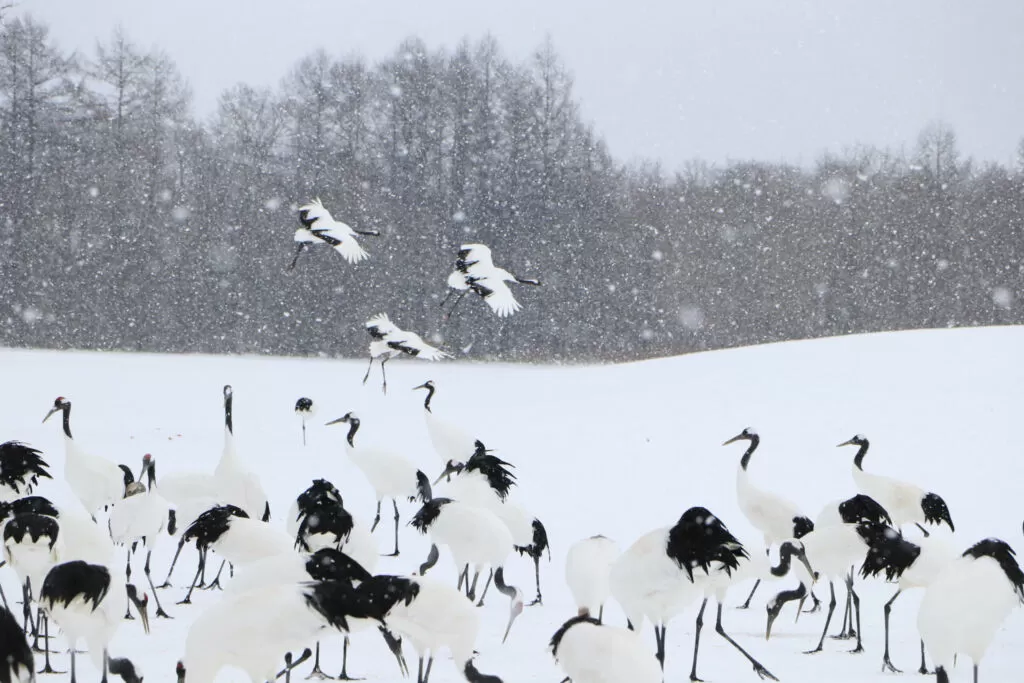
To see red-crowned cranes (tancho) in winter, head to Tsurui Village, from December when feeding begins, and especially in January and February. The Tsurui Village Board of Education says the number of cranes arriving peaks in January and February, and on some days exceeds 200. In fiscal 2026 (Reiwa 8), feeding begins in December or later, and the village decides the actual start date based on how many cranes have gathered and on the weather (Tsurui Village Board of Education, “About feeding the tancho”, checked 2026-11-02).
This article is for people going to see the cranes in January and February, and it covers viewing spots, timing, times of day, how to get there by car, and etiquette, using only official information. These are wild birds, so we cannot say you will always see them. The village also writes that feeding-site times change without notice.
Compare Hokkaido Campervan Rentals
Base yourself at New Chitose Airport and compare rates, vehicle types, and pickup locations all in one place.
Compare rental companies and vehicles →Why are red-crowned cranes easy to see in Tsurui Village in winter?
In winter the marshes freeze and the cranes can no longer find food, so they move closer to human settlements. The Wild Bird Society of Japan’s Tsurui-Ito Tancho Sanctuary explains that from mid-November to mid-March they gather at feeding sites prepared by people (the sanctuary’s “About the tancho”, checked 2026-11-02). The most important winter food is dent corn (corn grown for livestock feed) scattered at the feeding sites.
Feeding is carried out as a project of the national government and Hokkaido. According to Tsurui Village, feeding has helped the cranes recover, and nearly 2,000 are now confirmed. At the same time, there is a problem of too many cranes concentrating at the feeding sites during the wintering season, and the national government is reducing the amount of feed and shortening the feeding period. As a result, the period during which cranes can be seen at the feeding sites is also getting shorter. The village writes, “We recommend planning your trip within the feeding period” (Tsurui Village Board of Education, feeding page, checked 2026-11-02).
In the Hokkaido Prefectural Government’s wintering distribution survey (commissioned by the Ministry of the Environment), the number confirmed on January 23, 2026 was 1,902 in total. The first survey, on December 5, 2025, counted 1,136 (both include 38 captive birds; Hokkaido, “Tancho page”, checked 2026-11-02). Within the same winter, the number rose sharply from December to January.
Where can you see them? Comparing viewing spots in Tsurui Village, Kushiro, and Akan
It helps to think of it this way: to meet wild cranes, go to the feeding sites and roosts in Tsurui Village, and to see them up close in an enclosure, go to the facilities in Kushiro and Akan.
| Place | What you can see | Winter opening hours | Drive from Tancho Kushiro Airport, etc. |
|---|---|---|---|
| Tsurui Village, Tsurumidai | Wild red-crowned cranes. Feeding site. Many come from December to February | Outdoor viewing area. Feeding is often around 9 a.m. and 1–2 p.m. | About 30 minutes from JR Kushiro Station and Kushiro Airport (village guide) |
| Tsurui-Ito Tancho Sanctuary | Wild red-crowned cranes. Telescopes at the Nature Center and explanations by rangers | 9:00–16:00. Closed every Tuesday and Wednesday, among other days. Free admission | About 50 minutes from JR Kushiro Station and Kushiro Airport (village guide). Free parking available |
| Tsurui Village, Otowa Bridge | The river where they roost. In the depths of winter, cranes seen in the river mist | Outdoors. Rules apply (see below) | For the hill overlooking Otowa Bridge, use the road on the Hokkaido Route 243 side (in winter the road on the Hokkaido Route 53 side is not plowed) |
| Kushiro City Tancho Crane Park | A facility where you can observe cranes all year round | 9:00–16:00 (Oct 15–Apr 9). Closed Dec 31–Jan 3 | About 10 minutes from Tancho Kushiro Airport. 67 parking spaces, free |
| Akan International Crane Center [Grus] | Feeding of wild red-crowned cranes (from December. In principle once in the morning, usually around 8 a.m.) | 9:00–17:00, open year round (as listed on Visit Hokkaido) | About 45 minutes from JR Kushiro Station, about 15 minutes from Akan IC. 45 parking spaces, free |
Admission to Kushiro City Tancho Crane Park is ¥480 for adults, university students, and high school students, and ¥110 for elementary and junior high school students, according to Kushiro City’s facility fee list (Kushiro City, “List of facility fees”, checked 2026-11-02). For sightseeing nearby when you visit both the Tsurui Village viewing spots and the Akan facilities, see our Kushiro and Lake Akan drive article covering the Kushiro Marsh, red-crowned cranes, and Ainu culture and our Kushiro and Lake Akan guide that also includes marimo and Lake Mashu.
When is the best time to go? November, December, January–February, and March compared
The Tsurui Village Board of Education describes the arrivals month by month as follows. They shift from year to year, so read this as a rough guide.
| Period | Arrivals (Tsurui Village guide) |
|---|---|
| November | Few cranes arrive, and there are quite a few times of day when none are there |
| December | Depends on snow cover and temperature. In a typical year, days with 100 or more cranes increase from mid to late month |
| January–February | The peak period for arrivals. Exceeds 200 on some days. Courtship dances are also easier to see. Numbers begin to fall from late February |
| March | Pairs move on to their breeding grounds and arrivals decrease. Mostly young birds come |
We narrowed this down to January and February because that is when arrivals peak and because numbers fall from late February. The feeding period varies from year to year. For the latest feeding status, contact the Tsurui Village Board of Education (0154-64-2050) or the sanctuary (0154-64-2620).
What time should you go in Tsurui Village? Feeding and Nature Center hours
During the period of peak arrivals (typically late December to February), feeding is often held twice, morning and afternoon, though on some days there is only one feeding or the times shift. At Tsurumidai it is around 9 a.m. and 1–2 p.m., and at the sanctuary around 9 a.m. and 2 p.m. The village also writes that in the snow season, cranes almost never leave the feeding sites during the day even outside feeding times (Tsurui Village Board of Education, feeding page, checked 2026-11-02).
The sanctuary’s Nature Center is open 9:00–16:00, with free admission. It is closed every Tuesday and Wednesday, the first Thursday of each month (open if it is a national holiday), and December 26 to January 1. Even on closed days, you can observe the cranes from the outdoor viewing areas (Wild Bird Society of Japan, official sanctuary site, visitor information, Tsurui Village Board of Education, viewing and photography points, checked 2026-11-02). The Wild Bird Society of Japan writes that on bitterly cold mornings the cranes arrive later, and in the evening you can also see flocks flying off to their roost.
How do you see the morning and the roost at Otowa Bridge?
Tsurui Village calls Otowa Bridge “the only place where you can see the roost without disturbing the cranes” and describes the sight of the cranes floating in the river mist of the deepest winter as “fantastical.” Kikuchi Farm, which opens its private land, is listed as a highlight for watching the cranes return to the roost against the setting sun (Tsurui Village Board of Education, “Tancho viewing and photography points”, checked 2026-11-02).
In winter, the road from the Hokkaido Route 53 side to the hill overlooking Otowa Bridge from a distance is not plowed. The village directs visitors to use the road on the Hokkaido Route 243 side. At Otowa Bridge, the village’s leaflet bans certain actions. We quote the original in the next section.
What is the viewing etiquette? What drivers should know first
The leaflet the village hands out at Otowa Bridge specifically bans idling, leaving the engine running while parked. The original reads as follows: “Cars idling for long periods are especially conspicuous at Otowa Bridge, so please never do so,” and “Please do not leave the engine running to keep warm inside the car. Idling to warm up the engine should be limited to 5 minutes or less.” It also says “never” to saving a spot by leaving only items such as a tripod (Tsurui Village leaflet, “Stop idling! No reserving spots!”, checked 2026-11-02).
If you arrive in a campervan in the early morning, check with your rental base before you rent about how to use the heater. For the feeding sites, the village’s “Requests when viewing” include the following items (Tsurui Village Board of Education, feeding page, checked 2026-11-02).
- Feeding is done by the “feeders.” Entering the feeding site or feeding the cranes yourself is “strictly refused”
- Watch from the designated viewing areas. Some areas around the sites are closed to viewing
- Please refrain from “shouting or making loud noises,” “throwing things at the cranes,” “running around,” “climbing the fences,” and the like
- Drones over the feeding sites and their surroundings are “strictly refused”
- Please refrain from bringing pets such as dogs
- Private land belonging to the feeders adjoins the areas around the feeding sites. Please refrain from entering it
The village’s viewing and photography points page also says not to use flash and to take your trash home (same page, checked 2026-11-02). The Wild Bird Society of Japan’s nature information says the cranes become wary when people get out of their cars, so it asks visitors to watch from inside the car as much as possible (the sanctuary’s “Nature information,” as updated November 1, 2021, checked 2026-11-02). The full set of viewing rules for Tsurui Village is available as a PDF on the village’s local rules for tancho viewing page.
How long is the drive from Tancho Kushiro Airport? What about winter driving?
According to the village guide, Tsurumidai is about 30 minutes by car from Kushiro Airport and JR Kushiro Station, and the sanctuary is about 50 minutes. Kushiro City Tancho Crane Park is about 10 minutes from Tancho Kushiro Airport, and the Akan International Crane Center is about 45 minutes from JR Kushiro Station (Tsurui Village, Visit Hokkaido, Tancho Crane Park, same, Grus, checked 2026-11-02). These are the travel times listed officially. On days with snow or ice, allow longer than these figures.
If you are driving on snowy roads for the first time, read our Q&A for first-time snow drivers and how to tell snowstorms, whiteouts, and black ice apart first. Rental bases when you rent in Kushiro are listed in our article on companies where you can rent a campervan in Kushiro.
What should you wear in Kushiro in the early morning?
The viewing areas are outdoors, and there is waiting involved. For a guide to winter temperatures, see our article on November–February minimum temperatures and car camping gear, and for footwear and cold-weather accessories, see our article on shoes and what to pack for a winter trip.
Where should you stay?
If you want to do car camping in winter around Kushiro and Akan, you can choose from RV Park Akan Tancho-no-Sato or our article on four certified RV parks in Kushiro and Nemuro. Rates, facilities, and winter operation change, so check each page and the facility’s official site before departure.
New Chitose Airport · Tokachi-Obihiro Airport
View Moving Inn Campervans
Check vehicle types, rates, and availability on the official site.
See details at Moving Inn →Pre-departure checklist
- Set your travel day for December or later when feeding begins, ideally January–February (confirm the start date with Tsurui Village)
- If you are going to the sanctuary, you cannot enter the building on Tuesdays and Wednesdays, the first Thursday, and December 26 to January 1
- Kushiro City Tancho Crane Park is closed December 31 to January 3
- Watch the feeding sites from the designated viewing areas. Do not enter, feed the cranes, fly drones, or bring pets
- At Otowa Bridge, keep idling to 5 minutes or less and do not reserve spots
- On days with snow or ice, set out allowing more time than the travel times in the table
Frequently asked questions (FAQ)
When can you start seeing red-crowned cranes in winter?
In Tsurui Village, fiscal 2026 feeding begins in December or later. In a typical year, days with 100 or more cranes increase from mid to late December, and January and February are the peak (Tsurui Village Board of Education, checked 2026-11-02).
Where can you see them?
For wild cranes, the main spots are Tsurumidai in Tsurui Village, the Tsurui-Ito Tancho Sanctuary, and Otowa Bridge. Kushiro City Tancho Crane Park and the Akan International Crane Center are facilities, and the differences between the viewing spots are in the table in the main text (checked 2026-11-02).
Will you definitely see them?
They are wild, so we cannot promise. Tsurui Village notes that the number and times of feedings may change without notice (Tsurui Village Board of Education, checked 2026-11-02).
What time should you go?
The village says feeding at Tsurumidai is often around 9 a.m. and 1–2 p.m., and at the sanctuary around 9 a.m. and 2 p.m. Times may change (checked 2026-11-02).
How long is the drive from Kushiro Airport?
According to the village guide, it is about 30 minutes to Tsurumidai and about 50 minutes to the sanctuary. On snowy days it takes longer (Tsurui Village Board of Education, checked 2026-11-02).
What should you watch out for in viewing etiquette?
The main points in the village’s guidance are: do not enter the feeding sites, do not feed the cranes, do not fly drones, do not bring pets, and do not idle for long at Otowa Bridge (Tsurui Village Board of Education, Otowa Bridge leaflet, checked 2026-11-02).
Are there places to stay?
For car camping in Kushiro and Akan, you can search through RV Park Akan Tancho-no-Sato and our article on RV parks in Kushiro and Nemuro. Conditions change, so check with each facility before departure.
Pages to read next
- 10 places to watch wildlife in Hokkaido | Steller’s sea eagles, red-crowned cranes, Blakiston’s fish owls, and northern pikas: seasons, regions, and how to drive there and stay
- Kushiro and Lake Akan campervan drive guide | A complete guide to the Kushiro Marsh, red-crowned cranes, and Ainu culture [2026 edition]
- For first-time snow drivers in Hokkaido | What if you slip, what if you get stuck, do you need 4WD? Answers to common worries in a Q&A [2026-27]
- Deciding when to stop on Hokkaido’s winter roads | How to tell snowstorms, whiteouts, and black ice apart, and how to read road closure information [2026-27]
- RV Park Akan Tancho-no-Sato (Kushiro)
Book a Campervan in Hokkaido
Moving Inn New Chitose Airport supports English booking and offers airport transfers.
Pick a campervan by what matters to you.
Rent in winter (Dec–Mar)
Companies that rent through winter, listed apart from those that close.