Hokkaido Campervan Travel for Seniors | Unhurried Itineraries, Driving Tips & Health Management [2026 Edition]
A guide for travelers in their 60s and 70s planning a campervan trip in Hokkaido: choosing an easy-to-drive vehicle, designing a fatigue-free itinerary, hot spring safety, medication management, and comfortable layouts for couples.
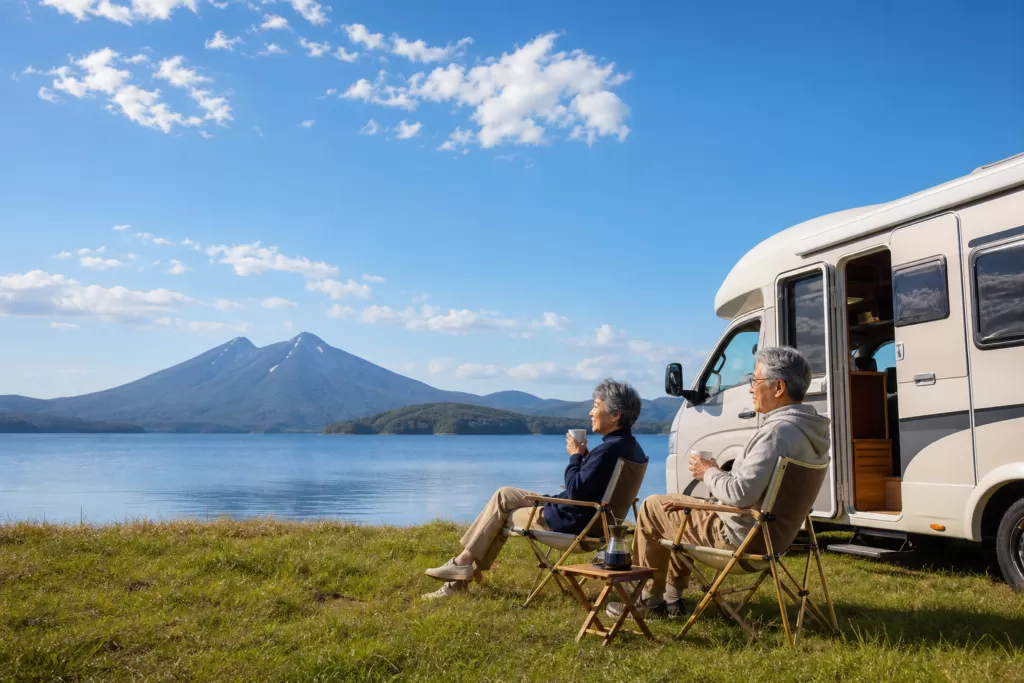
Retirement has finally given you time. You want to explore Hokkaido — a long-held dream — at your own unhurried pace. That is when a campervan comes to mind. No hunting for hotels, no loading and unloading luggage every day, and you can stay several nights in a place you love. Yet for senior travelers, real questions remain: Will my body hold up on long drives? Is getting in and out easy? What happens if I feel unwell on the road?
This article organizes what travelers in their 60s and 70s need to enjoy a safe campervan trip in Hokkaido, built around three pillars: choosing the right vehicle, designing an unhurried itinerary, and managing your health. “Slowly” and “thoroughly” is the guiding attitude — an unrushed journey is exactly where a campervan shows its true worth.
Why a Campervan Suits Senior Travel
A trip hopping between hotels and inns means carrying luggage at every check-in and check-out, and securing the next night’s lodging with every move. When you have energy to spare, that logistics work is part of the fun — but with age, the sheer number of arrangements can itself become a source of fatigue.
A campervan means your lodging travels with you. Pull over in front of a view you love and have a coffee; when evening comes, check into a nearby RV park. You can shift your departure time to match how you feel the next morning, and there are no cancellation fees. This flexibility is exactly why campervans and senior travel go so well together.
Travel and Lodging Become Independent
On a conventional trip, your movements are dictated by where the hotel is. If your hotel is far from the sights, the back-and-forth drains your energy. With a campervan you can sleep close to the places you want to see, cutting out unnecessary travel.
You Set Your Own Meal Rhythm
For travelers with dietary restrictions or sensitive digestion, day after day of restaurant meals can be a burden. A campervan comes with a kitchen, so you can cook on board. Being able to prepare meals that work with your medications is a practical advantage unique to senior travel.
Flexibility for Weather and How You Feel
Hokkaido’s weather changes quickly, and even in July and August there can be stretches of rain and low temperatures. On days when you are not feeling your best, you can simply stay put and extend your stay — something only vehicle-based travel allows. A hotel trip would mean extra room charges; with a campervan, it is only the parking fee.
Choosing an Easy-to-Drive Vehicle and Equipment
“Campervan” covers everything from tiny kei campers to large cab-over rigs, and some types suit seniors better than others. Even if you drive an ordinary car daily, a larger body changes how the vehicle feels, so choosing something you can handle without strain is the starting point of a safe trip.
Van Conversions: the Easiest Choice for Seniors
A van conversion is a camper built on a van base such as the Toyota HiAce or Nissan Caravan. The body is close in size to an ordinary van and fits in standard parking spaces. The entry step is low, and even tall people can move around inside without stooping.
Van conversions are widely available among Hokkaido’s rental campervans, and many drivers find a HiAce-based vehicle feels familiar right away. The rear space integrates a bed, refrigerator and sink — everything two people need for a trip.
Cab-Overs: More Living Space, but a Learning Curve
A cab-over camper places a living cabin on a truck chassis. The living space is generous, and some vehicles have permanent beds and separate toilet and shower rooms. However, at 5–7 m long and around 2 m wide, they are awkward on narrow roads and in multi-story car parks, and can be taxing for drivers with limited experience of large vehicles.
The “Cresson Journey” offered by Moving Inn from its New Chitose Airport base is a cab-over type with a permanent bed and refrigerator — a highly livable vehicle. If this would be your first time driving a cab-over, arranging a test drive or briefing before departure gives welcome peace of mind.
What to Check for Boarding and Moving Around Inside
If you have knee or back concerns, the step height and the presence of grab rails matter a great deal. Check the following before booking.
- Entry step: height from the ground to the first step (40 cm or less is desirable)
- Grab handles: position and shape of rails that assist boarding
- Bed height: height of the permanent bed (40–50 cm off the floor is easiest to rise from)
- Aisle width: whether there are places to hold onto while moving through the vehicle
- Lighting: whether the floor is well lit when moving around at night
Convertible beds require rearranging the seats every night. If you want to spare your knees, choosing a vehicle with a permanent bed from the start makes the whole trip easier.
Automatic Transmission, Backup Camera and Large Mirrors
Rental campervans are mostly automatic, but it is worth confirming. A backup camera is essential when reversing a large vehicle. Whether the side mirrors are large and shaped to cover blind spots can also be checked in the vehicle details when you book.
Compare Campervan Rentals in Hokkaido
Base yourself at New Chitose Airport and compare rates, vehicle types, and pickup locations all in one place.
Itinerary Design That Prevents Fatigue (Daily Distance and Multi-Night Stays)
Hokkaido’s roads are so pleasant that it is tempting to just keep driving. But long hours behind the wheel quietly erode stamina and concentration. For senior travel, the key is to plan around the distance you can drive comfortably, not the distance you could drive.
Keep Daily Driving Under 200 km
Hokkaido’s ordinary roads have few traffic lights, and 100 km can pass in under two hours. Unlike expressways, though, you must stay constantly alert for road conditions and wildlife darting out. Planning around 200 km per day keeps driving time to 3–4 hours and leaves room for sightseeing and rest.
The popular route “Hakodate → Lake Toya → Otaru → Asahikawa → Furano → Obihiro → Kushiro → Shiretoko” exceeds 1,000 km in total. Covering it in 7–10 days means 100–150 km per day — and once you add sightseeing, every day becomes dominated by driving. Spread the same route over 14–16 days, weaving in multi-night stays, and the trip becomes genuinely relaxed.
Take a Break Every Two Hours
Driving in the same posture for hours builds up leg swelling, back pain and stiff shoulders. Make it a rule of the road to stop at a roadside station or parking area every two hours and spend 10–15 minutes out of the vehicle moving your body. Hokkaido’s roadside stations are excellent, so you will never lack a place to rest.
For blood-clot prevention too, ankle rotations and heel raises after long drives are effective. Economy-class syndrome is not just an airplane problem.
Avoid Night Driving
Even in summer, the sun sets in Hokkaido between 18:00 and 19:00-something (around 19:30 in July). Deer, foxes and other wildlife come onto the roads after dark, and Hokkaido has one of Japan’s highest rates of nighttime wildlife collisions. A safe plan has you arriving at your RV park or campground by 17:00 — meaning you start toward your final destination by 14:00–15:00 at the latest.
The Case for Staying 2–3 Nights in One Place
Moving every day is tiring. When you find an RV park or campground you like, build in a stay of two or three nights. With a multi-night stay there is no repacking, and during the day you can leave the vehicle parked while you stroll the area or soak in a hot spring.
The Asahikawa–Biei area, the Furano area and the Shiretoko area each concentrate enough sights for two to three days. “Hub-style travel” — choosing a base and exploring its surroundings — suits senior travelers especially well.
14-Day Model Itinerary (New Chitose Round Trip)
Purely as a reference, here is a 14-day itinerary suited to senior travelers.
- Day 1: Pick up the campervan at New Chitose Airport → overnight in Tomakomai or at Lake Shikotsu
- Days 2–3: Lake Toya, two nights (hot springs, sightseeing cruise)
- Days 4–5: Hakodate, two nights (morning market, night view)
- Day 6: Via Onuma Park → overnight in Oshamambe
- Days 7–8: Otaru and Shakotan area, two nights
- Days 9–10: Asahikawa and Biei, two nights (Biei hills, Asahiyama Zoo)
- Days 11–12: Furano, two nights (Farm Tomita, lavender)
- Day 13: Move toward Yubari and Chitose
- Day 14: Return the campervan at New Chitose Airport and head home
This plan keeps daily driving to around 100–150 km and includes plenty of multi-night stays. If you want to reach eastern Hokkaido (Shiretoko, Kushiro), we recommend securing a schedule of around 21 days.
Hot Springs, Health Management, Medication and Meals
Hokkaido is a region where campervan travel and hot springs pair exceptionally well. Famous onsen areas — Lake Toya, Noboribetsu, Jozankei, Sounkyo, Tokachigawa, Kawayu — are scattered across the island, and many facilities welcome day bathers. A long, therapeutic soak is a powerful way to restore a body wearied by hours of driving.
Before You Get in the Bath
If you have a chronic condition, check the following before bathing.
- Water temperature: very hot baths (42°C and above) can cause sudden blood pressure swings. Acclimatize slowly, starting with a foot bath or a cooler tub
- Bathing time: 10–15 minutes per session; no long soaks. Leave before you feel lightheaded
- Medication interactions: if you take antihypertensives or diuretics, watch for post-bath dehydration. Hydrate before and after bathing
- Bathing alone: on days when you feel uncertain, let your partner know before you go in
Managing Medications
If you take multiple medications, bringing the full supply for the trip goes without saying — but campervan travel demands extra care with drugs that need refrigeration. Insulin, eye drops and other refrigerated medications can be kept in the on-board fridge, but at overnight spots without hookups the refrigerator may shut down. Use RV parks with electric hookups, or carry an insulated cooler bag.
Keep a written note of your medications and dosing schedule with you at all times; if you need to see a doctor while unwell, it lets you convey the information smoothly. We recommend carrying it in your wallet as an emergency card, together with your regular doctor’s contact details.
Meal Strategy: Combine On-Board Cooking with Roadside Stations
A pattern that works well in Hokkaido: cook breakfast and lunch in the campervan’s kitchen, then enjoy dinner at a local eatery or a roadside station restaurant. Roadside stations sell fresh local vegetables and seafood, which raises the quality of your on-board cooking too.
If salt or sugar intake is a concern, eating out less and cooking more directly supports your health management. Hokkaido ingredients are of such high quality that even the simplest preparation produces genuinely delicious meals.
Know Your Medical Access in Advance
Hokkaido is vast, and in the eastern and northern regions the nearest hospital can be 30–60 km away or more. Simply checking the major hospitals along your route on Google Maps before the trip adds real reassurance for the unexpected. Consider travel insurance as well — particularly a policy that covers medical costs within Japan.
A Comfortable Interior Layout for Traveling as a Couple
Most senior campervan trips are taken by couples or pairs of friends. Choosing an interior layout where two people can live comfortably makes an enormous difference to how satisfying the trip is.
Why a Permanent Bed Matters
Vehicles that require converting seats into a bed every night impose a physical chore at the end of each day. With a permanent bed, you simply climb in. If your back or hips are a concern, it is also worth checking the mattress firmness and thickness in advance.
Aisle Width for Two People Moving at Once
A narrow aisle makes morning routines and bedtime preparations feel cramped. Van conversions tend to be tighter inside than cab-overs, but layout changes the usability enormously. If you have any chance to view or walk through the vehicle together before renting, take it and actually move around inside.
Whether to Have an On-Board Toilet
Having to walk to an outside toilet at night is both a physical burden and a fall risk. A vehicle with an on-board cassette toilet brings real nighttime security. RV parks provide toilet buildings, but they may involve distance or steps. Depending on your health, make an on-board toilet a top-priority condition in your vehicle choice.
Privacy and Space to Unwind
Even traveling as a pair, having time to spend at your own pace helps the fatigue of travel melt away. A space where you can quietly read, listen to music or nap keeps the relationship harmonious even on a long journey. The generous living space of a cab-over is an advantage here as well.
New Chitose Airport / Tokachi-Obihiro Airport
Rent the Cab-Over Camper “Cresson Journey”
Base yourself at New Chitose Airport and travel all across Hokkaido by campervan.
Frequently Asked Questions (FAQ)
Q: Can someone in their 70s drive a campervan?
If you hold a license and drive regularly, a van-conversion campervan poses no particular difficulty. Cab-overs are larger, so if it is your first time, we recommend getting a feel for the vehicle in a spacious parking lot before setting off. Rental companies provide an operational briefing before departure.
Q: Can I travel with a chronic condition?
Many travelers with high blood pressure, diabetes, knee osteoarthritis and other chronic conditions enjoy campervan trips. Consult your regular doctor before the trip to confirm your prescription quantities and what to do if problems arise on the road. Consider travel insurance that covers medical expenses as well.
Q: How much does a rental campervan cost?
Rental campervans in Hokkaido run roughly ¥15,000–35,000 per night depending on vehicle type and season. Prices rise in the July–August high season, while June and September are closer to the off-season and can be cheaper. For seniors, prioritizing ease of entry and a permanent bed over cost is what directly determines the comfort of the trip.
Q: Which areas of Hokkaido suit senior travel best?
The Lake Toya and Hakodate areas, where hot springs and sightseeing come as a set, are popular with senior travelers. Roads are well maintained and daily distances stay short. The Asahikawa–Biei area also concentrates its sights and works well as a multi-night base. Eastern Hokkaido (Shiretoko, Kushiro) is spectacular, but distances are long, so build extra days into the schedule.
Q: RV park or campground — which suits seniors better?
For senior travel we recommend RV parks. They have electricity, running water and toilets, and many have resident managers. Because they take reservations, there is little risk of being turned away by crowds, and nighttime security is better. Fees are higher than campgrounds (roughly ¥2,000–4,000 per night), but reasonable for the comfort and reassurance.
Q: Is a campervan trip possible outside summer, in spring or autumn?
Late May to June and September to October offer mild temperatures and easy sightseeing. Crowds are thinner and the pace is calm. Nights can drop to around 10°C, however, so confirm in advance that the vehicle has heating (such as an FF heater). From late October the first snow becomes possible, so also check with the rental company about winter tires.
Book a Campervan in Hokkaido
Moving Inn New Chitose Airport supports English booking and offers airport transfers.
![Campgrounds Near Tokachi-Obihiro Airport: 8 Sites Within 30 km, Compared by Vehicle Access, Power and Price [2026]](https://hokkaido-campingcar.jp/wp-content/uploads/2026/10/photo-obihiro-airport-featured-pl232-768x512.jpg.webp)
![Campgrounds Near Hakodate Airport: 12 Sites Within 30 km, Compared by Vehicle Access, Power and Price [2026]](https://hokkaido-campingcar.jp/wp-content/uploads/2026/10/photo-hakodate-airport-featured-hl4722-768x484.jpg.webp)