Hokkaido Campervan Rental Cost-Saving Guide: Off-Peak Season, Plan Selection & Cost Reduction Techniques [2026 Edition]
北海道キャンピングカーレンタルの費用内訳を把握する
節約するためにはまず、どこに費用がかかっているかを把握することが先です。北海道キャンピングカーレンタル旅の主な費用は次の5つに分かれます。
- Rental fee: The largest single component of total cost. Varies greatly by vehicle type, duration, and season.
- Petrol: Depends on distance, fuel economy, and petrol price. For 1,500 km of travel, ¥20,000–30,000 is a typical ballpark.
- Campsite / RV park fees: Approximately ¥2,000–5,000 per night, with significant variation between facilities.
- Food: Varies greatly between eating out and self-catering. Using roadside stations and farm-direct shops keeps costs down.
- Sightseeing / admission / hot springs / toll roads: Depends on itinerary, but Hokkaido has many free spots and there is room to reduce this with planning.
Of these five, “rental fee” and “food” offer the greatest scope for saving. The following chapters look at specific ways to reduce each.
Cutting Rental Costs by Targeting Off-Peak Seasons and Weekdays
Choosing the right season and day of the week is the single most effective way to reduce rental costs. Many operators charge 20–30% or more above off-peak rates during the high season (July–August) of Hokkaido campervan rentals (as of June 2026).
High-Value Seasons
- May–June: Temperatures start rising; you can enjoy snowy peaks and fresh greenery at the same time. Fewer tourists mean campsites and sightseeing spots are less crowded.
- September–October: Autumn colours begin and salmon are in season. Rental rates drop as high season ends, and the weather is often stable.
- Weekday use (Mon–Thu): Many operators price weekdays below weekends and public holidays. Campsite reservations are also easier to secure.
For example, if a five-night van conversion rental costs ¥250,000 at weekend rates in August, the same rental at weekday rates in September can come to ¥180,000–200,000 — a difference of ¥70,000–80,000 for the same number of nights is not uncommon.
Using Early-Bird and Long-Stay Discounts
Many rental companies apply an early-bird discount (5–10%) when you book 1–3 months before departure. Some operators also increase the discount rate for rentals of 5+ nights. The key is to check the “long-stay plan” and “early-bird plan” sections of each operator’s website and choose whichever matches your situation. Discount conditions vary by company and season, so it is worth confirming directly before booking.
Reducing Per-Person Costs by Sharing Among a Group
Rental fees are charged per vehicle, so the more people you travel with, the lower the per-person cost. This is the simplest way to maximise the value for money of a campervan trip.
Per-Person Cost Comparison (Van Conversion, 5 Nights, Total Fee ¥200,000)
- 1 person: ¥200,000 per person
- 2 people: ¥100,000 per person
- 3 people: approx. ¥67,000 per person
- 4 people: ¥50,000 per person
Travelling with four people costs a quarter of what travelling alone costs. Split petrol and campsite fees equally on top of that, and the total per-person cost can come out at or below what a hotel-based holiday would cost. If you can put together a group of friends or family, increasing the headcount is your biggest single saving.
Cutting Both Rental Fees and Fuel Costs by Choosing the Right Vehicle
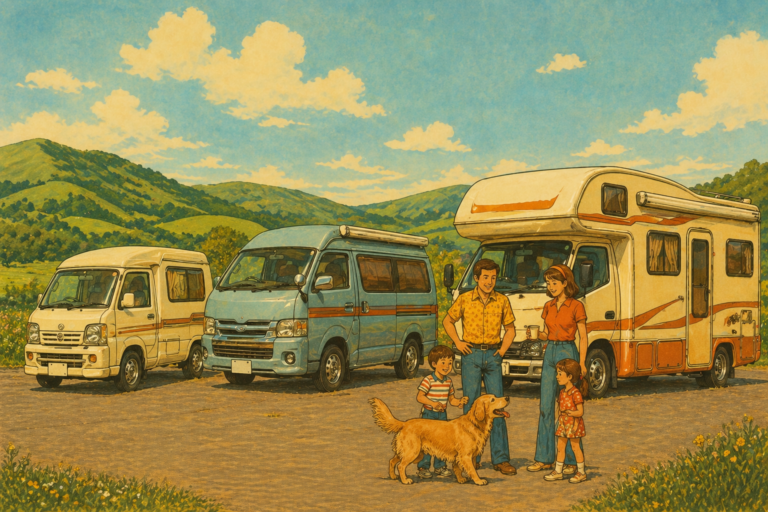
Even on the same itinerary, changing the vehicle type affects both the rental fee and fuel economy. It is important to choose a vehicle size that is “right” for your group size and luggage — one that is too big works against you on both rental cost and fuel.
For 1–2 People: Kei Camper
Kei campers are generally cheaper to rent than van conversions, and fuel economy is around 12–16 km/L — very economical. For 1,500 km at 14 km/L with petrol at ¥180/L, fuel comes to about ¥19,000, compared with ¥27,000 for a van conversion at 10 km/L — a difference of around ¥8,000.
For 3–4 People: Mid-Size Van Conversion Offers the Best Value
With 3–4 people in a van conversion, rental fees, fuel, and campsite costs spread out in a well-balanced way per person. Equipment is adequate, storage for food and luggage rarely becomes a problem, and it is well suited to longer trips.
For 5 or More People: Leverage the Cost-Sharing Effect with a Cab Conversion
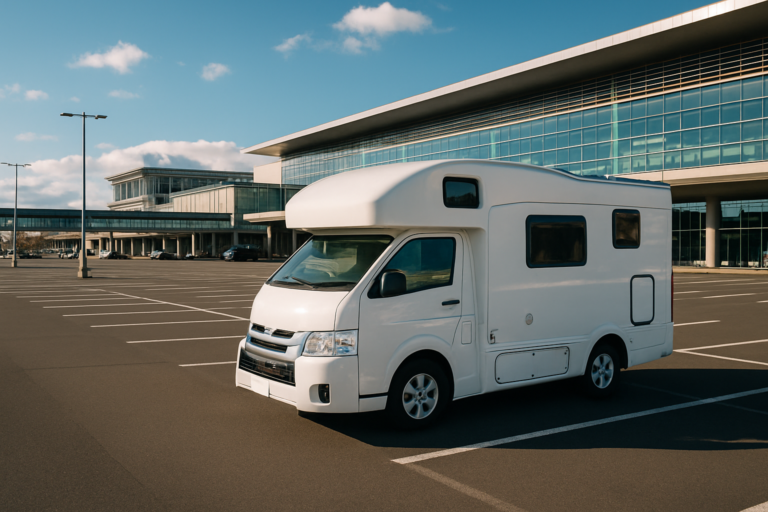
With 5–6 people, sharing a cab conversion can keep per-person costs very low. Moving Inn New Chitose Airport’s Cresson Journey (a cab conversion) has been accepting bookings since June 2026 and is well suited to spreading costs across a family or group. Because it comes with a shower and toilet on board, you can reduce the frequency of trips to external facilities, saving both time and money.
New from June 2026 — Departing New Chitose Airport
Rent the Cab Conversion “Cresson Journey”
Moving Inn New Chitose Airport has started accepting bookings for a genuine cab conversion. The spacious living area makes Hokkaido travel more comfortable for families and groups.
View Details at Moving Inn →Keeping Food Costs Down: Using Roadside Stations, Farm Shops, and Self-Catering
Food costs on a Hokkaido trip can range from ¥2,000 to ¥8,000 per day depending on how you manage them. Eating out every meal drives costs up, but cooking everything yourself can take the fun out of the trip. The key is making smart use of roadside stations, farm-direct markets, and local supermarkets to strike a balance between good food and controlled spending.
Making Use of Produce and Ready-Made Dishes at Roadside Stations
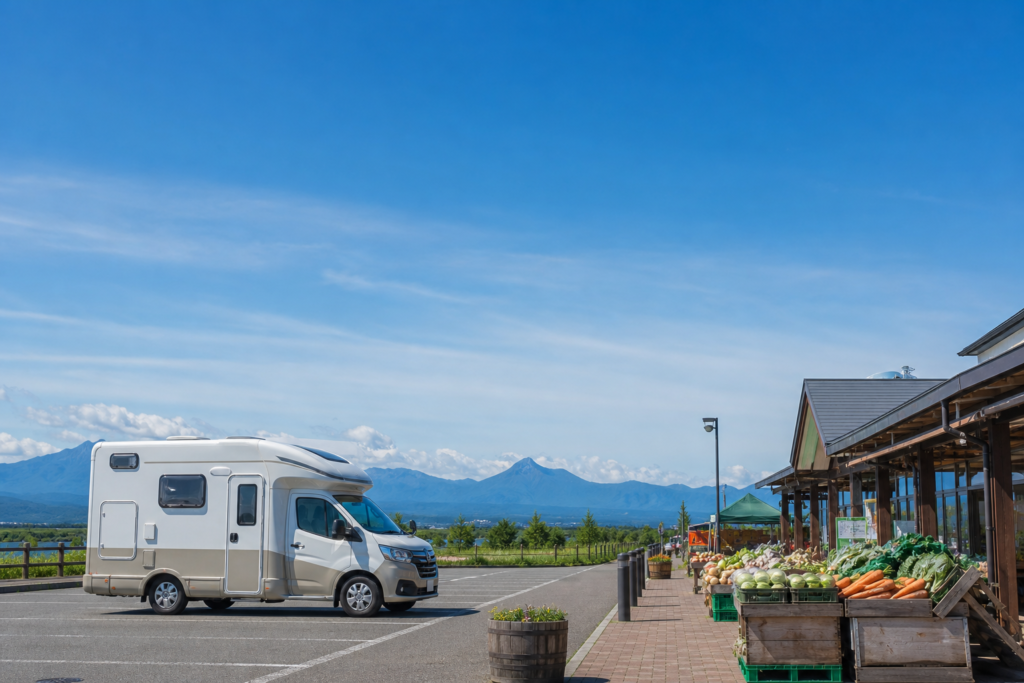
Hokkaido’s roadside stations are well stocked with vegetables, fruit, and processed goods, and prices are lower than eating out. Corn, potatoes, onions, tomatoes, and similar in-season produce (July–September) can often be bought fresher and cheaper at roadside stations than at local supermarkets. Ready-to-eat dishes (potato mochi, pork-bowl bento, etc.) are also plentiful and work well as quick meals.
Sourcing Ingredients from Local Supermarkets
Hokkaido supermarkets (Coop Sapporo, Arcus group, Tsuruha Drug, etc.) are spread across the whole island. Targeting evening markdowns (half-price stickers, discount labels) lets you pick up high-quality ingredients cheaply. Sashimi, sushi packs, and grilled fish are all ready to eat with the small kitchen in a campervan.
Choosing What to Cook
Cooking inside a campervan means limited heat and limited equipment. Sticking to simple menus — one-pot dishes, stir-fries, instant noodles, and retort pouches — cuts both cost and effort. Keeping breakfast and lunch quick and simple, then spending a little more on dinner, is a pattern that tends to keep overall trip satisfaction high.
Reducing Sightseeing Costs with Free and Low-Cost Spots
Hokkaido has a huge number of spots where you can enjoy the vast natural scenery for free. Paying admission every day at famous sightseeing attractions adds up fast, but combining free and paid spots cleverly can cut sightseeing costs by half or more.
Examples of Free and Low-Cost Spots
- Cape Sōya (Japan’s northernmost point): free, with car park.
- The hills of Biei (Patchwork Road, Ken and Mary’s Tree, etc.): free to view from your vehicle.
- Kushiro Marsh Observation Deck (Kushiro City Wetland Observation Tower): paid but low cost (approx. ¥500 per adult as of 2026).
- Roadside stations (michi-no-eki): parking and rest are free, paying only if you eat or shop.
- Strolling around Lake Toya: free on foot. The evening fireworks (every night, April–October) can be watched from the lakeside for free.
- Soya Hills in Wakkanai (the “White Road”): essentially free to drive through.
- Trailheads of the Daisetsuzan range (Asahidake, Kurodake, etc.): ropeway is paid, but the hiking trails themselves are free.
Narrowing your paid visits to “this one we will definitely pay for” moments, and filling the rest with free spots, makes it much easier to maintain satisfaction while keeping costs in check.
How to Save on Hot-Spring Costs
Hokkaido has many public and day-use hot-spring facilities, with low-price options (admission around ¥400–600) aimed at local residents dotted all over the island. Compared with the day-bathing fee at a high-end hot-spring inn in a tourist area (¥1,500–3,000), the difference is significant. Searching for “Hokkaido onsen kakuyasu” (budget hot springs) or “cho-ei onsen” (municipally run hot spring) is a good way to find the kind of places locals use.
Route Planning and Fuelling Tips to Cut Petrol Costs
Hokkaido’s sheer size means distance adds up quickly, and petrol is a non-trivial share of total travel costs. A little thought can save thousands of yen — or over ¥10,000.
Designing a Route That Avoids Unnecessary Backtracking
A back-and-forth route wastes distance. By designing a route that advances in one direction from your starting point (New Chitose Airport) toward your return point, you can sometimes reduce total distance by 20–30% while visiting the same attractions over the same number of days. A loop route is almost always more distance-efficient than an out-and-back route.
Fuelling Up at Cheaper Petrol Stations
Petrol prices vary by region. Competition is fierce in the main cities (Sapporo, Asahikawa, Obihiro) so prices tend to be lower there, while prices are often higher in remote islands and small towns in the far north. Using a fuel-price comparison app (e-nenpi or similar petrol price sites) to fill up more in cheaper areas makes a noticeable difference. Getting in the habit of filling the tank in the last city before entering a high-price zone saves money.
Using Motorways Selectively
Hokkaido motorways (Dō-ō Expressway, etc.) often involve long stretches, and tolls accumulate quickly. If you have plenty of time, using national and prefectural roads saves on toll costs. That said, driving long distances on ordinary roads is more tiring, so treating motorway sections where you feel fatigued — or night driving — as a safety cost worth paying is also a valid choice.
Saving Money Through Smart Insurance and Option Choices
Insurance and option selection is an often-overlooked part of rental costs. Adding unnecessary extras increases the bill, while skimping on necessary insurance can lead to large expenses if something goes wrong.
Understanding the Difference Between Basic and Optional Insurance
Rental vehicles typically include basic vehicle, personal-injury, and third-party property insurance in the rental fee, but there is usually an excess (your out-of-pocket amount in the event of an accident) set at ¥20,000–50,000. Adding the liability waiver (NOC cover) brings this down to zero, but adds around ¥3,000–5,000 for a five-night stay. For a first campervan trip or an unfamiliar itinerary, taking the cover gives peace of mind. Experienced drivers can save by opting out.
Bringing Your Own Bedding and Cooking Equipment Saves Money
Rental company bedding sets (duvet, pillow, sheet) can cost ¥1,000–2,000 per person per night. For 3 people over 5 nights, renting bedding adds ¥15,000–30,000 in optional extras. Bringing your own sleeping bag and pillow brings this cost close to zero. The same applies to cooking equipment — bringing compact pots, a frying pan, and cutlery makes the cooking-kit option (around ¥1,000–2,000/night) unnecessary.
Your Smartphone Can Replace a Sat-Nav and ETC Device
The optional sat-nav add-on (¥300–500/day) can be replaced by Google Maps or a navigation app on your smartphone. You will need a bracket to mount your phone on the campervan’s dashboard — a generic holder for ¥100–300 works fine if you prepare one in advance. For ETC (electronic toll collection), using your own ETC card rather than renting one avoids handling fees (confirm in advance whether the vehicle has an ETC device fitted).
Options for Reducing Accommodation Costs Beyond Campsites
Campsites are the default accommodation for campervan travel, but depending on circumstances, combining roadside stations, RV parks, and rest stops at roadside stations can reduce costs.
How to Use RV Parks
RV parks (fee-based car parks accredited by the Japan RV Association) are often priced lower than campsites, with most costing ¥1,500–3,500 per night. They have power and toilets, and many are adjacent to external facilities (hot springs, etc.). Because no tent pitch or campsite setup is required, they also save time, making them a good break-point on consecutive travel days. You can search for RV parks in Hokkaido via the Japan RV Association’s official website (as of June 2026).
Sleeping in Your Vehicle at Roadside Stations
Sleeping in Your Vehicle at Roadside Stationsは正式な宿泊施設としての利用ではありませんが、やむを得ない休憩・仮眠として利用されているケースは多いです。ただし道の駅ごとに方針が異なり、連泊禁止・エンジンかけっぱなし禁止・発電機使用禁止のルールを設けている施設があります。利用前に道の駅の公式サイトや掲示物でルールを確認し、マナーを守った利用を心がけましょう。宿泊施設としての利用は原則禁止という施設も増えているため、安易に「タダで泊まれる場所」として使うのは控えることが大切です。
Free and Low-Cost Campsites
Hokkaido still has a reasonable number of publicly run campsites (municipal and forest parks) that are free or cost only a few hundred yen. Facilities are often basic, but for travellers who are happy with a water source and toilets, they are a genuine cost-saving option. Searching for “Hokkaido muryō campjō” (free campsites in Hokkaido) or “[city name] municipal campsite” is a good way to find candidates. That said, always verify the latest information on ageing or closed facilities before heading out.
Frequently Asked Questions (FAQ)
Q: What is the cheapest season to enjoy a Hokkaido campervan trip?
A: September–October is particularly good. High-season rates (July–August) start to fall, autumn weather is often stable, and the autumn colours are a bonus. May–June is similarly good value at off-peak prices. Winter (November–April) raises the driving difficulty due to snow and ice, so it is not recommended for those with limited campervan travel experience.
Q: Do all rental companies offer early-bird discounts?
A: Not all companies offer them. However, many of the popular rental companies do have some form of early-booking or web-exclusive discount. Check the “plan selection” screen on the booking page, or call to ask — that is the most reliable approach. Check Moving Inn (New Chitose Airport store) and each operator’s official website for the latest discount information (as of June 2026).
Q: Are there ways to reduce campsite costs?
A: There are several effective approaches. First, use consecutive-night discounts (some sites discount for stays of 2–3+ nights). Second, choose unpowered or free-pitch sites (often ¥500–1,000 cheaper than powered assigned pitches). Third, use national- or prefectural-government-run campsites (many are priced lower than privately run ones). Fourth, mix in overnight stops at roadside stations (confirm in advance whether this is permitted).
Q: Can I save on food without missing out on Hokkaido cuisine?
A: Absolutely. The key is prioritising. For crab, sea urchin, or salmon roe, using a kaiten-zushi (conveyor-belt sushi) restaurant at ¥110–220 per plate can let you enjoy the same ingredients for less than a tenth of what a high-end restaurant would charge. Asahikawa, Sapporo, and Hakodate all have plenty of set-meal restaurants — the kind local residents use — where a full meal costs under ¥1,000–1,500. Simply avoiding the tourist-area premium spots makes a big dent in food costs.
Q: Which cost category gives the biggest saving if I prioritise it?
A: Rental fees give the biggest saving. Combining off-season, weekday, and early-bird booking can produce a difference of ¥50,000–100,000 or more on the same itinerary. Group size has the next biggest impact — going from 2 to 4 people halves the per-person rental cost alone. Food and petrol savings tend to accumulate in smaller ¥1,000–3,000 increments.
New from June 2026 — Departing New Chitose Airport
Rent the Cab Conversion “Cresson Journey”
Moving Inn New Chitose Airport has started accepting bookings for a genuine cab conversion. The spacious living area makes Hokkaido travel more comfortable for families and groups.
View Details at Moving Inn →