Rebun Island & Rishiri Island Campervan Island Travel Guide | Ferry Vehicle Transport, Costs & Important Notes [2026]
A guide to visiting Rebun and Rishiri Islands by campervan. Covers ferry vehicle transport procedures, costs, and key points to know before traveling.
Pick a campervan by what matters to you.
Rent at New Chitose Airport
See only the rental bases in Chitose, where the airport is.
Rent in winter (Dec–Mar)
Companies that rent through winter, listed apart from those that close.
Guide price
Moving Inn New Chitose Airport: HIACE van conversion from ¥22,000 per night. 20–30% off when booked 60–90 days ahead (official rate table, checked 15 Oct 2026).
New Chitose Airport map for campervan travellers →
Before you book: with an International Driving Permit if your country is in the Geneva Convention (for example the US, Australia, Singapore); Taiwan, Switzerland, Germany, France, Belgium and Monaco need your licence plus a Japanese translation (Tokyo Metropolitan Police). Questions in English: Moving Inn on WhatsApp. Every roadside station (michi-no-eki) must have free 24-hour toilets, and Hokkaido has 128 of them (MLIT).
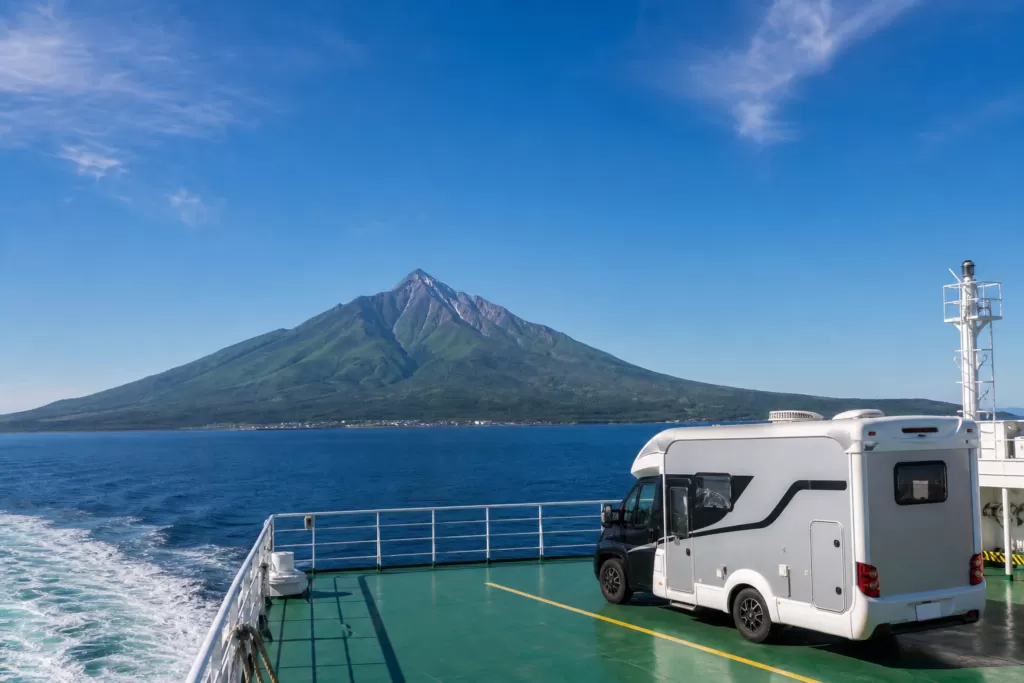
Rebun Island and Rishiri Island are Japan’s northernmost outlying islands, reached from Wakkanai by a 2-to-4-hour ferry crossing. The moment when Mt. Rishiri — often called “Rishiri-Fuji” for its perfect cone shape — rises out of the sea as the ferry approaches is more striking than any travel-guide photo. You can bring your own campervan onto the islands, which means you’re free to move around at your own pace without worrying about lodging availability, exploring the alpine flower fields, Lake Otatomari, and Rebun’s trekking routes on your own schedule. That freedom is the heart of this trip.
That said, the ferry link between the mainland and these islands runs under different rules than an ordinary car ferry: fare structure, booking timing, cancellation risk, and on-island fuel and food logistics. If you don’t know these in advance, your itinerary can fall apart. This guide organizes the practical information you need to bring a campervan to Rebun and Rishiri, section by section.
Note that most rental campervan companies’ terms of service prohibit ferry transport of their vehicles. Please read this guide with the assumption that you’re bringing your own privately owned campervan.
The Value — and the Cautions — of Bringing a Campervan to the Remote Islands
The biggest advantage of touring Rebun and Rishiri by campervan is freedom of movement. Sightseeing spots are scattered across the islands, and bus service is limited. You could rent a car locally, but bringing your own vehicle means you travel with all your food, bedding, and cooking gear already on board, with no need to arrange accommodation. On Rebun Island in particular, some routes to the island’s northern tip are served by only a few buses a day, so being able to drive yourself changes the quality of the trip enormously.
There are, however, several things to watch for. First is cancellation risk. The Rebun/Rishiri route is especially exposed to wind, and even in summer, a spell of bad weather can cause sailings to be cancelled or delayed. Unless you build in at least one buffer day before and after your island stay, your return date or next commitment can be thrown off. Avoid scheduling a “must be back today” kind of itinerary.
Second is the restriction on rental campervans. From converted Hiace vans to large cab-conversion motorhomes, most rental companies in Hokkaido state in their terms of service that ferry transport is not allowed, because it may void the vehicle insurance. Assume that only privately owned vehicles can be brought to the islands. If you’re reading this as a rental-car user, confirm this with your rental company well in advance, so you don’t find out at the harbor that you can’t make the crossing.
Also, the islands have far fewer commercial facilities than the mainland. Stock up on fuel, food, and daily necessities in Wakkanai beforehand — more on this in a later section.
Wakkanai–Rebun/Rishiri Ferry: Vehicle Transport Fares, Reservations & Length Restrictions
Ferries to Rebun and Rishiri are operated by Heartland Ferry. Departing from Wakkanai Port, they arrive at Oshidomari Port on Rishiri Island or Kafuka Port on Rebun Island. The crossing takes about 1 hour 40 minutes from Wakkanai to Oshidomari, and about 2 hours from Wakkanai to Kafuka; some sailings call at both islands via Wakkanai–Oshidomari–Kafuka.
Vehicle transport fares rise in steps according to the vehicle’s overall length. As a guide for 2026 (rates vary by peak season — always confirm the latest fares on the official site):
| Length class | Wakkanai–Oshidomari (Rishiri) | Wakkanai–Kafuka (Rebun) |
|---|---|---|
| Under 4m | Approx. ¥14,000–16,000 | Approx. ¥16,000–18,000 |
| 4m to under 6m | Approx. ¥20,000–24,000 | Approx. ¥22,000–26,000 |
| 6m or over | Approx. ¥32,000–38,000 | Approx. ¥34,000–40,000 |
Most campervans fall within 5–7m overall length, but large cab-conversion models (Joypop, Cresson-series, etc.) often come in around the 6m mark, and even slightly exceeding 6m bumps you into the next fare tier. Check your vehicle’s overall length on the vehicle inspection certificate and declare it with margin to spare — if your declared length doesn’t match the actual measurement, you may be refused boarding.
Passenger fares are charged separately: roughly ¥2,700 for an adult from Wakkanai to Rishiri, and roughly ¥3,200 for an adult from Wakkanai to Rebun (2nd class). Round-trip discounts apply for round-trip bookings. There is also a direct sailing between Rishiri and Rebun, so if you’re touring both islands you don’t need to return to Wakkanai in between.
Reservations are essential. Vehicle transport slots fill up faster than passenger seats. Weekends and the Obon period in summer (July–August) can sell out weeks in advance. Book early through the Heartland Ferry official website or by phone (0162-33-7000). Reservation changes are usually accepted free of charge up until the day before departure, though cancellation policies vary by season.
The Wakkanai Port ferry terminal has a vehicle staging area, and you need to arrive and line up at least an hour before departure. Large vehicles are loaded from the back in the order directed by staff. The terminal has a food area and souvenir shop, so you can pass the waiting time there.
Compare Hokkaido Campervan Rentals
Base yourself at New Chitose Airport and compare rates, vehicle types, and pickup locations all in one place.
Compare rental companies and prices →Rishiri Island Highlights: Mt. Rishiri & Lake Otatomari
Rishiri Island is a nearly circular island about 63km around, with Mt. Rishiri (Rishiri-Fuji) forming the backbone of the whole island at its center. This 1,721m free-standing peak looks almost perfectly triangular from the sea, and on a clear day the view from Rebun Island or Wakkanai is breathtaking. Watching the mountain grow larger as your ferry approaches is one of the most memorable moments of a Rishiri trip.
A drive around the island starting from Oshidomari Port, either clockwise or counter-clockwise, covers about 60km — you can hit the main spots in 2–3 hours even at a relaxed pace. The roads are paved and easy to drive even in a campervan, but some stretches heading into the mountain areas have steep grades and narrow width, so it’s safer for larger vehicles to park at a spot before that point and continue on foot.
Lake Otatomari is a wetland lake on the island’s south side, famous as a spot where Mt. Rishiri’s reflection appears on the water’s surface. The car park accommodates large vehicles, is free, and has a shop and restrooms. The “upside-down Fuji” reflection is easiest to see in the morning, and on windless days you’ll find a mirror-still, tranquil scene. The path circling the lake takes about 20 minutes to walk at a relaxed pace.
Minamihama Wetland and Lake Himenuma are also easy to add to a driving route. Lake Himenuma is about 10 minutes by car from Oshidomari Port, with a path that loops all the way around the lake. Ducks and waterfowl are plentiful in the early morning, making it a good spot to feel the island’s quiet atmosphere.
If you’re planning to climb Mt. Rishiri, it makes sense to combine it with an overnight stay in your campervan the night before. The trailheads are the Oshidomari route and the Kutsugata route; there are no mountain huts, only an emergency shelter, so a day hike is the standard approach. The typical round trip takes 8–10 hours. Most climbers start between 4 and 5am, so sleeping overnight in your vehicle near the trailhead parking the night before makes for a smooth start. Even in July and August, temperatures near the summit of Mt. Rishiri are low, and on windy days the perceived temperature drops sharply — be sure to bring cold- and wind-weather gear.
No trip to Rishiri Island is complete without the local sea urchin. Uni from Rebun and Rishiri has an excellent reputation nationwide, and July–August is peak season. Near Oshidomari Port, diners and markets serve uni-don (sea urchin rice bowls) for roughly ¥1,500–3,500. If you want to compare fresh uni from both islands, try it on both Rebun and Rishiri to taste the difference.
Rebun Island Highlights: Alpine Flowers & Trekking
Rebun Island is known as the “floating island of flowers.” Across hills rising from near sea level to about 300m, plants that would normally only grow at high alpine elevations bloom at ground level. Because the island sits so far north, summer temperatures stay low enough for alpine flora to thrive at low elevation. The island’s total area is 81.3km², less than half of Rishiri’s 182.1km², yet the density of things to see is remarkably high.
The signature flower is the Rebun Atsumorisou (Rebun lady’s slipper orchid). It’s listed as an endangered species on the Ministry of the Environment’s Red List and is known worldwide as a rare alpine plant endemic to Rebun Island. Access to its natural habitat is restricted, but you can view it in the Rebun alpine plant community area in the island’s north (including the Usuyuki-no-Sato area) or in dedicated protected zones. It’s at its best from early to late June.
The island has several trekking routes of varying difficulty and length. The best known is the Rebun Island Traverse Course (also called the Cape-to-Cape Course), running from Cape Sukoton at the island’s northern tip to Cape Keshi at the southern tip via the Momoiwa Observatory. It’s about 20km long and takes 6–8 hours, making it a route for experienced hikers. Walking almost the entire length of the island’s west coast, this course offers a continuous experience of flower fields with ocean views — one of the finest treks in Hokkaido.
If you’re not confident in your stamina, even a round trip to the Momoiwa Observatory (40–60 minutes on foot one-way from Kafuka Port) is enough to enjoy spectacular views. From the observatory, Rebun’s rolling hills and the ocean spread out before you, and on a clear day you can even see Mt. Rishiri in the distance. Flower variety peaks from mid-June to mid-July, so timing your visit then maximizes the alpine-flower experience.
Rebun’s trekking routes run mostly along trails and grassland rather than paved paths, so trekking shoes — not sneakers — are strongly recommended. On windy days it’s easy to lose your footing near the capes. There are also long stretches with no restrooms or shops along the way, so bring plenty of water and snacks. Fog is common in June and July, and visibility can suddenly worsen even on a clear day. Check the weather forecast and local conditions before setting out.
Another highlight of Rebun Island is Cape Sukoton. Located at the island’s northernmost point, on a clear day you may even spot Steller sea lions. Small reefs continue past the cape, leaving a strong impression that you’ve reached the northern edge of the sea. Parking is designed mainly for small cars, so it’s safer for large campervans to park on the wide shoulder before the cape and walk the rest of the way.
Dining on Rebun Island is concentrated around the Kafuka area. There are several local diners and uni-don restaurants near Kafuka Port. Most island eateries are open only for lunch, from around 11am to 2pm, and many close in the evening, so plan your schedule around lunchtime. Rebun kelp is a local specialty and a popular souvenir, also sold at the shop inside the ferry terminal.
New Chitose Airport / Tokachi-Obihiro Airport
Rent the Cresson Journey Cab-Conversion Motorhome
Base yourself at New Chitose Airport and travel all across Hokkaido by campervan.
See details at Moving Inn →Overnight Parking, Campsites, Water & Fuel on the Islands
Both Rebun and Rishiri Islands have well-maintained campsites. That said, there are far fewer facilities than on the mainland, and they get crowded during peak season.
On Rishiri Island, the Rishiri Island Family Campground “Yu-ni” near Oshidomari Port is right next to a hot spring facility, so you can bathe there. The sites are grassy and accept both tent camping and car/van camping. In the western Kutsugata area, “Kutsugata-misaki Park Campground” sits close to the coast, with views of Mt. Rishiri while you stay. Advance booking is recommended at both in July and August.
On Rebun Island, “Momoiwaso YH Campground” (near the Momoiwa Observatory parking area) close to Kafuka Port and “Sukoton Campground” are commonly used. Sukoton Campground is near the island’s northernmost point; the facilities are basic, but its ocean-view setting is a draw. Cooking areas and restrooms are maintained, but there are no shower facilities.
Before parking overnight at a michi-no-eki or public parking lot, check that facility’s rules in advance. The parking area near Oshidomari Port is open 24 hours, but for extended stays it’s good etiquette to check with the local visitor information center.
For water, you can refill at campsite cooking areas. Public facilities on the islands (michi-no-eki, campsites, ferry terminals) have running water. However, unlike on the mainland, the islands don’t have RV-point-style automatic water refill stations at michi-no-eki, so manual refilling at cooking areas is the norm.
You can also refuel (gasoline and diesel) on the islands, but the number of stations is very limited. Rishiri has one or two each in Oshidomari and Kutsugata; Rebun has a handful in the Kafuka area. Many are closed on Sunday and holiday afternoons, and early mornings. It’s safest to fill up completely in Wakkanai before boarding and treat on-island refueling as a top-up only. Campervans get worse fuel economy than ordinary cars, so keep in mind that just a few loops around the island can noticeably drain the tank.
Basic approach for food and daily supplies: stock up in Wakkanai before boarding the ferry. There are a few small supermarkets in Rebun’s Kafuka area, and grocery stores in Rishiri’s Oshidomari as well, but selection is limited and prices tend to be higher than on the mainland. Fresh food selection is usually best in the morning, and shelves can be bare by evening. Bring extra seasonings, instant food, and canned goods for a more comfortable stay.
In case of ferry cancellations, it’s important to always keep enough food and water on hand to stay on the island for several days. Bad weather can cause consecutive cancellations, so don’t plan around “I’ll be fine as long as I catch tomorrow’s ferry” — instead, prepare to handle an extra two nights if needed.
A quick note on hot springs and bathing facilities on the islands. On Rishiri Island, “Rishiri-Fuji Onsen” (in the Oshidomari area) offers day-use bathing and is popular with campervan travelers. On Rebun Island, there’s a public bathhouse and shower facility near Kafuka Port, though it’s small and can involve a wait when busy. Wiping down with wet wipes on days you can’t shower is just part of the island-travel experience.
Docomo has the widest mobile coverage on the islands, but you can lose signal at the northern tip (around Cape Sukoton on Rebun) and in mountainous areas. Download offline maps in your navigation app beforehand so you can still check your route in areas without signal. It’s also reassuring to bring some printed paper maps.
Frequently Asked Questions (FAQ)
Q: Can I bring a rental campervan to Rebun and Rishiri Islands?
Most rental companies’ terms of service prohibit ferry transport, because it may void the vehicle insurance. Always confirm this in advance with the rental company you plan to use. Very few rental companies in Hokkaido allow ferry transport, so plan this trip on the assumption that it requires bringing your own privately owned campervan.
Q: How much more does it cost if my campervan is over 6m long?
The 6m-and-over tier is often more than ¥10,000 higher one-way than the under-6m tier, a difference of ¥20,000 or more round-trip. You can check your vehicle’s overall length in the “overall length” field of the vehicle inspection certificate. If you have a carrier or bike rack mounted on the rear, declare the actual length including that attachment.
Q: What happens if the ferry is cancelled?
If a sailing is cancelled, both the passenger fare and the vehicle transport fare are refunded. However, a spot on the next sailing isn’t guaranteed — if the vehicle transport quota is full, you may need to change to a sailing the following day or later. We strongly recommend building in at least one extra day before and after your trip. You can check for cancellation notices on Heartland Ferry’s official website, social media, or by phone.
Q: What order should I visit Rishiri and Rebun Islands in?
The typical pattern is Wakkanai → Rishiri Island (2–3 nights) → Rebun Island (2–3 nights) → Wakkanai, or the reverse. There’s a direct sailing between Rishiri and Rebun, so you don’t need to return to Wakkanai in between. If you plan to climb Mt. Rishiri early in your trip, it’s better to visit Rishiri first while you have more stamina in reserve. Build slack into your travel days so you can adjust flexibly for weather.
Q: How do I get to Wakkanai, and how long does it take?
From New Chitose Airport, it’s about 6 hours (approx. 340km) via the expressway (Dō-ō Expressway → Asahikawa-kita IC) and National Route 40. Along the way, refuel in Asahikawa or Nayoro, then fill up completely in Wakkanai before boarding the ferry. It’s easier on your body to stay one night in Wakkanai and take the ferry the next morning. Wakkanai city has the “Wakkanai” michi-no-eki, a popular spot with overnight campervan travelers.
Q: What’s the best season to visit Rebun and Rishiri Islands?
June to August is best for a campervan visit. June is peak season for the Rebun Atsumorisou and other alpine flowers, with fewer tourists and a comfortable pace. July–August overlaps with peak uni season and the trekking season, but ferry vehicle slots get especially crowded. From September on, the flowers are past their peak and tourist numbers drop, but Mt. Rishiri’s autumn foliage begins, letting you enjoy the quieter islands at a relaxed pace. In winter (November–April), sailings are cut back significantly and most campsites close.
Book a Campervan in Hokkaido
Moving Inn New Chitose Airport supports English booking and offers airport transfers.
Pick a campervan by what matters to you.
Rent at New Chitose Airport
See only the rental bases in Chitose, where the airport is.

![Campgrounds Near Tokachi-Obihiro Airport: 8 Sites Within 30 km, Compared by Vehicle Access, Power and Price [2026]](https://hokkaido-campingcar.jp/wp-content/uploads/2026/10/photo-obihiro-airport-featured-pl232-768x512.jpg.webp)
![Campgrounds Near Hakodate Airport: 12 Sites Within 30 km, Compared by Vehicle Access, Power and Price [2026]](https://hokkaido-campingcar.jp/wp-content/uploads/2026/10/photo-hakodate-airport-featured-hl4722-768x484.jpg.webp)