Hokkaido Campervan Trips and Autumn Bear Safety: How to Avoid Encounters in the September–November Sighting Surge (2026 Edition)
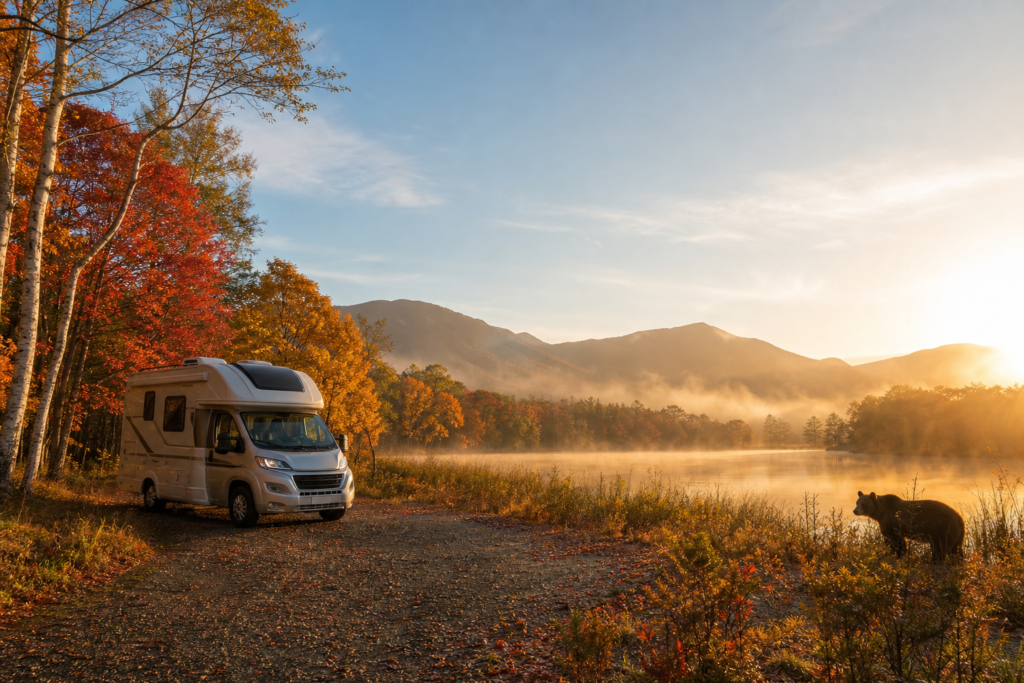
“Bears are only active in summer. By autumn they’re getting ready to hibernate, so the mountains go quiet” — that’s the assumption many people planning an autumn Hokkaido campervan trip make. It’s actually the opposite. Hokkaido Prefecture sets a “Special Autumn Bear Caution Period” every year. For fiscal 2026 it runs from September 1 to October 31, extended to November 30 in years when the mountain nut and berry crop is poor (Hokkaido Prefecture, “About Bear Caution Alerts”, checked 2026-08-24).
The numbers back this up. The monthly trend of bear-related reports to Hokkaido Police shows a first peak in July and a second peak in September–October. In fiscal 2023, reports reached 3,970 by the end of November, far above the previous four years’ range of 1,816–2,240 (Ministry of the Environment review committee document, “Current State of Hokkaido’s Brown Bear Countermeasures”, checked 2026-08-24).
This article covers why sightings increase in autumn, using primary data; the situations where campervan travelers are actually most likely to encounter a bear (mushroom picking, hiking, and other autumn activities); what to do if you encounter one while driving; and precautions you can take overnight in your campervan — all within the range of official information confirmed as of 2026-08-24. For overnight parking spot selection and general gear, see our Complete Guide to Overnight Parking in Hokkaido. Here, we focus specifically on autumn bear safety.
New from New Chitose Airport — Available from June 2026
Rent the Cabcon “Cresson Journey”
Base yourself at New Chitose Airport and compare rates, vehicle types, and pickup locations all in one place.
See details at Moving Inn →Why bear sightings increase in autumn
The autumn bear problem happens because “what bears need” and “what people are doing” overlap in the same season.
From the bear’s side: in the autumn months before hibernation, brown bears feed intensively on mountain nuts and berries such as acorns and wild grapes to build up fat reserves. Every year from September 1–16, Hokkaido conducts a “Autumn Mast Survey” on how well these crops have fruited, with results published in mid-October. In years judged poor to very poor, bears that can’t find enough food expand their range and are seen more often near towns and villages — a cause-and-effect relationship laid out in Ministry of the Environment and Hokkaido Prefecture materials (Ministry of the Environment review committee document, checked 2026-08-24). Put simply: when there’s no food in the mountains, bears come down closer to where people are. That’s the mechanism behind the autumn increase.
From the human side: Hokkaido Prefecture explains that it sets the autumn caution period because it is “a season when more people go into the mountains and fields, raising the risk of injury” (Hokkaido Prefecture, checked 2026-08-24). Autumn foliage, mushrooms, wild plants, fishing — autumn is also the season when people head into bear habitat.
The design of the caution period itself reflects this structure.
- Base period: typically September–October (for fiscal 2026, September 1 – October 31)
- Extension condition: extended to November 30 in years when mountain nuts and berries fruit poorly to very poorly
In other words, “it’s November now, so it’s fine” doesn’t always hold — in some years the caution period runs a month longer depending on how the crop turned out. If you’re planning a November trip, the practical step is to check the mid-October mast survey results and whether the caution period has been extended on Hokkaido Prefecture’s page before finalizing your itinerary.
Laying out this system and survey schedule by travel month looks like this.
| Travel month | What’s happening | What to check before you go |
|---|---|---|
| September | Caution period begins (Sep 1). Mast survey conducted (Sep 1–16) | Latest sighting reports for your destination municipality |
| October | Caution period continues. Mast survey results published mid-October | Sighting reports plus survey results (poor/very poor crop or not) |
| November | If the crop was poor to very poor, caution period extends to Nov 30 | Whether it was extended — treat extension years with the same alertness as October |
If you’re leaving in September, the survey results aren’t out yet, so sighting reports from each municipality are your main source of information. Leaving from mid-October onward, you also have that year’s overall crop outcome as an additional planning signal, which sharpens your read on the season.
Reports peak twice a year: July, then September–October
Let’s confirm “autumn increases” with data rather than a general impression. The monthly trend chart of reports to Hokkaido Police in the Ministry of the Environment’s review committee document (dated December 26, 2023) shows a first peak in July every year and a second peak in September–October (same document, checked 2026-08-24). The July peak corresponds to the breeding and dispersal season; the autumn peak comes from the food search described above.
Total reports by fiscal year are as follows.
| Fiscal year | Reports to Hokkaido Police |
|---|---|
| FY2019 | 1,825 |
| FY2020 | 1,816 |
| FY2021 | 2,197 |
| FY2022 | 2,240 |
| FY2023 | 3,970 (as of end of November) |
By the end of November, FY2023 had already exceeded the prior year by more than 1.7 times, and the document explicitly notes “an unusual increase in autumn reports.” That year, the autumn crop was poor, and bears searching for food showed up near towns more often. The mechanism described above — a poor crop driving a spike in autumn reports — shows up directly in the numbers.
Note that this data is from fiscal 2023. We have not been able to confirm the latest FY2024 or FY2025 report figures. Just before your trip, check the current year’s and region’s situation on Hokkaido Prefecture’s bear caution alert page and each municipality’s sighting information.
For campervan trip planning, here’s how to read this: September–October in Hokkaido is peak season for autumn foliage and food, one of the most appealing times to visit — but it’s also the second-busiest period of the year for bear reports. The conclusion isn’t “don’t go,” it’s “choose your activities assuming this is a high-report period.”
Nearly 40% of injuries happen during the exact activities travelers want to do in autumn
There’s a gap between “sightings increase” and “people get attacked.” What are people doing when accidents happen? The same Ministry of the Environment document includes a breakdown of the activity at the time of injury from April 1989 through November 2023 (same document, checked 2026-08-24).
| Activity at time of accident | Share |
|---|---|
| Hunting / pest control | 37% |
| Mushroom / wild plant picking | 31% |
| Forestry work | 8% |
| Farm work | 6% |
| Hiking | 6% |
| Fishing | 3% |
| Other | 9% |
The largest category, “hunting/pest control” (37%), involves hunters and doesn’t directly apply to travelers. What matters is what comes next: mushroom and wild plant picking at 31%, hiking at 6%. Together that’s 37% — the same share as hunting/pest control — made up entirely of activities travelers do for autumn recreation. Add fishing’s 3% and it’s close to 40%.
The same document also reports that when a human injury incident occurs, the fatality rate is 33% — roughly one in three. That’s a far more serious figure than the mental image most people have of a bear encounter in town (data as of fiscal 2023, checked 2026-08-24).
For campervan travelers, what this data means is that the dangerous moment isn’t while driving or overnighting in the vehicle — it’s the moment you get out and walk into brush or forest. There’s a straightforward reason mushroom and wild plant picking accidents are so common: you walk with your eyes down, in silence, which makes it harder to notice an approaching bear — and just as hard for the bear to notice you. In brush with poor visibility, both sides can end up at close range before either notices the other.
If you’re planning mushroom picking or autumn foliage hiking in Hokkaido, pair your activity plan with checking sighting reports for your destination and making noise as you walk. We cover the details of mushroom picking in our Tokachi mushroom picking guide, and autumn foliage hiking in our autumn foliage trekking guide. Both are exactly the activities behind that “31%” and “6%.”
New from New Chitose Airport — Available from June 2026
Rent the Cabcon “Cresson Journey”
Base yourself at New Chitose Airport and compare rates, vehicle types, and pickup locations all in one place.
See details at Moving Inn →If you encounter a bear while driving, stay in the vehicle
Driving through eastern or northern Hokkaido in autumn, there’s a real chance you’ll spot a bear near the road. What should you do? The Ministry of the Environment’s “Bear Sighting Response Manual” (revised edition) states, in effect, that if you encounter a bear while driving, you should not get out of the vehicle, and should instead call the police from inside the car and follow their instructions (Ministry of the Environment, “Bear Sighting Response Manual”, checked 2026-08-24).
To summarize, the confirmed response comes down to two points.
- Don’t get out of the vehicle (this includes getting out or approaching to take photos)
- Call the police (110 in Japan) from inside the vehicle and follow their instructions
Common mistakes include rolling down a window to film the bear on a smartphone, or staying parked to watch until it leaves. A campervan’s larger body can make you feel protected, but what the manual actually asks for is staying inside and calling it in — not staying at the scene to observe.
You may also come across advice to “sound your horn to scare the bear off.” We were not able to confirm the effectiveness or any official recommendation for this within the scope of our research. This article limits itself to what we could confirm — don’t get out, call from inside the vehicle. If you’re unsure what to do, prioritize calling for help over trying an improvised deterrent.
Overnight in your campervan: autumn-specific precautions
Keeping food in sealed containers inside the vehicle is a basic step we cover in our Complete Guide to Overnight Parking. Here, we add points specific to autumn, building on the data above. In autumn, bears are in their pre-hibernation feeding push, when their drive to find food is at its strongest for the year — and in poor-crop years, their search range extends closer to towns.
Don’t leave cooking smells behind. One advantage of a campervan is being able to cook entirely inside, but during autumn overnight stays, smells that escape through ventilation, along with cookware and food scraps left outside, become sources of odor. On nights you cook something strong-smelling like grilled meat or fish, don’t leave cookware outside — seal food waste and keep it inside the vehicle. Leaving trash outside can effectively invite a food-searching bear straight to your vehicle.
Don’t leave what you’ve foraged outside. An autumn-specific blind spot is your own haul — mushrooms, wild plants, fruit. These are literally the same food a bear is searching for, so avoid leaving them outside overnight or under a side awning; seal them and bring them inside the vehicle.
Check sighting reports for where you’re staying, that same day. Hokkaido Prefecture and individual municipalities publish bear sighting information. Rather than checking once before departure and stopping there, make it a habit to check the latest reports for that municipality when you decide where to stay that night — this lets you adapt to an “unusual autumn,” like a poor-crop year. In a year like FY2023, when reports were more than 1.7 times the year before, last year’s experience doesn’t necessarily apply.
Arrive at your overnight spot while it’s still light. Autumn days in Hokkaido are short, and from October it’s dark by early evening. Arriving somewhere new after dark means you can’t check things you’d only notice on site — scattered trash nearby, or a municipal caution sign posted somewhere. Arriving before sunset is both a bear-safety measure and a way to scout your surroundings for the next morning.
Cut down on trips outside at night and early morning. Handle bathroom breaks, trash, and locking up before bed, and keep time spent outside during dark hours to a minimum. This isn’t a special bear precaution — it’s just good overnight-parking practice. Whether your vehicle has gear that reduces the need to step outside at night, like a portable toilet, is a reasonable factor to weigh when choosing a vehicle for autumn Hokkaido.
Frequently Asked Questions (FAQ)
Q. When is the Special Autumn Bear Caution Period?
For fiscal 2026, it runs September 1 – October 31. In years when acorns, wild grapes, and other mountain crops fruit poorly to very poorly, it’s extended to November 30 (Hokkaido Prefecture, checked 2026-08-24). Whether it’s extended depends on that year’s mast survey, with results published mid-October, so check the latest announcement before a November trip.
Q. Is autumn or summer more dangerous for bear encounters?
The monthly report trend shows two peaks, July and September–October — it isn’t a case of one season being dangerous and the other safe (Ministry of the Environment review committee document, checked 2026-08-24). That said, human injury causes are concentrated in autumn activities — mushroom/wild plant picking at 31%, hiking at 6% — so autumn, when people head into the mountains, is a season where encounters are more likely to turn into incidents. We were unable to confirm location-specific encounter probabilities from published materials.
Q. Can you be attacked while sleeping inside a campervan?
The statistics we reviewed (activity-at-injury breakdown, April 1989 – November 2023) don’t include a category for injuries occurring inside a parked vehicle overnight. The recorded causes are all outdoor activities — mushroom/wild plant picking, hunting, hiking, and so on. That said, this isn’t grounds for assuming “anything goes as long as you’re inside” — keep managing food and trash and checking sighting reports regardless.
Q. If I spot a bear while driving, is it okay to scare it off with my horn?
We were unable to confirm the effectiveness or any recommendation for horn use within the Ministry of the Environment manual we reviewed. The confirmed response is limited to two points: don’t get out of the vehicle, and call the police from inside and follow their instructions (Ministry of the Environment, “Bear Sighting Response Manual”, checked 2026-08-24).
Q. Should I bring a bear bell or bear spray even on a driving-based trip?
You won’t need them while you’re in the vehicle, but it’s a different story if you’re planning to leave the car for mushroom picking, foraging, or hiking on trails through brush. Given that these activities together account for close to 40% of human injuries (mushroom/wild plant picking 31% + hiking 6% + fishing 3%, checked 2026-08-24), decide based on whether you actually plan to get out and walk. We cover gear details in our Complete Guide to Overnight Parking.
Q. Once it’s November, can I stop worrying?
It depends on the year. In years with a poor to very poor crop, the caution period is extended to November 30, and in FY2023 reports had already reached 3,970 by the end of November, far above the prior four years. If you’re planning a November trip, it’s worth checking the mid-October mast survey results and whether the period has been extended before deciding.
Three things to do before you leave for a safe autumn drive in Hokkaido
The autumn increase in sightings isn’t random — it follows an explainable pattern tied to crop conditions and how many people head into the mountains. Once you understand the pattern, the actions follow. Here are three things to do before you leave.
- Check the latest status of the caution period and mast survey on Hokkaido Prefecture’s bear caution alert page (for a November trip, check whether it’s been extended)
- If you’re planning mushroom picking or hiking, prepare on the assumption that these activities rank near the top of injury causes (31% and 6%) — check sighting reports for your destination and be ready to make noise while walking
- For overnight stays, decide in advance not to leave anything with a smell — food waste, cookware, foraged items — outside the vehicle
Once these three points are built into your itinerary, round out your autumn Hokkaido plan with our Complete Guide to Overnight Parking in Hokkaido for where to park and what gear to bring.
Book a Campervan in Hokkaido
Moving Inn New Chitose Airport supports English booking and offers airport transfers.
![Things to Do in Sapporo in Winter: Beyond the Snow Festival, Plus Seasonal Highlights and a Campervan Guide [2026-27]](https://hokkaido-campingcar.jp/wp-content/uploads/2026/10/sapporo-hl1841-768x576.jpg)
![Monbetsu Drift Ice Festival 2027 [Feb 11–14]: Dates, Ice Sculptures, Garinko-go Icebreaker, Parking and Access by Campervan](https://hokkaido-campingcar.jp/wp-content/uploads/2026/10/monbetsu-hl999-768x576.jpg)
![Hokkaido New Year Weather and What to Wear | Sapporo, Hakodate, Asahikawa, Obihiro Mornings and Evenings, and Heavy-Snow Years [2026-27]](https://hokkaido-campingcar.jp/wp-content/uploads/2026/10/hokkaido-new-year-holiday-weather-eyecatch-768x432.webp)
![Hokkaido Illumination 2026-27 [Dates]: Sapporo Starts Nov 20, Plus Otaru, Asahikawa, Obihiro & Hakodate for Campervan Trips](https://hokkaido-campingcar.jp/wp-content/uploads/2026/10/hokkaido-illumination-2026-eyecatch-768x432.webp)