Do Campervans Need a Dash Cam? How to Choose One for Long-Distance Drives in Hokkaido [2026 Guide]
No government statistic tracks dash cam adoption in Japan; private surveys range 43% to 82%. Here's what actually matters for a long Hokkaido drive.
Pick a campervan by what matters to you.
Rent at New Chitose Airport
See only the rental bases in Chitose, where the airport is.
Rent in winter (Dec–Mar)
Companies that rent through winter, listed apart from those that close.
Guide price
Moving Inn New Chitose Airport: HIACE van conversion from ¥22,000 per night. 20–30% off when booked 60–90 days ahead (official rate table, checked 15 Oct 2026).
Before you book: with an International Driving Permit if your country is in the Geneva Convention (for example the US, Australia, Singapore); Taiwan, Switzerland, Germany, France, Belgium and Monaco need your licence plus a Japanese translation (Tokyo Metropolitan Police). Questions in English: Moving Inn on WhatsApp. Every roadside station (michi-no-eki) must have free 24-hour toilets, and Hokkaido has 128 of them (MLIT).
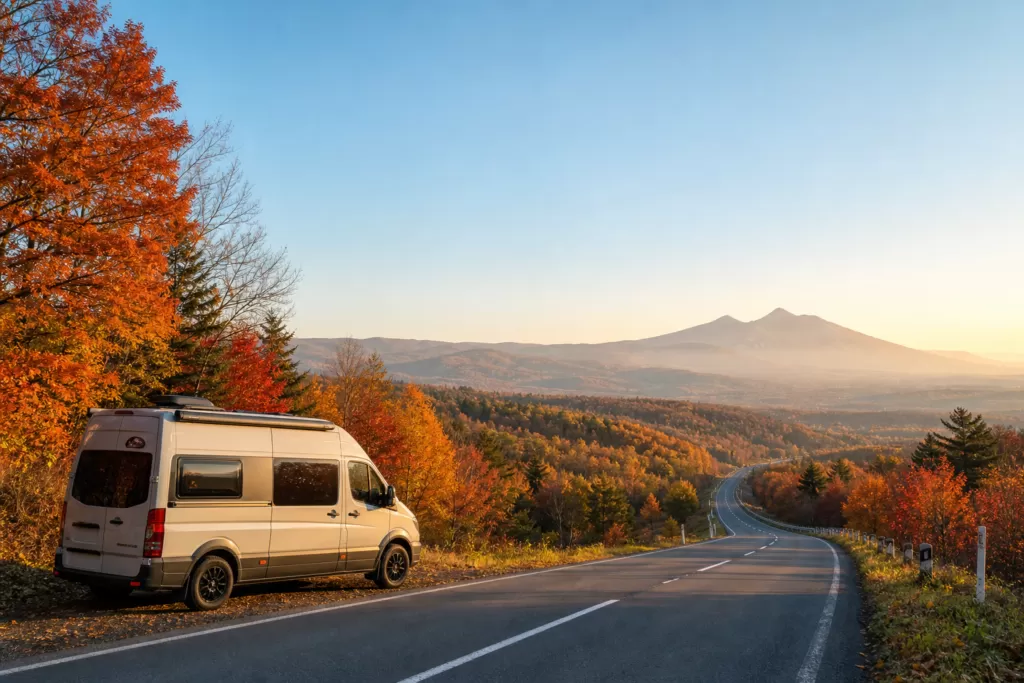
Before renting a campervan for a long-distance drive in Hokkaido, many people wonder whether they should bring their own dash cam. Unsignalized intersections along national highways, single-lane mountain passes with oncoming traffic, wildlife suddenly darting onto the road — the driving environment here is different from Honshu in ways that continue for miles, so it’s natural to want a record of what happens on the road.
Let’s be upfront about one thing: this article won’t cite an official statistic for “what percentage of cars in Japan have a dash cam.” As far as we could confirm, no such official statistic exists. Instead, we’ll focus on what actually matters when choosing a dash cam for long-distance driving in Hokkaido, based only on facts we could verify.
Is there an official statistic for dash cam adoption rates?
We checked the National Police Agency’s official page on “Using Dash Cams.” It contains manuals for traffic safety education and near-miss footage for hazard-prediction training, but no statistical data on vehicle adoption or penetration rates (confirmed 2026-08-27, National Police Agency official site). We also checked other government bodies that publish statistics, such as the Ministry of Land, Infrastructure, Transport and Tourism and the Ministry of Internal Affairs and Communications, but found no official statistics compiling dash cam adoption rates there either.
In other words, there’s no government statistic that can state definitively what percentage of cars nationwide have a dash cam installed. This article won’t build its argument around such a number either.
So what about the “adoption rate: X%” figures you see in the news? Let’s look at that next.
How much should you trust the “adoption rate: X%” figures in the news?
A search turns up several figures from independent surveys conducted by insurance companies and manufacturers. For example, a survey by Pioneer conducted in December 2024 reported an installation rate of 63.8% (confirmed 2026-08-27, JAF Mate Online), while Sony Assurance’s 2021 nationwide car-life survey reported a figure of 43.0% (confirmed 2026-08-27, Goo-net Magazine). At the prefecture level, an AXA General Insurance survey reported installation rates of 82.0% in Kanagawa Prefecture and 80.0% in Osaka Prefecture (confirmed 2026-08-27, Kyodo News PR Wire).
All of these are private-company surveys, each using its own methodology, sample, and collection method, conducted in different years. The fact that the figures range so widely, from 43.0% to 82.0%, is itself a sign that these aren’t a unified, official survey. They’re useful as a general indication that adoption is trending upward, but they can’t be used to make a specific claim like “X% of cars driving in Hokkaido have a dash cam.” This article treats these numbers as reference information only, not as the basis for how to choose one.
With the numbers out of the way, let’s look at how a dash cam actually helps on a long-distance drive in Hokkaido.
When does a dash cam actually help on a long-distance drive in Hokkaido?
Hokkaido’s national highways are known for unsignalized intersections, long stretches of single-lane two-way roads, and sections where houses disappear for dozens of kilometers once you leave a town. If a rear-end collision or contact accident happens with no witnesses around, footage from your drive can serve as evidence for establishing fault. Wildlife suddenly darting onto the road — Ezo deer in particular — is another risk specific to Hokkaido, and having a recording of the situation when you had to make a sudden evasive maneuver carries real weight too.
When driving a rental vehicle on roads you don’t know well, or navigating turning rules you’re not used to, near-misses are more likely to happen. If trouble does occur, whether or not you have footage can easily change how negotiations go. A dash cam isn’t a legal requirement — you can see how it differs from equipment like fire extinguishers, which are legally mandatory, in our article on campervan safety equipment.
So does a rental campervan come with a dash cam already installed?
Does the campervan you rent already come with a dash cam?
This varies by company, based on what’s listed on their official sites. QUUM’s official site explicitly lists “dash cam” in the equipment list for 4 of its 5 vehicle models (confirmed 2026-08-27, official site). We also checked other companies’ vehicle pages, but found that only a limited number explicitly list a dash cam in their equipment lists (confirmed 2026-08-27).
Even when a dash cam is installed, how long the footage is kept and how it’s provided in the event of an accident can differ from company to company. It’s worth confirming not just whether one is installed, but also how the footage would be handled if an accident happened, before you book. If a vehicle doesn’t have one, or you can’t confirm it does, bringing your own is the alternative. From here, let’s look at what to consider when choosing one.
Image quality and field of view — what should you look for?
According to Kakaku.com’s buying guide, a good baseline is Full HD resolution — roughly 2 megapixels or more — with a horizontal field of view of 100 degrees or wider (confirmed 2026-08-27, Kakaku.com, “How to Choose a Dash Cam Without Regrets”). If the resolution is too low, footage may not be clear enough to read a license plate in the event of an accident. For long-distance driving in Hokkaido, where you may need to capture the plate of an oncoming car or a vehicle behind you, it’s worth choosing a model that meets or exceeds this baseline.
With a narrow field of view, a side-on collision at an intersection or a merge from an adjacent lane can happen outside the frame entirely. On Hokkaido’s national highways, where single-lane two-way traffic is common, choosing a wider angle that can cover the oncoming lane extends the range of what you can actually use as evidence.
Next, let’s cover something essential and unique to Hokkaido: how a dash cam handles the cold.
Operating in cold climates — what should you check?
Winter in Hokkaido is on a completely different scale from what you’d expect on Honshu. According to the Asahikawa Tourism Convention Bureau, Japan’s record low temperature is -41°C, observed in Asahikawa on January 25, 1902 (confirmed 2026-08-27, Asahikawa Tourism Convention Bureau official site). That record is an extreme, one-off historical event, but it’s still not unusual for inland areas like Asahikawa and Tokachi to see winter lows of -20°C or below today.
Every commercially available dash cam has a manufacturer-specified “guaranteed operating temperature range” listed in its spec sheet. Some models designed with Honshu’s climate in mind are only rated down to around -10°C. If you’re buying or bringing a dash cam with the intention of using it through a Hokkaido winter, always check the minimum operating temperature in that specific product’s spec sheet. Rather than naming specific products or spec numbers, this article’s guidance is simply: check the operating temperature range in the spec sheet before you buy.
In low temperatures, it’s not just the dash cam unit itself — the microSD card used for recording can also become unstable. Some cards list their own recommended operating temperature range too, so it’s worth checking both the unit and the card together.
Do you need front-and-rear dual cameras?
There are single-camera models that only record the front, and dual-camera models that record front and rear simultaneously. On a Hokkaido trip that’s mostly long stretches of expressway and national highway driving, situations come up where you’d want a record of a tailgating vehicle closing the gap behind you, or aggressive driving-like behavior. A front-and-rear dual camera lets you capture evidence not only of a collision ahead of you, but also of being rear-ended.
That said, dual-camera models run wiring to two separate locations, front and rear, which makes installing one in a rental vehicle more complicated to route. Choose based on the balance between this benefit and how easy the unit is to install and remove.
Should you use parking surveillance mode on an overnight-parking trip?
Parking surveillance mode keeps recording what’s around the vehicle even while the engine is off. On a campervan trip where you’re often parked overnight at places like Michi-no-Eki (roadside rest stops) or convenience stores, where all kinds of people come and go, this can be meaningful as a record of break-ins or vandalism.
On the other hand, parking surveillance mode keeps drawing on the vehicle’s battery. If you’re using it for extended overnight parking, many units require a separate external battery in addition to the vehicle’s own, so it’s worth thinking through how you’ll supply power in advance. You want to avoid a dead battery that won’t start the engine the next morning. Whether to use parking surveillance mode should come down to how often you’re parking overnight and how easily you can secure a power source. The legal status of overnight parking itself is covered in detail in our article on whether overnight parking is legal, and how to choose overnight parking spots beyond Michi-no-Eki is covered in our RV park roundup article.
What should you watch out for when installing one yourself in a rental vehicle?
When installing one in a rental vehicle, there are two main things to watch out for: how you draw power, and restoring the vehicle to its original condition. Most dash cams run on power from the cigarette lighter socket, but on a vehicle where you’re also running appliances for overnight parking, that socket may already be in use. If you’re going to run wiring through the cabin, confirm with the rental company beforehand whether double-sided tape marks or clip holes will be an issue at return before you install anything.
A suction-cup mount lets you attach and remove the unit without leaving marks on the windshield. Before returning the vehicle, remove all wiring and the unit itself, and make sure you don’t leave anything behind in the cabin.
Frequently Asked Questions (FAQ)
Q1: What percentage of cars in Japan have a dash cam?
We could not find any official adoption-rate statistics published by public bodies such as the National Police Agency (confirmed 2026-08-27). Private surveys by insurance companies and others have reported figures ranging from 43.0% to 63.8%, but since the survey bodies and years differ, none of these can be treated as an official, definitive figure.
Q2: How can I check whether the campervan I’m renting has a dash cam?
Some companies explicitly list it in the equipment list on their official site (for example, QUUM, confirmed 2026-08-27). For companies that don’t list it explicitly, contact them directly at the time of booking to confirm.
Q3: Can I use an off-the-shelf dash cam as-is through a Hokkaido winter?
The guaranteed operating temperature range differs by product. Some models designed with Honshu’s climate in mind are only rated down to around -10°C. Since inland areas like Asahikawa and Tokachi commonly see winter lows of -20°C or below, check the operating temperature range in the spec sheet before you buy.
Q4: Should I choose a front-and-rear dual camera or a single front camera?
We can’t give a definitive answer, but for a trip that’s mostly long-distance expressway and national highway driving, a front-and-rear dual camera gives you a wider range of coverage, since it can also capture evidence if you’re rear-ended. Weigh this against the extra wiring work involved in installing one yourself.
Q5: What do I need for parking surveillance during overnight parking?
Parking surveillance mode itself comes built into many products, but running it for extended periods often requires an external battery. To avoid draining the vehicle’s own battery, confirm how you’ll supply power in advance.
Compare Campervan Rentals in Hokkaido
Base yourself at New Chitose Airport and compare rates, vehicle types, and pickup locations all in one place.
Compare Rental Companies & Rates →On a long-distance drive in Hokkaido, there are other precautions worth keeping in mind beyond your dash cam. It’s worth also checking our article on autumn brown bear precautions, our article on drivetrain types for snowy roads, our article on studless tire timing, and our guide to overnight parking at expressway SA/PA rest areas.
Compare Campervan Rentals in Hokkaido
Base yourself at New Chitose Airport and compare rates, vehicle types, and pickup locations all in one place.
Compare Rental Companies & Rates →Book a Campervan in Hokkaido
Moving Inn New Chitose Airport supports English booking and offers airport transfers.
Pick a campervan by what matters to you.
Rent at New Chitose Airport
See only the rental bases in Chitose, where the airport is.

![Hokkaido Winter Trip: Shoes & Packing List [2026] – 2,060 Sapporo Fall Transports and a Pre-Departure Checklist](https://hokkaido-campingcar.jp/wp-content/uploads/2026/10/hokkaido-winter-trip-shoes-packing-eyecatch-768x432.webp)
![Snow Cancels Your New Chitose Airport Flight? Rebooking Rules and Campervan Rental Delays [2026]](https://hokkaido-campingcar.jp/wp-content/uploads/2026/10/new-chitose-airport-snow-cancellation-eyecatch-768x432.webp)