Campervan Surf Trips in Hokkaido: Japan Sea & Pacific Surf Points and Overnight Parking [2026 Guide]
Hokkaido has 36 registered surf points on both coasts. We cover 4 spots with confirmed overnight-parking cases, from Ishikari Beach to Itanki.
Pick a campervan by what matters to you.
Rent at New Chitose Airport
See only the rental bases in Chitose, where the airport is.
Rent in winter (Dec–Mar)
Companies that rent through winter, listed apart from those that close.
Guide price
Moving Inn New Chitose Airport: HIACE van conversion from ¥22,000 per night. 20–30% off when booked 60–90 days ahead (official rate table, checked 15 Oct 2026).
New Chitose Airport map for campervan travellers →
Before you book: with an International Driving Permit if your country is in the Geneva Convention (for example the US, Australia, Singapore); Taiwan, Switzerland, Germany, France, Belgium and Monaco need your licence plus a Japanese translation (Tokyo Metropolitan Police). Questions in English: Moving Inn on WhatsApp. Every roadside station (michi-no-eki) must have free 24-hour toilets, and Hokkaido has 128 of them (MLIT).
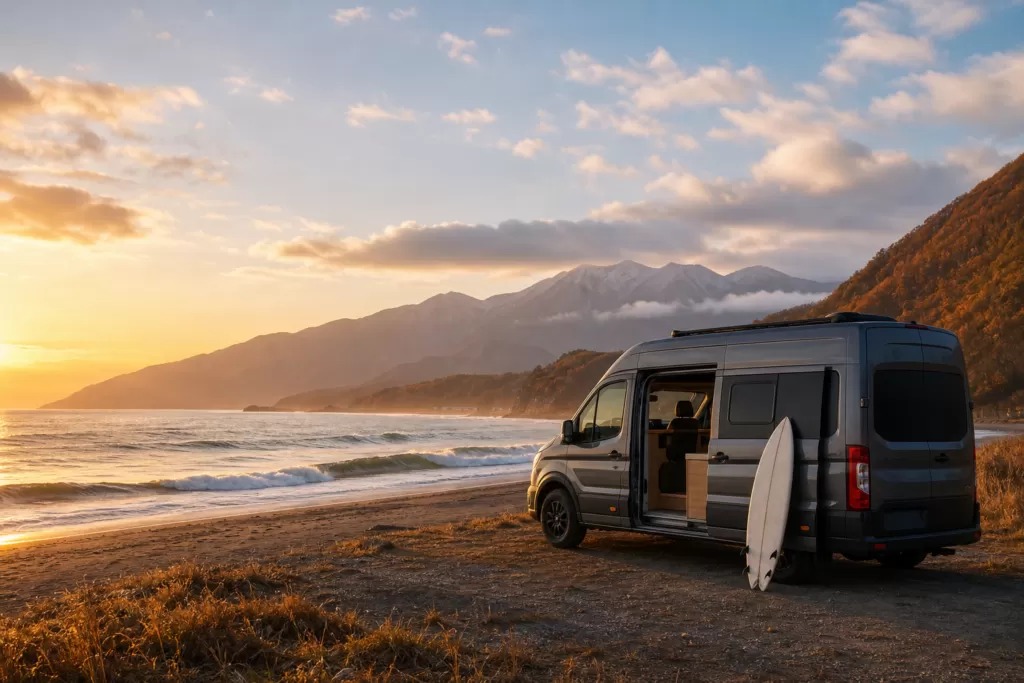
Surfers in Hokkaido are still a minority compared to Japan’s main island of Honshu. Even so, real surf points exist on both the Japan Sea side and the Pacific side, and a specialized database site for local surfers lists 36 points in Hokkaido alone (confirmed 2026-08-27, Surf Point 888 Japan). This article focuses on four of those points that are relatively easy to access and where actual cases of overnight parking have been confirmed, summarizing the characteristics of each and what to watch for when parking overnight.
To be upfront about it, Hokkaido’s surfing population itself is niche, and combining it with a campervan can’t be called common. Even so, the freedom to travel while carrying your board and the convenience of changing clothes and napping on the spot are areas where surf trips and campervans go well together.
How Common Is Surfing + Overnight Parking in Hokkaido, Really?
A look at specialized media confirms that trips combining surfing and overnight parking exist as a nationwide genre in Japan. For example, Carstay (VANLIFE JAPAN) has published multiple articles such as “What kind of spot is recommended for overnight parking the night before surfing?” and “Which vehicle is best for surf-and-park trips?” (confirmed 2026-08-27), and they actually describe a style of moving between points and staying overnight to match that day’s wind and waves.
In Hokkaido too, we found several blogs publishing overnight-parking experience reviews for individual points such as Hama-Atsuma Beach Park and Itanki Beach (confirmed 2026-08-27). Compared with nationally popular areas, there’s less information available, but it’s confirmed that surfers actually do park overnight there. From here, we’ll go through the facts we could confirm for each point.
Ishikari Beach: The Closest Japan Sea Point to Sapporo, Good for Beginners
This is a beach break spreading out on the north side of Ishikari Bay New Port, and the level is said to suit beginners to intermediate surfers. It easily picks up west to northwest swells, and the best season is autumn through winter (confirmed 2026-08-27, Surf Point 888 Japan). The wave quality is mellow, making it well suited to relaxed riding on longboards and fun boards.
There’s a free parking lot available year-round, along with restrooms and a changing room. Showers may require a fee (same source, confirmed 2026-08-27). From central Sapporo it’s just under an hour by car via the Ishikari IC, and about 1 hour 10 minutes from New Chitose Airport. Of the four points, this is the most accessible from downtown Sapporo.
Hama-Atsuma: Hokkaido’s Leading Major Point, Ridable Year-Round
This is a Pacific-side beach break in Atsuma, Yufutsu District, in an area close to the Tomakomai Ferry Terminal. It’s described as a leading major point in Hokkaido where “the days you can’t surf are fewer than the days you can” throughout the year. The best season is summer through autumn, and the level suits beginners upward (confirmed 2026-08-27, Surf Trip Japan). Access is also good, about 5 minutes by car from the Atsuma IC on the Hidaka Expressway, and about 30 minutes from New Chitose Airport.
The adjacent Hama-Atsuma Beach Park can be used as a free parking lot and campsite. According to overnight-parking experience reviews, the parking lot is unpaved but nearly flat and is not closed at night, and the restrooms are flush-type and usable at night (confirmed 2026-08-27, Car Camping Summary Wiki admin blog). The same review also notes as points of caution that there are no bathing facilities or convenience stores nearby, and that there have been reports of bear sightings. Water temperature is said to rise to around 20°C in summer, while winter brings severe cold that makes a drysuit essential (same source, confirmed 2026-08-27).
Itanki Beach: One of Japan’s 100 Best Shores for Its “Singing Sand,” a Muroran Point on the Pacific
This is about 1.7km of sandy beach in Miyuki-cho, Muroran City, known for its “singing sand” that makes a sound when you walk on it, and it’s designated as one of Japan’s 100 Best Shores (confirmed 2026-08-27, Wikipedia “Itanki Beach”). It was once operated as a swimming beach, but was closed as a swimming beach after the summer of 2017 due to frequent rip currents (same source, confirmed 2026-08-27). While closed as a swimming beach, it remains active as a surf point, and several surf-wave information sites still provide tide and wave-height data (confirmed 2026-08-27).
The terrain is a beach break, and offshore winds come from the northwest. The main peak on the right becomes a wave with a broad shoulder when a southerly swell comes in, while the left side is said to suit beginner practice when the waves are small (confirmed 2026-08-27, Surf Trip Japan). The fact that this coast was prone to rip currents is something to keep in mind not just for swimming but also when entering the water to surf. The parking lot is listed as “available” on JAF Navi, but we could not confirm its capacity (confirmed 2026-08-27).
Shiraoi: A Pacific-Side Point with Stable Conditions from May to October
This point is in Shiraoi, Shiraoi District, and has a maintained parking lot and restrooms. Because the water is deep, it’s characterized by becoming a powerful beach break when the swell size picks up, and it’s also introduced as a point beginners can enjoy. The best season is May through October (confirmed 2026-08-27, from multiple surf point information sites). You reach the point by driving along the coastal road toward Muroran and turning at a convenience store that serves as a landmark (confirmed 2026-08-27).
While Ishikari Beach’s best season is autumn through winter and Hama-Atsuma’s is summer through autumn, Shiraoi’s centers on early summer through autumn. This shows that which side, Japan Sea or Pacific, you should center your trip around changes depending on the season you visit.
What Should You Watch Out for When Parking Overnight at Surf Points?
Surf points are also part of local surfers’ living space. A specialized media article warns that “surfing has its own local rules for each region and point, and there are surf points that only locals may enter, as well as places where you must not park” (confirmed 2026-08-27, Carstay (VANLIFE JAPAN)). At a point you’re visiting for the first time, you need to be careful enough to decide where to park only after observing where cars are already parked and how the locals behave.
Taking your trash home, using privacy covers while changing, and being considerate of nighttime noise are just as essential here as in overnight parking anywhere else. You can check privacy measures in our article on curtains and privacy covers, and the legal status of overnight parking itself in our article on whether overnight parking is legal. All four points introduced here are beach parks and parking lots that are not official dedicated overnight-parking facilities, so the rules could change. Please check the latest information right before your visit.
Can You Load a Surfboard into a Rental Campervan?
It’s said that loading a surfboard upside down with the tail facing forward makes it easier to prevent fin damage in case of an accident (confirmed 2026-08-27, from a surf equipment specialty site). For boards too long to fit inside the vehicle, there’s also the option of installing a roof carrier, but whether a rental vehicle allows bringing and installing a roof carrier depends on each rental company’s rules.
The size of the cargo space and the space available with the bed set up varies greatly between campervan models. Whether a longboard can be loaded inside can’t be judged without checking the cargo dimensions for each specific model. Before booking, tell the rental company the number and length of your boards and confirm whether they can be loaded. You can check the basics of renting a campervan and how to choose a vehicle in our article on renting a campervan in Japan.
How Do You Check Wave and Weather Information on the Ground?
For a style where you move between points while judging that day’s wind and waves, a connectivity environment that lets you access wave information sites and live cameras even while driving is essential. Ishikari Beach, Hama-Atsuma, Itanki Beach, and Shiraoi are all along the coast away from urban areas, and while not as bad as mountainous areas, signal strength varies by location. Making it a habit to check major wave information sites on your smartphone before moving will make choosing that day’s point smoother. We’ve summarized the tendencies of areas with weak signal in Hokkaido and how to prepare before departure in our article on connectivity.
Frequently Asked Questions (FAQ)
Q1: If I’m going to surf in Hokkaido, which season is best?
It depends on the point. Ishikari Beach’s best season is said to be autumn through winter, Hama-Atsuma’s is summer through autumn, and Shiraoi’s is May through October (confirmed 2026-08-27). Since water temperature drops in winter, cold-weather gear such as a drysuit becomes essential.
Q2: Can you still swim or surf at Itanki Beach today?
As a swimming beach, it was closed after the summer of 2017 due to frequent rip currents (confirmed 2026-08-27). As a surf point, however, several wave information sites still provide up-to-date tide and wave-height data, and it’s treated as an active point.
Q3: Are there points beginner surfers can go into?
Ishikari Beach and Hama-Atsuma are points described as suitable for beginners. Itanki Beach’s left side is also said to suit beginner practice when waves are small, but given its history as a coast prone to rip currents, please be careful to only enter the water within a range you’re comfortable with.
Q4: Can I park overnight in a rental campervan with my surfboard still loaded?
It depends on the cargo dimensions of the specific vehicle model. Whether a longboard can be loaded inside varies by model, so before booking, tell the rental company the number and length of your boards and confirm whether they can be loaded.
Q5: What should you especially watch out for when parking overnight at a surf point?
Keeping in mind that these are part of local surfers’ living space, the basics are: judge whether a spot is fine to park in by looking at cars already parked there, take your trash home with you, and be considerate about nighttime noise and privacy. Please check the latest local rules right before your visit.
Compare Hokkaido Campervan Rentals
Base yourself at New Chitose Airport and compare rates, vehicle types, and pickup locations all in one place.
Compare Rental Companies and Rates →For planning a Hokkaido trip beyond a surf trip, our article on the best season, our article listing RV parks, and our article on shower options can also help you decide where to go.
Compare Hokkaido Campervan Rentals
Base yourself at New Chitose Airport and compare rates, vehicle types, and pickup locations all in one place.
Compare Rental Companies and Rates →Book a Campervan in Hokkaido
Moving Inn New Chitose Airport supports English booking and offers airport transfers.
Pick a campervan by what matters to you.
Rent at New Chitose Airport
See only the rental bases in Chitose, where the airport is.

![New Chitose Airport Guide: From Arrival to Driving Off in a Campervan, Ramen Dojo, Sushi, Onsen and Your First Day [2026]](https://hokkaido-campingcar.jp/wp-content/uploads/2026/10/new-chitose-airport-guide-eyecatch-dusk-768x512.jpg.webp)
![Campgrounds Near Tokachi-Obihiro Airport: 8 Sites Within 30 km, Compared by Vehicle Access, Power and Price [2026]](https://hokkaido-campingcar.jp/wp-content/uploads/2026/10/photo-obihiro-airport-featured-pl232-768x512.jpg.webp)
![Campgrounds Near Hakodate Airport: 12 Sites Within 30 km, Compared by Vehicle Access, Power and Price [2026]](https://hokkaido-campingcar.jp/wp-content/uploads/2026/10/photo-hakodate-airport-featured-hl4722-768x484.jpg.webp)