Sapporo Matsuri (Hokkaido Jingu Reisai) by Campervan: Parade Schedule, Traffic Control, and Where to Park
Sapporo Matsuri's mikoshi parade, about 1,000 people strong, tours central Sapporo all day on June 16, closing roads around Odori for hours.
Pick a campervan by what matters to you.
Rent at New Chitose Airport
See only the rental bases in Chitose, where the airport is.
Rent in winter (Dec–Mar)
Companies that rent through winter, listed apart from those that close.
Guide price
Moving Inn New Chitose Airport: HIACE van conversion from ¥22,000 per night. 20–30% off when booked 60–90 days ahead (official rate table, checked 15 Oct 2026).
Before you book: with an International Driving Permit if your country is in the Geneva Convention (for example the US, Australia, Singapore); Taiwan, Switzerland, Germany, France, Belgium and Monaco need your licence plus a Japanese translation (Tokyo Metropolitan Police). Questions in English: Moving Inn on WhatsApp. Every roadside station (michi-no-eki) must have free 24-hour toilets, and Hokkaido has 128 of them (MLIT).
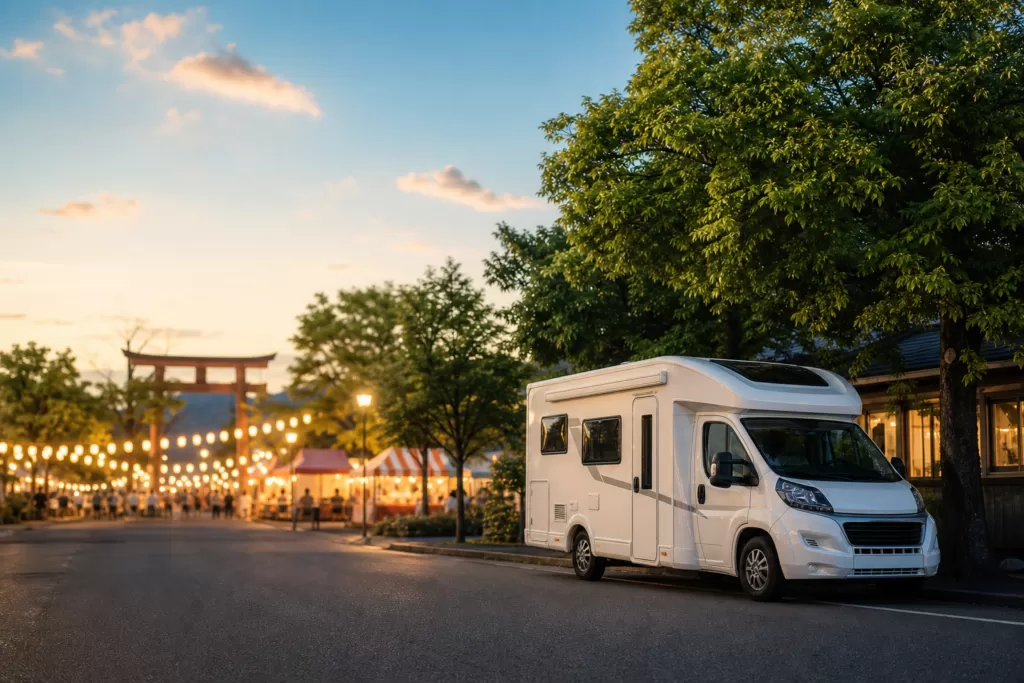
Sapporo Matsuri (Hokkaido Jingu Reisai) is Sapporo’s early-summer festival, usually held June 14–16. On the final day, a mikoshi parade of about 1,000 people — four hōren (ceremonial palanquins) and a line of floats — spends the whole day walking through central Sapporo, while hundreds of food stalls line Nakajima Park and the grounds of Hokkaido Jingu.
It’s a spectacular festival, but for anyone arriving by car, it’s one of the hardest days of the year to get around. On the parade day, the area around Odori and Ekimae-dori stays under traffic control for most of the daytime, and Nakajima Park has no dedicated parking. For a large vehicle like a campervan, it matters even more to decide where to park and how to move around beforehand. This article covers the schedule, the parade route, the traffic control pattern, and where to park a campervan.
Going to the Hokkaido Jingu Festival (Sapporo Matsuri)?
- Where to rent: Moving Inn New Chitose Airport.
- Where to stay: Nakajima Park has no dedicated parking. Base yourself on the outskirts with easy subway access. Candidates are listed in the Sapporo RV park guide.
The Festival Usually Runs June 14–16, with the Mikoshi Parade on the Final Day
The official name of Sapporo Matsuri is Hokkaido Jingu Reisai. Because the main festival day is fixed at June 15, the event runs for three days, usually June 14–16. Since the dates are fixed regardless of the day of the week, some years fall on weekdays.
| Date (typical) | Main event |
|---|---|
| June 14 | Yoimiya-sai (eve festival). Food stalls start in earnest. |
| June 15 | Reisai (main festival). The most solemn ritual day at Hokkaido Jingu. |
| June 16 | Mikoshi togyo (parade). The procession tours central Sapporo (some years cancelled or changed for rain, etc.) |
The festival is rooted deeply enough in local life that June 15 is treated as “Kyodo no Hi” (Hometown Day) at many Sapporo schools, with half-day classes. The detailed schedule and the parade route map are published by Hokkaido Jingu every year, so always check that year’s announcement before you go. Note that in some years the dates fall close to or overlap with the YOSAKOI Soran Festival, which pushes the citywide congestion even higher than a typical mid-June week.
The Parade (Mikoshi Togyo) Leaves the Shrine in the Morning and Walks Downtown Until Evening
The procession is made up of attendants carrying halberds and banners, floats, and four hōren (mikoshi), roughly 1,000 people in total. The route through the city runs about 15km. Based on the actual 2026 schedule, the procession left Hokkaido Jingu at 8:30am, headed from the Maruyama area toward downtown, and reached the Tongu (temporary shrine, Chuo-ku Minami 2-jo Higashi 3-chome) around 11:35am. It left the Tongu at 1:00pm for the afternoon route, held a brief ceremony (Chūren-sai) at Minami 1-jo Nishi 4-chome in the early afternoon, and returned to the shrine around 4:50pm (confirmed 2026-08-29, based on reporting from a local Sapporo Higashi-ku media outlet).
Just passing one point along the route takes the procession about 30 minutes. If you want to watch from the roadside, check the estimated passing time on that year’s route map and stake out your spot a little early so you can watch it calmly. The Odori and Ekimae-dori stretches tend to draw the biggest crowds, so if you want photos, the section nearer Maruyama, or the arrival/departure scenes around the Tongu, are worth aiming for instead.
On Parade Day, Traffic Is Controlled for Nearly the Whole Day — Don’t Drive Into the City Center
On the day of the parade, vehicle traffic around Odori and Ekimae-dori is restricted in stages as the procession moves through. In 2026, the scale was large enough that a hotel along Ekimae-dori told guests to expect “traffic control from around 9:00am to around 4:50pm,” covering roughly 8:00am to around 5:00pm overall (confirmed 2026-08-29). In some years the streetcar has also run a shortened shuttle route during the day.
Because the restrictions move along with the procession, it’s normal for a street that was open a moment ago to be closed 30 minutes later. If you get stuck in a traffic jam, a large vehicle like a campervan has a much harder time backing out and leaving. Plan on not driving anywhere near Odori, Ekimae-dori, or Susukino during the daytime on parade day. If you just need to pass through the city center, the realistic options are detouring east of Sosei-gawa-dori or via Kanjo-dori to avoid the controlled area, or shifting your timing to before 8:00am or after 5:00pm.
For the Nakajima Park Food Stalls, Park Your Car and Take the Subway
During the festival, Nakajima Park is lined with a few hundred food stalls, and in some years sideshow attractions such as haunted houses are set up as well. Operating hours have generally been announced as roughly 10:00am to around 9:00pm, but both the number of stalls and the hours change from year to year, so check that year’s announcement (confirmed 2026-08-29).
As for parking, the park’s own management states clearly that Nakajima Park has no dedicated parking lot. During the festival, the parking for facilities inside the park is also closed to general use, and nearby pay-and-display lots get crowded (confirmed 2026-08-29, official Nakajima Park website). More fundamentally, most pay-and-display lots in the city center simply can’t fit a campervan, due to space size or height limits.
The answer is simple: park on the outskirts and take the subway in. Nakajima Park is directly served by Nakajima-koen Station or right next to Horohirabashi Station on the Namboku Line. If you secure a parking spot near a suburban station at either end of the Namboku Line (toward Asabu or Makomanai) or along the Tozai Line and take the subway from there, traffic control and congestion stop being your problem. There are surface pay-by-time lots around Makomanai and Asabu stations too, but whether a campervan actually fits depends on its size, so check each lot’s space dimensions in advance.
On the Maruyama / Hokkaido Jingu Side, Combine a Shrine Visit with the Grounds’ Food Stalls
Food stalls aren’t only at Nakajima Park — they also line the grounds of Hokkaido Jingu and the area around its plum grove. The scale is smaller than at Nakajima Park, but the advantage here is that you can combine it with a shrine visit and a walk through the greenery of the adjoining Maruyama Park. You can also watch the procession depart in the morning and return in the evening at the shrine itself, so if you want to see the start of the parade, beginning from the Maruyama side works well.
Hokkaido Jingu does have a paid parking lot, but because visitors are concentrated during the festival period, public transportation is what’s recommended (confirmed 2026-08-29). It’s about a 15-minute walk from Maruyama-koen Station to the shrine, and the Tozai Line subway gets you there without trouble. The underground parking at Maruyama Park has a height limit, so a campervan almost certainly won’t fit. The same principle applies here: park on the outskirts, move by subway.
Base Your Overnight Stay Somewhere on the Outskirts with Subway Access
Since the festival runs into the night, if you’re traveling by campervan, staying overnight near Sapporo and splitting your visit — parade in the daytime, Nakajima Park stalls in the evening — is the easier way to move around. Base yourself somewhere on the outskirts with easy subway access, not in the city center. RV parks in and around Sapporo are limited in number, so booking early is essential if you’re timing your trip for mid-June. Candidates are listed in our Sapporo RV Park Guide.
If you’re renting a vehicle for this trip, choosing a company with a pickup location inside Sapporo cuts out unnecessary travel. Compare in-city rental options in our Sapporo Campervan Rental Comparison.
Frequently Asked Questions
Is Sapporo Matsuri held on the same dates every year?
Because the main festival day is fixed at June 15, the event runs for three days, usually June 14–16. Since the dates are set by day of the month rather than day of the week, some years fall on weekdays. The exact timings and whether the parade goes ahead are announced each year, so check that year’s announcement from Hokkaido Jingu before you go.
What time does the parade (mikoshi togyo) run, and where does it go?
Based on the actual 2026 schedule, the procession left Hokkaido Jingu at 8:30am on June 16, went from the Maruyama area toward Odori and Ekimae-dori, reached the Tongu (Minami 2-jo Higashi 3-chome) before noon, left the Tongu at 1:00pm for the afternoon route, and returned to the shrine around 4:50pm. The route and estimated passing times are published as a route map every year, so that year’s announcement is the reliable source.
Can I drive a campervan close to the venue?
We don’t recommend it. Nakajima Park has no dedicated parking, and during the festival the parking for facilities inside the park is also off-limits to the general public. On parade day, a wide area of the city center is under traffic control during the daytime, and many pay-and-display lots in the city simply aren’t sized for a campervan. The realistic plan is to park near a suburban subway station or at an RV park and take the subway in.
How late are the food stalls open?
In most years, the Nakajima Park stalls have been announced as running roughly 10:00am to around 9:00pm, while the stalls on the Hokkaido Jingu grounds sometimes close in the early evening only on the parade day. Both the number of stalls and the hours vary year to year, so check that year’s announcement.
Precisely because Sapporo Matsuri is a festival where a procession tours the whole city over a full day, deciding where to park in advance is what determines how comfortable your day actually is. The event usually runs June 14–16. Start by checking that year’s route map and traffic control information, then plan around parking on the outskirts and moving by subway. If you want to combine it with festivals or events at other times of year, our Hokkaido Campervan Event Calendar 2026 is a good place to start.
Book a Campervan in Hokkaido
Moving Inn New Chitose Airport supports English booking and offers airport transfers.
Pick a campervan by what matters to you.
Rent at New Chitose Airport
See only the rental bases in Chitose, where the airport is.

![Hokkaido Tourism Statistics: 46.13 Million Visitors a Year, Foreign Visitors by Country, Peak Months and Travel Purposes [FY2025]](https://hokkaido-campingcar.jp/wp-content/uploads/2026/10/hokkaido-tourism-statistics-2025-eyecatch-768x432.webp)

![What to Do in Tokachi in Winter: Dog Sledding, Snowshoeing, the Shikaribetsu Ice Village, and Staying at Kitanomori [2027]](https://hokkaido-campingcar.jp/wp-content/uploads/2026/10/tokachi-winter-dogsled-1-768x432.jpg.webp)
![Where to See Snow for the First Time in Hokkaido: Snow Play Spots and When Snow Is Guaranteed [2026-27]](https://hokkaido-campingcar.jp/wp-content/uploads/2026/10/hokkaido-snow-play-first-snow-eyecatch-768x432.webp)
![10 Days in Hokkaido in Winter: Campervan Itinerary from New Chitose Airport, January Skiing and Hot Springs, February Snow Festival and Drift Ice [2027]](https://hokkaido-campingcar.jp/wp-content/uploads/2026/10/winter10days-eyecatch-a-0-mi-js1v1qqiiz0aaaaaaaclwq-768x432.jpg.webp)