Can I Drive a Campervan in Hokkaido on My Licence? Rules by Country (IDP, Translation, Who Cannot Drive)

Planning to drive a campervan around Hokkaido? The first thing to sort out isn’t the vehicle — it’s whether your home driving licence actually lets you drive in Japan at all, and for how long. The rule depends entirely on which country issued your licence, and it trips up more travellers than any campervan-specific question. This guide walks through the requirement for each country, using only what Japan’s National Police Agency (NPA) and the Japan Automobile Federation (JAF) publish. Where we could not confirm a detail from an official source, we say so rather than guess.
For the whole process of renting, including what to bring on pickup day, booking and insurance, see our guide to renting a campervan in Hokkaido with a foreign driver’s licence.
This article is about licence eligibility only. If you’re wondering which licence category lets you drive a Hokkaido campervan of a given size (for example, whether an AT-only licence is enough), see our companion guide: Hokkaido Campervan Licence Requirements by Rental Company.
The three possible situations

Under Japanese law, a foreign licence holder falls into one of three groups:
- International Driving Permit (IDP), 1949 Geneva Convention format — valid if your country is a party to the 1949 Road Traffic Convention (the “Geneva Convention”) and issues the IDP in its prescribed format. Most English-speaking countries fall here.
- Foreign licence + official Japanese translation — for a short list of countries/regions whose domestic licensing system Japan recognises as equivalent, even though they don’t issue the 1949-format IDP. As of NPA’s published guidance, this is five countries and one region: Switzerland, Germany, France, Belgium, Monaco, and Taiwan.
- Neither is valid — for a country in neither category (mainland China is the clearest example), you cannot drive in Japan on your home licence at all, IDP or not, and must obtain a Japanese licence through the standard conversion process before driving.
A separate rule caps how long any of this lasts. With an IDP, you can drive for up to one year from the date you land in Japan, and only while the IDP itself is still valid (one year from its issue date) — whichever ends first. With a translated licence, the limit is one year from landing (and your home licence must still be valid). Your visa or trip length doesn’t change this. There is also a “3-month rule” for people recorded in Japan’s Basic Resident Register (mid- to long-term residents): if they leave Japan and come back within 3 months, the re-entry date does not restart the one-year clock. Source: Tokyo Metropolitan Police Department — International Driving Permits, Tokyo MPD — Foreign licences requiring a translation.
Comparison table: what your country needs
| Country / region | What you need | Driving period in Japan | Common mistake |
|---|---|---|---|
| Australia | 1949 Geneva Convention IDP | Up to 1 year from landing, within 1 year of the IDP\’s issue date | Using an IDP issued long before the trip — it must still be within 1 year of its issue date, as well as within 1 year of landing. |
| New Zealand | 1949 Geneva Convention IDP | Up to 1 year from landing, within 1 year of the IDP\’s issue date | Bringing only a photocopy of the IDP — carry the original booklet plus your home licence. |
| USA | 1949 Geneva Convention IDP (AAA or National Auto Club, obtained before departure) | Up to 1 year from landing, within 1 year of the IDP\’s issue date | Believing a US state licence alone (without an IDP) is enough — it is not accepted on its own. |
| UK | 1949 Geneva Convention IDP | Up to 1 year from landing, within 1 year of the IDP\’s issue date | Ordering the IDP too late — UK IDPs are issued by the Post Office and can take time to arrange before a trip. |
| Canada | 1949 Geneva Convention IDP | Up to 1 year from landing, within 1 year of the IDP\’s issue date | Assuming a Canadian G licence converts automatically — it doesn’t; you still need the IDP for a rental. |
| Singapore | 1949 Geneva Convention IDP | Up to 1 year from landing, within 1 year of the IDP\’s issue date | Confusing Singapore’s IDP with the different international permit format some neighbouring countries use. |
| Taiwan (台灣) | Licence + official Japanese translation (no IDP recognised) | 1 year from landing in Japan | Bringing an IDP — Taiwan does not issue the 1949-format IDP, so an IDP from Taiwan is not valid in Japan; only the translated licence route works. |
| Hong Kong | 1949 Geneva Convention IDP | Up to 1 year from landing, within 1 year of the IDP\’s issue date | Assuming the mainland China rule (no driving at all) also applies to Hong Kong — it does not; Hong Kong issues a valid Geneva IDP. |
| South Korea (대한민국) | 1949 Geneva Convention IDP | Up to 1 year from landing, within 1 year of the IDP\’s issue date | Bringing the Korean domestic licence alone without the IDP booklet. |
| Germany (Deutschland) | Licence + official Japanese translation (no IDP recognised) | 1 year from landing in Japan | Assuming Germany issues the 1949 IDP — it doesn’t; only the translated-licence route is valid. |
| France | Licence + official Japanese translation (no IDP recognised) | 1 year from landing in Japan | Bringing a “permis international” from France — France is not a 1949 Geneva IDP issuer for this purpose; use the translation instead. |
| Thailand (ประเทศไทย) | 1949 Geneva Convention IDP | Up to 1 year from landing, within 1 year of the IDP\’s issue date | Confusing the requirement with neighbouring countries that use the 1968 Vienna Convention permit, which Japan does not accept. |
| Mainland China (中国大陆) | Neither IDP nor translation is valid — you cannot drive in Japan on a mainland Chinese licence | Not applicable | Assuming an international permit purchased online (not government-issued) will work — no such permit is valid, and mainland China is not on Japan’s translation-country list. |
Sources for the table: National Police Agency — Foreign driving licence holders; Tokyo MPD — countries requiring a translation; NPA — translation-service designation document (states “6 countries and 1 region”); JAF — translation application.
Australia
To drive a campervan in Hokkaido, you need a 1949 Geneva Convention International Driving Permit alongside your Australian licence. You can drive on it for up to one year from the day you land, as long as the IDP is still within one year of its issue date. Get the IDP from your state motoring club before you leave — it cannot be issued after you arrive in Japan.
Australia is a party to the 1949 Geneva Convention, so an IDP issued in Australia (through your state’s motoring association) is accepted in Japan alongside your home licence. Rental companies will check both documents together. You can drive on it for up to one year from your landing date, and only while the IDP itself is valid (one year from issue) — whichever ends first. Long-stay visitors should check the issue date before they fly.
New Zealand
New Zealand licence holders need a 1949 Geneva Convention IDP, obtained before travel, to drive in Japan. You can drive on it for up to one year from arrival, within the IDP’s own one-year validity.
New Zealand is a Geneva Convention signatory, and the AA issues the IDP domestically. Bring both the IDP booklet and your NZ licence — rental staff in Hokkaido will want to see the physical permit, not a photo of it.
USA
US licence holders need a 1949 Geneva Convention IDP from AAA or the National Auto Club, arranged before departure, alongside their state licence. You can drive on it for up to one year from landing, within the IDP’s own one-year validity.
The US is a Geneva Convention party, and IDPs are issued domestically only by AAA or the National Auto Club (not by mail from overseas, and not by third-party websites). A common mistake is assuming the state driver’s licence alone is enough for a rental in Japan — it isn’t; the IDP is required in addition to it.
UK
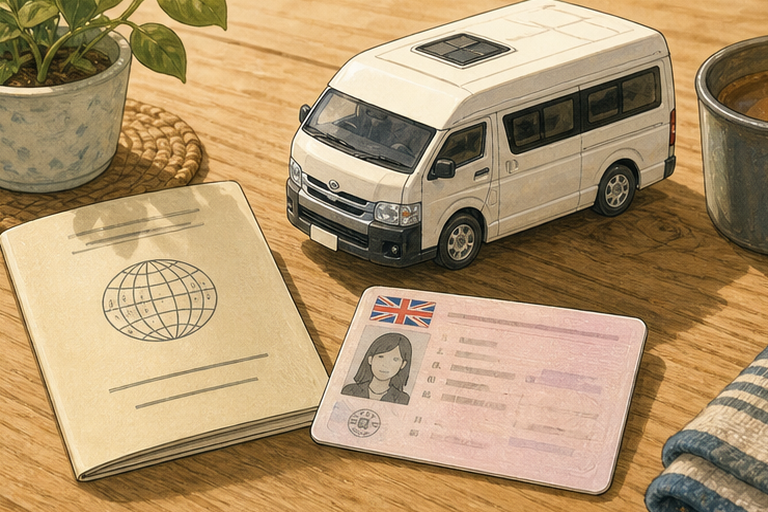
UK licence holders need a 1949 Geneva Convention IDP, obtainable from the Post Office, in addition to their UK licence. You can drive on it for up to one year from the date you arrive, within the IDP’s own one-year validity.
The UK issues the IDP through Post Office branches, and processing isn’t instant, so arrange it well before your Hokkaido trip. Bring your physical UK photocard licence together with the IDP.
Canada
Canadian licence holders need a 1949 Geneva Convention IDP, issued by CAA, alongside their provincial licence. You can drive on it for up to one year from landing, within the IDP’s own one-year validity.
Canada is a Geneva Convention party and CAA issues the IDP. Provincial licences vary in format, but the IDP itself is standardised, so rental staff in Japan check the IDP first and your home licence as the underlying document.
Singapore
Singapore licence holders need a 1949 Geneva Convention IDP, issued by the Automobile Association of Singapore, alongside their licence. You can drive on it for up to one year from landing, within the IDP’s own one-year validity.
Singapore is a Geneva Convention signatory. Make sure the IDP you obtain is specifically the 1949-format permit — some regional international permits use a different convention format that Japan does not accept.
Taiwan (台灣)
在日本開露營車,台灣駕照持有人不能使用國際駕照,因為台灣不核發1949年日內瓦公約格式的國際駕照。您需要台灣駕照附上官方日文翻譯文,翻譯文可由台灣日本關係協會或JAF等指定機構製作。有效期限為入境日本後一年。
Taiwan is one of the countries/regions Japan treats as an exception: instead of an IDP, you need your Taiwanese licence with an official Japanese translation attached. The translation can be issued by the Taiwan-Japan Relations Association, JAF, or another designated body — not any translator. Validity for driving in Japan is one year from your date of arrival. A frequent mistake is assuming an international driving permit purchased or obtained in Taiwan will work — it will not, because Taiwan is not a 1949 Geneva Convention IDP issuer for this purpose; only the translated-licence route is recognised. Source: Tokyo MPD, JAF translation service.
Hong Kong
在日本開露營車,香港駕照持有人需要1949年日內瓦公約格式的國際駕駛許可證(International Driving Permit),連同香港駕照一併使用。有效期為抵達日本後一年。
Unlike Taiwan, Hong Kong is a Geneva Convention IDP issuer, so Hong Kong licence holders take the standard IDP route rather than the translated-licence route. Apply through the Hong Kong Automobile Association or the Transport Department before travel. Don’t assume mainland China’s “no driving” rule extends to Hong Kong — it doesn’t; the two are treated completely differently under Japanese law.
South Korea (대한민국)
일본에서 캠핑카를 운전하려면 한국 면허증과 함께 1949년 제네바 협약 방식의 국제운전면허증이 필요합니다. 일본 입국일로부터 1년간 유효합니다.
South Korea is a Geneva Convention signatory, and the IDP is issued domestically before departure. A common mistake is bringing only the Korean licence card without the separate IDP booklet — Japanese rental staff need to see both.
Germany (Deutschland)
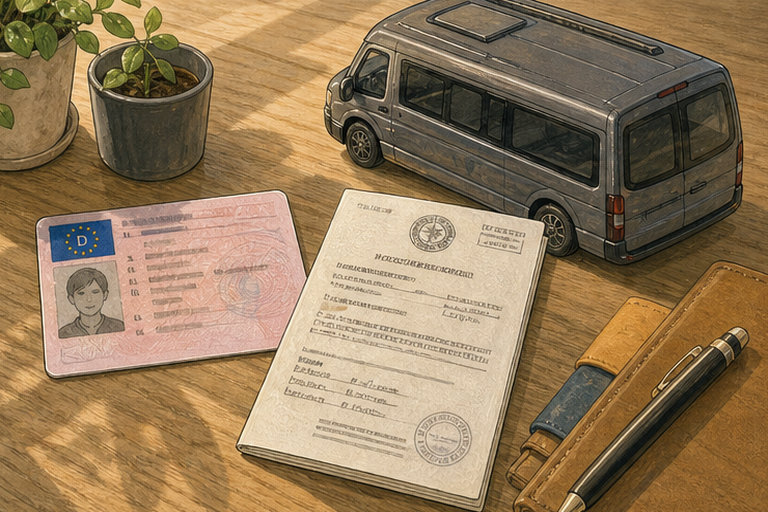
Um in Hokkaido einen Campervan zu fahren, benötigen deutsche Führerscheininhaber keinen internationalen Führerschein, da Deutschland kein Ausstellungsland für den IDP nach dem Genfer Abkommen von 1949 ist. Stattdessen brauchen Sie Ihren deutschen Führerschein mit einer offiziellen japanischen Übersetzung, gültig für ein Jahr ab Einreise nach Japan.
Germany is one of Japan’s translation-route countries: bring your German licence with an official Japanese translation, which can be issued by the German Automobile Club (ADAC’s designated route) or JAF. A frequent misunderstanding is assuming any German-issued “internationaler Führerschein” satisfies Japan’s requirement — Japan does not recognise a Germany-issued IDP for this purpose; only the translated-licence route works, valid for one year from arrival. Source: Tokyo MPD.
France
Pour conduire un camping-car à Hokkaido, les titulaires d’un permis français n’ont pas besoin d’un permis de conduire international, car la France ne délivre pas le permis au format de la Convention de Genève de 1949 reconnu par le Japon. Il faut votre permis français accompagné d’une traduction officielle en japonais, valable un an à compter de votre entrée au Japon.
France is on the translation-country list rather than the IDP list for this specific rule. The translation can be arranged through JAF or another designated body before or after arrival. A common mistake is obtaining a French “permis de conduire international” and assuming it satisfies Japanese requirements — it does not; the translated-licence route is the only valid option, and it’s good for one year from landing.
Thailand (ประเทศไทย)
หากต้องการขับรถแคมป์ปิ้งคาร์ในฮอกไกโด ผู้ถือใบขับขี่ไทยต้องมีใบอนุญาตขับรถระหว่างประเทศ (IDP) ตามอนุสัญญาเจนีวาปี 1949 ควบคู่กับใบขับขี่ไทย ใช้ได้หนึ่งปีนับจากวันที่เดินทางเข้าประเทศญี่ปุ่น
Thailand is a Geneva Convention signatory, and the IDP is issued by the Department of Land Transport before travel. A frequent point of confusion is that some neighbouring countries in the region use the newer 1968 Vienna Convention permit format, which Japan does not accept — make sure the permit obtained is the 1949 Geneva format specifically.
Mainland China (中国大陆)
持中国大陆驾照的人士无法在日本驾驶露营车。中国大陆既不发放日本承认的1949年日内瓦公约格式国际驾照,也不在日本认可翻译文的国家名单之内。若要在日本自驾,必须先按正规换证程序取得日本驾照。
Mainland China is not a Geneva Convention IDP issuer, and it is not on the short list of countries/regions whose licence-plus-translation Japan accepts (that list is Switzerland, Germany, France, Belgium, Monaco, and Taiwan). This means there is no route to drive in Japan on a mainland Chinese licence alone — not with an IDP, and not with a translation. The only path is to obtain a Japanese licence through the standard conversion (menkyo kirikae) process. A common and costly mistake is buying an “international driving permit” from a commercial website before the trip — these are not government-issued IDPs and are not valid in Japan regardless of appearance.
Countries not covered above
If your country isn’t listed here, check with the Japanese embassy in your country before booking a campervan. Rules differ by whether your country signed the 1949 Geneva Convention, and we did not want to guess at a country’s status without an official source in front of us.
Frequently asked questions
Do I need an International Driving Permit (IDP) to rent a campervan in Hokkaido?
It depends on your country. If your country is a party to the 1949 Geneva Convention (this includes Australia, New Zealand, the USA, the UK, Canada, Singapore, Hong Kong, South Korea, and Thailand among others), yes — bring the IDP alongside your home licence. If your country is Switzerland, Germany, France, Belgium, Monaco, or Taiwan, you don’t use an IDP; you need your licence with an official Japanese translation instead. For any other country, check with the Japanese embassy before you travel.
How long can I drive in Japan on an IDP or a translated licence?
With an IDP: up to one year from the date you land in Japan, and only while the IDP is within one year of its issue date — whichever ends first. With a translated licence: up to one year from landing. Your visa length doesn’t extend this. For people recorded in Japan’s Basic Resident Register (mid- to long-term residents), a “3-month rule” also applies: leaving Japan and returning within 3 months does not reset the clock.
Can I get an International Driving Permit after I arrive in Japan?
No. An IDP must be issued by the authorised motoring body in your own country before you travel. There is no way to obtain a valid IDP once you are in Japan.
My country isn’t on either list — what do I do?
Contact the Japanese embassy or consulate in your country before booking. Do not assume an IDP purchased from a commercial website will be accepted — Japan only recognises IDPs issued by the authorised body in a Geneva Convention member country.
Does an AT-only licence or a small car licence let me drive a Hokkaido campervan?
That depends on the campervan’s size and the rental company’s policy, which is separate from the country-eligibility question covered in this article. See our companion guide, Hokkaido Campervan Licence Requirements by Rental Company, for that comparison.
Book a Campervan in Hokkaido
Moving Inn New Chitose Airport supports English booking and offers airport transfers.

![Monbetsu Drift Ice Festival 2027 [Feb 11–14]: Dates, Ice Sculptures, Garinko-go Icebreaker, Parking and Access by Campervan](https://hokkaido-campingcar.jp/wp-content/uploads/2026/10/monbetsu-hl999-768x576.jpg)
![Hokkaido New Year Weather and What to Wear | Sapporo, Hakodate, Asahikawa, Obihiro Mornings and Evenings, and Heavy-Snow Years [2026-27]](https://hokkaido-campingcar.jp/wp-content/uploads/2026/10/hokkaido-new-year-holiday-weather-eyecatch-768x432.webp)

![Hokkaido Illumination 2026-27 [Dates]: Sapporo Starts Nov 20, Plus Otaru, Asahikawa, Obihiro & Hakodate for Campervan Trips](https://hokkaido-campingcar.jp/wp-content/uploads/2026/10/hokkaido-illumination-2026-eyecatch-768x432.webp)
![What to Do in Tokachi in Winter: Dog Sledding, Snowshoeing, the Shikaribetsu Ice Village, and Staying at Kitanomori [2027]](https://hokkaido-campingcar.jp/wp-content/uploads/2026/10/tokachi-winter-dogsled-1-768x432.jpg)