Kushiro & Lake Akan Campervan Drive Guide | Marshland, Marimo & Lake Mashu Complete Guide [2026]
Your complete guide to exploring the Kushiro and Lake Akan area by campervan.
Pick a campervan by what matters to you.
Rent at New Chitose Airport
See only the rental bases in Chitose, where the airport is.
Rent in winter (Dec–Mar)
Companies that rent through winter, listed apart from those that close.
Guide price
Moving Inn New Chitose Airport: HIACE van conversion from ¥22,000 per night. 20–30% off when booked 60–90 days ahead (official rate table, checked 15 Oct 2026).
New Chitose Airport map for campervan travellers →
Before you book: with an International Driving Permit if your country is in the Geneva Convention (for example the US, Australia, Singapore); Taiwan, Switzerland, Germany, France, Belgium and Monaco need your licence plus a Japanese translation (Tokyo Metropolitan Police). Questions in English: Moving Inn on WhatsApp. Every roadside station (michi-no-eki) must have free 24-hour toilets, and Hokkaido has 128 of them (MLIT).
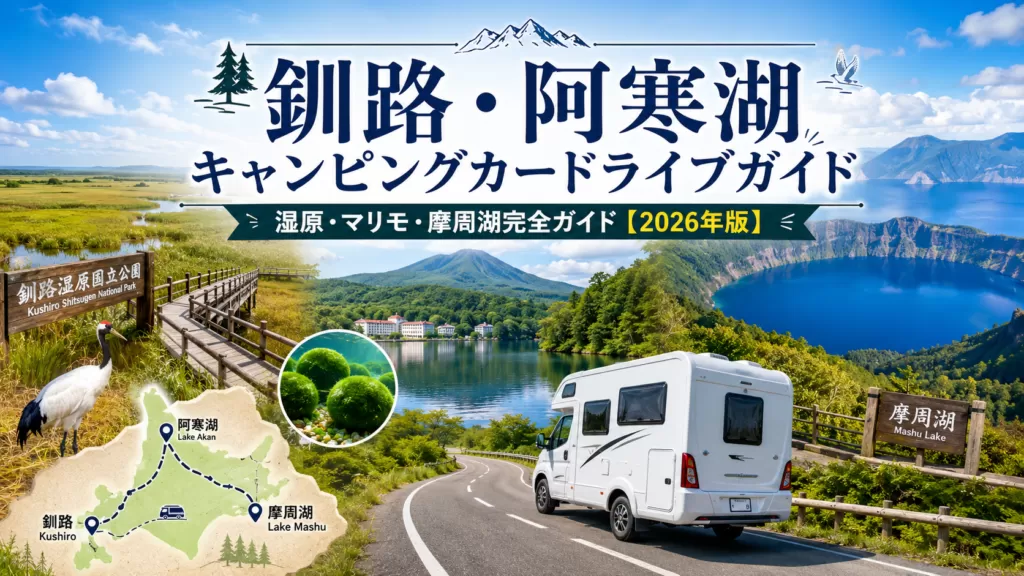
The Kushiro and Lake Akan area is the heart of eastern Hokkaido, where the Kushiro Marshland, Lake Akan, Lake Mashu and Lake Kussharo sit within a short drive of each other. Because the sights are widely spread and public transport is limited, a campervan is the most flexible way to explore the region at your own pace.
This guide covers everything you need to plan a campervan trip through the Kushiro and Lake Akan area: access routes, detailed descriptions of the main attractions, places to park overnight, a recommended itinerary and a cost simulation. It is structured around practical information to help first-time visitors to eastern Hokkaido decide what to see and how many days to allow.
Tap a dot on the map to see its name here.
Tap a dot to see its name and a link to where it appears in this article. 5 places whose location could not be confirmed are not shown. Dot positions are based on each facility’s address or officially published location. Lakes and expressways are from OpenStreetMap data.
Cost Guide: Campervan Rental in the Kushiro & Akan Area
Here are the approximate nightly rental rates for a campervan in this area (prices vary by season and operator):
| Vehicle type | Approx. rate per night | Best for |
|---|---|---|
| Kei camper | ~¥13,000–¥38,000 | Up to 2 people · compact travel |
| Van conversion | ~¥20,000–¥58,000 | 2–4 people · families welcome |
| Cab-over | ~¥26,000–¥94,000 | 4–6 people · full equipment |
These figures cover the vehicle only. Fuel, toll roads, campsite fees and food are extra. For a detailed breakdown of a 4-night 5-day trip departing from Obihiro, see the Hokkaido 4-night 5-day cost simulation.
Approximate total cost for a 4-night 5-day trip from Obihiro for 2 people (expressway included):
| Cost item | Kei camper | Van conversion | Cab-over |
|---|---|---|---|
| Rental (4 nights) | ~¥52,000–¥152,000 | ~¥80,000–¥232,000 | ~¥104,000–¥376,000 |
| Fuel (~800 km) | ~¥8,000–¥10,000 | ~¥10,000–¥14,000 | ~¥14,000–¥20,000 |
| Expressway (return) | ~¥4,000–¥8,000 (Obihiro–Akan IC return) | ||
| Campsites / RV parks (4 nights) | ~¥0–¥4,000 per night | ||
| Food (2 people, 4 days) | ~¥20,000–¥40,000 (mix of cooking and eating out) | ||
Total for 2 people over 4 nights / 5 days: approximately ¥100,000–¥200,000. A campervan removes hotel costs entirely, which often makes it less expensive than a comparable hotel-based trip.
Getting to Kushiro & Lake Akan
| Departure point | Distance to Kushiro city | Approximate travel time |
|---|---|---|
| New Chitose Airport | ~270 km | ~3 hours+ (via Doto Expressway) |
| Obihiro city | ~140 km | ~1.5–2 hours |
| Kushiro Airport | ~15 km | ~25 minutes |
Obihiro (Tokachi Obihiro Airport) is the most convenient gateway. Renting a campervan in Obihiro and touring the Kushiro and eastern Hokkaido area from there is the most practical approach. For operators based in Obihiro, see Obihiro / Eastern Hokkaido Campervan Rental. If coming from New Chitose, allow about 3 hours via the Doto Expressway.
The Doto Expressway now extends from Obihiro / Otofuke IC to Akan IC, and from there it is about 40 minutes to Lake Akan. Without expressway, Route 38 from Obihiro to Kushiro is a scenic drive worth taking at least once.
Main Attractions: Kushiro & Lake Akan Area
Kushiro Marshland
Japan's largest marshland and a national park, home to the iconic Japanese crane (tancho). Covering roughly 18,000 hectares and listed as a Ramsar wetland, it has multiple observation decks you can visit as you drive through.
- Hosooka Observatory: Within walking distance of Hosooka Station on the JR Senmo Line. Overlooks the meandering Kushiro River and the vast marshland. Free entry, parking available. The evening light across the wetland is especially beautiful — aim for late afternoon.
- Kushiro City Marshland Observatory: About 10 km from central Kushiro. Entry fee: ¥480 for adults (as of 2026, verify). The best vantage point for grasping the scale of the marshland, with a boardwalk trail.
- Kottaro Marshland Observatory: A quieter northern viewpoint with few tourists. Free parking; known as a stargazing spot at night.
- Canoe tours: Canoe tours on the Kushiro River are a highlight — the only way to experience the wetland from water level. Half-day to full-day tours are available from multiple operators; advance booking required. Expect to pay around ¥5,000–¥10,000 per person.
Kushiro Shitsugen Norokko Train (seasonal, late April–early October)
The "Kushiro Shitsugen Norokko" sightseeing train runs between Kushiro and Touro stations primarily on weekends and public holidays from late April to early October. The open observation car lets you watch the marshland roll past, and Japanese cranes are sometimes spotted along the way.
A popular way to combine it with a campervan trip is to park at Hosooka Station, ride the Norokko train to central Kushiro for lunch, then return. Check the JR Hokkaido website for up-to-date schedules before travelling.
Lake Akan — Marimo and Ainu Kotan
A caldera lake where the special natural monument marimo (giant algal balls) grow. The lakeshore is lined with the Akan Onsen hot-spring resort and the Ainu Kotan (Ainu indigenous settlement). The lake circumference is about 26 km, but there is no road around the lake, so the usual way to take in the views is the lake cruise.
- Akan Lake cruise: A cruise (about 85 minutes) that stops at Churui Island, where you can see marimo in their natural habitat up close at the Marimo Exhibition and Observation Centre. Ticket price: around ¥2,000 per adult (varies by season — verify). Runs approximately late April to early November. This is the only way to observe marimo in the water.
- Ainu Kotan: A cultural district within the Akan Onsen resort area, where you can see demonstrations of Ainu wood carving and embroidery, browse handicrafts for sale, and sample Ainu cuisine at on-site restaurants. In the evening, watch traditional performances (paid, reservation recommended) such as "Lost Kamuy" at the Ikoro Ainu Theatre.
- Akan Onsen day bathing: Several hotels along the lakeshore accept day visitors. Expect to pay ¥500–¥1,500 per person (varies by facility and time of day). Even if you sleep in your campervan, you can still enjoy a proper onsen soak.
There is a free car park near the entrance to the Akan Onsen resort area that can accommodate large vehicles. It fills up during peak summer hours, so arriving early in the morning is advisable.
Lake Mashu
A caldera lake with some of the clearest water in the world, often shrouded in mist — hence the nickname "Misty Lake Mashu." On a clear day the deep blue surface, known as "Mashu Blue," is breathtaking.
- Observatory No.1: The widest panorama; the most popular viewpoint. Parking fee: ¥410 for standard vehicles (as of 2026, verify). Overlooks the lake and the central island (Kamuisshu).
- Observatory No.3: Lower elevation, closer to the water. Free parking, far fewer visitors.
- Ura-Mashu Observatory: Viewpoint from the opposite (Kiyosato) side; popular when combined with the Mystical Blue Pond (Kamino Ko).
Even a misty day at Lake Mashu has its own haunting beauty. Clear skies are more likely in the early morning (6–8 am). One of the best arguments for campervan travel: if the mist is heavy on arrival, stay nearby and try again at dawn.
Lake Kussharo
Japan's largest caldera lake (about 57 km in circumference), dotted with hot-spring spots along its shore, including Sunayu and Kawayu Onsen. The lake is a famous wintering site for whooper swans, which gather in large numbers from November through March.
- Sunayu: Dig into the lakeshore sand and hot-spring water bubbles up — a unique and completely free experience. Free car park nearby.
- Kawayu Onsen: About 10 minutes from the lake. Strong sulphurous spring; multiple day-bathing facilities. Free foot bath available.
- Wakoto Peninsula Lakeside Campsite: A beautifully situated campsite right on the Lake Kussharo shoreline, with some sites suitable for campfires.
Kushiro Fisherman's Wharf MOO
A harborfront complex in central Kushiro serving fresh seafood bowls and traditional robatayaki (fireside grilling). The sunset from here — Kushiro is famed for one of Japan's three great sunsets — is best viewed from the Nusamai Bridge between May and September on clear evenings.
Robatayaki is one of Hokkaido's signature dining experiences: guests choose fresh seafood, meat and vegetables to grill over a central fire at the table. Several specialist robatayaki restaurants operate in central Kushiro; reservations are recommended.
Compare Hokkaido campervan rentals
See prices, vehicle types, and bases side by side, including areas beyond Kushiro & Lake Akan.
See details at Moving Inn →Where to Park Overnight in the Kushiro & Akan Area
| Overnight location | Area | Approx. cost | Notes |
|---|---|---|---|
| Michi-no-Eki Akan Tancho-no-Sato | Akan-cho, Kushiro | Free (overnight parking) | Gateway to Lake Akan · near tancho observation facility · 24h car park |
| Kottaro Marshland Observatory car park | Northern Kushiro Marshland | Free | Stargazing spot · minimal facilities · no toilets |
| Kussharo Lake Campsite (Sunayu) | Teshikaga-cho | ¥500–¥1,500/night | Lakeside · next to Sunayu · cooking facilities |
| Wakoto Peninsula Lakeside Campsite | Teshikaga-cho (Lake Kussharo) | ¥500–¥1,000/night | Quiet lakeside site · hot spring nearby |
| RV Park Akan Tancho no Sato | Akan-cho, Kushiro | ¥1,500/night (power +¥500) | In the Michi-no-Eki Akan Tancho no Sato car park · hot-spring bath for one person included |
| Akan Kohan Campsite | Akan Onsen, Kushiro | Check official site | Quiet lakeside campsite · limited sites, book early in summer |
| Tsurui Campsite | Tsurui Village | Check official site | Walking distance to the Tsurui-Ito Tancho Sanctuary feeding ground · winter heating essential |
Rules vary between roadside stations (michi-no-eki). Dispose of rubbish responsibly, keep engines switched off overnight, and avoid early-morning noise. If you need electrical hook-ups or hot water, prioritise booking an RV park.
4 Nights / 5 Days Model Itinerary — Departing from Obihiro
The Classic Eastern Hokkaido Loop: Kushiro, Akan, Shiretoko
A 4-night / 5-day loop from Obihiro covering the main sights of eastern Hokkaido. Moving anticlockwise from Kushiro is the most efficient routing.
- Day 1: Pick up campervan in Obihiro → drive to Kushiro via Route 38 (~2 hrs) → Kushiro Marshland (Hosooka Observatory, boardwalk) → robatayaki dinner at Kushiro Fisherman's Wharf → overnight in or near Kushiro, or at Michi-no-Eki Akan Tancho-no-Sato
- Day 2: Drive to Lake Akan (~1.5 hrs) → morning: lake cruise to see marimo → afternoon: Ainu Kotan walk, traditional performance in the evening → Akan Onsen day bath → overnight at Akan lakeside campsite
- Day 3: Lake Mashu (Observatory No.1 and No.3) → Lake Kussharo / Sunayu → Kawayu Onsen → overnight at a campsite near Teshikaga
- Day 4: Drive to Shiretoko (~1 hr 40 min from Teshikaga) → Rausu / Shiretoko Pass → overnight at Michi-no-Eki Utoro Shiretoko
- Day 5: Shiretoko Five Lakes (early-morning guided tour recommended) → Abashiri / Memanbetsu → drive back to Obihiro (~3 hrs) → return campervan
If returning to Obihiro on Day 5, leave Shiretoko by early afternoon. Adding one more night extends the trip to 6 days and gives you time to explore the Kitami / Abashiri area. For more on Shiretoko, see Shiretoko Campervan Rental Travel Guide (Japanese).
2 Nights / 3 Days — Kushiro & Akan Focus (Kushiro Airport IN/OUT)
A compact itinerary concentrating on Kushiro and Lake Akan. Note that dedicated campervan rental operators at Kushiro Airport are limited; the usual approach is to rent in Obihiro or New Chitose and arrange to collect near the airport.
- Day 1: Arrive at Kushiro Airport → Kushiro Marshland (Hosooka Observatory) → Norokko train if running → dinner in central Kushiro, overnight
- Day 2: Lake Akan (cruise, Ainu Kotan) → Lake Mashu → Kussharo Sunayu → overnight near Teshikaga or at lakeside campsite
- Day 3: Morning bath at Kawayu Onsen → drive from Teshikaga to Kushiro Airport (~1 hr) → return campervan, depart
A 2-night trip does not leave enough time to add Shiretoko — plan that as a separate visit with at least 1–2 nights dedicated to it.
Seasonal Notes for Eastern Hokkaido
Spring (April–May)
Eastern Hokkaido spring arrives late. Average temperatures from late April to May are around 4–12°C, so a vehicle heater and warm sleeping bag are still necessary. However, crowds are thin and you can enjoy Lake Mashu and the Kushiro Marshland in near-solitude. It is also tancho nesting season, increasing the chance of crane sightings near the marshland.
Summer (June–August)
While inland eastern Hokkaido can occasionally exceed 30°C, Kushiro city is frequently cool and misty due to the sea fog (yamase) that drifts in from the Pacific. It is known as having the coolest summer in Japan, making it a favourite for visitors escaping the heat. The Lake Akan cruise, Norokko train and all summer activities run at full schedule. Camp-site and RV park bookings fill up — reserve well ahead.
Autumn (September–October)
Autumn foliage around Lake Mashu and Lake Akan runs from late September to mid-October, when the larch and birch trees turn gold. The marshland takes on a beautiful contrast of tawny grass and blue sky. Temperatures drop sharply — below 5°C on October mornings — making a well-heated campervan particularly welcome.
Winter (November–March)
Eastern Hokkaido winters are severe, with regular ice and snowfall. Winter campervan travel in this region is for experienced drivers only. Studded winter tyres are essential. Some operators restrict travel in eastern Hokkaido during winter — always confirm with your operator before booking. Rewards include whooper swans on Lake Kussharo, tancho at the Kushiro Marshland, and drift ice along the Okhotsk coast (February–March). In February, Lake Akan hosts the Lake Akan Ice Festival “Fuyu Hanabi”, with fireworks and activities on the frozen lake.
Compare Hokkaido campervan rentals
See prices, vehicle types, and bases side by side, including areas beyond Kushiro & Lake Akan.
See details at Moving Inn →Pre-Departure Checklist for Kushiro & Akan
- Fuel: Petrol stations are limited in the Lake Akan Onsen area and the countryside around Teshikaga. Fill up in Kushiro city or Obihiro before heading into the mountains.
- Groceries: There are supermarkets in Akan Onsen and Teshikaga town, but selection is limited. Buy provisions in Obihiro or Kushiro before heading to the highland areas.
- Mobile coverage: Lake Mashu, Ura-Mashu and the northern Kottaro Marshland area can have weak or no signal. Download offline maps (e.g. Google Maps offline) before you leave.
- Insect repellent: Horseflies and mosquitoes are abundant around the marshland from June to August. Long sleeves and insect repellent spray are essential.
- Warm layers: Even in summer, lake shores and early mornings are cold. Keep a fleece or jacket inside the vehicle cabin at all times.
- Activity bookings: The Lake Akan cruise and canoe tours can sell out. Once your dates are fixed, book these activities as soon as possible.
Frequently Asked Questions
Can I rent a campervan in Kushiro or Lake Akan?
Dedicated campervan rental operators in Kushiro city itself are limited. The standard approach is to rent from an Obihiro or New Chitose operator and drive to the Kushiro area. Some operators offer one-way returns to Kushiro; pick up in Obihiro and drop off in Kushiro. See Obihiro / Eastern Hokkaido Campervan Rental (Japanese) for operator details.
Do I have to take the cruise boat to see the marimo?
The Akan Lake Eco Museum Centre on the shore also has a marimo display (free entry — verify). However, if you want to visit Churui Island and see marimo in their underwater habitat, the cruise boat (paid) is the only option. The cruises run approximately late April to early November — check dates before planning your visit.
Is Lake Mashu worth visiting if it is misty?
Absolutely. Mist is common, but clear days do happen — early mornings (6–8 am) and winter / spring tend to have better visibility. The great advantage of a campervan is being able to park nearby, sleep, and try again at dawn. Even a misty visit has its own ethereal atmosphere.
Can I drive a large campervan to Hosooka Observatory?
The Hosooka Observatory parking lot is designed for regular and medium-sized vehicles. Campervans wider than 2.5 m or taller than 3 m may not be able to enter. Contact the Kushiro Shitsugen National Park Hosooka Visitors Lounge in advance to confirm parking, or park at the entrance and walk in.
Where can I see Japanese cranes (tancho)?
In winter (December–March), tancho gather at feeding stations around the Kushiro Marshland. In summer they disperse across the wetland grassland and are harder to spot, but the Akan International Crane Centre (Tancho Natural Park) in Kushiro allows year-round observation. Roadside sightings during early-morning drives through the marshland area are also not uncommon. In Tsurui Village, the Tsurui-Ito Tancho Sanctuary draws dozens to over 100 cranes at its winter morning feeding time, sometimes visible just a few meters away.
When does the Kushiro Shitsugen Norokko train run?
The Norokko sightseeing train runs primarily on weekends and public holidays from late April to early October between Kushiro and Touro stations (about 45 minutes). A reserved seat ticket (seat reservation + base fare) is required. Check the JR Hokkaido website for the current schedule; the summer weekend services fill up quickly so book early.
Book a Campervan in Hokkaido
Moving Inn New Chitose Airport supports English booking and offers airport transfers.
Pick a campervan by what matters to you.
Rent at New Chitose Airport
See only the rental bases in Chitose, where the airport is.

![When and Where Can You See Harbor Seals at Cape Erimo? Kaze no Yakata Official Information, Viewing Season, and Windy-Day Notes [2026-27]](https://hokkaido-campingcar.jp/wp-content/uploads/2026/10/erimo-cape-lighthouse-768x511.jpg.webp)
![Where and Under What Conditions Can You See Diamond Dust in Hokkaido? How Cold a Morning It Takes, and Where It Appears [2026-27]](https://hokkaido-campingcar.jp/wp-content/uploads/2026/10/hokkaido-diamond-dust-nayoro-768x512.jpg.webp)
![Can You Drive to Hokkaido Jingu for Hatsumode? Parking, Crowds, and Where to Park and Walk [2027]](https://hokkaido-campingcar.jp/wp-content/uploads/2026/10/hokkaido-jingu-winter-torii-768x504.jpg.webp)
![Hokkaido Roads Over New Year [2026-27] | Expressway Sections Prone to Blizzard Closures, Forecast Congestion Days, No Holiday Discount, and New Chitose Airport Parking](https://hokkaido-campingcar.jp/wp-content/uploads/2026/10/hokkaido-winter-rural-road-edge-markers-768x432.jpg.webp)
![Where to See Sea Smoke (Kearashi) in Hokkaido: Rumoi’s Ogon-misaki and the Morning Conditions [2026-27]](https://hokkaido-campingcar.jp/wp-content/uploads/2026/10/rumoi-kearashi-sea-smoke-768x511.jpg.webp)
![Geminid Meteor Shower 2026 in Hokkaido: Peak Around 23:00 on December 14, Sapporo Moonset 20:40, and Staying Warm in a Winter Campervan [2026]](https://hokkaido-campingcar.jp/wp-content/uploads/2026/10/geminids-2026-hokkaido-768x575.jpg.webp)