Complete Guide to Hokkaido Scenic Drive Routes | Recommended Courses & Stunning Views [2026 Edition]
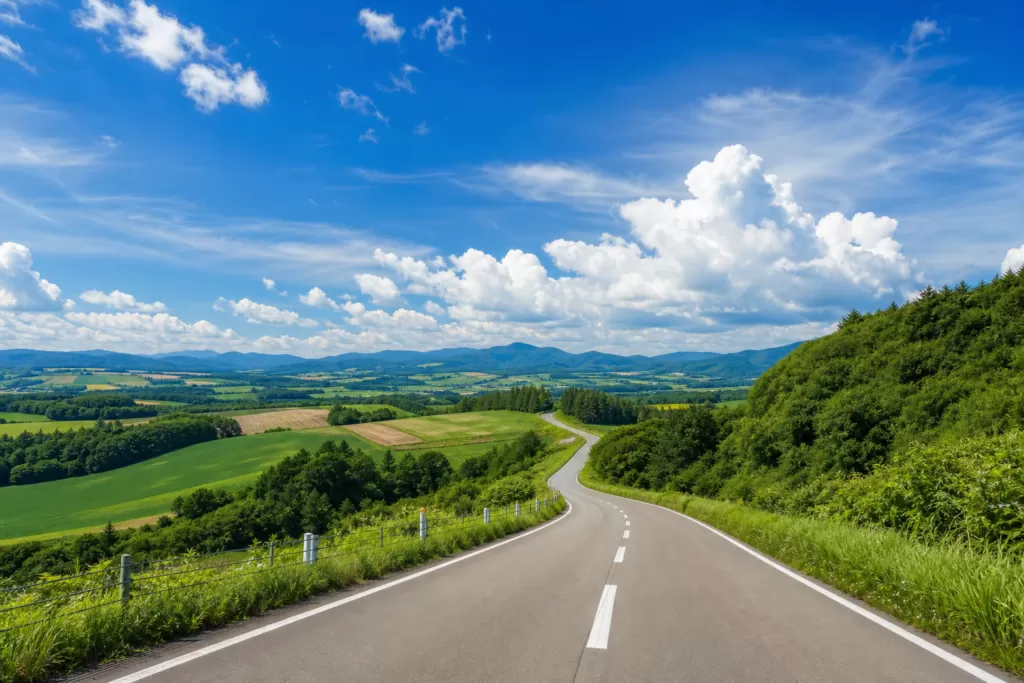
Hokkaido is Japan’s largest island, covering approximately 78,000 square kilometers — about 34% of Honshu’s area. As a driving destination, few places offer this level of freedom. Whether you head east, west, north, or south from New Chitose Airport, entirely different landscapes await: mountains, coastlines, open plains, and wetlands. This guide covers recommended routes by region, scenic highlights, and tips for traveling by campervan.
Hokkaido’s road network stretches about 100,000 km in total, with national routes alone exceeding 4,400 km. Wide agricultural roads and prefectural roads with few traffic lights offer a scale of driving rarely experienced on Honshu. In a rental car or campervan, covering 300–400 km a day while visiting multiple spots is entirely realistic. Below are specific routes and stops by region.
Best Season & Estimated Costs for Hokkaido Drives
Seasonal Highlights
The main driving season in Hokkaido is May through October. June to August is particularly pleasant, with temperatures around 20–25°C — coinciding with lavender blooms (July, Furano) and alpine wildflowers. Tourist crowds peak in summer, but this period offers the best balance of scenery, weather, and road conditions.
May is a hidden gem: fewer tourists, easy parking, and snow-green contrasts on fresh vegetation. Roads are almost entirely clear of ice. The Shiretoko Traverse Road typically opens in early May, with snow walls still lining the pass — an ethereal sight. September and October bring spectacular autumn foliage; colors start in the Daisetsuzan range in early September and reach Shiretoko’s grasslands by early October. Both months are less crowded than summer and comfortable for campervan travel.
Estimated Costs (7 nights 8 days, based at New Chitose Airport)
| Item | Estimated Cost | Notes |
|---|---|---|
| Campervan rental | ¥140,000–280,000 | Varies by vehicle type and season (7 nights) |
| Fuel | ¥20,000–40,000 | 2,000 km, fuel economy 8–10 km/L |
| RV park / roadside station overnight | ¥0–15,000 | Free to ¥2,000/night |
| Food & sightseeing | ¥30,000–60,000 | Savings possible with self-catering |
| Total | ¥190,000–400,000 | For 2 people: ¥100,000–200,000 per person |
In areas with sparse gas stations — particularly inland Hokuto and Okhotsk — get into the habit of refueling whenever you spot a station. Around Soya Cape and the tip of the Shiretoko Peninsula, stations can be far apart. Most campervans get 8–10 km/L with a 60–80 L tank, giving a range of 500–700 km. When driving in northern or eastern Hokkaido, always keep the tank topped up.
Central & Southern Hokkaido Drive Routes (Lake Shikotsu, Niseko, Hakodate)
New Chitose Airport → Lake Shikotsu → Niseko → Otaru / Yoichi
Lake Shikotsu is about 40 km / 45 minutes from New Chitose Airport. Japan’s northernmost non-freezing lake is famous for its clarity; canoeing and lakeside walks are popular. In a campervan, you can arrive early and enjoy the calm morning surface.
From Shikotsu, Route 82 and National Route 230 lead to Lake Toya, another classic stop. Toya is a caldera lake with an island at its center; the 43 km lakeside circuit road is easy to drive with outstanding scenery. Continue to Niseko, which stays cool even in summer and offers views of Mt. Yotei plus outdoor activities. Niseko is about 130 km / 2 hours from New Chitose Airport.
Yoichi is roughly 50 km / 1 hour from Niseko, known for the Nikka Whisky Yoichi Distillery (tours and tastings available) and fruit orchards. Otaru is another 30 km / 40 minutes away — stroll the stone warehouses along the Otaru Canal, then return to New Chitose Airport in about 65 km / 1 hour. Plan 2–3 nights to explore this route at a relaxed pace.
New Chitose Airport → Lake Toya → Hakodate
Direct from New Chitose Airport to Hakodate is about 280 km / 3 hours. With stops at Lake Toya and Oshamanbe, plan 4–5 hours of sightseeing driving. In Hakodate, don’t miss Goryokaku (the view from the tower is stunning) and the night view from Mt. Hakodate. Note that private vehicles are restricted on Mt. Hakodate at night from May to October — take the ropeway from the base. Campervans do best parking in designated lots and using public transport to ascend.
Onuma Quasi-National Park (about 30 km from Hakodate) is a popular side trip. Trails around Lake Onuma and Lake Konuma take 30 minutes to 1 hour, with beautiful views of Mt. Komagatake. Returning to New Chitose Airport via expressway takes about 3 hours. Two nights in southern Hokkaido makes for a satisfying trip.
Compare Hokkaido Campervan Rentals
Base yourself at New Chitose Airport and compare rates, vehicle types, and pickup locations all in one place.
Compare rental companies & prices →Eastern Hokkaido & Shiretoko Scenic Drive Routes
New Chitose Airport → Kushiro Wetlands → Lake Mashu → Shiretoko
Kushiro is about 220 km / 2.5 hours from New Chitose Airport. Japan’s largest wetland can be viewed from the Hosooka Observation Deck and Kushiro Shitsugen Observation Deck along National Route 391. Red-crowned cranes live here; with luck you may spot one by the road.
Lake Mashu is about 80 km / 1 hour 15 minutes from Kushiro. This caldera lake, famous as the “Lake of Mist,” often has clear views in the early morning and autumn, with a striking blue surface. Two observation decks (First and Third) offer different perspectives. Lake Akan is 30 km / 45 minutes further, blending Ainu culture with hot springs and famous as the home of marimo algae balls. Evenings feature traditional Ainu dance performances at the Akan Lake Ainu Theater Ikoro.
From Lake Akan to Shiretoko Utoro is about 130 km / 1 hour 45 minutes. The Shiretoko Peninsula is a UNESCO World Natural Heritage site of pristine wilderness. Shiretoko Five Lakes (about 20 km from Utoro) can be explored on a free elevated boardwalk or a guided ground trail (fee and guide required during certain periods). The Shiretoko Traverse Road (National Route 334) crosses the 738-meter Shiretoko Pass and offers views of Mt. Rausu and Kunashir Island; it’s open May through October only.
Returning from Shiretoko Utoro to New Chitose Airport is about 350 km / 4 hours (expressway). A base at Shiretoko with 3–4 nights is the classic eastern Hokkaido itinerary. The Shiretoko Cape cruise (1–3 hour options) frequently spots whales, dolphins, and brown bears — book ahead.
Notes for Eastern Hokkaido Drives
Wildlife encounters are far more frequent in eastern Hokkaido than on Honshu. Ezo deer (Hokkaido sika deer) often dart onto national routes at night — slow down after sunset. Campervans are heavy and have longer braking distances, so early headlights and careful speed management are essential. In the Shiretoko area, brown bears occasionally appear near roads. Manage garbage carefully and store food properly; current bear sighting information is available at the Shiretoko World Heritage Center in Utoro and the Rausu Visitor Center.
Northern Hokkaido & Soya Drive Routes
New Chitose Airport → Asahikawa → Furano & Biei → Wakkanai
Asahikawa is about 130 km / 1.5 hours from New Chitose Airport (expressway). Asahikawa Zoo is nationally famous for its “flying penguin” exhibit and behavioral displays. Open until sunset in summer (April–November). About 1 hour from the city, Mt. Asahidake (2,291 m), Hokkaido’s highest peak, can be reached by ropeway to 1,600 m for panoramic Daisetsuzan views even in the snow season.
Biei is about 30 km / 40 minutes from Asahikawa. The rolling patchwork farmland contains spots made famous by commercials: Mild Seven Hill, Ken & Mary’s Tree, Seven Star Tree. Furano is about 25 km / 30 minutes from Biei. Lavender peaks in July; Farm Tomita (free admission) turns purple in a quintessential Hokkaido panorama.
Wakkanai is about 280 km / 3.5 hours from Furano. The coastal route via Nayoro, Otoineppu, and Teshio along the Sea of Japan (National Route 232, Orolon Line) is the highlight of a northern Hokkaido drive — dead-straight roads alongside the Sarobetsu Plain with Mt. Rishiri seemingly floating on the ocean.
Japan’s Northernmost Point: Soya Cape
Soya Cape is about 30 km / 30 minutes from Wakkanai city center. A triangular pyramid monument marks Japan’s northernmost point; on clear days Sakhalin is visible with the naked eye. Nearby Soya Cape Campsite (free) accommodates campervans for overnight stays (confirm in advance). Ferries run from Wakkanai Port to Rishiri Island and Rebun Island (about 1 hour 40 minutes to Oshidomari Port), making island add-ons popular.
Northern Hokkaido is the farthest area from New Chitose Airport, requiring over 700 km round trip. Allow at least 4 nights 5 days: head north via Asahikawa, Furano, and Biei, then turn around from Wakkanai. On the return, the Okhotsk coast route along National Route 238 (via Esanukasen) offers a completely different landscape. Esanukasen is a 16 km dead-straight road in Sarufutsu Village with nothing but open horizon — a powerfully Hokkaido experience beloved as a hidden gem among northern Hokkaido drivers.
Benefits of Driving Hokkaido in a Campervan
Freedom Without Hotel Reservations
Hotels near Hokkaido’s summer tourist hotspots book up fast, making last-minute reservations difficult. In a campervan, you can change your route based on mood or weather, and freely decide to stay an extra night somewhere you love. Using roadside stations and RV parks keeps accommodation costs low while staying comfortable.
Using Roadside Stations (Michi-no-Eki) for Overnight Stays
Hokkaido has 128 roadside stations as of September 2026 — essential rest stops for breaks, meals, and local produce. Most allow overnight parking, and campervans are a common sight. However, roadside stations are not campsites; tents, BBQs, generators, and wastewater disposal are prohibited. Staying in your vehicle is permitted, but treat it as a parking area, not a campsite.
Electric-hookup RV parks are spread across Hokkaido, typically ¥1,000–2,500 per night. If you need power, locate them on your route in advance. Services such as “RV Park Hokkaido” and “Choi Tabi Hokkaido” let you search all RV parks across the island. Many are adjacent to roadside stations and some include showers, water, and waste facilities — ideal for staying put and relaxing while sightseeing.
Sourcing Local Ingredients & Self-Catering
With a campervan kitchen, you can cook local produce bought that day at roadside stations or markets. Furano corn, Yoichi grapes, Kushiro seafood, Asahikawa ramen ingredients — cooking locally sourced food on the road is a campervan-exclusive pleasure. It also cuts food costs significantly, especially for families. Hokkaido scallops from Abashiri or Mombetsu, saury or hairy crab from Nemuro — eastern Hokkaido seafood bought in season can cost half the supermarket price. Plan purchases around your cooler or onboard refrigerator capacity.
Managing Larger Parking Needs
Campervans are typically 5–7 m long and may not fit standard compact parking spaces. Expect to use oversized or end-of-row spaces at tourist sites; finding a spot can take time when crowded. Arriving early works well at popular spots like the Mt. Hakodate ropeway base, Shiretoko Five Lakes, and Lake Mashu observation decks. Where shuttle buses operate, park and transfer from the lot.
New Chitose Airport / Tokachi-Obihiro Airport
Rent the Cab-Over Campervan “Cresson Journey”
Base yourself at New Chitose Airport and travel all across Hokkaido by campervan.
See details at Moving Inn →Frequently Asked Questions (FAQ)
Q: How many days do I need to be satisfied with a Hokkaido drive?
If you focus on one region, 5–7 days. For a full Hokkaido circuit, 10–14 days. From New Chitose Airport, central and southern Hokkaido alone is doable in 3–4 nights, but adding eastern Hokkaido (Shiretoko) or northern Hokkaido (Soya) adds significant distance. Campervans save time on accommodation logistics, so you tend to visit more spots in the same number of days.
Q: Which route is recommended for a first-time Hokkaido drive?
For first-timers, we recommend the “Central Circuit”: New Chitose Airport → Lake Shikotsu → Niseko → Otaru → Asahikawa → Furano & Biei → New Chitose Airport. The total distance is 700–800 km, fitting neatly into 6–7 days, and showcases Hokkaido’s diverse landscapes. Driving in May (fewer crowds) or late September to October (autumn foliage) is especially memorable.
Q: Can I stay overnight in a campervan at a roadside station?
Parking overnight at most roadside stations is allowed, but roadside stations are not campsites. Tents, campfires, BBQs, generators, and wastewater disposal are prohibited. Sleeping inside your vehicle is generally accepted, but rules vary by facility. Check each station’s official website or signage before you stay. If you need electric hookup and waste facilities, use an RV park instead.
Q: Where can I rent a campervan in Hokkaido?
Multiple rental companies are based near New Chitose Airport, clustered within 30–60 minutes of the terminal. From June 2026, Moving Inn opened a location about 10 minutes by car from New Chitose Airport (free shuttle), offering the cab-over campervan “Cresson Journey” — so you can drive away immediately after landing. For vehicle types, pricing, and departure bases, see the rental comparison page.
Q: What road conditions should I watch out for in Hokkaido?
Hokkaido’s national and prefectural roads are smooth with few hills, but long straight sections can lead to unintentional speeding. Observing speed limits and watching for Ezo deer at night are especially important. Parts of eastern and northern Hokkaido have no mobile phone coverage — carry a paper map or offline map as backup. Even in June to August, temperatures in mountain areas and at night can drop below 10°C, so keep warm layers in the vehicle.
Book a Campervan in Hokkaido
Moving Inn New Chitose Airport supports English booking and offers airport transfers.

![When and Where Can You See Harbor Seals at Cape Erimo? Kaze no Yakata Official Information, Viewing Season, and Windy-Day Notes [2026-27]](https://hokkaido-campingcar.jp/wp-content/uploads/2026/10/erimo-cape-lighthouse-768x511.jpg.webp)
![Where and Under What Conditions Can You See Diamond Dust in Hokkaido? How Cold a Morning It Takes, and Where It Appears [2026-27]](https://hokkaido-campingcar.jp/wp-content/uploads/2026/10/hokkaido-diamond-dust-nayoro-768x512.jpg.webp)
![Can You Drive to Hokkaido Jingu for Hatsumode? Parking, Crowds, and Where to Park and Walk [2027]](https://hokkaido-campingcar.jp/wp-content/uploads/2026/10/hokkaido-jingu-winter-torii-768x504.jpg.webp)
![Hokkaido Roads Over New Year [2026-27] | Expressway Sections Prone to Blizzard Closures, Forecast Congestion Days, No Holiday Discount, and New Chitose Airport Parking](https://hokkaido-campingcar.jp/wp-content/uploads/2026/10/hokkaido-winter-rural-road-edge-markers-768x432.jpg.webp)
![Where to See Sea Smoke (Kearashi) in Hokkaido: Rumoi’s Ogon-misaki and the Morning Conditions [2026-27]](https://hokkaido-campingcar.jp/wp-content/uploads/2026/10/rumoi-kearashi-sea-smoke-768x511.jpg.webp)
![Geminid Meteor Shower 2026 in Hokkaido: Peak Around 23:00 on December 14, Sapporo Moonset 20:40, and Staying Warm in a Winter Campervan [2026]](https://hokkaido-campingcar.jp/wp-content/uploads/2026/10/geminids-2026-hokkaido-768x575.jpg.webp)