Complete Guide to Campervan Air Conditioning | Types, Power, and Summer Use in Hokkaido [2026 Edition]
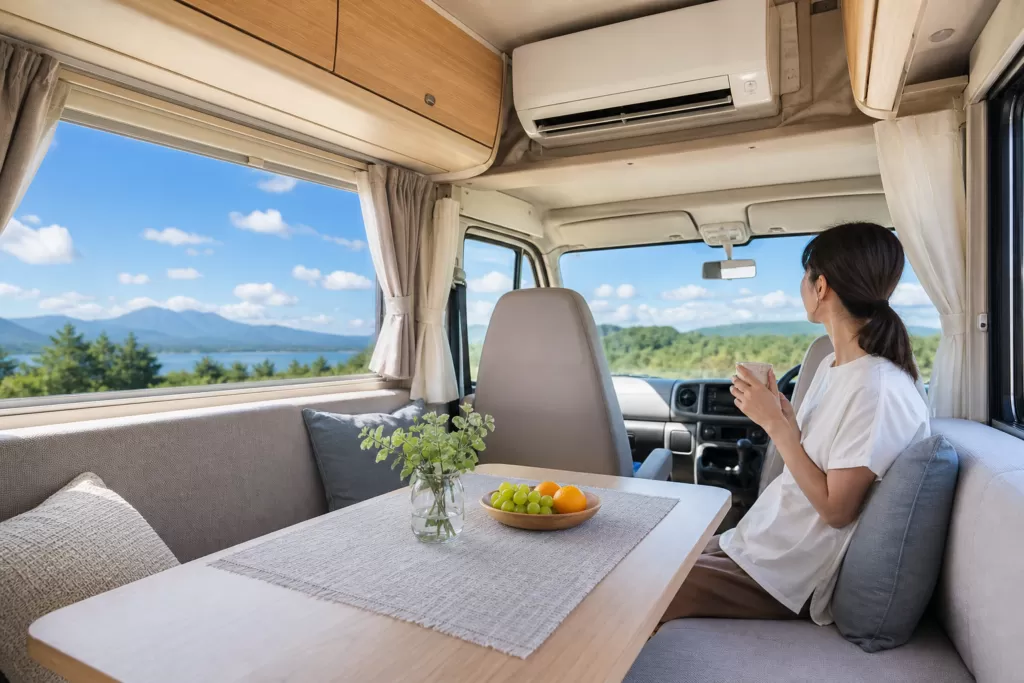
Types of Campervan Air Conditioners (Running Charge, Sub-Battery, Shore Power)
Campervan air conditioners fall into three main categories based on power source. Your choice determines comfort, running costs, and freedom of movement. Even if a listing says “air conditioning included,” the specifics differ greatly — always confirm details. Note that campervans have two separate systems: the “driving air conditioner” (cab) and the “living space air conditioner.” Don’t confuse the two.
① Running Charge + Sub-Battery System
The alternator charges the sub-battery while driving; the air conditioner draws from that battery when stopped. Comfortable while driving via engine power, but parked and sleeping you rely on sub-battery capacity. A standard sub-battery (~100 Ah) powering a 100 V household unit (800–1,200 W) typically lasts 1–2 hours — not enough for a full night.
② Shore Power (External Hookup) System
A 100 V / 15 A (or 30 A) supply from a campsite or RV park powers a standard household air conditioner in the van. With power available, the air conditioner runs all night. RV park electric sites typically cost ¥1,000–2,500/night — a practical cost for comfortable sleep.
③ On-Board Generator System
A gasoline or diesel generator produces 100 V power for the air conditioner anywhere. The advantage is location freedom, but there is noise, fuel replenishment, and maintenance. Some campsites ban generator use at night — check first. Generator-equipped rental campervans are relatively rare.
④ Driving Air Conditioner (Engine-Direct)
Like a regular car, engine-driven compressor. Standard in the cab of most campervans. Works while driving; stops when the engine stops. The living space air conditioner uses one of systems ①–③ above.
In summary: shore power is easiest; generators give location freedom but create noise. Large lithium battery + running charge is a promising future option. For rentals, plan an itinerary incorporating electric hookup RV parks.
Power Capacity and Air Conditioner Consumption
The trickiest aspect is understanding the relationship between power draw and available capacity. Key figures for running a household air conditioner in a van:
Household 100 V Air Conditioner Consumption
Typical small air conditioners (6–8 tatami, cooling or heat/cool) vary by operating mode:
- Start-up (compressor kick): 1,200–1,500 W
- Rated cooling operation: 600–1,000 W
- Inverter (energy-saving) stable operation: 400–700 W
A typical RV park electric site supplies 100 V / 15 A (max 1,500 W). If start-up current exceeds 1,500 W, the breaker trips. Choose an inverter (energy-saving) unit or a campervan-specific model to stay within limits.
How Long Can You Run on Sub-Battery Alone?
A typical rental campervan sub-battery holds ~100 Ah (about 1.2 kWh). Usable capacity is 50–70%, giving ~600–840 Wh. At 700 W, the battery runs out in under 1 hour. The practical solution: drive during the day → check in to an electric hookup site → sleep with shore power.
Lithium Battery Vehicles Are a Different Category
More campervans now carry large lithium-ion batteries (200–400 Ah). A 400 Ah lithium pack has over 4 kWh of usable energy — enough for 4–6 hours of air conditioning. Most rental campervans don’t yet offer this. When booking, confirm battery capacity and whether it’s lithium or lead-acid.
Quick Reference: Power Capacity vs. Air Conditioner Use
- Sub-battery 100 Ah (lead-acid): ~1–1.5 hours. Overnight use unrealistic.
- Sub-battery 200 Ah (lead-acid): ~2–3 hours. Late-night-only use may work.
- Lithium 200 Ah: Higher effective capacity; 4–5 hours within reach.
- Shore power 100 V / 15 A: Up to 1,500 W. Energy-saving unit runs all night.
Is Air Conditioning Really Necessary in Hokkaido’s Summer?
Hokkaido has a reputation for cool summers. Coastal areas — Sapporo, Otaru, Hakodate — average 20–23°C in July, mild compared to mainland Japan’s heat. But campervan travel creates situations where going without air conditioning is genuinely difficult.
Inland Areas (Obihiro, Asahikawa) Regularly Exceed 30°C
Hokkaido’s temperatures vary greatly by region. Obihiro, Asahikawa, and Kitami regularly exceed 30°C in July–August; Obihiro has recorded temperatures close to 40°C. Buildings and vehicles in Hokkaido were designed for cold, not heat. A campervan in direct sunlight becomes greenhouse-like; interior temperatures can climb 10°C above ambient.
Mosquitoes and Horseflies Make Opening Windows Impossible
July and August bring heavy mosquitoes and horseflies. Near wetlands and forests, opening a window lets them pour in. Insect screens help but can’t fully block ventilators. The result: sealed windows at night → stuffy van → air conditioning becomes essential.
When Is Air Conditioning Not Needed?
If all of the following apply, you may be comfortable without air conditioning:
- Traveling in early June or after September (cooler temperatures)
- Route is mainly coastal or eastern Hokkaido (Kushiro, Nemuro)
- Overnight spots are in areas where temperatures drop below 20°C at night
- Vehicle has a ventilator and insect-screen window system
Conversely, if driving inland in July–August, air conditioning is strongly recommended. For families with children, the elderly, or pet owners, treat air conditioning as essential, not merely helpful.
How to Combine Sub-Battery and Shore Power
For continuous comfortable air conditioning, decide on a clear power strategy — “we have a sub-battery” alone isn’t enough if power cuts out during the night.
Plan Your Itinerary Around RV Parks and Electric Sites
Hokkaido has many RV parks with electric hookups. With shore power, the air conditioner can run all night and the sub-battery can be fully recharged before morning. Plan so that nights when you want air conditioning are booked at electric sites — this eliminates stress and maximizes comfort.
Charge While Driving → Use Eco Mode When Parked
On days without an electric site, charge the sub-battery while driving, then run the air conditioner in eco mode (higher set point, lower fan speed) briefly after parking. Setting just 3–4°C below ambient cuts consumption significantly. On a 30°C day, 26–27°C on low fan can keep consumption below 600 W.
Monitor the Sub-Battery Level
Most modern campervans have a battery monitor. Before your rental, ask staff how to read it so you can estimate before bed how many hours of air conditioning remain. Lead-acid batteries shouldn’t go below 50% — stopping at 30–40% and briefly running the engine to recharge is both practical and vehicle-protective.
Use the Driving and Living Air Conditioners Separately
In larger vehicles (cab-overs), the cab and living space air conditioners are separate systems. Use the cab unit while driving; switch to the living space unit when parked or sleeping. Running both simultaneously is power-hungry — while driving, rely on windows and ventilators in the living area to keep the alternator focused on charging.
How to Rent an Air-Conditioned Campervan
When renting an air-conditioned campervan, explicitly confirm a “living space air conditioner” is fitted. The driving (cab) air conditioner is in nearly every vehicle; a living space unit is not standard on all models.
Key Questions to Ask
- Is there an air conditioner in the living/sleeping area?
- Power system: sub-battery only, shore power compatible, or generator?
- Sub-battery capacity (100 Ah, 200 Ah, etc.) and type (lead-acid or lithium)?
- Maximum shore power cord rating (15 A, 30 A)?
- Any rental company rules about air conditioner use?
Air-Conditioned Campervan Options in Hokkaido
Among rental companies based at New Chitose Airport, availability varies by vehicle. Kei campervans and compact van-conversions often lack living space air conditioning; van-conversions (HiAce-based) and cab-overs generally have it. For July–August travel, filter by “air conditioning” when choosing your vehicle.
Rental Costs and Seasonal Variation
Air-conditioned campervans are generally more expensive than kei campervans. Reference prices as of June 2026 (estimates; actual prices vary):
- Van-conversion (with air conditioning): ¥25,000–40,000/night (peak season ¥30,000–50,000+)
- Cab-over (with air conditioning, shower, toilet): ¥35,000–60,000/night
- Kei campervan (no air conditioning, ventilation only): ¥12,000–25,000/night
Popular air-conditioned vehicles sell out fast in the July–August peak season. Book 2–3 months in advance.
Compare Hokkaido Campervan Rentals
Base yourself at New Chitose Airport and compare rates, vehicle types, and pickup locations all in one place.
Compare rental companies & prices →Cresson Journey (Cab-Over): Air Conditioning & Shore Power Ready
Moving Inn, which opened near New Chitose Airport in June 2026, offers the cab-over “Cresson Journey” with living space air conditioning and shore power connectivity. Paired with RV park electric sites, expect a comfortable overnight experience in Hokkaido’s summer heat. Confirm sub-battery capacity and shore power specs on Moving Inn’s vehicle detail page.
New Chitose Airport / Tokachi-Obihiro Airport
Rent the Cab-Over Campervan “Cresson Journey”
Base yourself at New Chitose Airport and travel all across Hokkaido by campervan.
See details at Moving Inn →Frequently Asked Questions (FAQ)
Q: How is a campervan air conditioner different from a regular car’s?
A regular car uses an engine-driven compressor — it only works while the engine runs. A campervan’s living space air conditioner typically uses a sub-battery or shore power (100 V), so it can run with the engine off during sleep. However, it requires monitoring power capacity and hookup availability.
Q: Can I sleep all night with the air conditioner on using just the sub-battery?
With a standard sub-battery (100 Ah lead-acid), this is very difficult. At ~700 W consumption, a 600–840 Wh battery lasts 1–2 hours. For 7–8 hours overnight, you need either shore power at an electric hookup site or a large-capacity lithium battery vehicle.
Q: Is it really hot in Hokkaido in July and August without air conditioning?
It depends on the area. Coastal east (Kushiro, Nemuro) stays cool — no air conditioning needed. But inland Obihiro, Asahikawa, and Kitami regularly exceed 30°C, and campervan interiors get even hotter. For children, the elderly, pets, or inland-focused itineraries, choose an air-conditioned vehicle.
Q: How much do RV park electric hookup sites cost?
In Hokkaido, ¥1,000–3,000 per night is typical (as of June 2026; varies by facility and season). When booking, confirm whether the site is 100 V / 15 A and how long the power cord is.
Q: What should I check when renting an air-conditioned campervan?
Three things: ① Is there a living space air conditioner (don’t confuse with the cab unit)? ② Is shore power hookup available? ③ What is the sub-battery capacity and type (lead-acid or lithium)? Ask the rental company before booking to avoid discovering at your campsite that air conditioning isn’t usable. Also check for any usage restrictions in the rental terms.
Book a Campervan in Hokkaido
Moving Inn New Chitose Airport supports English booking and offers airport transfers.

![When and Where Can You See Harbor Seals at Cape Erimo? Kaze no Yakata Official Information, Viewing Season, and Windy-Day Notes [2026-27]](https://hokkaido-campingcar.jp/wp-content/uploads/2026/10/erimo-cape-lighthouse-768x511.jpg.webp)
![Where and Under What Conditions Can You See Diamond Dust in Hokkaido? How Cold a Morning It Takes, and Where It Appears [2026-27]](https://hokkaido-campingcar.jp/wp-content/uploads/2026/10/hokkaido-diamond-dust-nayoro-768x512.jpg.webp)
![Can You Drive to Hokkaido Jingu for Hatsumode? Parking, Crowds, and Where to Park and Walk [2027]](https://hokkaido-campingcar.jp/wp-content/uploads/2026/10/hokkaido-jingu-winter-torii-768x504.jpg.webp)
![Hokkaido Roads Over New Year [2026-27] | Expressway Sections Prone to Blizzard Closures, Forecast Congestion Days, No Holiday Discount, and New Chitose Airport Parking](https://hokkaido-campingcar.jp/wp-content/uploads/2026/10/hokkaido-winter-rural-road-edge-markers-768x432.jpg.webp)
![Where to See Sea Smoke (Kearashi) in Hokkaido: Rumoi’s Ogon-misaki and the Morning Conditions [2026-27]](https://hokkaido-campingcar.jp/wp-content/uploads/2026/10/rumoi-kearashi-sea-smoke-768x511.jpg.webp)
![Geminid Meteor Shower 2026 in Hokkaido: Peak Around 23:00 on December 14, Sapporo Moonset 20:40, and Staying Warm in a Winter Campervan [2026]](https://hokkaido-campingcar.jp/wp-content/uploads/2026/10/geminids-2026-hokkaido-768x575.jpg.webp)