How Much Does a Campervan Cost to Own Per Year? Purchase vs. Rental Cost Comparison [Real Figures]
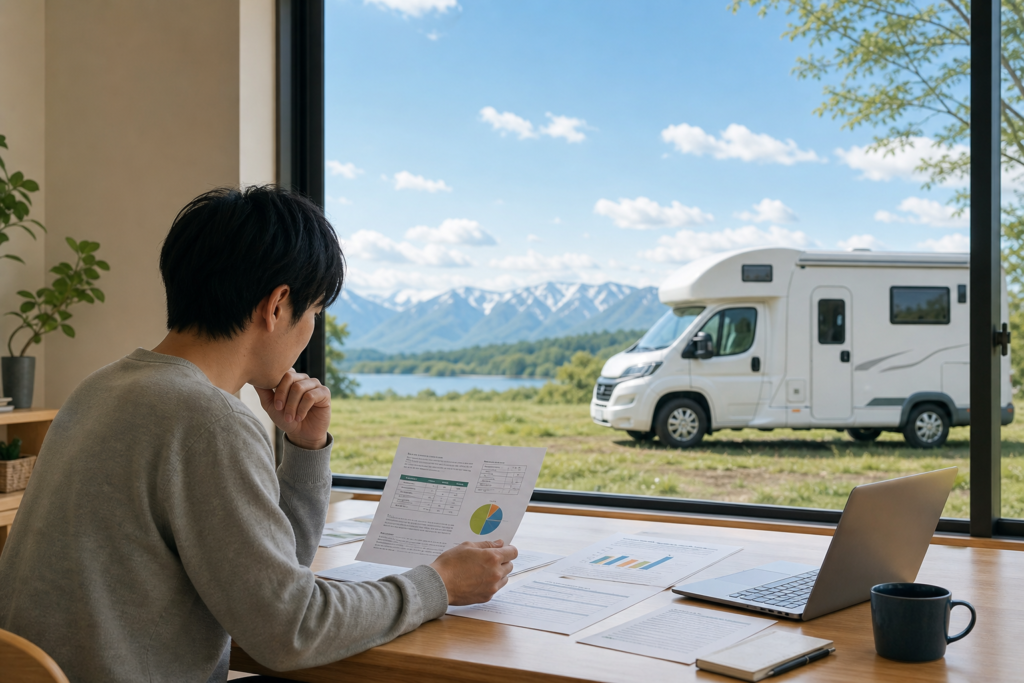
Annual ownership costs for a campervan run roughly 250,000 to 600,000 yen, depending on the vehicle type — and that’s on top of the purchase price. Just keeping one costs you that much every year. It’s a real phenomenon: people buy out of pure enthusiasm, then sell within two or three years because the ongoing costs become too much. The top reasons people let go of their campervans are “used it less than expected” and “parking and insurance were too much of a burden.” Renting, by contrast, costs about 30,000 to 70,000 yen for a one-night, two-day trip. The break-even point between buying and renting comes down to how many days a year you actually use it — and the bottom line is: if you use it 10 days or fewer per year, renting is cheaper.
This article breaks down annual ownership costs item by item with real figures, runs simulations for three vehicle types — kei campers, van conversions, and cab-over motorhomes — and compares the total cost of buying versus renting over 3, 5, and 10 years.
Annual Running Costs: 5 Key Categories
1. Vehicle Tax: 10,000–50,000 yen per year
Most campervans are registered under the “8-number” plate (special-purpose vehicle: camping), which makes the annual tax about 20% lower than a regular passenger car of the same engine size. For a HiAce-based van conversion (2.7L petrol), the annual tax is around 41,000 yen; for a Camuroad-based cab-over (2.8L diesel), also around 41,000 yen; and for a kei camper (8-number plate), about 12,000 yen per year.
2. Insurance: 80,000–150,000 yen per year
Compulsory liability insurance (JCI) is paid at vehicle inspection time — for 8-number vehicles, it costs about 20,000 yen for 24 months. The bigger expense is voluntary insurance: because campervans have high vehicle values (5 million to over 10 million yen), adding comprehensive coverage brings annual premiums to 80,000–150,000 yen. Some insurers won’t cover 8-number vehicles at all, so the limited choice of providers is something to research before buying.
3. Inspection & Maintenance: Average 70,000–150,000 yen per year
8-number vehicles require inspection every two years (including the first inspection on a new vehicle). Inspection costs — statutory fees plus servicing — typically run 120,000–200,000 yen per visit, averaging out to 60,000–100,000 yen per year. On top of that come tires (a set of four for a cab-over costs 100,000–150,000 yen and needs replacing every three to four years), batteries (sub-battery replacement: 30,000–50,000 yen), and repairs to fitted-out components like diesel heaters and refrigerators. Failures in the fitted-out parts often can’t be handled by a regular garage — sending it back to the coachbuilder adds both cost and time.
4. Parking: 0–360,000 yen per year
If you can park at home, this costs nothing. If you need to rent a space, cab-overs — which stand over 2.8 m tall — can’t fit in multi-story or covered car parks, so you need a flat, large-format outdoor space. In rural areas, that runs 5,000–10,000 yen per month; in cities, 20,000–30,000 yen per month. Annually, that’s up to 360,000 yen — the single most variable item in running costs.
5. Fuel: 50,000–150,000 yen per year
At 5,000 km per year, a van conversion getting 9 km/L on petrol at 170 yen/L costs about 94,000 yen in fuel; a cab-over at 7 km/L on diesel at 150 yen/L costs about 107,000 yen. This is a variable cost — drive less and you pay less — but it can lead to the counterproductive habit of avoiding long trips because of the running costs.
Annual Running Cost Simulation by Vehicle Type
These estimates assume 5,000 km per year and renting a parking space at 8,000 yen/month (a typical rural rate).
| Item | Kei Camper | Van Conversion | Cab-Over Motorhome |
|---|---|---|---|
| Vehicle tax | 12,000 yen | 41,000 yen | 41,000 yen |
| Insurance (JCI + voluntary) | 60,000 yen | 100,000 yen | 130,000 yen |
| Inspection & servicing (annual avg.) | 50,000 yen | 90,000 yen | 130,000 yen |
| Parking | 96,000 yen | 96,000 yen | 96,000 yen |
| Fuel (5,000 km/year) | 60,000 yen | 94,000 yen | 107,000 yen |
| Annual total | approx. 280,000 yen | approx. 420,000 yen | approx. 500,000 yen |
If you can park at home, subtract about 100,000 yen. If you’re renting a space in a city, add 100,000–250,000 yen. On a monthly basis, a cab-over costs just over 40,000 yen. Think of it as “a vehicle that costs you 40,000 yen a month even when you’re not driving it” — that framing makes the weight of ownership costs easier to feel. And worth noting: in Japan, the average campervan is used roughly 20–30 days per year, meaning for the other 330 days it’s sitting in a parking space generating costs and nothing else. That low utilization rate is the real crux of the buy-versus-rent question.
Buying vs. Renting: Total Cost Over 3, 5, and 10 Years
This comparison pits buying a new van conversion (7,000,000 yen) against renting an equivalent vehicle (40,000 yen per one-night, two-day rental × 5 trips per year = 200,000 yen/year). The purchase side accounts for resale value — campervans hold their value relatively well (many sell for 40–50% of purchase price even after 10 years) — and deducts that residual value from the total cost.
| Period | Buying (net vehicle loss + running costs) | Renting (5 trips/year) |
|---|---|---|
| 3 years | approx. 3,360,000 yen (2,100,000 yen depreciation + 1,260,000 yen running costs) | 600,000 yen |
| 5 years | approx. 4,900,000 yen (2,800,000 yen depreciation + 2,100,000 yen running costs) | 1,000,000 yen |
| 10 years | approx. 8,400,000 yen (4,200,000 yen depreciation + 4,200,000 yen running costs) | 2,000,000 yen |
At five trips a year (around 10 days), the gap reaches over 6,000,000 yen over 10 years. And the rental figure already includes insurance, maintenance, and parking — with zero risk of unexpected repair bills. Buying only starts to make financial sense when usage increases significantly and the vehicle becomes something you genuinely live out of — or when you’re using it for weeks at a time for workation-style trips.
Upfront Costs and Surprise Expenses That Don’t Show Up in Running Cost Estimates
There are costs that don’t appear in standard running cost calculations, and they’re worth understanding before you buy. Start with upfront costs: on top of the vehicle price, registration and pre-delivery servicing add 200,000–400,000 yen, and once you start adding equipment — solar panels, lithium sub-batteries, a side awning — you’re looking at another 500,000–1,500,000 yen. Campervans are the kind of vehicle that makes you want to keep upgrading after purchase; most owners put in tens of thousands more over the first two or three years.
The three most common unexpected expenses are:
- Sub-battery lifespan: Lead-acid batteries need replacing every 3–5 years at a cost of 30,000–50,000 yen. Upgrading to lithium runs 200,000–400,000 yen.
- Leaks and resealing: The shell on a cab-over motorhome typically needs its sealant replaced after 5–10 years. Left untreated, moisture gets into the interior structure, and repairs can reach hundreds of thousands of yen.
- Diesel heater and refrigerator failures: Repair or replacement costs 50,000–200,000 yen. Waiting on parts from the coachbuilder can leave you without the vehicle for one to two months.
The 420,000 yen annual running cost figure is a “normal year” estimate — it doesn’t include these surprise expenses. Over 10 years of ownership, it’s realistic to expect an additional 500,000–1,000,000 yen in unplanned costs on top of that.
If You’re Using It in Hokkaido, “Rent Locally” Is Another Option Worth Comparing
If you live in Honshu and your main use case for a campervan is trips to Hokkaido, there’s a third comparison axis to consider before deciding whether to buy or rent: the cost of taking your own vehicle to Hokkaido.
On the Oarai–Tomakomai ferry route, a campervan over 5 metres long pays 40,000–60,000 yen in vehicle fare one way, plus separate fares for any passengers. The round trip comes to around 100,000 yen and takes about 18 hours each way. If you’re planning to take your campervan to Hokkaido every summer, that’s 100,000 yen and two full days every year as a fixed cost. With local rental, you fly in (Tokyo–Shin-Chitose Airport is 10,000–20,000 yen one way if you book early) and pick up a vehicle near the airport — significantly cheaper and faster. Comparing a 5-night, 6-day Hokkaido trip: transport costs for bringing your own campervan by ferry come to around 100,000 yen, while flights for two plus five days of local rental runs 130,000–160,000 yen. Factor in zero accommodation costs and zero ongoing running costs, and local rental comes out ahead overall for Hokkaido-focused use.
Why “10 Days or Fewer = Renting Wins” — The Numbers Behind It
Here’s a simplified break-even calculation. The annual effective cost of owning a van conversion is: depreciation (4,200,000 yen over 10 years = 420,000 yen/year) + running costs (420,000 yen/year) = roughly 840,000 yen per year. Renting costs about 20,000 yen per day. 840,000 ÷ 20,000 = 42 days. In pure theory, you’d need to use it 42 days a year just to break even with owning.
That said, ownership comes with real value that money can’t fully capture: the freedom to leave on a whim, and being able to keep your gear loaded and ready to go. So as a practical rule of thumb: 10 days or fewer per year — rent without hesitation; more than 30 days — buying is worth considering; anywhere in between — it depends on your lifestyle. At 10 days of use, rental costs 200,000–250,000 yen per year — still less than annual running costs for a van conversion with parking (420,000 yen), before even factoring in the purchase price. Renting wins clearly.
There’s another hidden benefit to renting: you get to try different vehicle types each time. Driving both a van conversion and a cab-over makes it very clear which features you actually need and which you don’t. If you’re thinking about buying in the future, renting first to test things out in real conditions is genuinely worthwhile.
Managing Running Costs with an Annual Budget: Practical Tips for Owners
If you do decide to buy, treating running costs as a fixed monthly expense makes unexpected bills much less stressful. The approach is simple: take the annual running cost of 420,000 yen (for a van conversion) plus a 100,000 yen reserve for unexpected expenses, totalling 520,000 yen per year. Divide by 12 and set up an automatic transfer of 43,000 yen per month into a dedicated vehicle account. In years with inspections or tire replacements, spending spikes — but if you’re drawing from the reserve, your household budget stays smooth.
Alongside running costs, it’s also worth tracking depreciation — the loss in vehicle value over time. If a new 7,000,000 yen van conversion sells for 2,800,000 yen after 10 years, that’s 420,000 yen of value lost per year, or 35,000 yen per month. Combined with the 43,000 yen monthly running cost, the true effective cost of ownership is around 78,000 yen per month. The honest question to ask yourself is: “Is the freedom to leave whenever I want worth 78,000 yen a month to me?” If the answer is yes, buying makes sense. If you’re not sure, renting is still the right call.
Want to Try Before You Decide?
If you’re in the Hokkaido / Shin-Chitose Airport area, Moving Inn is a straightforward option for campervan rental. They have everything from van conversions to cab-over motorhomes, making it easy to try different types before committing to a purchase. No running costs, no parking fees — you just pay for the days you use it. After reading the numbers in this article, the logic of that should be pretty clear.
Browse Moving Inn’s campervan rentals
Compare all Hokkaido campervan rental companies
FAQ: Campervan Running Costs
Q1. How much more expensive is a campervan to run than a regular car?
Compared to a minivan of similar size (roughly 250,000–350,000 yen per year), a van conversion runs about 50,000–100,000 yen more, and a cab-over about 150,000–250,000 yen more. The main differences are voluntary insurance (higher because of the vehicle’s value), inspection and servicing (coachbuilt components cost more to repair), and tires. Vehicle tax is actually lower for 8-number registered vehicles.
Q2. Does 8-number registration reduce running costs?
Vehicle tax is about 20% lower than for a regular passenger car of the same engine size, and inspections are every two years. However, voluntary insurance providers are limited for 8-number vehicles, and premiums tend to be higher — so overall, the savings are modest: roughly just the tax reduction. Note that 8-number registration also requires meeting structural requirements (sleeping facilities, water supply, etc.), so registering purely for tax savings won’t pass inspection.
Q3. Are there ways to reduce running costs?
In order of impact: (1) park at home (saves around 100,000 yen per year); (2) review your insurance terms (raising the excess, limiting drivers, etc. can save 20,000–50,000 yen per year); (3) buy tires and oil elsewhere and have them fitted at the garage (saves 10,000–30,000 yen per year). That said, cutting corners on the coachbuilt components — plumbing and electrics in particular — tends to be expensive when things go wrong, so don’t skip those inspections.
Q4. Does buying used bring running costs down?
Tax, insurance, and parking don’t change, and maintenance costs tend to go up. Vehicles over 10 years old also face a vehicle tax surcharge (about 15% extra). Older models often have fitted-out components — diesel heaters, refrigerators, batteries — all due for replacement at the same time, which can mean 200,000–500,000 yen in a single year. Buying used reduces the purchase price, not the running costs — keep those two things separate in your thinking.
Q5. So which is better — buying or renting?
If you’ll use it 10 days or fewer per year, renting is clearly cheaper. If you’ll use it more than 30 days a year, buying is worth considering. If you’re not sure, the fastest way to find out is to rent for a year, keep count of how many days you actually use it, and do the maths. If it’s under 10 days, you have your answer. If you kept thinking “I wish I could have booked more days but couldn’t get a reservation,” that’s your sign to start looking at buying. And if your main destination is Hokkaido, renting locally means no ferry, no long drive — just fly in and go.