Hokkaido Campervan Rental 1-Month Cost Simulation | Total Costs and Key Notes for Long-Term Stays [2026 Edition]
How much does it cost to rent a campervan in Hokkaido for a month? A full cost simulation covering rental fees by vehicle type, petrol, campsites, and food.
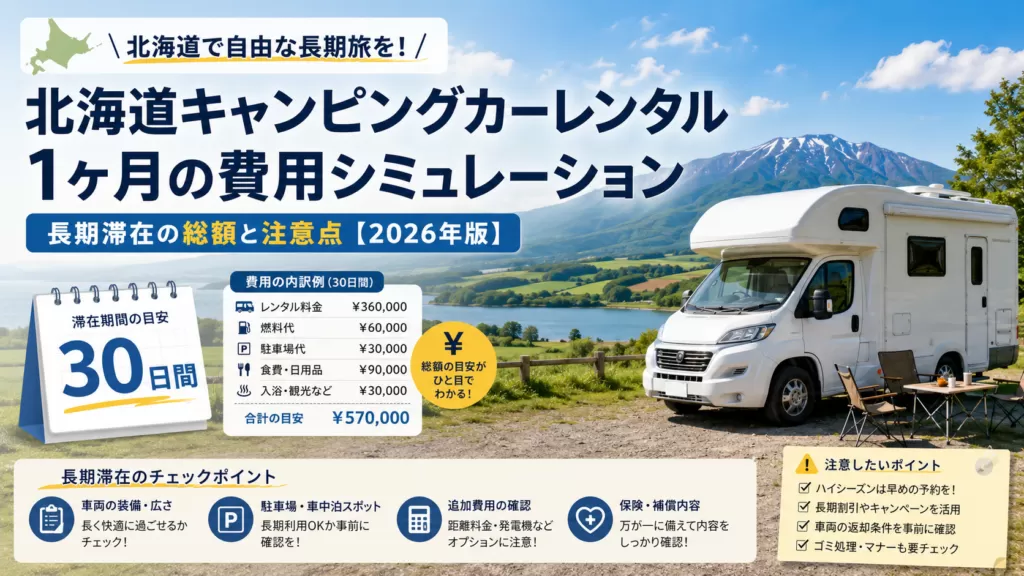
A month-long Hokkaido campervan stay. It’s a dream for many — retirees on an extended journey, remote workers combining travel with work, or those who want to slowly circle all of Hokkaido. Long-term rental demand is real.
This article provides a cost simulation for a 1-month rental. Beyond the rental fee alone, we estimate the total cost including petrol, campsites, food, and everything else along the way. We also cover common pitfalls around mileage limits, suggested long-stay itineraries, and how to choose campsites for extended trips.
New Chitose Airport / Tokachi-Obihiro Airport
Rent the Cabcon “Cresson Journey”
Base yourself at New Chitose Airport and compare rates, vehicle types, and pickup locations all in one place.
See details at Moving Inn →Monthly Rental Fee by Vehicle Type
Estimates for a 30-day rental. Long-term discounts may apply depending on the operator. The figures below reflect 2026 market rates.
| Vehicle Type | Daily Rate | 30 Days (no discount) | After Long-Term Discount (10–30% off) |
|---|---|---|---|
| Kei camper | ¥7,800–19,800 | ¥234,000–594,000 | Approx. ¥164,000–535,000 |
| Van conversion (1BOX-based) | ¥12,000–33,000 | ¥360,000–990,000 | Approx. ¥252,000–891,000 |
| Cab-over (full-spec) | ¥16,500–57,000 | ¥495,000–1,710,000 | Approx. ¥347,000–1,540,000 |
※ Whether a long-term discount applies and the discount rate vary by operator. Even if not listed on the official website, contacting the operator directly sometimes gets you a deal.
Liability waiver fees (¥1,100–5,500/day) are charged separately. For 30 days this adds ¥33,000–165,000. Since this is insurance on top of standard coverage, confirm whether you’ll take it out before booking.
Long-Term Discount Rates and Negotiation Tips
Many operators have discounts for rentals of a week, two weeks, or a month or more. However, these are often not listed on official websites — checking directly in advance is very important.
Typical long-term discount ranges:
- 7–13 days: 5–10% discount
- 14–29 days: 10–20% discount
- 30 days or more: 15–30% discount
Off-season long-term rentals (October–June) are easier to negotiate and may yield even better terms. During summer (July–August) peak season, discounts may not apply.
When negotiating, emphasising that you’ll rent for the full 30 days without early cancellation, and that you’ll treat the vehicle carefully, tends to get a more flexible response. Getting quotes from multiple operators also helps you gauge the market.
Full Trip Cost: 1-Month Total Simulation
An estimate for a couple of 2 travelling Hokkaido for one month in a mid-grade van conversion. Assumes 2,000–3,000km of driving.
| Cost Item | Estimate (1 month) | Notes |
|---|---|---|
| Rental fee (30 days) | ¥270,000–742,500 | Assumes 15–25% long-term discount applied |
| Liability waiver (30 days) | ¥33,000–165,000 | ¥1,100–5,500/day |
| Petrol | ¥35,000–60,000 | 2,000–3,000km at 8–12km/L, petrol ¥175–180/L |
| Toll roads | ¥8,000–25,000 | Depends on expressway usage |
| Campsites/RV parks (30 nights) | ¥60,000–120,000 | ¥2,000–4,000/night |
| Food (2 people × 30 days) | ¥60,000–100,000 | Mainly self-catering |
| Hot springs/bathing | ¥10,000–20,000 | ¥500–800/visit × approx. 20 visits |
| Other (sightseeing, miscellaneous) | ¥20,000–50,000 | Entry fees, shopping, etc. |
| Total (2 people) | ¥496,000–1,282,500 | — |
| Per person | ¥248,000–641,000 | — |
For a month-long trip, this often works out cheaper than 30 nights in hotels. The elimination of accommodation costs makes the total more affordable than many expect. For 2 people in a mid-grade van conversion, ¥500,000–1,300,000/month is a realistic ballpark.
To cut costs, free parking spots (roadside stations / Michi-no-Eki, road-side lay-bys) are an option. However, staying multiple consecutive nights at Michi-no-Eki is considered poor etiquette at many locations, so the standard approach is to combine them with RV parks and campsites.
Mileage Limits and Excess Charges
One of the most commonly overlooked aspects of long-term rentals is the mileage limit. Some operators cap daily driving and charge extra if you go over (for example, one operator includes 250km/day free and charges ¥55 per extra km).
Circling all of Hokkaido in a month means driving approximately 2,500–4,000km. A 250km/day cap allows 7,500km over 30 days, which easily covers a full loop, but with a lower cap you may go over if you move around a lot for sightseeing. Check the cap and excess charges before booking.
What to confirm regarding mileage limits:
- The daily cap (e.g. 250km/day)
- Whether a total cap for the rental period applies
- The excess charge per km
- Whether an unlimited mileage plan is available
If your route covers eastern or northern Hokkaido where attractions are often 100+km apart, choosing an unlimited or high-cap operator is safer. Telling the operator upfront “I plan to drive roughly 3,000 km in a month” will help them recommend the best plan.
Sample Itineraries for a 1-Month Trip
A month gives you enough time to circle all of Hokkaido and still have days to spare. Here are three representative route patterns.
Eastern Hokkaido Focus Route (30 days)
A route centred on eastern Hokkaido — Shiretoko, Lake Akan, Kushiro Wetlands, Obihiro — where untouched nature is concentrated. Ideal for those who want to immerse themselves in Hokkaido’s wild scenery.
- Days 1–3: Pick up at New Chitose Airport → Sapporo and Otaru sightseeing
- Days 4–6: Furano and Biei (lavender, Patchwork Road)
- Days 7–9: Asahikawa (Asahiyama Zoo) → Abashiri, Sea of Okhotsk coast
- Days 10–15: Shiretoko Peninsula (Utoro, Rausu)
- Days 16–20: Kushiro Wetlands → Lake Akan → Lake Mashu, Lake Kussharo
- Days 21–25: Obihiro (Tokachi Plain, Shiawase Station) → Hidaka
- Days 26–28: Lake Toya → Noboribetsu
- Days 29–30: Hakodate sightseeing → return to New Chitose Airport
Estimated total driving: 2,800–3,500km. Eastern Hokkaido involves long distances between stops — choose an operator with a 150km+ daily cap for comfort.
Northern Hokkaido Focus Route (30 days)
A route centred on northern Hokkaido’s northernmost areas — Wakkanai, Rebun Island, Cape Soya. Suits those who prefer quieter, less-crowded travel or want to include island visits.
- Days 1–2: Pick up at New Chitose Airport → Sapporo
- Days 3–5: Furano and Biei
- Days 6–8: Asahikawa → Nayoro → Wakkanai (Cape Soya, Soya Hills)
- Days 9–11: Rebun Island and Rishiri Island (ferry round trip)
- Days 12–14: Rumoi → Mashike → Orolon Line
- Days 15–20: Otaru → Niseko → Shakotan Peninsula
- Days 21–25: Lake Toya → Showa-Shinzan → Hakodate
- Days 26–28: Onuma Quasi-National Park → southern Hokkaido sightseeing
- Days 29–30: Tomakomai → return to New Chitose Airport
The ferry to Rebun/Rishiri can accommodate the campervan, but separate vehicle fees apply (Wakkanai–Rishiri vehicle fares are ¥21,650 one way for under 4 m and ¥34,450 for under 6 m; double for a round trip). Using a bicycle or rental car on the island is another option.
Relaxed Central/Southern Hokkaido Focused Route (30 days)
A route that spends plenty of time in areas with well-developed tourism infrastructure — Sapporo, Otaru, Niseko, Hakodate. Low daily mileage, ideal for campervan first-timers or those who want to unwind.
- Days 1–5: Extended stay in Sapporo (Odori Park, Mt. Moiwa, Maruyama)
- Days 6–8: Otaru (canal, Yoichi)
- Days 9–12: Shakotan Peninsula circuit (Shimamui Coast, Kamui Cape)
- Days 13–17: Niseko/Kutchan (Mt. Yotei foothills, hot springs)
- Days 18–21: Lake Toya → Date → Noboribetsu
- Days 22–25: Hakodate (Goryokaku, morning market, Mt. Hakodate)
- Days 26–28: Onuma → Yakumo → Oshamanbe
- Days 29–30: Tomakomai → return to New Chitose Airport
Estimated total driving: 1,200–1,800km. Low mileage means operators with a 100km/day cap work fine.
Choosing Campsites and RV Parks for Long Stays
On a month-long trip, the quality of your campsite/RV park choices heavily affects comfort. Keeping these points in mind reduces the chance of disappointment.
Check for Power and Water/Waste Facilities
Over a long stay, power consumption from the fridge, lighting, and phone charging adds up. Securing a site with external power (100V, 30A or more) two or three times a week prevents battery drain.
RV parks provide power, parking, and toilets and typically cost ¥2,000–3,500/night. The Japan RV Association website lists RV parks across Hokkaido.
Confirm Multi-Night Stay Policies in Advance
Popular campsites sometimes cap consecutive nights (e.g. “max 3 nights”). If you want to linger somewhere you like, always confirm when booking whether multi-night stays are allowed.
Hokkaido auto campsites peak in July–August and book up fast. For a month-long summer trip, pre-booking key campsites 1–2 months in advance gives peace of mind.
Wi-Fi and Mobile Network Coverage
If you’re combining remote work with travel, connectivity matters a lot. Some parts of Hokkaido have weak signals, and mountain or island areas may have none at all.
Carrying SIM cards from multiple carriers (Rakuten, Docomo, au) or subscribing to a pocket Wi-Fi router helps. Campsite Wi-Fi often has weak security — not ideal for sending business data.
Access to Showers and Hot Spring Facilities
Over a month, bathing access directly affects quality of life. RV parks and premium campsites have showers, though coin showers typically cost ¥200–400/use.
Hokkaido has abundant hot springs with day-use facilities across every area. Most charge ¥500–800 entry, and many include saunas. Choosing overnight spots within 10km of a hot spring makes daily bathing easy.
Practical Tips for Cutting Costs
On a month-long trip, how you structure costs makes a big difference to the total. Here are actionable savings tips from real trips.
Driving Habits to Reduce Petrol Costs
Campervans are heavier than standard cars and less fuel-efficient. Long air conditioner use makes it worse. Sticking to national roads over expressways can improve economy. Petrol prices vary significantly by region — cheaper options are easier to find in cities. Refuel where possible in towns along main roads and be aware that tourist spots, remote areas, and islands tend to charge more.
Reducing Campsite Costs
Free or low-cost overnight options include Michi-no-Eki parking and road-side lay-bys. However, long stays at Michi-no-Eki or running the engine overnight is widely considered poor etiquette. Combining 2–3 nights/week at RV parks or campsites with free parking for the rest keeps accommodation costs down.
Hokkaido has many national/prefectural forest campsites (free or cheap) — free sites or those at ¥500–1,000/night are scattered throughout. They have minimal facilities, so some degree of self-sufficiency is required.
Tips for Reducing Food Costs
Self-catering is standard in campervan travel. Cooking with local produce from supermarkets and Michi-no-Eki cuts costs significantly versus eating out. Hokkaido produces cheap, high-quality vegetables, seafood, and dairy — shopping at local supermarkets alone raises the quality of your meals.
Another idea: collect hometown tax (furusato nozei) return gifts as food items before the trip and use them as provisions — a way to stretch the budget while still eating well.
New Chitose Airport / Tokachi-Obihiro Airport
Rent the Cabcon “Cresson Journey”
Base yourself at New Chitose Airport and compare rates, vehicle types, and pickup locations all in one place.
See details at Moving Inn →Key Cautions for Long-Term Rentals
Mileage limits: As noted above, some operators set a daily mileage cap. If you plan to drive 3,000km+ in a month, confirm excess charge policies before signing.
Winter rentals (December–March): Road icing and snow are a given. Confirm studded/winter tyres are fitted, and if you’re unfamiliar with icy driving, plan your route accordingly.
Post and documents: For trips of a month or more, sort out mail forwarding and how you’ll receive important documents before you leave.
Power and connectivity: Without periodic access to external power (at RV parks etc.), the battery will drain over a long stay. Consider bringing a portable power station or solar panel.
Buffer days before return: If your flight home is fixed, setting the return date 1–2 days early protects against weather or traffic delays. Especially if you’re returning from eastern or northern Hokkaido to New Chitose Airport, build in extra time.
For those who want to compare Hokkaido campervan rental companies, see the page below.
FAQ
Q. How much does it cost to rent a campervan in Hokkaido for a month?
Rental fees alone range from ¥234,000 to ¥1,710,000 (varies by vehicle type and operator). Including petrol, campsites, and food, a realistic total for 2 people in a van conversion is roughly ¥500,000–1,300,000 for the month. Long-term discounts can bring the cost down.
Q. Are discounts available for month-long rentals?
Many operators have long-term discount schemes. A 15–30% discount is typical for 30+ day rentals. Even if not listed on the official website, calling the operator directly sometimes works. Off-season (October–June) tends to be more negotiable.
Q. What is the best time of year for a month-long Hokkaido trip?
For pleasant weather, June–September is best. For cost savings, early June–early July or September is recommended. Peak season (late July–August) pushes rental prices up and makes bookings harder to get. Winter (December–March) involves snow and ice — not recommended for those without Hokkaido driving experience.
Q. Are there mileage limits?
Some operators set a daily mileage cap (for example, 250km/day free, then ¥55 per extra km). If you expect to drive 3,000–5,000km+ in a month, confirm the cap and excess charges in advance.
Q. How do I handle laundry on a month-long trip?
Coin laundromats near Michi-no-Eki and campsites are the standard solution. Many Michi-no-Eki have laundromats nearby. Some RV parks have on-site washing machines. Batching laundry on fine weather days is the efficient approach.
Q. Should I mainly sleep at RV parks or combine them with free parking?
For a month-long stay, the most common approach is using RV parks or paid campsites for 4–5 nights/week and combining them with Michi-no-Eki or free parking for the rest. Planning RV park nights strategically around power charging, shower access, and laundry makes a big difference to comfort.
Book a Campervan in Hokkaido
Moving Inn New Chitose Airport supports English booking and offers airport transfers.
![When and Where Can You See Harbor Seals at Cape Erimo? Kaze no Yakata Official Information, Viewing Season, and Windy-Day Notes [2026-27]](https://hokkaido-campingcar.jp/wp-content/uploads/2026/10/erimo-cape-lighthouse-768x511.jpg.webp)
![Where and Under What Conditions Can You See Diamond Dust in Hokkaido? How Cold a Morning It Takes, and Where It Appears [2026-27]](https://hokkaido-campingcar.jp/wp-content/uploads/2026/10/hokkaido-diamond-dust-nayoro-768x512.jpg.webp)
![Can You Drive to Hokkaido Jingu for Hatsumode? Parking, Crowds, and Where to Park and Walk [2027]](https://hokkaido-campingcar.jp/wp-content/uploads/2026/10/hokkaido-jingu-winter-torii-768x504.jpg.webp)
![Hokkaido Roads Over New Year [2026-27] | Expressway Sections Prone to Blizzard Closures, Forecast Congestion Days, No Holiday Discount, and New Chitose Airport Parking](https://hokkaido-campingcar.jp/wp-content/uploads/2026/10/hokkaido-winter-rural-road-edge-markers-768x432.jpg.webp)
![Where to See Sea Smoke (Kearashi) in Hokkaido: Rumoi’s Ogon-misaki and the Morning Conditions [2026-27]](https://hokkaido-campingcar.jp/wp-content/uploads/2026/10/rumoi-kearashi-sea-smoke-768x511.jpg.webp)
![Geminid Meteor Shower 2026 in Hokkaido: Peak Around 23:00 on December 14, Sapporo Moonset 20:40, and Staying Warm in a Winter Campervan [2026]](https://hokkaido-campingcar.jp/wp-content/uploads/2026/10/geminids-2026-hokkaido-768x575.jpg.webp)