Does a Campervan Have a Shower? Types, How to Use, and Alternatives — Everything in One Place
A vehicle-by-vehicle breakdown of campervan shower options in Hokkaido.
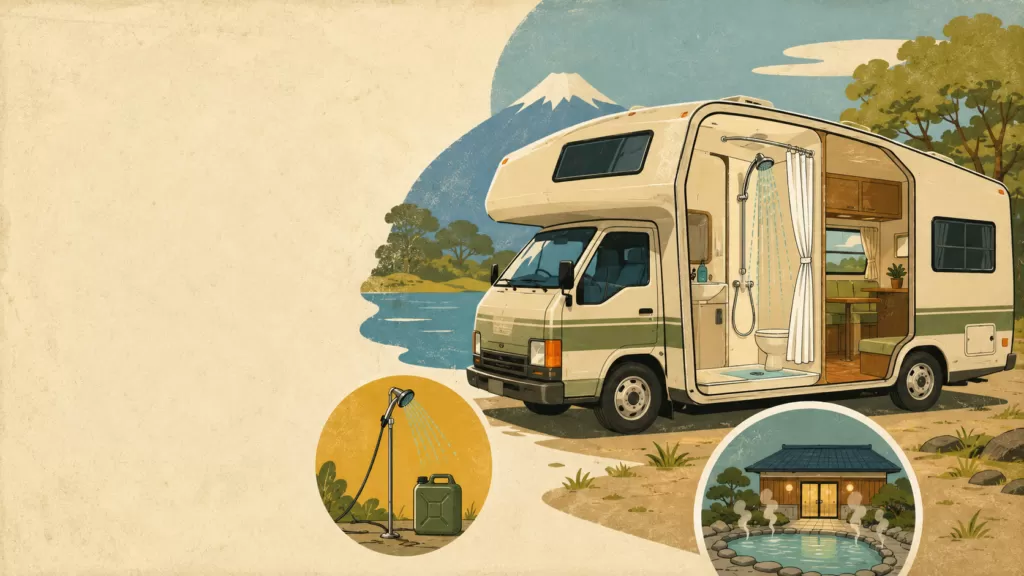
“Does a campervan have a shower?” — This is one of the most common questions from people considering a rental.
The short answer: whether you can shower depends heavily on the vehicle type. Not all campervans have one, and even those that do work differently. “Shower included” doesn’t necessarily mean anything like a hotel shower room.
This article covers campervan types and how their shower setups work, the reality of showers in rental vehicles, alternatives when there’s no shower, and how to find bathing options in Hokkaido. Read before your trip to avoid being caught off guard.
Whether a Campervan Has a Shower Varies Greatly by Vehicle Type
Campervans come in several types, and shower availability differs dramatically. Without understanding this first, you risk booking a vehicle expecting a shower that isn’t there.
Approximate shower rates by vehicle type:
| Vehicle Type | Approx. Shower Rate | Notes |
|---|---|---|
| Cab-over (large) | 30–50% | Dedicated shower room models exist — but not all vehicles have one |
| Van conversion | 5–15% | Tight interior space means built-in showers are rare; portable showers common instead |
| Kei campervan | Nearly 0% | Space simply doesn’t allow it; alternatives are a given |
| Bus / full conversion | 50–80% | Large size makes shower rooms feasible; rental availability is limited |
For detailed differences between vehicle types, see the 7-type campervan guide. The basic rule: the bigger the vehicle, the more likely it has shower facilities.
In Hokkaido rentals, van conversions and cab-overs are most common. Van conversions mostly don’t have showers. Cab-overs may have shower rooms depending on the specific vehicle — but don’t assume without checking.
When booking, ask not just “is there a shower?” but also “what type?” “what’s the tank capacity?” and “how is the wastewater handled?” — that way you won’t be surprised on the road.
Types of Showers (Hot Water, Portable, Cab-Over Shower Room)
Campervan showers come in three main types.
① Built-in Hot Water Shower (with shower room)
Found in some cab-overs and larger van conversions — a dedicated shower space inside the vehicle. A water heater (electric boiler or gas) heats the water for use in a small shower stall.
Tank capacity varies by vehicle but is typically 20–50 liters — enough for one person to shower for 3–5 minutes. It’s not designed for home-style continuous use.
Three things to note:
- Needs refilling: The tank needs water before you can use it. Know in advance where to refill — RV Parks and Michi-no-Eki water stations
- Wastewater needs to be disposed: When the waste tank fills up, you need a place to empty it. Dumping anywhere is prohibited — use RV Park drainage facilities or designated waste stations
- Consumes power or gas: Heating water takes energy. On days without external power, it draws from the sub-battery or LP gas — track your consumption
For power management, see the external power guide.
The actual routine runs in four steps: ① check the fresh-water tank level (skip the shower if less than 30 litres remain) → ② switch on the water heater and wait 20–30 minutes for hot water → ③ wet your body → turn off → lather → rinse, repeated methodically (the so-called “military shower”) → ④ wipe down the shower room and ventilate afterward to prevent mould. The shower itself may take five minutes, but preparation and clean-up add up to a 30–40 minute job.
Some domestic cab-overs have a “multi-room” — a small compartment with a cassette toilet, waterproof tray, and showerhead that doubles as a changing room, toilet, and basic shower. However, many rental companies prohibit shower use in these rooms due to cleaning and drainage management concerns. Equipment being present doesn’t mean it may be freely used — always confirm the usage rules before booking.
② Portable Shower (manual / electric)
Even vehicles without a shower room can use a portable shower for basic body washing. Two main types:
Manual pressure type: Fill a tank with water, pump to pressurize, and water comes out the shower head. No power needed — a plus. But water pressure is low and there’s no heating function, so water temperature depends on ambient heat and sunlight. Capacity is often 10–20L; some products include a black tank to warm in sunlight. Priced around ¥3,000–8,000.
Electric pump type: Place water in a bucket or collapsible tank, and a small electric pump sends water to the shower head. Many run on USB charging and can draw power from a car’s cigarette socket. Decent water pressure, but no hot water function — you’ll need to heat water separately. Priced around ¥2,000–5,000.
Practical uses include rinsing off sand or mud after swimming or camping, a quick cool-down rinse for children, and washing a pet’s paws. A single 10-litre water container is enough for two quick rinse-downs for one adult. Available at camping stores or Amazon. Worth having for longer trips.
③ Outdoor Shower (rear shower)
Some cab-overs have an external shower nozzle mounted at the rear — designed for rinsing off bodies and gear after the ocean or muddy trails. Not suitable for private bathing. Use it to wash off sand, rinse wetsuits or boots.
New Chitose Airport / Tokachi-Obihiro Airport
Rent the Cabcon “Cresson Journey”
Base yourself at New Chitose Airport and compare rates, vehicle types, and pickup locations all in one place.
See details at Moving Inn →Shower Reality for Rentals in Hokkaido
A summary of what shower situations look like at Hokkaido campervan rental companies.
At rental companies focused on van conversions, vehicles with showers are a minority. Assume there’s no shower and plan around alternatives. Companies that also offer cab-overs may clearly list shower availability per vehicle — check the vehicle detail page before booking, or call and ask directly.
Key things to confirm before booking:
- Is there a shower, and if so, what type? (hot water or portable?)
- Water tank capacity and how to refill
- Waste tank capacity and how/where to dump
- Estimated gas or power consumption for use
- Water fill and dump locations along the route (does the company provide guidance?)
If you specifically want a cab-over with a shower, the rule is: confirm the shower room exists before booking.
Toilet availability also varies by vehicle type. See the toilet guide for a clearer picture of overall comfort.
Alternatives When There’s No Shower (Hot Springs, RV Parks, Coin Showers)
Even without an onboard shower, there are plenty of ways to stay clean on the road. In fact, many people in Hokkaido feel they don’t need one — because day-use hot springs and public baths are abundant throughout the island.
① Day-Use Hot Springs & Public Baths
Hokkaido has approximately 230 hot spring areas — more than any other prefecture in Japan. Day-use bathing facilities are scattered across the island, and along the main driving routes you’ll find one within roughly 30 km almost anywhere. Most charge ¥300–700.
Representative areas and examples (prices may vary):
- Noboribetsu / Tōya Lake area: Some of Hokkaido’s top hot spring areas. Public day-use facilities available, some in the ¥300–500 range
- Asahikawa / Furano area: Plenty of Michi-no-Eki and public bath facilities; easy to work into your route
- Kushiro / Obihiro area: Strong sento (public bath) culture; local baths available for around ¥450–500
- Wakkanai / Sōya area: Fewer large hot spring facilities, but bathing options near Michi-no-Eki exist
When planning your itinerary, try to schedule overnight stops near hot springs or Michi-no-Eki with bathing facilities every 1–2 days. Being able to soak in a hot spring while traveling through Hokkaido is one of the great pleasures of campervan travel.
Hokkaido has 128 roadside rest stations (Michi-no-Eki), and over 10 of them have a hot spring or bathing facility on-site or immediately adjacent — well-known examples include Shihoro Onsen, Mukawa Shiki-no-Yakata, and Aurora Town 93 Rikubetsu. You can bathe and then sleep nearby in the same visit.
② RV Park Shower Facilities
There are more than 50 RV Parks across Hokkaido, and most either include a bathing facility or have one nearby. An RV Park with shared shower stalls means you don’t need an onboard shower at all — in addition to electricity, water, and drainage.
RV Park showers are either included in the accommodation fee or charged separately (around ¥200–500). Confirm when booking.
For how to choose and use RV Parks, see the detailed RV Park guide.
③ Coin Showers
Some gas stations, truck stops, and facilities near hot springs have coin showers (around ¥200–500 for 5–10 minutes). Not as relaxing as a hot spring, but useful for a quick rinse after a sweaty day. Handy when your schedule is packed or you miss hot spring opening hours.
④ Wet Wipes & Body Sheets
On days when bathing isn’t possible, body wipes and large wet wipes come in handy. Not a substitute for a shower or hot spring, but a quick wipe of armpits, neck, and soles makes a noticeable difference to how you feel the next morning.
Campervan travelers try to minimize luggage, but body wipes are thin, space-efficient, and effective. Many people doing Hokkaido summer campervan trips keep 1–2 packs on hand as a habit.
Foaming facial cleansing wipes and waterless shampoo sheets are also available commercially. You can pick them up at Michi-no-Eki shops or convenience stores as needed.
⑤ A Sample Bathing Plan: 5 Nights Without a Shower
To show that a no-shower vehicle is genuinely no problem, here is a typical 6-day round trip from Sapporo with bathing facilities mapped out.
| Day | Overnight Area | Example Bathing Facility |
|---|---|---|
| Day 1 | Furano | Highland Furano (day-use bath) |
| Day 2 | Sounkyo | Kurodake-no-Yu |
| Day 3 | Shiretoko / Utoro | Yuhi-dai-no-Yu |
| Day 4 | Akan Lake | Day-use bath at a lakeside hotel |
| Day 5 | Obihiro | City moor onsen public bath (from ¥490) |
A hot spring bath every evening for six days, and every facility is within a 15-minute drive of the overnight stop. Keeping a bath kit — towel, change of clothes, small change — near the vehicle door makes the nightly onsen run effortlessly smooth.
How to Find Bathing Options in Hokkaido
A summary of services and methods for finding shower or bathing spots on the road.
Search Google Maps for “温泉” or “日帰り入浴”
The simplest approach. Search “日帰り温泉” (day-use hot spring), “日帰り入浴”, or “銭湯” (public bath) near your current location or next overnight stop — reviews with hours and prices will come up. You can also filter by “open Sunday” or “open late.”
Michi-no-Eki Stamp Rally App / Official Michi-no-Eki Site
Many Hokkaido Michi-no-Eki have adjacent hot spring or bathing facilities. The official Michi-no-Eki site and the “Michi-no-Eki Travel Guide Official App” let you filter by facility. Check “温泉・入浴” (hot springs/bathing) to see which nearby stations have bathing facilities.
“Nifty Onsen” / “MAPPLE”
Search services specialized in day-use hot springs. Filter by area, price, and amenities — “shower only,” “sento,” “open-air bath,” etc. Useful for planning a Hokkaido route with hot springs built in.
Ask the Rental Company in Advance
Hokkaido rental companies know local conditions. Ask “Can you recommend places along the route where we can shower or use hot springs?” — they often share local insider info. The best time to ask is during the orientation at pickup.
New Chitose Airport / Tokachi-Obihiro Airport
Rent the Cabcon “Cresson Journey”
Base yourself at New Chitose Airport and compare rates, vehicle types, and pickup locations all in one place.
See details at Moving Inn →FAQ
Q. Is a long trip okay without a shower?
Absolutely. Hokkaido has excellent day-use hot spring coverage, and many people travel for 1–2 weeks without an onboard shower. Build hot spring overnight stops into your itinerary and you can bathe properly every day.
Q. Can I use a cab-over shower like a hotel shower?
Not really. Vehicle shower tanks hold 20–50 liters — enough for a 3–5 minute shower per person. Water volume and pressure are very different from a hotel. Think of it as a facility to “rinse off sweat.”
Q. What temperature is the portable shower water?
Most portable showers don’t have a heating function. In midsummer Hokkaido, leaving a black tank in direct sunlight can warm it somewhat, but comfortable temperatures aren’t guaranteed. In cold weather, water will be quite cold.
Q. Do RV Park showers need to be reserved in advance?
It depends on the facility. Most RV Parks include shared showers in the accommodation fee — no extra reservation needed. Some facilities have usage time limits (e.g., until 10pm), so if you’re arriving late, confirm in advance.
Q. Can the onboard shower be used in Hokkaido in winter?
Not in vehicles without winterisation — water in the tank and pipes will freeze and cause damage. In winter, rental companies typically drain and disable the entire water system, so treat hot spring baths as your only bathing option. Enjoying a snow-view open-air bath every evening is one of the unique luxuries of a winter Hokkaido campervan trip.
Q. Is no shower a problem with children?
It depends on how often you’re moving. Children sweat more and have sensitive skin, so daily bathing is preferable. Design your itinerary to include a hot spring or RV Park with a shower every day. Note that some facilities do not admit infants who are not yet potty-trained, so it’s wise to identify a few private bath (kashikiri-buro) options along your route in advance. Keep children’s body wipes on hand for days when you can’t reach a bath.
Q. Where can I dump wastewater?
Use RV Park drainage facilities. Dumping at Michi-no-Eki or general parking areas is prohibited. One key reason to include RV Parks in your itinerary is wastewater disposal. In summer when shower use and washing increases wastewater — secure a stop with drainage every 1–2 days.
Summary
The key points about campervan showers:
- Shower availability varies by vehicle type. Kei and van conversions mostly don’t have one. Cab-overs — confirm before booking
- Even with a shower, it doesn’t work like home. Understand tank capacity, water temperature, and wastewater disposal before using
- A Hokkaido trip works fine without a shower. Combining hot springs, RV Parks, and coin showers, you can stay clean every day
- Just having body wipes improves trip comfort. Worth packing as insurance for days you can’t bathe
In campervan travel, “adapt to the situation” beats “look for perfect facilities.” No shower? Head to a hot spring. Hot spring too far? Use body wipes. That kind of flexibility lets you enjoy Hokkaido’s vastness more fully.
Book a Campervan in Hokkaido
Moving Inn New Chitose Airport supports English booking and offers airport transfers.
![When and Where Can You See Harbor Seals at Cape Erimo? Kaze no Yakata Official Information, Viewing Season, and Windy-Day Notes [2026-27]](https://hokkaido-campingcar.jp/wp-content/uploads/2026/10/erimo-cape-lighthouse-768x511.jpg.webp)
![Where and Under What Conditions Can You See Diamond Dust in Hokkaido? How Cold a Morning It Takes, and Where It Appears [2026-27]](https://hokkaido-campingcar.jp/wp-content/uploads/2026/10/hokkaido-diamond-dust-nayoro-768x512.jpg.webp)
![Can You Drive to Hokkaido Jingu for Hatsumode? Parking, Crowds, and Where to Park and Walk [2027]](https://hokkaido-campingcar.jp/wp-content/uploads/2026/10/hokkaido-jingu-winter-torii-768x504.jpg.webp)
![Hokkaido Roads Over New Year [2026-27] | Expressway Sections Prone to Blizzard Closures, Forecast Congestion Days, No Holiday Discount, and New Chitose Airport Parking](https://hokkaido-campingcar.jp/wp-content/uploads/2026/10/hokkaido-winter-rural-road-edge-markers-768x432.jpg.webp)
![Where to See Sea Smoke (Kearashi) in Hokkaido: Rumoi’s Ogon-misaki and the Morning Conditions [2026-27]](https://hokkaido-campingcar.jp/wp-content/uploads/2026/10/rumoi-kearashi-sea-smoke-768x511.jpg.webp)
![Geminid Meteor Shower 2026 in Hokkaido: Peak Around 23:00 on December 14, Sapporo Moonset 20:40, and Staying Warm in a Winter Campervan [2026]](https://hokkaido-campingcar.jp/wp-content/uploads/2026/10/geminids-2026-hokkaido-768x575.jpg.webp)