Cycling + Campervan Hokkaido Guide | Bike Loading, Top Routes & Base-Camp Travel [2026]
A practical guide to combining cycling and a campervan in Hokkaido. Covers how to load road bikes and e-bikes, recommended cycling routes, base-camp itinerary planning, maintenance, and resupply.
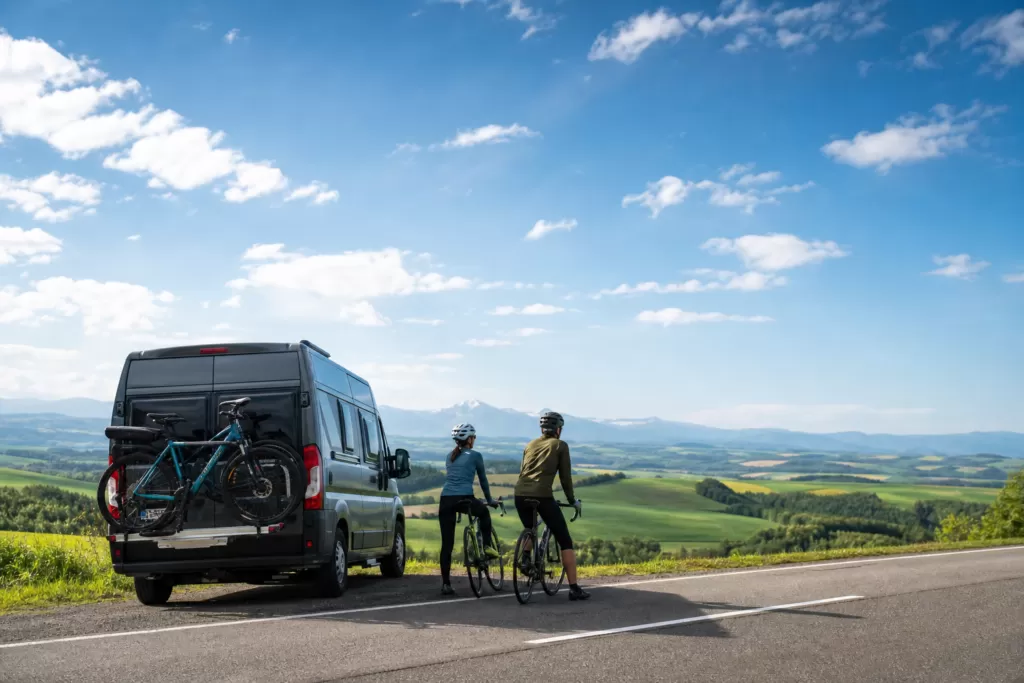
Combining cycling with a campervan unlocks a uniquely powerful way to explore Hokkaido. The rolling hills of Biei, the forested shores of Lake Shikotsu, the arrow-straight roads along the Okhotsk coast — these landscapes reveal their depth only at the pace of a bicycle. Tent camping adds weight and weather risk; using a campervan as a “mobile base” solves both problems at once.
The real advantage is freedom of movement. Want to ride a little further down the road? Drop the campervan at a point ahead and do a “shuttle ride” back. You carry nothing heavy on the bike, and at the end of the day you return to your own bed and kitchen. The combination of comfort and big mileage — impossible with a tent — is the heart of this travel style.
This guide covers everything from safely loading a road bike or e-bike, to the best cycling routes around Hokkaido, to how to structure a base-camp itinerary.
Why Campervans and Cycling Are a Perfect Match
For touring cyclists riding Hokkaido, the two biggest challenges are gear weight and unpredictable weather. A campervan solves both in one go.
Freedom from Heavy Loads
A normal bike tour means stuffing sleeping bags, tents, cookware, and clothes into panniers — often 10–15 kg total, which takes a serious toll on climbs. With a campervan, you carry nothing on the bike. Less fatigue means more distance and more vertical gain each day.
Built-in Weather Insurance
Hokkaido weather, especially in the mountains, can shift from clear skies to thunderstorms by midday. In a tent you simply endure it. With a campervan, you step inside when the rain starts, or swap riding for a drive to the next destination.
Especially Effective with E-bikes
E-bikes, increasingly available for rent, need daily charging. A campervan’s sub-battery or shore-power outlet lets you plug in overnight and start every morning at full charge. With a range of 50–120 km per charge (depending on assist level and terrain), an e-bike covers a full day’s riding with ease. See our campervan power and sub-battery guide for more on the electrical setup.
A campervan also means you can bring helmets, gloves, cycling shoes, and spare tubes without worrying about airline baggage limits. No cramming everything into a bike bag — just load up and go.
How to Carry Your Bike (Interior / Rear Carrier / Hitch)
There are three main ways to transport a bicycle in or on a campervan. Each differs in capacity, convenience, and legal requirements — choose the one that suits your bike and travel style.
Interior Loading (Simplest and Safest)
HiAce-based campervans and van conversions typically allow one road bike (front wheel removed) to be laid flat inside without seriously cramping the living space. No theft risk, no exposure to rain.
Protect the frame and derailleur from contact with luggage — use a bike bag or wrap the frame in a blanket. Two or more bikes are a tight fit, so consider the next options for groups.
Rear Bike Carrier (Cycle Carrier)
A carrier attached to the hitch receiver or tow hook holds 2–4 bikes without using interior space — ideal for families or groups riding together.
Legal note: If the loaded carrier extends beyond the vehicle’s width, you must apply for an oversize-load permit under Japan’s Road Traffic Act. If the license plate is obscured, a temporary plate display is also required. Check the loaded width and plate visibility before purchasing a carrier; apply at your nearest police station before departure if needed.
Hitch Platform Carrier (Folding Bikes)
For folding bikes or mini-velos, a hitch-mounted platform carrier is easy to attach and remove. Not suitable for full-size road or mountain bikes — always check the rated load capacity of the carrier.
Compare Hokkaido Campervan Rentals
Base yourself at New Chitose Airport and compare rates, vehicle types, and pickup locations all in one place.
Compare Rental Companies & Prices →Recommended Cycling Routes (Biei Hills, Lake Shikotsu, Okhotsk Coast & More)
Hokkaido has dozens of cycling routes. The following areas stand out for campervan compatibility, scenery quality, and road conditions.
Biei & Furano (Kamifurano to Biei Hills)
The classic Hokkaido cycling destination. The panoramas from the hilltops sink in only at bicycle speed. The 15–25 km route linking the Patchwork Road and Zeru no Oka is hilly but manageable for beginners; farm road parking spots are plentiful, so leaving the campervan and looping back is straightforward.
See the Biei & Furano campervan area guide for more detail. Expect 300–500 m of climbing per day — an e-bike makes a significant difference.
Lake Shikotsu (Chitose to Shikotsu to Poropinai)
About 30 minutes from New Chitose Airport. Prefectural Road 16 hugs the lakeshore with light traffic and vivid blue water alongside. A full lap of the lake is roughly 50 km with minimal climbing — relatively flat. Staying multiple nights at the Poropinai campsite and riding a different route each day is a natural fit for the base-camp style.
Check the Lake Shikotsu campervan guide for overnight spots and nearby facilities.
Okhotsk Coast (Abashiri to Shari to Utoro)
A coastal route combining National Route 334 and prefectural roads. Dead-straight roads running to the horizon — a sight almost impossible to find on Honshu. Mostly flat at sea level, accessible to riders of all fitness levels. On windy days, drive the campervan ahead and ride back with a tailwind.
Lake Toya & Niseko
Lake Toya is about 43 km around. There are steep climbs toward Nakayama Pass, but the flat lakeside road alone offers stunning scenery. Niseko has a strong mountain-bike culture with plenty of gravel roads — gravel bikes and e-MTBs are more suitable here than road bikes.
Eastern Hokkaido & Kushiro Wetlands
The dedicated cycling path along the edge of the Kushiro Wetlands — Japan’s largest — is one of a kind. Red-crowned cranes and deer appear roadside; the sense of scale is nothing like anywhere on Honshu. The stretch from Hororo-guchi to Hosooka Observatory is well-paved and fine for road bikes. Campsite density in eastern Hokkaido is low, making campervan mobility especially valuable here.
Autumn Foliage Rides (Late September to October): Mikuni Pass and Tokapuchi 400
Cycling in Hokkaido has a summer image, but late September through October — crisp air, little sweat, far fewer insects — is when riding itself becomes the reward, and the farmland changes into its harvest colors. For foliage on foot, see the autumn foliage trekking guide; for illuminated foliage after dark, the autumn light-up guide. This section is about routes for passing through the foliage under your own power.
Mikuni Pass Hill Climb (Nukabira Onsenkyo to Mikuni Pass)
The national-highway climb from Nukabira Onsenkyo toward Mikuni Pass is a single road through the endless forest sea of the Higashi-Daisetsu area. The summit, Mikuni Pass, sits at 1,139 m — the highest pass on any national highway in Hokkaido — and has a parking area and a scenic rest stop serving coffee (Tokachi Tourism Federation, confirmed 2026-08-17). The view over the forest and the Matsumi Bridge turns into a sweep of golden foliage in autumn.
What makes this road worth pedaling is the speed. A slope that a car passes in a few minutes, a climbing cyclist gets to soak in at around 10 km/h the whole way up. With a campervan, a one-way hill climb is easy to arrange: have a companion drive ahead and wait at the summit parking area, ride only the ascent, then load the bike and drive back down together. Riding only the descent works too, but a long autumn descent chills the body fast in the airflow — put on a windproof jacket and full-finger gloves before you start dropping.
Above 1,000 m, mornings and evenings from October onward are nothing like the lowlands, and snowfall is possible depending on the timing. Check the weather and road restrictions on the morning of your ride, and switch to a lowland route if conditions look bad. Peak-color timing across Hokkaido and drive-based itineraries are covered in the autumn foliage drive guide.
Tokapuchi 400: Riding the Tokachi Plain at Harvest Time
Tokachi has a nationally designated cycling route, Tokapuchi 400. Starting and ending in Obihiro, it links northern and southern Tokachi — from Kamishihoro to Taiki — in a 403 km figure-eight: a mountain section running toward Mikuni Pass on the north side, and a panorama section facing the Hidaka Range and the open plain on the south (MLIT, confirmed 2026-08-17).
There is no need to ride all 403 km. Park the campervan around Obihiro, the crossing point of the figure-eight, and pick a flat farmland section each day depending on the weather and your legs — the autumn version of the base-camp style described below. From late September through October, Tokachi is in the middle of its harvest: farm machinery moving between fields, windbreak forests beginning to turn, and the ridgeline of the Hidaka Range in the distance — scenery quite unlike the solid green of summer. Farm vehicles enter and leave the roads more often at harvest time, so slow down and give way. Extend to the northern end and the route connects with the Mikuni Pass climb above into one continuous autumn trip.
Three things change from summer riding. Finish by around 3 p.m., because the sun sets early. Carry a windproof layer for descents and cold mornings. Slow down in corners on days when fallen leaves or morning dew make the road slick. End the day with an onsen stop by campervan and get back to base before dark — shift into the rhythm of the short season, and autumn riding stays comfortable.
How to Structure a Base-Camp Itinerary
The base-camp approach — staying in one spot for 2–3 nights and cycling out radially each day — is particularly effective with a campervan.
The Core Idea
Instead of moving the campervan every day, you secure 2–3 nights at a campsite or RV park and ride out from there. No setup and teardown every morning. Wet cycling clothes from the day before stay hanging to dry. No matter how far you ride, your own bed is waiting at the end of the day.
Sample 3-Night Base-Camp Itinerary (Biei Area)
- Day 1 (Travel & Setup): Pick up the campervan at New Chitose Airport, drive to a Biei campsite (e.g., Shirogane Camping Ground), set up. Take a short test ride on the farm roads nearby to get your bearings.
- Day 2 (Full Ride): Ride the Patchwork Road → Zeru no Oka → Shikisai no Oka loop. Approx. 30–40 km, 400 m of climbing. Lunch at a café in Biei town.
- Day 3 (Different Direction): Head toward Tokachidake and the Shirogane Onsen route. Continuous climbing — e-bike recommended. Stop at the hot spring before returning to the campervan.
- Day 4 (Travel Day): Break camp and drive to the next base (e.g., Lake Shikotsu).
What to Look for in a Base Location
The key criteria for a cycling-friendly base: easy road access, shower facilities, and power outlets (for e-bike charging). RV parks often have AC power — ideal for e-bike riders. Many campsites now have 100V outlets in the kitchen shelter; confirm when booking. Without a shore-power outlet, you’ll charge from the campervan’s sub-battery — make sure the system has enough capacity (400–500 Wh for a full e-bike charge).
Balancing Drive Days and Ride Days
For a one-week trip, “2 drive days + 5 base-camp days” gives less sense of Hokkaido’s scale than “3 drive days + 2-night bases at 2 locations.” Distance reference: New Chitose Airport to Biei is about 3 hours using the expressway; Biei to Abashiri about 3 hours; Abashiri to Kushiro about 2 hours. Use drive days to rest the legs and enjoy the scenery from the cab.
The “weather-reading shift” — checking the forecast the night before and deciding whether to ride or drive — is one of the campervan’s biggest advantages over hotel-based trips, where check-in times lock your schedule.
New Chitose Airport / Tokachi-Obihiro Airport
Rent the Cab-Over Campervan “Cresson Journey”
Base yourself at New Chitose Airport and travel all across Hokkaido by campervan.
View Details at Moving Inn →Practical Notes: Resupply, Maintenance, Washing, and Water
Campervan cycling is comfortable, but without basic bike maintenance supplies you can end up stranded. Here’s what to bring and how to manage resupply on the road.
Essential On-Board Tools and Spare Parts
- Spare inner tubes (2 or more): Hokkaido’s farm roads have gravel and sharp stones — puncture risk is real. Even tubeless tires can fail if sealant runs low. Always carry spare tubes and tire levers.
- Mini pump: Enough to get rolling after a roadside repair. Keep a floor pump in the campervan for daily pressure checks.
- Chain lube: After riding in rain, wipe the chain and re-lube. Wet-lube holds up better in Hokkaido’s variable weather than dry-lube.
- Multi-tool (hex key set): Saddle height, brake adjustments, and other on-the-go tweaks.
Food and Water Resupply
In rural Hokkaido, convenience stores can be 30–50 km apart. Load up on energy food (gels, bars, rice balls) and water before each ride. The campervan fridge lets you pre-cool bottles the night before. If you can’t park the campervan at the start, drive ahead to a midpoint and create your own resupply stop.
Keep an eye on the water tank level. Post-ride showers and bike washing use water quickly — identify refill points (roadside stations, campsite kitchen shelters) before heading out each morning.
Washing and Maintaining the Bike
After gravel or rain rides, the bike gets seriously dirty. Rinsing at the campsite kitchen shelter is convenient, but some sites prohibit bike washing — check in advance. A collapsible bucket and sponge in the campervan let you haul water from the shelter tap. Compact battery-powered pressure washers are growing in popularity, but full-size models drain the water tank fast — balance carefully.
E-bike Charging Routine
Most e-bike batteries are around 500 Wh. Charge time is 4–6 hours; plug in before bed and you’ll start the morning at full charge. Charging via the campervan inverter (100V output) puts a significant load on the sub-battery — combine with driving charge and shore power (powered campsites, RV parks) where possible. Not all rental campervans have inverters — confirm before booking.
See our campervan power and sub-battery guide for a full breakdown of charging options.
Post-Ride Recovery (Body and Gear)
Showering after a sweaty ride is one of the great perks of campervan travel. With tank capacity typically 30–50 L, keep showers to 3–5 minutes per person. Stopping at a roadside onsen is an excellent way to save water — Hokkaido has hot springs everywhere and they’re easy to add to a route. Cycling jerseys are quick-dry; hand-wash at night and hang in the van or under the awning and they’ll be ready by morning.
FAQ
Q: Can I bring a bicycle in a rental campervan?
It depends on the rental company. Interior loading is generally permitted; hitch or rear carriers may be an optional add-on or prohibited. State clearly that you want to bring a bike when booking.
Q: Can I rent a road bike in Hokkaido?
Sport bike rental shops exist in Sapporo, Asahikawa, and Obihiro. E-bike rentals are expanding at tourist spots like Biei and Lake Toya. Book early — during peak season availability disappears fast.
Q: Is it illegal to carry a bike on a rear carrier?
It can be. If the loaded carrier exceeds the vehicle width, an oversize-load permit is required. If the license plate is hidden, a temporary plate display is needed. Check loaded width and plate visibility when buying a carrier; apply at a police station before departure if required.
Q: Can I charge an e-bike every day?
Yes, if you stay at powered campsites or RV parks. At unpowered sites, you’ll rely on the sub-battery — combined with driving charge, it’s manageable but plan carefully. Confirm the charging setup before booking your overnight spots.
Q: For a beginner, which is easier — Biei or Lake Shikotsu?
Lake Shikotsu is flatter and more beginner-friendly. Biei has significant hills — you need to climb to enjoy the hilltop views. A good first-time plan is to get comfortable around Lake Shikotsu, then tackle Biei. An e-bike makes Biei’s climbs much easier.
Q: What do I do if it rains while I’m riding?
With the base-camp setup, just head back to the campervan. Keep a compact rain jacket in your jersey’s back pocket for sudden showers. Hokkaido summers can be surprisingly cool, and getting soaked raises the risk of hypothermia — change out of wet clothes in the van as soon as possible.
Book a Campervan in Hokkaido
Moving Inn New Chitose Airport supports English booking and offers airport transfers.

![Campgrounds Near Tokachi-Obihiro Airport: 8 Sites Within 30 km, Compared by Vehicle Access, Power and Price [2026]](https://hokkaido-campingcar.jp/wp-content/uploads/2026/10/photo-obihiro-airport-featured-pl232-768x512.jpg.webp)
![Campgrounds Near Hakodate Airport: 12 Sites Within 30 km, Compared by Vehicle Access, Power and Price [2026]](https://hokkaido-campingcar.jp/wp-content/uploads/2026/10/photo-hakodate-airport-featured-hl4722-768x484.jpg.webp)