Hokkaido Drift Ice Campervan Road Trip: Complete Winter Guide (Abashiri, Monbetsu & Shiretoko 2026-27)
From late January to early March, drift ice covers the Sea of Okhotsk coast.
Pick a campervan by what matters to you.
Rent at New Chitose Airport
See only the rental bases in Chitose, where the airport is.
Rent in winter (Dec–Mar)
Companies that rent through winter, listed apart from those that close.
Guide price
Moving Inn New Chitose Airport: HIACE van conversion from ¥22,000 per night. 20–30% off when booked 60–90 days ahead (official rate table, checked 15 Oct 2026).
New Chitose Airport map for campervan travellers →
Before you book: with an International Driving Permit if your country is in the Geneva Convention (for example the US, Australia, Singapore); Taiwan, Switzerland, Germany, France, Belgium and Monaco need your licence plus a Japanese translation (Tokyo Metropolitan Police). Questions in English: Moving Inn on WhatsApp. Every roadside station (michi-no-eki) must have free 24-hour toilets, and Hokkaido has 128 of them (MLIT).
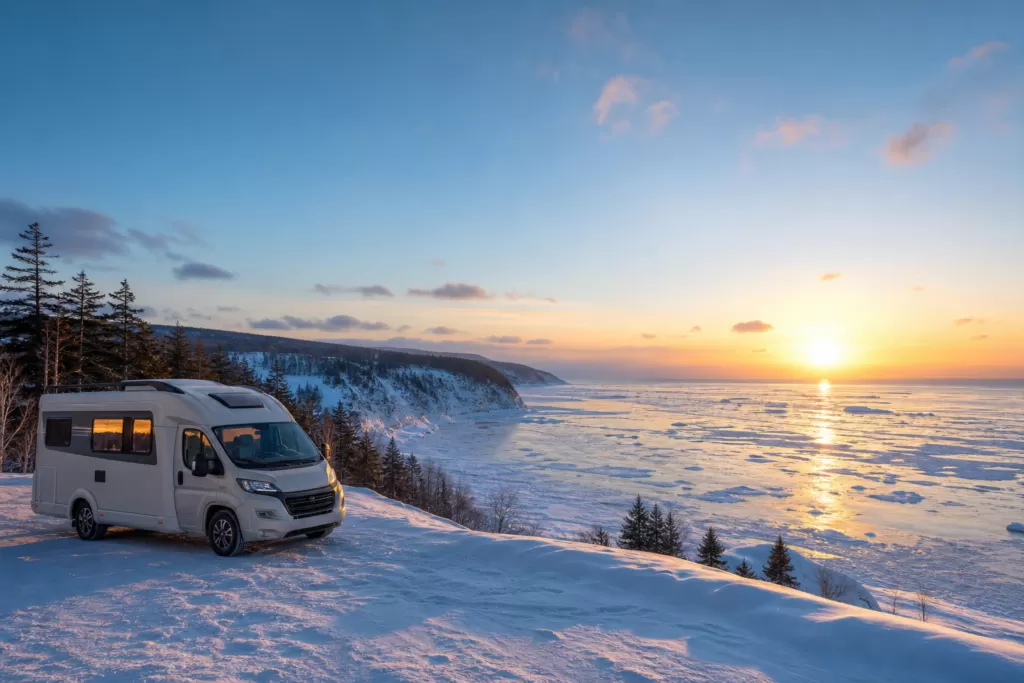
Every January through March, the Sea of Okhotsk transforms. Massive sheets of drift ice—formed near Sakhalin and carried south by ocean currents—push against Hokkaido’s northeastern coast. For most travelers, this means a day trip, a boat ride, and a flight home. But with a campervan, you wake up 50 meters from the ice-covered shore, coffee in hand, before the tour buses arrive. That’s the experience this guide is built around.
Below you’ll find everything you need to plan a winter campervan road trip along Hokkaido’s Okhotsk coast: when to go, where to go, what to check before renting, a working 3-day itinerary, and honest advice on booking. No fluff—just the practical stuff.
New Chitose Airport / Tokachi-Obihiro Airport
Rent the Cabcon “Cresson Journey”
Base yourself at New Chitose Airport and compare rates, vehicle types, and pickup locations all in one place.
See details at Moving Inn →Why Drift Ice + Campervan = Hokkaido’s Best Winter Experience
The logistics of drift ice tourism are awkward if you’re staying in hotels. Abashiri and Monbetsu have limited accommodation—especially in February—and the icebreaker boats depart early in the morning. Getting there the night before means paying premium rates for whatever rooms remain.
A campervan solves this neatly. You park near the port the night before, set your alarm, and walk to the ticket counter. No taxi, no rushed checkout, no missed boat. The vehicle becomes your hotel, and in winter, the Okhotsk coast has almost no tourist traffic—roads are clear, parking lots are empty, and the landscape looks like something off a nature documentary.
It’s also worth saying: drift ice season in Hokkaido is strikingly beautiful on land. The fields and roads around Abashiri and Monbetsu are blanketed in snow, and the flat light of a February morning turns everything silver and blue. Driving through this in a warm campervan is one of those travel experiences that sticks with you.
Drift Ice Season: When to Go & What to Expect
Drift ice typically reaches the Okhotsk coast in late January and peaks in mid-February. By early March it starts retreating. If you want the densest, most dramatic ice, aim for the second week of February. If you want fewer crowds (already thin compared to summer), late January or early March works fine too.
Average temperatures during the season run around -6°C during the day, colder at night. On the deck of an icebreaker boat, wind chill drops that further. Layer properly: thermal base layer, fleece mid-layer, a windproof outer shell, and insulated gloves and hat. Don’t underestimate it.
Inside a properly equipped campervan (with a diesel forced-air heater, called an FF heater in Japan), nighttime temperatures are manageable. Ask your rental company to demonstrate how the heater works before you drive off—it runs independently of the engine and uses diesel fuel, which needs topping up separately.
3 Best Drift Ice Spots: Abashiri vs Monbetsu vs Shiretoko
Abashiri — The Aurora Icebreaker and the Museum
Abashiri is the most well-known drift ice destination, and for good reason. The Aurora sightseeing ship runs from late January to late March, taking passengers through the ice fields for about an hour. There’s a morning departure in the 8 AM range that hits the best light—worth the early alarm. Adult tickets are ¥5,000 in January and March, rising to ¥6,000 during the February peak; elementary-school children ride for half price (confirmed on the official site, July 2026).
On land, the Okhotsk Ryuhyo Museum (on top of Tento Mountain) lets you touch real drift ice and step into a -15°C room. It’s about 10 minutes by car from the center of town. Parking near the port gets crowded during peak weeks—arriving the evening before and sleeping nearby avoids the morning scramble.
Monbetsu — Garinko-go and More Parking Space
Monbetsu draws fewer visitors than Abashiri, which makes it easier to navigate with a campervan. The Garinko-go uses a drill-type screw mechanism to break through the ice—visually different from Abashiri’s Aurora and genuinely impressive to watch. Drift ice cruises run from mid-January to the end of March, take 60–90 minutes. For the 2027 winter season (January 15 to March 31), fares are ¥5,000 for adults and ¥2,500 for elementary-school children in January and March, and ¥6,000 and ¥3,000 in February (confirmed on the official site, October 7, 2026). In February, the Monbetsu Drift Ice Festival adds ice sculptures and street food to the mix. Abashiri holds the Abashiri Okhotsk Drift Ice Festival on February 6–7.
The port area has wide parking, and Michi-no-Eki Okhotsk Monbetsu (a roadside rest stop) is a convenient overnight option. Monbetsu feels quieter, more local, and easier to move around in—a good choice if you want the drift ice experience without the tourist-spot density of Abashiri.
Shiretoko (Utoro) — Drift Ice Walking
Shiretoko offers something neither Abashiri nor Monbetsu does: you can walk on the drift ice. Guided drift ice walking tours in dry suits let you float between ice sheets, lie back on the surface, and experience the ice from the inside rather than from a boat deck. Mid-February to early March is the main window for this.
Utoro has a Michi-no-Eki with hot spring access nearby. It’s about 90 minutes from Abashiri by car. Book the drift ice walk in advance—spots fill up, especially in February.
Winter Campervan Checklist: 5 Things to Confirm Before You Book
Renting a campervan in winter is different from summer. These five points matter a lot in Hokkaido’s cold months.
- 4WD or AWD available? — East Hokkaido roads in winter are frequently compacted snow or ice. Front-wheel drive is manageable, but 4WD gives you significantly more confidence. Ask specifically which drivetrain the vehicle uses.
- Studded or winter tires fitted? — This should be standard for winter rentals in Hokkaido, but confirm it. Do not assume.
- FF heater operation — The cabin heater runs on diesel and operates separately from the engine. Ask the rental staff to show you how to start, stop, and refuel it.
- Roadside assistance coverage — Getting stuck in snow or having a breakdown in the Okhotsk region in February is a different situation than a summer flat tire near Sapporo. Check whether roadside assistance is included or available as an add-on.
- Return location and refueling — Gas stations are sparse in parts of east Hokkaido. Know where you’ll refuel on the way back, and confirm full-tank return rules before you leave.
Sample 3-Day Itinerary: New Chitose → Drift Ice Coast
This itinerary works for someone flying into New Chitose Airport (CTS) and returning from the same airport. It covers all three main drift ice areas without feeling rushed—assuming reasonable winter driving speeds and no severe weather days.
Day 1: Pick up campervan at New Chitose → drive east via the Dotou Expressway → arrive Abashiri by late afternoon (approx. 350km, 4 hours). Park near the port. Walk around, grab dinner, sleep early.
Day 2: Morning — Aurora icebreaker (book in advance). Midday — Okhotsk Ryuhyo Museum. Afternoon — drive to Monbetsu (approx. 90 min). Evening — drift ice festival or Garinko-go departure if there’s a late sailing. Overnight in Monbetsu.
Day 3: Drive to Shiretoko Utoro (approx. 2 hours). Drift ice walk tour in the morning (pre-booked). Head back west in the afternoon toward New Chitose—this is a long drive (5–6 hours), so leave by 1 PM at the latest. Return campervan before closing time.
If three days feels tight, dropping Shiretoko from Day 3 and spending more time in Monbetsu is a reasonable adjustment. Alternatively, fly into Memanbetsu Airport (closest to Abashiri) and pick up your campervan there to cut travel time.
Why We Recommend Moving Inn for Winter Travelers
There are several campervan rental companies in Hokkaido, and most do a reasonable job. Moving Inn stands out specifically for winter east Hokkaido travel for three reasons.
Every vehicle is 4WD — Not every rental company can say this. Every Moving Inn vehicle is 4WD and runs on studless winter tires (interview with Moving Inn, October 6, 2026), which makes a real difference on icy Okhotsk-region roads.
Free shuttle from New Chitose and Tokachi-Obihiro airports — This removes the usual friction of getting to the rental point. If you’re flying in to Obihiro (closer to the Tokachi area), the shuttle still gets you to the vehicle without needing a separate taxi or bus.
English and Traditional Chinese reservations — During drift ice season, a large share of visitors come from Taiwan, Australia, and other English-speaking countries. Being able to communicate clearly with your rental company—in your language—is worth more than it sounds when you’re troubleshooting a heater at 11 PM in Monbetsu.
More details and booking: Moving Inn rental page.
Booking Tips & Price Guide
February is peak drift ice season, and while it’s nothing like summer demand, the week around Japan’s National Foundation Day holiday (February 11) fills up fast. Book at least 2 months out, ideally 3. January and March are easier to book last-minute, but don’t count on it.
Rough pricing for a van-conversion class campervan runs ¥20,000–¥30,000 per night (as of 2026). Larger cab-over conversions cost more. Check whether winter tire fees, FF heater fuel charges, and insurance are bundled or extra—these add up.
New Chitose Airport / Tokachi-Obihiro Airport
Rent the Cabcon “Cresson Journey”
Base yourself at New Chitose Airport and compare rates, vehicle types, and pickup locations all in one place.
See details at Moving Inn →FAQ
Is it actually warm enough to sleep in a campervan in Hokkaido winter?
Yes, with an FF heater running. The cabin stays comfortable at 15–20°C even when it’s -10°C outside. Bring a sleeping bag rated for cold temperatures as a backup, and make sure you understand how to safely ventilate the vehicle overnight. For more on snow driving and other winter concerns, see our complete guide to Hokkaido winter travel worries.
What driving license do I need?
Most campervans in Japan require a standard automatic driving license. An International Driving Permit (IDP) is required for visitors—get one before you travel, as Japan does not issue them to foreign visitors. Check the specific vehicle’s weight and length requirements when booking, as larger models may need a different license category.
What if there’s no drift ice when I arrive?
The icebreaker boats head out into the sea even when ice isn’t visible from shore—so you’re likely to see something as long as the season is active. The Okhotsk Ryuhyo Museum has drift ice on display year-round. And Abashiri and Shiretoko are genuinely beautiful in winter regardless of ice conditions.
Can I drive on winter roads with a regular rental campervan?
With studded winter tires and ideally a 4WD vehicle, yes. Take it slow, leave extra stopping distance, and avoid driving in heavy snowfall or low visibility. If the weather turns bad, stopping at a roadside rest area (Michi-no-Eki) and waiting it out is the right call.
Is a 3-day trip enough?
3 days covers the main spots if you’re efficient. 4–5 days is more comfortable, especially if you want to spend real time in Shiretoko or add a day in the Tokachi/Furano area on the way back. First-time visitors who want to take it slowly are better off with 4 days minimum.
Book a Campervan in Hokkaido
Moving Inn New Chitose Airport supports English booking and offers airport transfers.
Pick a campervan by what matters to you.
Rent at New Chitose Airport
See only the rental bases in Chitose, where the airport is.

![Campgrounds Near Tokachi-Obihiro Airport: 8 Sites Within 30 km, Compared by Vehicle Access, Power and Price [2026]](https://hokkaido-campingcar.jp/wp-content/uploads/2026/10/photo-obihiro-airport-featured-pl232-768x512.jpg.webp)
![Campgrounds Near Hakodate Airport: 12 Sites Within 30 km, Compared by Vehicle Access, Power and Price [2026]](https://hokkaido-campingcar.jp/wp-content/uploads/2026/10/photo-hakodate-airport-featured-hl4722-768x484.jpg.webp)