How to Rent a Campervan at Hakodate Airport | Pickup & Return Guide for Southern Hokkaido (2026)
Explains how to rent a campervan from Hakodate Airport: airport delivery, shuttle bus transfers, the pickup and return process, and how to use it for trips to Onuma Park, Matsumae, and Esashi.
Landing at Hakodate Airport and wanting to hop straight into a campervan? The first questions are usually: can you pick the vehicle up right at the airport, or do you need to travel to a rental base yourself? The short answer is yes — several companies in the Hakodate area offer airport delivery or shuttle service, so you can start your Southern Hokkaido drive just a few hours after landing.
This article covers how to get from Hakodate Airport to your campervan, the real flow of pickup and return, and how to use it for trips to Onuma Park, Matsumae, Esashi, and the Lake Toya area. If you want to compare Hakodate-area bases by price and vehicle type, also check the full Hakodate campervan rental comparison.
Hakodate Airport is the gateway to Southern Hokkaido and a starting point for sights a little further from central Hakodate, such as Onuma Park, Matsumae, and Esashi. Once you’ve sorted out how to get the campervan at the airport, the rest is up to you — sleep and travel freely around Southern Hokkaido at your own pace, which is the real strength of a campervan trip.
How do you get from Hakodate Airport to the campervan?
There are broadly two ways to get into a campervan at Hakodate Airport: having a vehicle delivered to the airport, or taking a bus to a rental base near Hakodate Station and picking it up there. Which one suits you depends on how much luggage you have and which company you book with.
Companies offering airport delivery or shuttle pickup
In the Hakodate area, Select Campingcar Hakodate delivers vehicles to Hakodate Airport for a delivery fee of around ¥4,000 one way. Nomadoya also runs a free shuttle to Shin-Hakodate-Hokuto Station, Hakodate Station, and Hakodate Airport, and is a good fit if you’re traveling with a dog around Southern Hokkaido. “Amity Hakodate-go,” bookable through Carstay, also supports handover at Hakodate Airport in addition to Hakodate Station and Shin-Hakodate-Hokuto Station.
Delivery fees and available hours change with the season and booking situation, so confirm directly with each company’s official site or booking form before you reserve. Whether you meet in the airport lobby or at a parking area also varies by company.
| Company | Base | Airport service | Vehicle type | Pets |
|---|---|---|---|---|
| Select Campingcar Hakodate | Showa, Hakodate | Airport delivery, around ¥4,000 one way | Cabcon | Not allowed |
| Nomadoya | Onuma, Nanae Town | Free shuttle to airport, Hakodate Station, Shin-Hakodate-Hokuto Station | Cabcon, Kei-camper | Allowed |
| Amity Hakodate-go (Carstay) | Wakamatsu-cho, Hakodate | Handover available at Hakodate Station, Shin-Hakodate-Hokuto Station, and Hakodate Airport | Vancon (seats 6, sleeps 5) | Please confirm |
Nomadoya’s base itself is close to Onuma Park, so you can get shuttled from the airport and go straight into a walk around Onuma. Select Campingcar Hakodate is really built around pickup within Hakodate city with airport delivery as an add-on, while for Amity Hakodate-go you check the vehicle details and latest availability through the Carstay booking page.
Taking a bus to the rental base
If the company you’re using doesn’t offer airport delivery, or you’d rather pick up in the city, you can use the shuttle bus between Hakodate Airport and the area in front of Hakodate Station. It runs to match domestic flight arrivals and departures, takes as little as 20 minutes, and costs ¥700. From in front of Hakodate Station, take a taxi or the streetcar to city bases such as Ado VAN’S. Tajima Rental Station Shin-Hakodate-Hokuto is in Hokuto City: take the Hakodate Main Line to Shin-Hakodate-Hokuto Station, and the shop is a 1-minute walk from the south exit.
If you’re arriving by shinkansen at Shin-Hakodate-Hokuto Station, there’s also one shuttle bus a day from the station to Hakodate Airport. Since it only runs once a day, check the schedule ahead of time if you’re coming by shinkansen rather than by plane.
On cost, airport delivery through Select Campingcar Hakodate runs around ¥4,000 one way. Taking the bus to the rental base costs ¥700, but you’ll also need a taxi fare and extra travel time from the station. If you have a lot of luggage or want to leave right after landing, delivery makes sense; if you want to keep costs down, the bus is the easier choice.
Compare Hokkaido campervan rentals
See prices, vehicle types, and bases side by side, including areas beyond Hakodate.
Compare rental companies and prices →What actually happens from pickup to return?
Handing over a campervan takes a bit longer than a regular rental car, mainly because of the vehicle walkthrough. Knowing the flow in advance makes it easier to plan your schedule after landing.
What happens at pickup
- Showing your driver’s license and confirming your booking details
- Checking the vehicle for scratches and dents (walking around the exterior with staff)
- An explanation of how to use the kitchen, sink, toilet, heating, and other onboard equipment
- Checking the remaining water in the fresh and waste water tanks
- An explanation of insurance coverage and the deductible amount
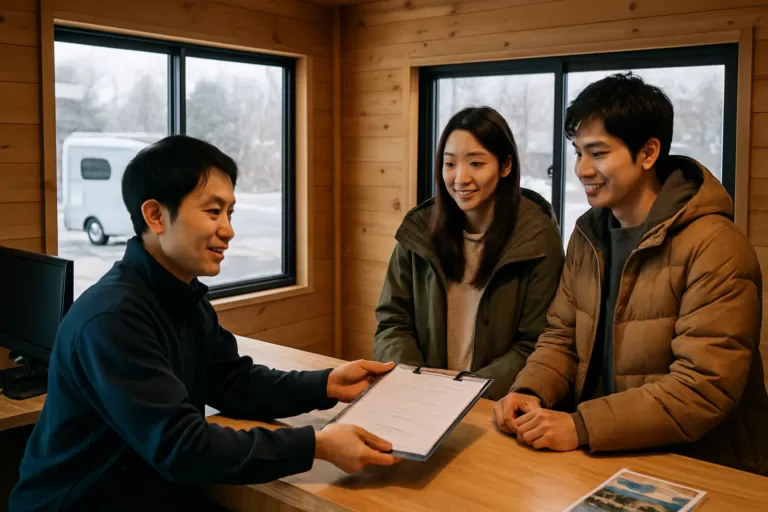
This walkthrough alone often takes 30 minutes to an hour. Even if you have the vehicle delivered to the airport, you’ll get the same explanation on the spot, so it’s safer to assume travel plus the walkthrough will take up close to half a day on arrival. If it’s your first time in a campervan, it’s worth trying the heating, water pump, and fridge power switch yourself on the spot, since these aren’t things a regular car has — it saves confusion once you’re on the road.
What to do before returning the vehicle
Before returning the vehicle, you’re typically asked to refuel (or return with a full tank from a gas station), clear out trash, do a quick clean, and empty the waste water tank. The exact conditions vary by company, so it’s worth re-reading the return conditions in your contract or booking confirmation email before you head out.
Many people set their return time by working backward from their flight, but if you’re using Hakodate Airport delivery for the return as well, you need to factor that delivery time into your travel plan too. Scheduling to return the vehicle three hours before boarding gives you some cushion if things run a little late.
Insurance typically includes bodily injury and property damage liability as part of the base rate, with vehicle damage coverage usually carrying a deductible. Some companies offer additional coverage to reduce that deductible (an insurance waiver / NOC waiver system), which is worth taking out if it’s your first time driving a campervan, since it takes some of the worry out of the day. Confirm the specific deductible amount before you sign the contract.
Touring Southern Hokkaido: start with Onuma Park and Lake Toya
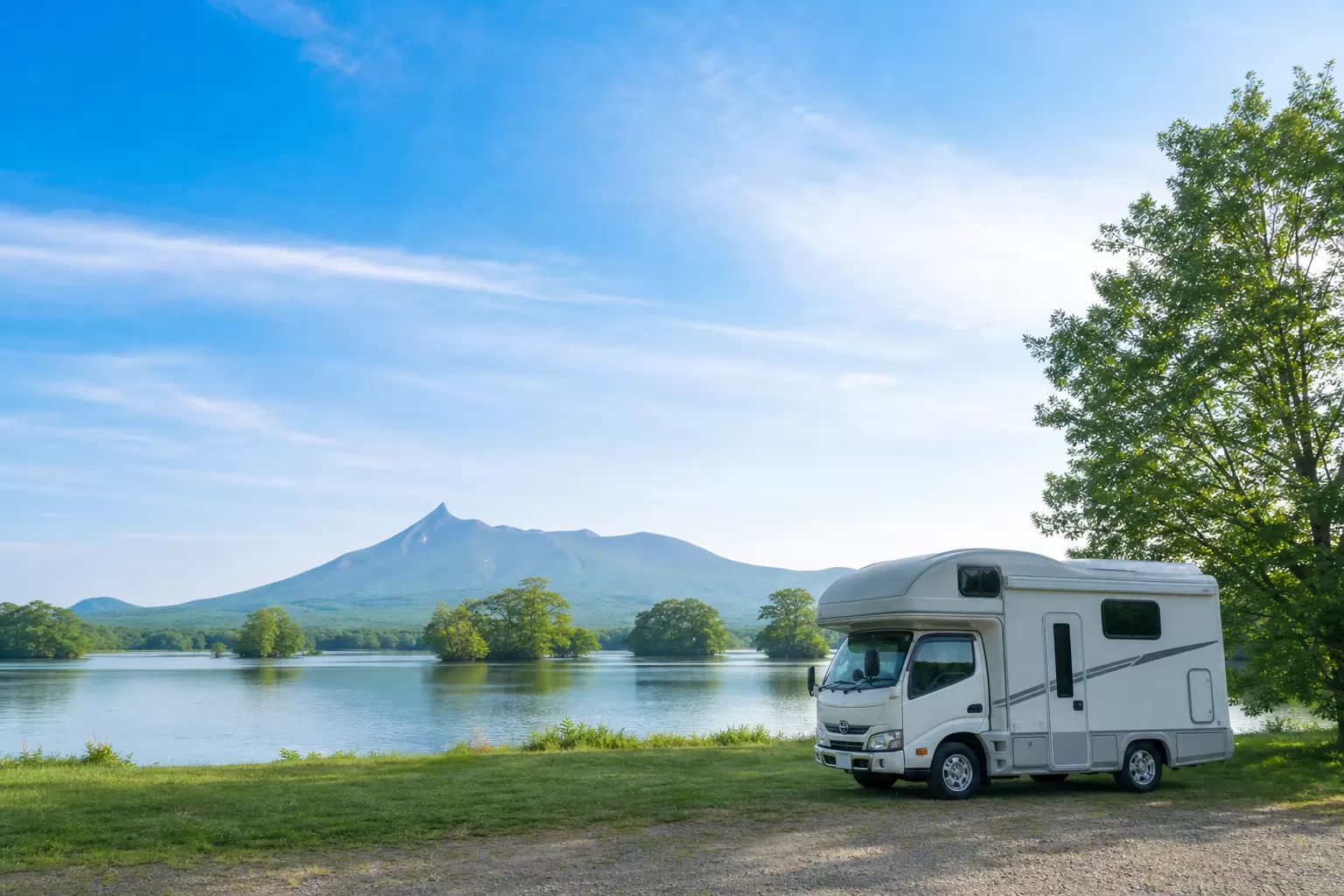
Onuma Park and Lake Toya are the easiest drives to build around Hakodate Airport. Onuma Park is about a 30-minute drive from Hakodate Airport, and you can walk the shore of Onuma Quasi-National Park with a view of Mt. Komagatake, which is why many visitors stop by on the day they arrive. Nomadoya’s base is also in Onuma, so if you’re traveling with a dog, you can combine pickup and sightseeing in one stop.
Lake Toya is about 2 hours 40 minutes by expressway from Hakodate Airport, roughly 180 km away. That’s a bit far for a one-night, two-day Southern Hokkaido trip, so it makes more sense either to spend the time around Onuma and central Hakodate, or to plan two nights or more if you want to make it out to Lake Toya.
Give yourself extra time for the Matsumae/Esashi coastal route
If you’re heading for Matsumae Castle or the historic streets of Esashi, the route runs along the coastal Route 228 south or north from central Hakodate. There are long stretches with few traffic lights, but also narrow sections and blind curves, so plan extra time if you’re not used to driving a campervan on this kind of road. Exact travel times to Matsumae and Esashi shift with seasonal road conditions, so it’s worth checking your car navigation or map app for the latest route before you set off.
From central Hakodate to Matsumae Castle is about 96 km, roughly 2 hours 5 minutes by car. Esashi is a bit closer, but a same-day round trip from Hakodate Airport to either place adds up to more than 4 hours of driving alone. A workable pattern is to stay near the airport and go only as far as Onuma on day one, then push out to Matsumae and Esashi on day two before heading north toward central Hokkaido — that way you keep moving in the campervan without piling up driving fatigue.
This area has fewer roadside stations and overnight parking spots than central Hakodate. Checking candidate spots ahead of time on this guide to overnight parking spots in Hokkaido means less scrambling to find somewhere to stay after dark. Some coastal stretches also have little street lighting after sunset, so it’s safer to plan to reach your overnight spot before it gets dark.
What to check before you book
Some Hakodate-area campervan companies close for the winter between November and March. Tajima Rental Station Shin-Hakodate-Hokuto closes from November 1 to March 31, so check the operating period first if you want to book in winter. It’s also worth confirming Ado VAN’S and Select Campingcar Hakodate’s winter operating status directly with each company, either on their site or when you inquire about a booking.
On pets, Nomadoya allows them onboard, while the other three companies generally do not. If you’re planning to travel with a dog, it’s faster to narrow down by pet policy before you start comparing vehicle types.
Cancellation fees and rescheduling conditions also differ by company. Since a flight delay or cancellation could push back your pickup time, it’s worth noting down the cancellation policy and a phone number you can reach on the day when you finish booking. Reception can be weak in the arrivals lobby at the airport, so it also helps to confirm in advance whether the company can be reached by LINE or email.
On licenses, most cabcons (the larger-bodied type) can still be driven on a standard driver’s license, though depending on vehicle size a mid-size license may be required in some cases. Checking the vehicle weight listed on the registration certificate against your license category when you book avoids trouble on the day.
Fuel type is a mix of diesel and gasoline vehicles, so always confirm the fuel type before you refuel. There are several gas stations around Hakodate Airport and central Hakodate, but fewer along the Matsumae/Esashi route or the stretches away from Onuma. Refueling once you’re below half a tank means you won’t have to worry about running low in the mountains.
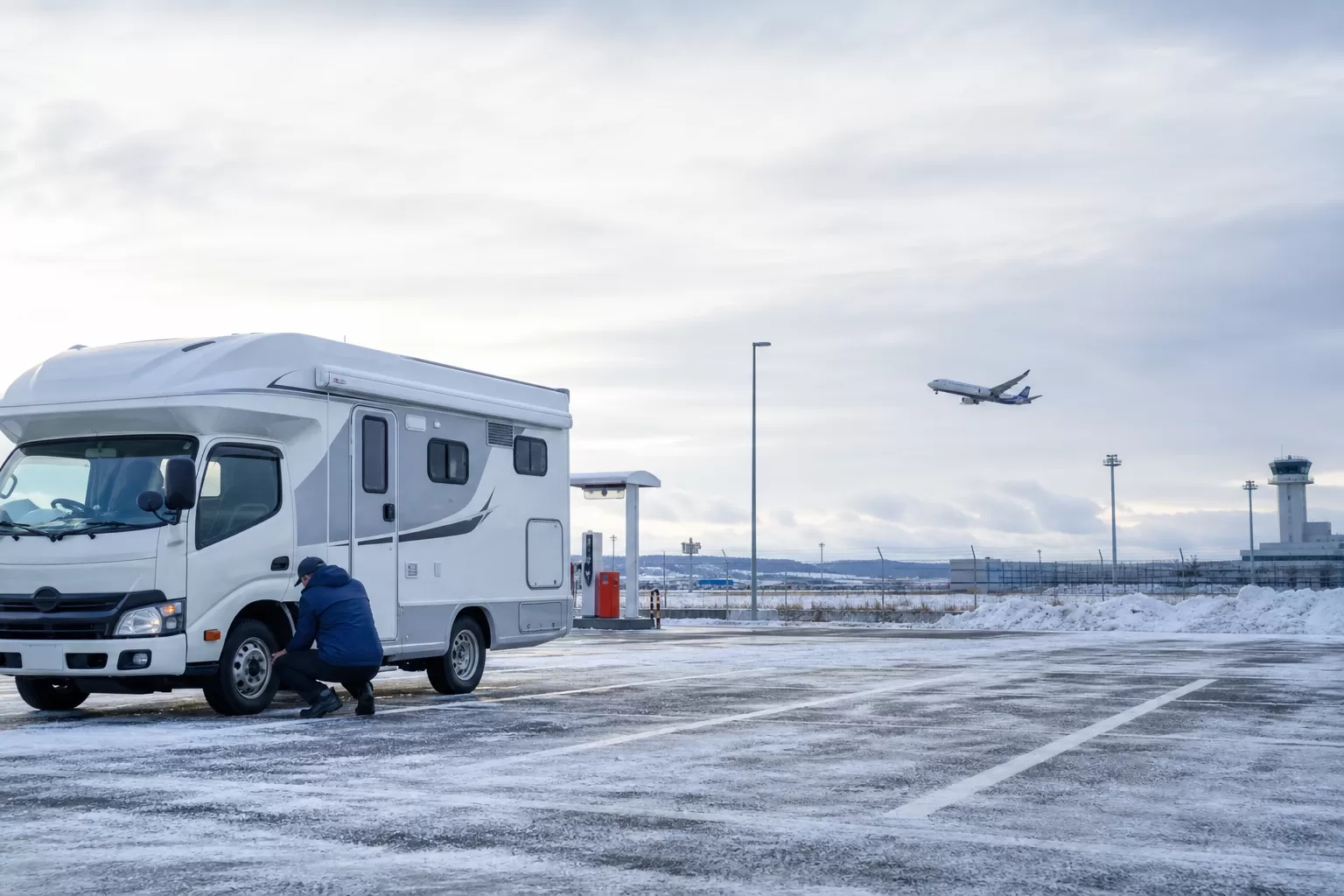
If you’re renting a campervan at Hakodate Airport in winter, also check whether the vehicle is fitted with studless tires. Most operating bases fit studless tires as standard through winter, but whether the vehicle has FF heating (heating that works both while driving and parked) varies by vehicle. If you’re planning to sleep in the vehicle overnight, the type of heating is something to ask about before you book.
What does arrival day actually look like?
If you land at Hakodate Airport on a morning flight, you’ll typically finish the delivery handover and vehicle walkthrough around midday. From there it’s about a 30-minute drive to Onuma Park, so a realistic plan is to spend the afternoon of day one walking around Onuma, then stay overnight near a roadside-station hot spring or a hotel parking area in the city. If you land in the evening, it’s less stressful to stay near the airport or in central Hakodate that first night and save sightseeing for the next morning.
If you’re coming by shinkansen to Shin-Hakodate-Hokuto Station, your plans for the day depend on whether the base offers a shuttle from the station. With a company like Nomadoya that runs a free shuttle to the station, you can head straight to pickup once you step off the train. If you choose a base without a shuttle, budget the time and fare for a taxi from the station as well.
What to prepare in advance so you’re not caught out on the day
- Your driver’s license (the original — arrange an international driving permit ahead of time if you need one)
- Your booking confirmation email or something showing your reservation number
- A credit card (many companies use this for the deposit and any extra charges)
- Personal items for sleeping in the vehicle, such as a sleeping bag and a change of clothes (bedding is often provided with the vehicle, so confirm when you book)
- If traveling with a pet: a carrier or leash, and a final check that you’ve chosen a pet-friendly company
An international driving permit in particular has to be obtained in your home country before you fly — there’s no way to arrange one after you land at Hakodate Airport, so put it on your pre-departure checklist if you’re coming from overseas. Many companies accept a booking confirmation shown on your phone screen instead of a printout, but since reception can be patchy in some spots, it’s also worth saving a screenshot just in case.
Flying in: how many days and how large a vehicle should you choose?
If you’re flying into Hakodate Airport, your arrival and departure days will naturally have less driving time. Staying near the airport on arrival night and touring Southern Hokkaido properly from the next day, over a trip of two nights, three days or more, gives you a better balance between travel and sightseeing. A one-night, two-day trip often ends up filled just by the round trip to Onuma Park.
For group size, Ado VAN’S’s kei-camper “Happy1” suits 2-3 people, Nomadoya’s kei-camper is about the same, Nomadoya’s and Select Campingcar Hakodate’s cabcons fit around 4 people, and Amity Hakodate-go seats 6 and sleeps 5, making it suited to families or groups. If your group is larger than 5, confirm before booking whether even a cabcon can fit everyone within capacity.
Frequently Asked Questions
Q1: Can I pick up a campervan directly at Hakodate Airport?
It depends on the company. Select Campingcar Hakodate, Nomadoya, and Amity Hakodate-go (listed on Carstay) all support handover or delivery at the airport. Confirm availability and fees directly with each company before booking.
Q2: What should I use to get from the airport to the rental base myself?
You can take the shuttle bus between Hakodate Airport and the area in front of Hakodate Station. It runs to match domestic flights, takes as little as 20 minutes, and costs ¥700. From there, take a taxi or the streetcar to bases in the city, or the Hakodate Main Line to Tajima near Shin-Hakodate-Hokuto Station.
Q3: Can you rent a campervan at Hakodate Airport in winter?
It depends on the base. Tajima Rental Station Shin-Hakodate-Hokuto closes from November 1 to March 31. Check other companies’ winter operating status on their official site or by phone.
Q4: How long does it take from Hakodate Airport to Onuma Park or Lake Toya?
Onuma Park is about a 30-minute drive away. Lake Toya is about 2 hours 40 minutes by expressway, roughly 180 km. A one-night, two-day trip suits Onuma; two nights or more makes Lake Toya realistic.
Q5: Can I bring my dog on a campervan trip from Hakodate Airport?
Nomadoya allows pets onboard and also runs a free shuttle to Shin-Hakodate-Hokuto Station, Hakodate Station, and Hakodate Airport. The other three companies generally don’t allow pets, so if you’re traveling with one, narrow down by pet policy first.
Q6: Can I rent a campervan with an international driving permit?
Most companies accept an international driving permit issued under the Geneva Convention. However, since it can’t be obtained locally, you need to get it issued in your home country before traveling to Hakodate Airport. Confirm eligibility and required documents such as your passport with the company before booking.
The international driving permit only covers licenses issued by Geneva Convention member states and territories, and a Taiwanese license isn’t among them. Taiwan, along with Switzerland, Germany, France, Belgium, and Monaco, instead requires the original license plus a Japanese translation (valid for one year after arrival in Japan). A license issued in mainland China isn’t valid for driving in Japan under either arrangement (Tokyo Metropolitan Police Department, on Geneva Convention signatory countries; how to drive in Japan on a foreign license from a government-designated country; confirmed July 30, 2026). See our guide to required documents and procedures by nationality for the details.
Q7: Should I choose a cabcon or a kei-camper from Hakodate Airport?
A kei-camper suits 2-3 people who want easier driving, while a cabcon suits 4 or more who want more onboard equipment. A kei-camper is narrower, which makes it easier to handle on the narrower stretches toward Matsumae and Esashi. Because a cabcon is taller and wider, it’s worth checking height limits at roadside stations and parking areas in advance.
Once you’ve decided how you’ll get around from Hakodate Airport, the rest is just choosing where to pick up. Do you want to pick up right at the airport, travel to the station area first, or bring a dog? Decide those three things first, then compare prices and vehicle types across the four Hakodate bases.
Book a Campervan in Hokkaido
Moving Inn New Chitose Airport supports English booking and offers airport transfers.
![Can You Rent a Campervan in Hokkaido in Winter (Dec–Mar)? Companies With Winter Closures and What to Check Before Booking [2026]](https://hokkaido-campingcar.jp/wp-content/uploads/2026/10/hokkaido-campingcar-rental-winter-open-eyecatch-768x432.webp)