Onuma Park Campervan Guide | Mt. Komagatake, Onuma Quasi-National Park & Overnight Parking in Southern Hokkaido (2026 Edition)
Introduces Onuma Quasi-National Park's sightseeing boat, bike rentals, and a Michi-no-Eki where you can park overnight, along with access from Hakodate.
Pick a campervan by what matters to you.
Rent at New Chitose Airport
See only the rental bases in Chitose, where the airport is.
Rent in winter (Dec–Mar)
Companies that rent through winter, listed apart from those that close.
Guide price
Moving Inn New Chitose Airport: HIACE van conversion from ¥22,000 per night. 20–30% off when booked 60–90 days ahead (official rate table, checked 15 Oct 2026).
New Chitose Airport map for campervan travellers →
Before you book: with an International Driving Permit if your country is in the Geneva Convention (for example the US, Australia, Singapore); Taiwan, Switzerland, Germany, France, Belgium and Monaco need your licence plus a Japanese translation (Tokyo Metropolitan Police). Questions in English: Moving Inn on WhatsApp. Every roadside station (michi-no-eki) must have free 24-hour toilets, and Hokkaido has 128 of them (MLIT).
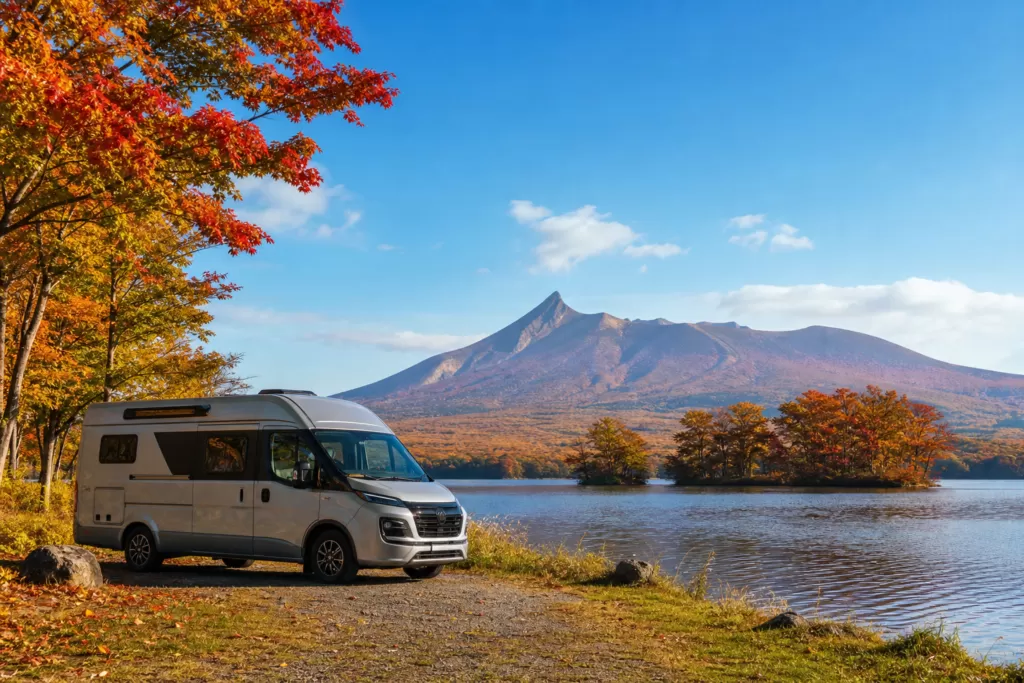
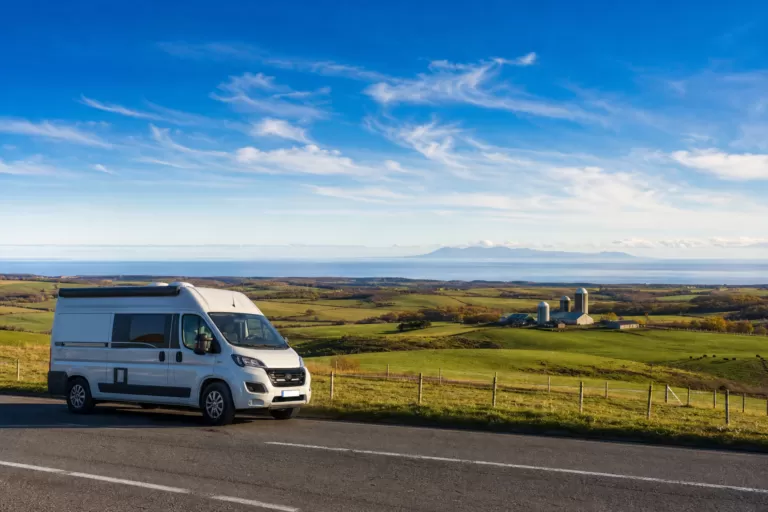
About 40 minutes by car from central Hakodate, at the foot of Mt. Komagatake (also called Oshima-Fuji), sits Onuma Quasi-National Park: three lakes — Onuma, Konuma, and Junsainuma — dotted with 126 small islands. Many visitors treat it as a quick stop on a Hakodate sightseeing trip, but it’s actually a great match for a campervan. You can cruise or cycle around the lakeshore at your own pace, then park overnight with Mt. Komagatake in view. A one-night, two-day southern Hokkaido trip fits together naturally here.
This guide covers the highlights of Onuma Quasi-National Park, access from Hakodate, cruise and rental-cycle prices, and where to find parking lots and Michi-no-Eki (roadside stations) that allow overnight parking. If you also want to know how to pick up a campervan at Hakodate Airport and plan a wider southern Hokkaido route, see How to Rent a Campervan at Hakodate Airport. All prices and facility details were confirmed as of July 2026 — please check each official site for the latest operating status before booking.
What is Onuma Quasi-National Park?
Onuma Quasi-National Park spans Onuma, Konuma, and Junsainuma lakes in the town of Nanae, along with 126 small islands formed by past eruptions of Mt. Komagatake. Designated a quasi-national park in 1958, the view of Mt. Komagatake reflected on the lake has been named one of the “New Three Views of Japan.” The central Onuma Park area gathers the cruise boat pier, walking trails, and souvenir shops, with a relaxed pace quite different from downtown Hakodate.
Mt. Komagatake is still an active volcano, standing 1,131 meters tall. The summit trail can be restricted depending on volcanic activity, so if you plan to hike, check the latest information from Nanae or Mori town beforehand. Even without hiking, the mountain is worth seeing simply from the lakeshore.
Hokkaido-Komagatake volcano update (checked October 8, 2026) Hokkaido-Komagatake has been at Volcanic Alert Level 2 (do not approach the crater) since October 2, 2026. Stay out of the area within about 4 km of the crater. Do not plan a climb; check the notices from Nanae, Mori and Shikabe towns and the Japan Meteorological Agency’s Hokkaido-Komagatake page. The lakeside of Onuma Park is about 10 km from the crater.
Onuma, Konuma, and Junsainuma each have their own character. Onuma is the lively hub with the cruise pier and rental-cycle shops; Konuma has quiet inlets that are good for birdwatching; Junsainuma sits further back and sees fewer visitors, making it a good spot for quiet time. Early summer brings fresh green foliage against the water, autumn pairs colored leaves with Mt. Komagatake, and in winter the lake freezes over completely for yet another look.
The park has three walking trails — Oshima, Fujimidai, and a sunset viewpoint — each offering a different angle on the mountain and lake. Oshima is the most popular trail, a loop of about 30 minutes crossing bridges from island to island. Fujimidai looks at Mt. Komagatake from the opposite shore, giving a different composition than the view from the cruise boat.
At the center of the park is the Onuma International Communication Plaza, home to a tourist information center, souvenir shops, and light-meal spots. Many campervan travelers use its parking lot as a base for walking or renting bicycles. With restrooms and vending machines on hand, it’s an easy place to stop before or after the cruise or cycling.
Access from Hakodate to Onuma Park
From Hakodate Station, it’s about 29 km to Onuma Park via National Route 5 and the Hakodate Shindo, roughly a 40-minute drive. By JR, the limited express “Hokuto” or “Super Hokuto” takes about 30 minutes from Hakodate Station to Onuma-koen Station, while a local train takes about 50 minutes (confirmed as of July 2026 based on JR Hokkaido’s timetable). From Hakodate Airport, it’s a bit under an hour by car.
If you’re driving a campervan, most of the roads are single-lane in each direction, so a large cabcon may need extra care passing oncoming traffic in some sections. If you rent a campervan in central Hakodate and head straight to Onuma, using a rental company based in Onuma, Nanae saves you the extra drive — you can pick up and be at the lakeshore right away.
Plenty of people visit Onuma on a day trip by public transport, but a campervan lets you connect the cruise, cycling, and overnight parking all with one vehicle, with no worries about moving between them. Not having to load and unload luggage also means you can duck straight back into the vehicle the moment it starts raining — one of the real perks of campervan travel.
New Chitose Airport / Tokachi-Obihiro Airport
Rent the Cabcon “Cresson Journey”
Base yourself at New Chitose Airport and travel all across Hokkaido by campervan.
See details at Moving Inn →If you’re heading to southern Hokkaido from New Chitose Airport, it’s about three and a half hours via the expressway. Treat the drive itself as part of the trip, stopping at Michi-no-Eki roadside stations along the way.
There are several paid parking lots in front of Onuma-koen Station, with day-use rates of roughly ¥500 as a guide (this varies by season and operator, so check the posted signage on site). Some lots restrict vehicle height or width, so if you’re bringing a large campervan, it’s worth confirming in advance whether it will fit, to avoid scrambling on the day.
Island-Hopping on the Onuma Cruise Boat
A visit to Onuma isn’t complete without the cruise boat run by Onuma Godo Yusen. It winds among the 126 islands scattered across Onuma and Konuma over about 30 minutes, giving you a view of Mt. Komagatake from the water. Fares are ¥1,460 for adults and ¥730 for children (ages 6–12), with one free infant ticket per accompanying adult (confirmed as of July 2026 via the Onuma Godo Yusen official site).
The season runs from mid-April to early December. Regular sailings operate from May 1 to October 31, while April, November, and December run on an irregular schedule, so check sailing status before departure if you’re visiting in those months. In winter, the cruise is replaced by other activities such as the Ice Park. Parking is available at the pier, so you can leave your campervan there before boarding.
There’s a shorter course that stays on Onuma, and a slightly longer one that extends to Konuma. On clear days, Mt. Komagatake reflects sharply on the water; on cloudy or drizzly days, a misty lake surface has its own mood. Onboard announcements explain the origins of the island names, so kids tend to stay engaged too.
Discounted fares are available for holders of physical, intellectual, or mental disability certificates: ¥730 for adults and ¥370 for elementary schoolers (confirmed as of July 2026 via the official site). Show your certificate at the ticket window if you qualify.
Cycling Around the Onuma Lakeshore
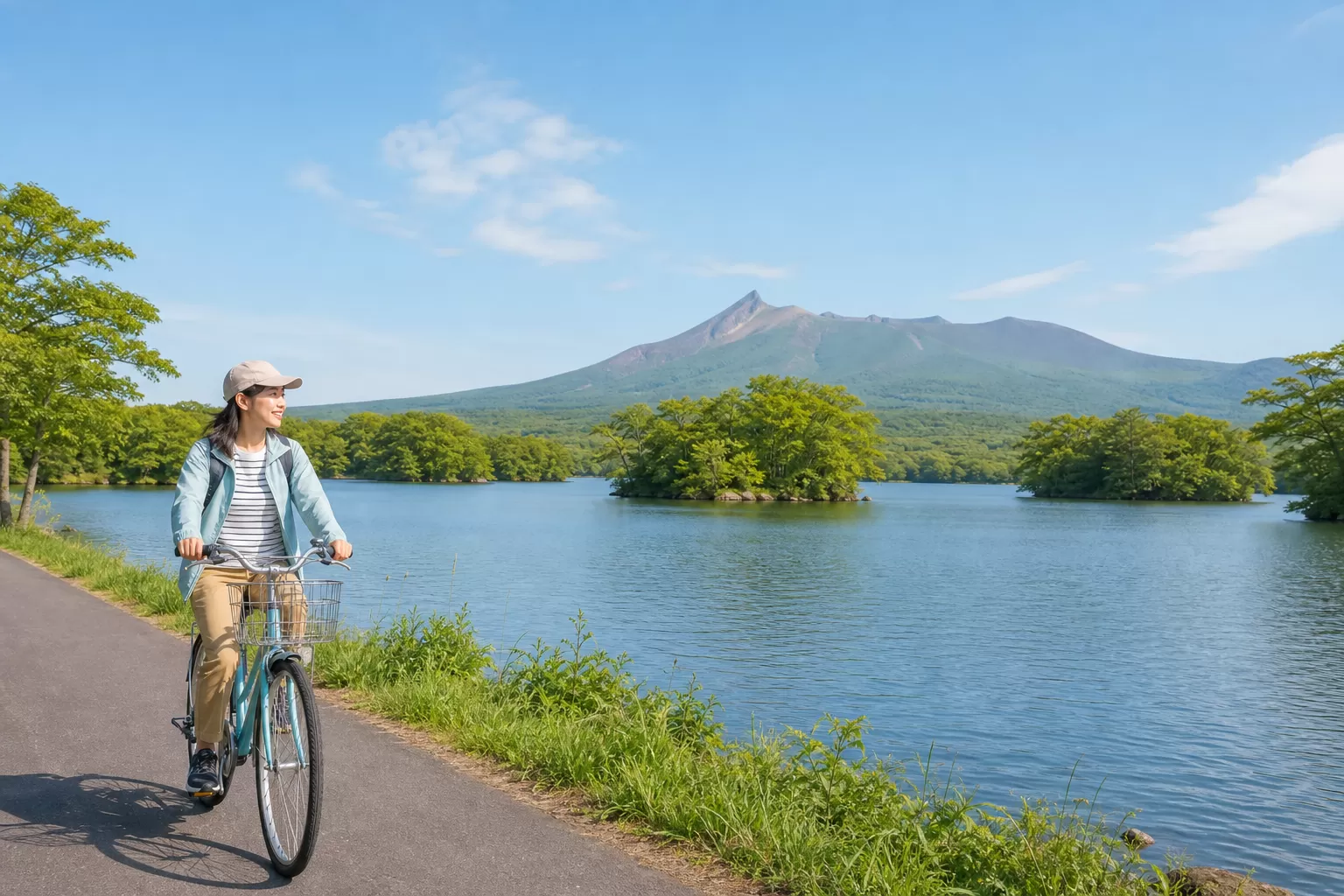
Onuma Park has well-maintained walking trails, so it’s enjoyable on foot alone, but riding the roughly 14 km loop course around the lake brings you to views you won’t see from the cruise boat. Rental bikes are available at shops near Onuma-koen Station and around the lakeshore, at roughly ¥500 per hour or ¥1,000 per day (confirmed as of July 2026 based on each shop’s listed rates).
Some shops offer e-bikes, a good choice if you’re not confident about your stamina or are traveling with kids. The loop takes about half a day, so pairing a morning ride with an afternoon cruise works well.
There are gazebos and benches along the course where you can rest, so feel free to take it slow and stop for photos. Hakodate Onuma Prince Hotel also offers bike rentals, at ¥1,210 for an unlimited full day or ¥825 for up to two hours (confirmed as of July 2026 via the hotel’s official site). Non-guests may be able to use it too, so it’s worth keeping in mind as a backup when the station-front shops are busy.
Rentals mainly run from spring through autumn, with most shops closed in winter. If you visit in winter, plans shift from cycling and cruising to the Ice Park or snowshoeing the park’s walking trails.
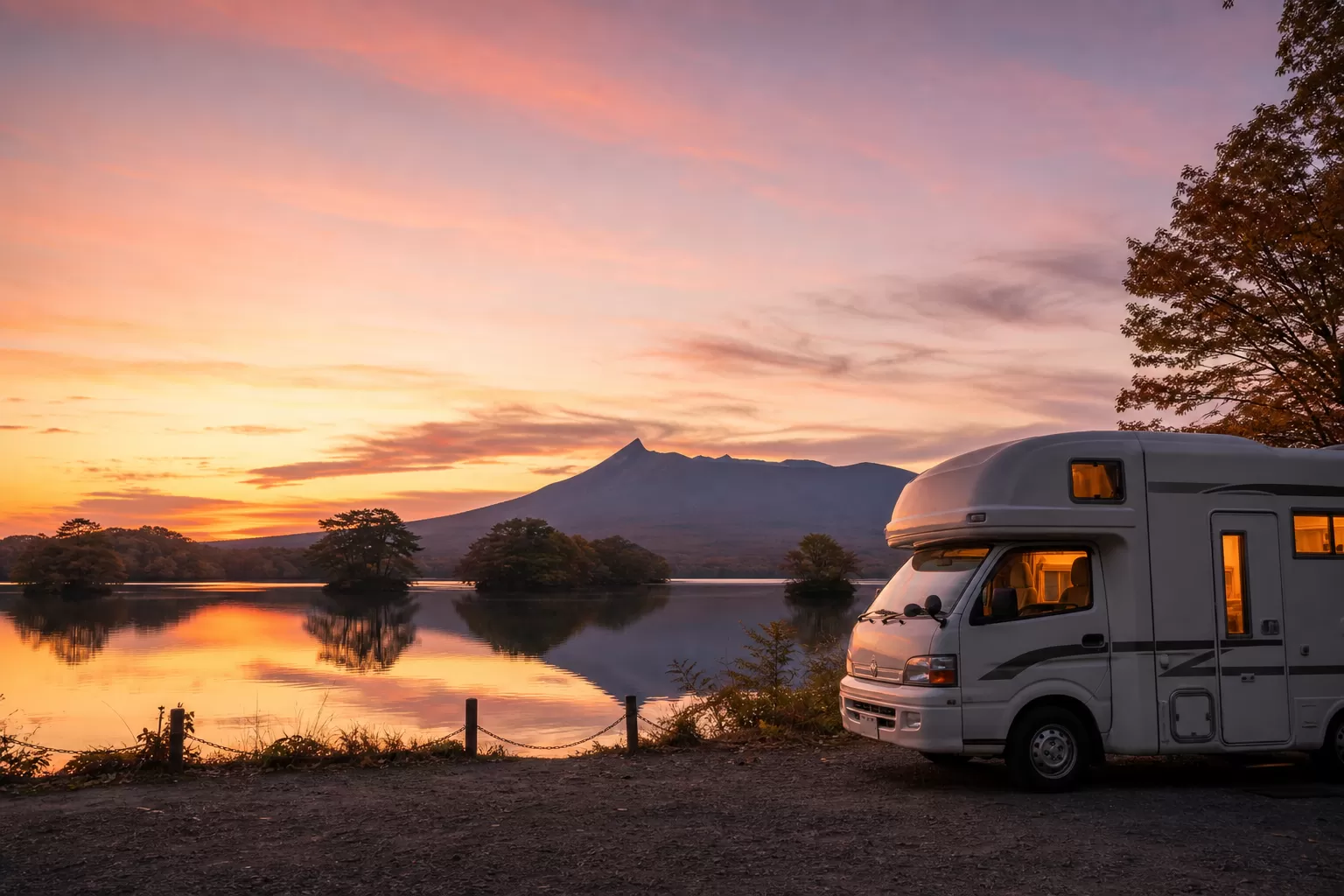
Where to Park Overnight with a View of Mt. Komagatake
If you want to pick up and return your campervan right in the Onuma area, “Nomadoya,” based in Onuma, Nanae, is convenient. It offers free vehicle delivery to Shin-Hakodate-Hokuto Station, Hakodate Airport, Hakodate Station, and Onuma Koen Station, and allows pets on board, making it a good option if you want to explore Onuma Park with your dog (confirmed as of October 2026 via the official site). Since the base itself is close to Onuma Park, you can be walking the lakeshore the same day you pick up the vehicle.
As for overnight parking itself, there aren’t many spots around Onuma-koen Station set up for long-hour free parking. Engine noise and light can carry easily to nearby homes and tourist facilities, so for overnight stays it’s more practical to use the Michi-no-Eki roadside stations introduced below. Enjoy Onuma during the day, then move a short distance to rest at a Michi-no-Eki for the night — that’s the approach least likely to cause trouble.
When sleeping in your campervan, don’t forget ventilation and condensation control during seasons with big morning-evening temperature swings. Being near a lake, mornings and evenings around Onuma get chilly even in summer, and fog can roll in from autumn onward. Left unchecked, condensation on the windows makes the cabin feel damp, so running the ventilation fan before bed makes for an easier tidy-up in the morning.
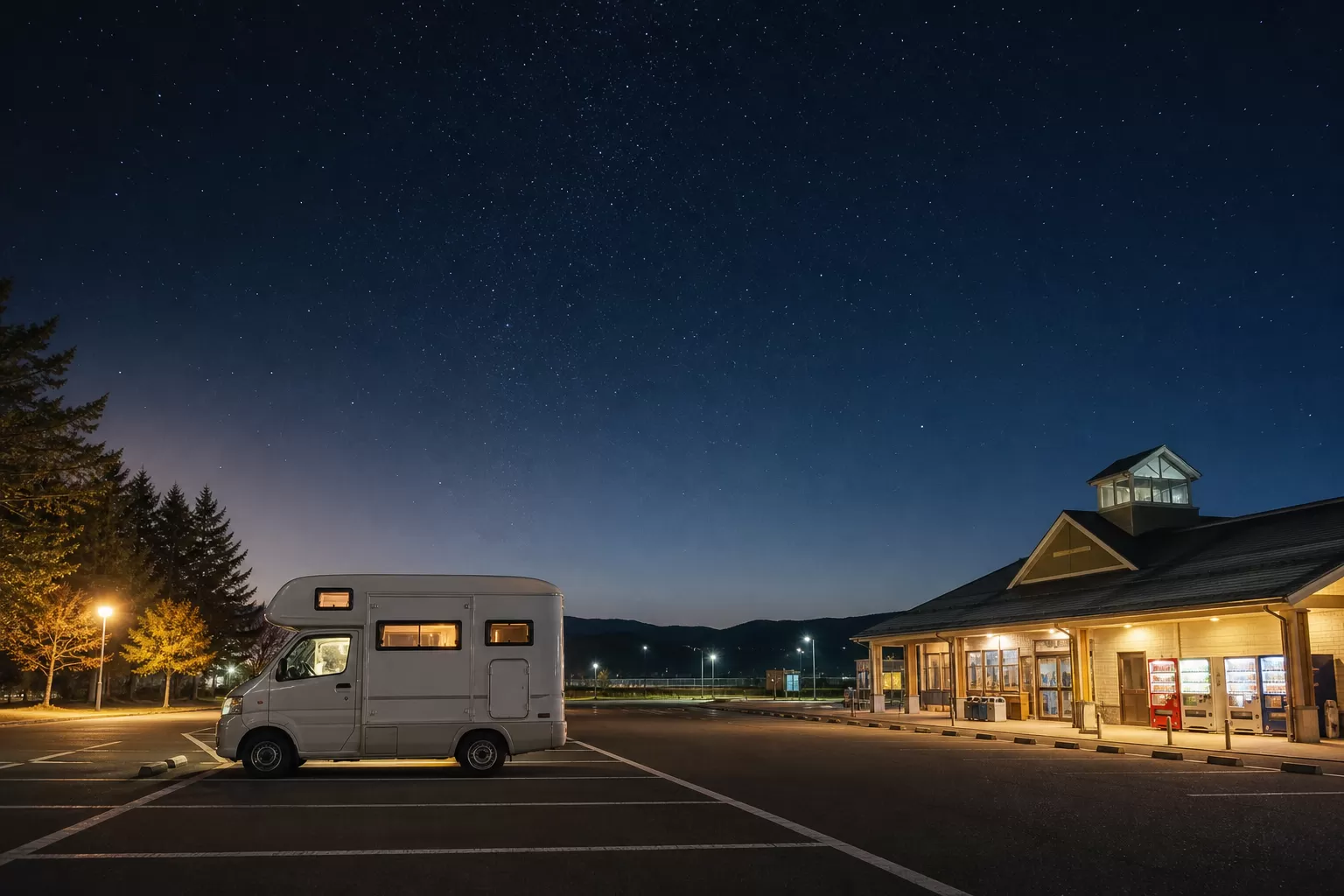
Overnight Parking Plans in Southern Hokkaido, Based Around Michi-no-Eki
About 15 minutes’ drive from Onuma is “Michi-no-Eki Nanairo Nanae.” Located along National Route 5, it’s a fairly large roadside station with 148 regular car spaces (including 8 for accessible parking) and 23 spaces for large vehicles. The 24-hour restrooms have washlets, and free Wi-Fi reaches inside vehicles on the grounds (confirmed as of July 2026 based on facility information).
That said, being right along the national route means you can’t fully avoid road noise. Parking spaces are also a bit narrow, so if quiet matters to you, choose a spot further from the building. Burnable trash can’t be disposed of here, but bottles, cans, and glass can be dropped off 24 hours a day near the restroom entrance.
Heading a bit more toward Hakodate, on the Kameda Peninsula side, there’s also “Michi-no-Eki Jomon Roman Minamikayabe.” It’s the only roadside station in Japan that displays a National Treasure — a hollow clay figurine (dogu) — making it a distinctive stop. There’s one covered parking space plus regular parking, and 24-hour restrooms with washlets (confirmed as of July 2026 based on facility information). There’s no water supply or trash disposal here, so it’s a good idea to take care of refilling and restocking beforehand.
| Location | Approx. Distance from Onuma Park | Parking Capacity | Features |
|---|---|---|---|
| Michi-no-Eki Nanairo Nanae | About 15 min. by car | 148 regular + 23 large-vehicle spaces | 24-hour restrooms, in-vehicle Wi-Fi, well-stocked shop |
| Michi-no-Eki Jomon Roman Minamikayabe | About 40 min. by car | 1 covered space plus regular parking | National Treasure clay figurine exhibit, 24-hour restrooms |
Both sit between downtown Hakodate and Onuma Park, so they’re easy to stop at whether you’re heading out or heading back. If you have a few extra days, you could split your stays — one night at Nanairo Nanae, another at Minamikayabe — and extend your route out toward the Kameda Peninsula.
Keep in mind that both roadside stations are meant only for rest and short naps. If you’re parking for an extended overnight stay, avoid busy hours and be considerate of other visitors. Leaving your engine running, using a generator, or talking loudly are the kinds of things that tend to cause friction with other users, so it’s best to avoid them.
Dispose of trash according to each facility’s rules, and if you need to carry anything out, gather it up and dispose of it at the next convenience store or roadside station. Keep water-area use modest too — long stretches of dishwashing or cooking at the tap can create friction with other travelers and staff.
New Chitose Airport / Tokachi-Obihiro Airport
Rent the Cabcon “Cresson Journey”
Base yourself at New Chitose Airport and travel all across Hokkaido by campervan.
See details at Moving Inn →Extending Your Route from Onuma Park Across Southern Hokkaido
Using Onuma Park as a base, it’s easy to head toward downtown Hakodate, the Matsumae/Esashi area, or Lake Toya. A common route is to see Hakodate’s night view and Goryokaku by day, stay overnight at Onuma, then head toward Mori town the next day with Mt. Komagatake in view — an efficient way to cover southern Hokkaido. For a comparison of Hakodate rental bases, see The Complete Hakodate Campervan Rental Comparison.
Pushing on to Mori town also gets you into ekiben culture, including the famous ikameshi (stuffed squid rice). Mt. Komagatake looks different from the Onuma side versus the Mori side, so if you have the time, it’s worth viewing it from both directions.
A One-Night, Two-Day Model Route
If it’s your first time visiting Onuma, this flow works without pushing too hard. On day one, spend the morning in central Hakodate seeing Goryokaku and Mt. Hakodate, then head to Onuma in the afternoon for the cruise. In the evening, have dinner around the Onuma International Communication Plaza, then move to “Michi-no-Eki Nanairo Nanae” before dark to stay the night.
On day two, head back to Onuma in the morning for a loop around the lakeshore by rental bike, then set off around midday. Push on toward Mori town to view Mt. Komagatake from the other side, grab some ikameshi, and either head home or continue toward Lake Toya — that’s the standard version of this route. Feel free to swap the order of the cruise and cycling depending on the weather or how many days you have.
Frequently Asked Questions (FAQ)
Can I park overnight near Onuma-koen Station?
The area around the station is close to tourist facilities and homes, so there aren’t many spots suited to long-hour overnight parking. It’s more practical to enjoy Onuma during the day and move to a Michi-no-Eki like Nanairo Nanae a short distance away for the night.
Can I fit both the cruise and cycling into one day?
The cruise takes about 30 minutes and cycling around half a day, so splitting them between morning and afternoon lets you enjoy both in one day. Note that the cruise runs on an irregular schedule in April, November, and December, so check sailing status beforehand if visiting during those months.
Can I travel around Onuma with a pet?
The rental company “Nomadoya,” based in Onuma, Nanae, allows pets on board. That said, some facilities, including the cruise boat, may restrict pets, so it’s best to check with each facility beforehand.
Can I hike Mt. Komagatake?
Mt. Komagatake is an active volcano, and its trails can be restricted depending on volcanic activity. If you’re planning to hike, check the latest information from Mori or Nanae town beforehand. Even without hiking, you can enjoy the mountain plenty from the lakeshore or the cruise boat.
Is Onuma Park worth visiting in winter?
The cruise boat and rental cycles close for winter, but they’re replaced by winter-only activities such as the Ice Park. The combination of a snow-covered Mt. Komagatake and the lake is worth seeing too, so with proper winter tires and cold-weather gear, it’s still an enjoyable visit.
Are there height or size restrictions at campervan parking lots?
Some parking lots do set height or width restrictions. If you’re traveling in a large cabcon, it’s a good idea to confirm in advance by phone or on each parking lot’s website whether it can accommodate your vehicle, to avoid trouble finding a spot on site.
Book a Campervan in Hokkaido
Moving Inn New Chitose Airport supports English booking and offers airport transfers.
Pick a campervan by what matters to you.
Rent at New Chitose Airport
See only the rental bases in Chitose, where the airport is.