Insurance, NOC and the Deductible for a Hokkaido Campervan: What You Are Actually Agreeing To

Insurance, NOC and the Deductible for a Hokkaido Campervan: What You Are Actually Agreeing To
Insurance is one of the questions we get asked about most often — right up there with the price total itself. Renters write in with a booking half-finished, a total that looks bigger than the headline rate, and a form using terms that do not exist outside Japan: NOC, “anshin” cover, a deductible that is never quite spelled out. This article will not give you one number that applies everywhere — coverage terms are set by each operator individually, and the only total that matters is the one on your own booking screen. What we can do is explain what each term means and exactly where to look before you pay.
This article is about the three lines you agree to on the booking screen. For the broader picture — CDW, what insurance never covers, credit-card travel insurance — see our complete guide to campervan rental insurance in Hokkaido.
What “insurance” actually covers on a campervan booking
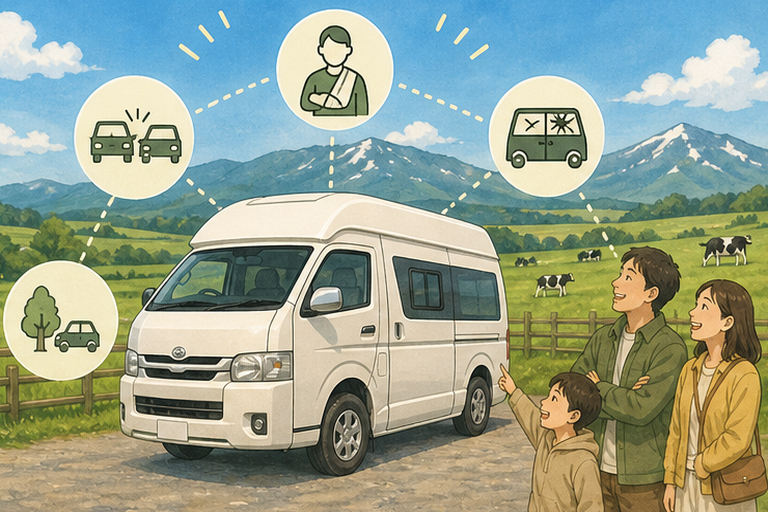
When a Japanese rental operator says a vehicle is “insured,” they usually mean a package of several separate things bundled into one rate, not a single policy. In most quotes you will see some combination of:
- Third-party bodily injury (taijin) — people you injure, often unlimited (mugen-dai).
- Third-party property damage (taibutsu) — property you damage; may or may not be unlimited.
- Vehicle damage cover (sha-ryo hoken) — damage to the rental vehicle itself, almost always with a deductible attached.
- Personal accident cover (jinshin shougai) — a fixed payout if someone in your own vehicle is hurt.
- A business-loss charge (eigyou hoshou) — not insurance in the usual sense; a fee covering the operator’s lost income while a damaged vehicle is off the road, and one renters are often surprised by, since it applies even when the accident was not your fault.
Which of these are included in the headline rate, which cost extra, and which have caps, varies by operator. This is exactly the shape of question we see in enquiries — travelers asking how the total, the deductible, NOC, the business-loss charge and the mileage limit all fit together before they commit. Treat it as a checklist, not a single line item.
The deductible: what it is, and why this article will not give you a number
The deductible — in Japanese, menseki (免責), literally “exemption from liability” — is the amount you are responsible for if the vehicle is damaged, before the operator’s insurance covers the rest. It is not a fine and not proof you did something wrong; it is the excess built into the policy, the same concept as the excess on a car insurance policy anywhere else. Some operators charge it as a flat daily fee on every booking, separate from what you would owe on an actual claim; others structure it differently. It is not standard across the industry.
We are deliberately not stating a deductible amount in this article, for the same reason we do not quote a headline rental price: the figure varies by operator and vehicle, and can change between when this was written and when you book. What we can tell you is where it lives — the operator’s own rates page, and the booking summary before you confirm. If an operator cannot tell you the amount when you ask, that itself is useful information.
NOC: the “anshin” or “hoshou” service, and why it is optional

NOC stands for “No Operation Charge.” It is a separate, optional add-on that waives — fully or partly — the business-loss charge described above: the fee covering the operator’s lost income while a damaged vehicle is off the road. Operators market it under different names — “anshin service” (安心サービス, “peace of mind service”) or “hoshou service” (補償サービス, “compensation service”). The name changes; the idea does not — it is a waiver you pay for up front so you are not billed separately for the operator’s downtime after an at-fault accident.
Two things to be clear on. First, NOC waives the business-loss charge specifically — it is not the same as the vehicle-damage deductible, and paying for one does not automatically cover the other; check what each operator’s version actually waives. Second, it is presented as optional at booking for most operators, so it is something you can decline if you are confident in your own cover (see the FAQ on travel insurance below). Whether it can be removed after you have selected it, and whether any refund applies, is a question for the operator directly.
How Moving Inn structures this — in Moving Inn’s own terms
We are describing one operator here, not the industry — everything below is what Moving Inn itself states and should not be read across to any other company.
Moving Inn’s published rate at both its New Chitose Airport and Tokachi-Obihiro Airport bases already includes a vehicle compensation package: unlimited third-party bodily injury cover, unlimited third-party property damage cover, and personal accident cover for people in the vehicle at a fixed sum. A vehicle-damage deductible applies on top of that — the amount is stated on Moving Inn’s own site and in the booking screen, and we are not repeating a figure here for the reasons explained above. Moving Inn also offers its own NOC-style option, marketed as an “anshin” (peace-of-mind) service, as a separate opt-in add-on. What it removes from your liability, and at what cost, is something to read on Moving Inn’s own rates page and confirm again in the booking summary before you pay — the terms can change, so treat the live booking screen as the current source, not any figure printed elsewhere, including on this page. On damage, Moving Inn told us that minor scratches cost nothing extra. If the damage keeps the vehicle from going out on its next rental, you pay a business-loss charge (eigyou hoshou), but if you took the business-loss compensation option, there is no extra charge in that case either (interview with Moving Inn, October 6, 2026).
What other operators do: read their own page, every time
Hokkaido has dozens of campervan rental operators, and we have not audited all of their insurance and NOC terms for this article. Some bundle vehicle-damage cover into every rate with no way to opt out; others make it optional and price it separately; some cap the deductible at a lower amount on an upgraded plan, others do not offer an upgrade at all. A structure that is correct for one operator is not a safe assumption for the next. If you are comparing operators for the same trip, open each one’s own rates page and look for the same three things: the deductible, whether a business-loss charge (eigyou hoshou) applies separately, and whether an NOC-style waiver is offered and at what cost. Our operator comparison guide is a starting point for narrowing the field, but insurance terms need to come from each operator’s own current page.
How to actually check this before you pay

“Check the booking screen” is not a brush-off — it is a sequence you can follow in a few minutes with any operator’s reservation system, including Moving Inn’s.
- Start a quote for your actual dates and vehicle. Rates and options differ by season and model, so a generic search will not show your real terms.
- Look for a line item labelled insurance, compensation (hoshou), or deductible (menseki) in the price breakdown. On most Japanese booking systems this is a separate line from the base daily rate.
- Look separately for an NOC or “anshin service” checkbox or toggle. It is usually an optional extra you can add or leave unchecked — if you cannot find it, ask about it.
- Check the total at the bottom of the booking summary, not the headline rate at the top of the page. The daily rate on a landing page is a starting figure, not the total.
- If anything is unclear, ask before you pay, not after. This is one of the most common questions renters ask, and operators expect it.
If something actually happens: the one step that is not optional
Whatever your deductible and NOC status, one procedural step applies regardless of coverage: any accident, however minor, needs to be reported to the police (keisatsu) at the scene, and to the rental operator as soon after as possible. This is not a formality to skip because the damage looks small — in Japan, a police accident report is generally required for an insurance claim on the vehicle to be processed at all, and without one, the deductible and compensation terms you checked before booking may not apply as expected. Save the operator’s emergency contact number to your phone before you drive off, not after something has gone wrong.
If you are booking a winter trip, insurance and NOC are only one part of what to confirm before you go — our guide to renting a campervan in Hokkaido in winter covers what heating, cold-weather equipment and overnight parking to check for as well. If you are looking specifically at New Chitose Airport, the Moving Inn New Chitose Airport base page has the pickup and vehicle details for that location, and our English-language homepage is the starting point for the rest of our Hokkaido campervan coverage.
Frequently asked questions
Can I decline the insurance or the NOC waiver?
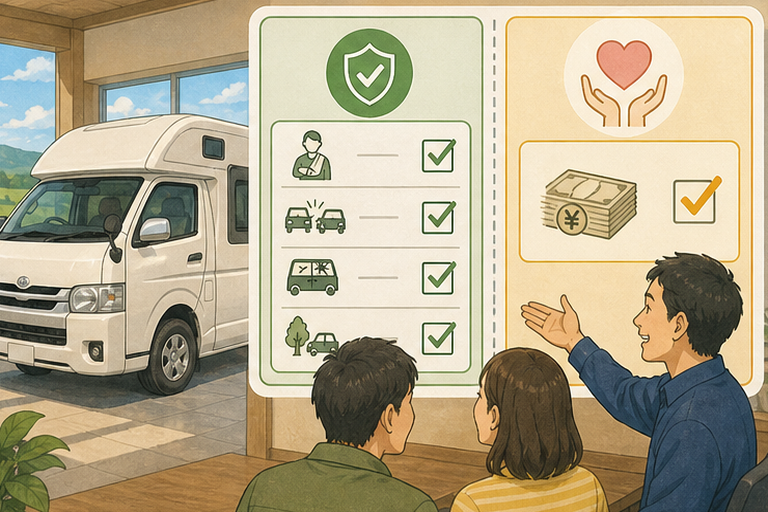
The base vehicle-damage and third-party cover included in the rate is usually not something you can remove — it is built into the price you are quoted, in the same way it would be with a standard rental car. NOC is different: it is presented as an optional add-on by most operators, including Moving Inn, and can typically be left unselected at booking. Whether it can be removed after you have already added it, and whether that comes with any refund, depends on the operator and the stage of your booking — ask directly rather than assuming.
Is the NOC charge per day, or a flat one-time fee?
Both structures exist across operators — some price it per day, others as a single flat fee for the whole booking. On a long rental this changes the total noticeably, so check it in the price breakdown for your own dates rather than assuming either structure by default.
I already have travel insurance from my home country. Do I still need the operator’s cover?
Some renters decline the operator’s optional NOC-style cover because they are relying on their own travel insurance. Before doing this, confirm directly with your own insurer — not the rental operator — that your policy covers damage to a rented vehicle in Japan, at what deductible, and through what claims process; policies vary widely here and some exclude vehicle rental entirely. The base cover built into the rental rate is generally not something you can opt out of regardless of your own insurance.
What happens if I have an accident — what is the actual procedure?
Report it to the police at the scene first, then contact the rental operator’s emergency line as soon as you can. A police report is generally required for the vehicle’s insurance claim to proceed, so skipping this step — even for damage that looks minor — can affect whether your deductible and NOC terms apply the way you expected. Save the operator’s emergency contact number to your phone before you set off.
What is the difference between the deductible and NOC?
The deductible (menseki) is the amount you are liable for toward repairing the rental vehicle itself if it is damaged. NOC waives a separate charge — the operator’s lost rental income while the vehicle is off the road being repaired, sometimes called a business-loss or “eigyou hoshou” charge. They cover different things, so removing or reducing one does not automatically affect the other; check both separately on the booking screen.
Book a Campervan in Hokkaido
Moving Inn New Chitose Airport supports English booking and offers airport transfers.
![Monbetsu Drift Ice Festival 2027 [Feb 11–14]: Dates, Ice Sculptures, Garinko-go Icebreaker, Parking and Access by Campervan](https://hokkaido-campingcar.jp/wp-content/uploads/2026/10/monbetsu-hl999-768x576.jpg)
![Hokkaido New Year Weather and What to Wear | Sapporo, Hakodate, Asahikawa, Obihiro Mornings and Evenings, and Heavy-Snow Years [2026-27]](https://hokkaido-campingcar.jp/wp-content/uploads/2026/10/hokkaido-new-year-holiday-weather-eyecatch-768x432.webp)

![Hokkaido Illumination 2026-27 [Dates]: Sapporo Starts Nov 20, Plus Otaru, Asahikawa, Obihiro & Hakodate for Campervan Trips](https://hokkaido-campingcar.jp/wp-content/uploads/2026/10/hokkaido-illumination-2026-eyecatch-768x432.webp)
![What to Do in Tokachi in Winter: Dog Sledding, Snowshoeing, the Shikaribetsu Ice Village, and Staying at Kitanomori [2027]](https://hokkaido-campingcar.jp/wp-content/uploads/2026/10/tokachi-winter-dogsled-1-768x432.jpg)